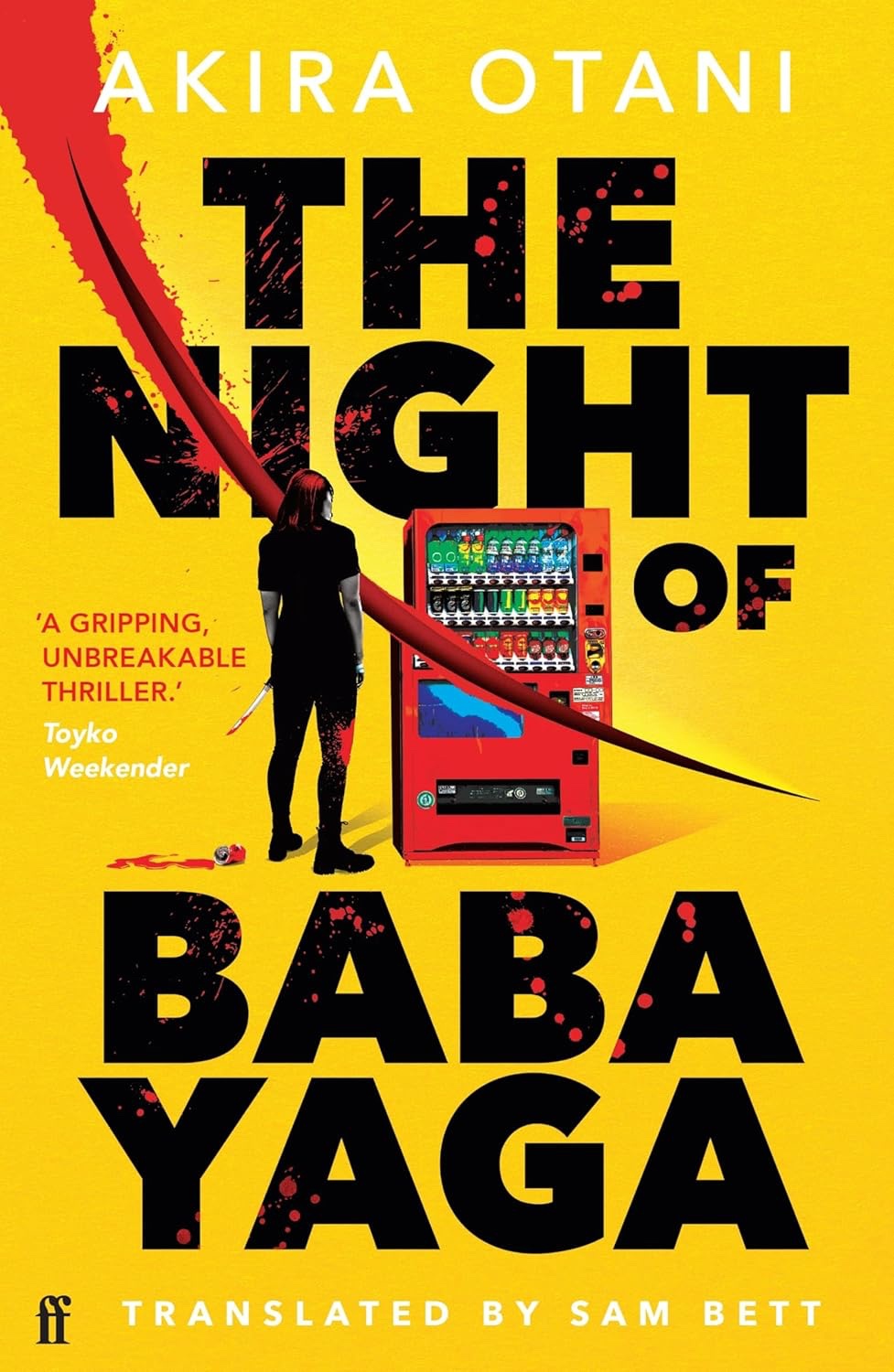
The Night of Baba Yaga is two hundred pages of violence, torture, and rape. All of the novel’s descriptions of violence, torture, and rape are graphically explicit; and again, there are two hundred pages of them. I enjoyed this book, but it’s not for everyone.
The bulk of The Night of Baba Yaga is set in Tokyo in 1979. A 22yo street brawler named Yoriko Shindo is pressed into the service of a notorious yakuza crime syndicate whose boss has ordered her to become the chauffeur for his precious only daughter, a prim-and-proper college student named Shoko. The yakuza boss assumes that, because Shindo is female, she won’t attempt to romance Shoko, but of course the two women fall in love and help each other escape the family.
I’d like to say that The Night of Baba Yaga is a love story, but it’s more of a series of fight scenes occasionally broken by scenes of torture and rape. The novel begins and ends with Shindo getting the shit beaten out of her, and most of the gaps in the fighting are created by the aforementioned torture and rape. I’m not saying this is a bad thing. The Night of Baba Yaga is what it is, which is a lesbian BDSM hurt/comfort fantasy in which male characters enact hurt so that female characters can provide comfort. Aside from the brief comfort scenes, there’s not much romantic chemistry or character development.
The Night of Baba Yaga is empowering for the woman who wrote it, no doubt, and I get the sense that there will be queer readers (such as myself) who will be amused to see this sort of openly horny fantasy in print. The Night of Baba Yaga isn’t empowering for any of the characters, however. Short interstitial chapters jump ahead in time, but I hope it’s not a spoiler to say that nobody gets a happy ending. Not in this sort of story. The tragedy is so over-the-top it’s Shakespearean.
Personally, I thought the ultraviolence was a lot of fun. The action is so gory and exaggerated that it’s difficult to take seriously, and The Night of Baba Yaga feels silly and campy in the same way that Takashi Miike movies like Ichi the Killer do. If you (like me) are a fan of the horror movie mindset that inspires you to cheer with delight when somebody’s hand gets chopped off, The Night of Baba Yaga delivers.
The translator, Sam Bett, has done an amazing job. Fight scenes are notoriously difficult to write, yet the translation is snappy and remarkably fast-paced. The character voices aren’t “natural” by any means, but they’re pitch-perfect for the genre. When it comes to descriptions of rape and violence, Bett doesn’t pull any punches. It’s an incredible translation, and I am in awe.
I’ve seen social media reviews hailing The Night of Baba Yaga as “an inspirational queer romance,” and it 100% most definitely is not that. Nobody does any learning or growing in this story, which has exactly zero social commentary. Rather, The Night of Baba Yaga is an adrenaline-laced lesbian power fantasy about being the most badass fighter you can be until you die. If you’re not the target audience, The Night of Baba Yaga probably isn’t for you. Like Wolverine, it’s the best at what it does, and what it does isn’t very nice. This short and compulsively readable novel gets in, gets messy, and gets what it came for.
 Contemporary Japanese Literature