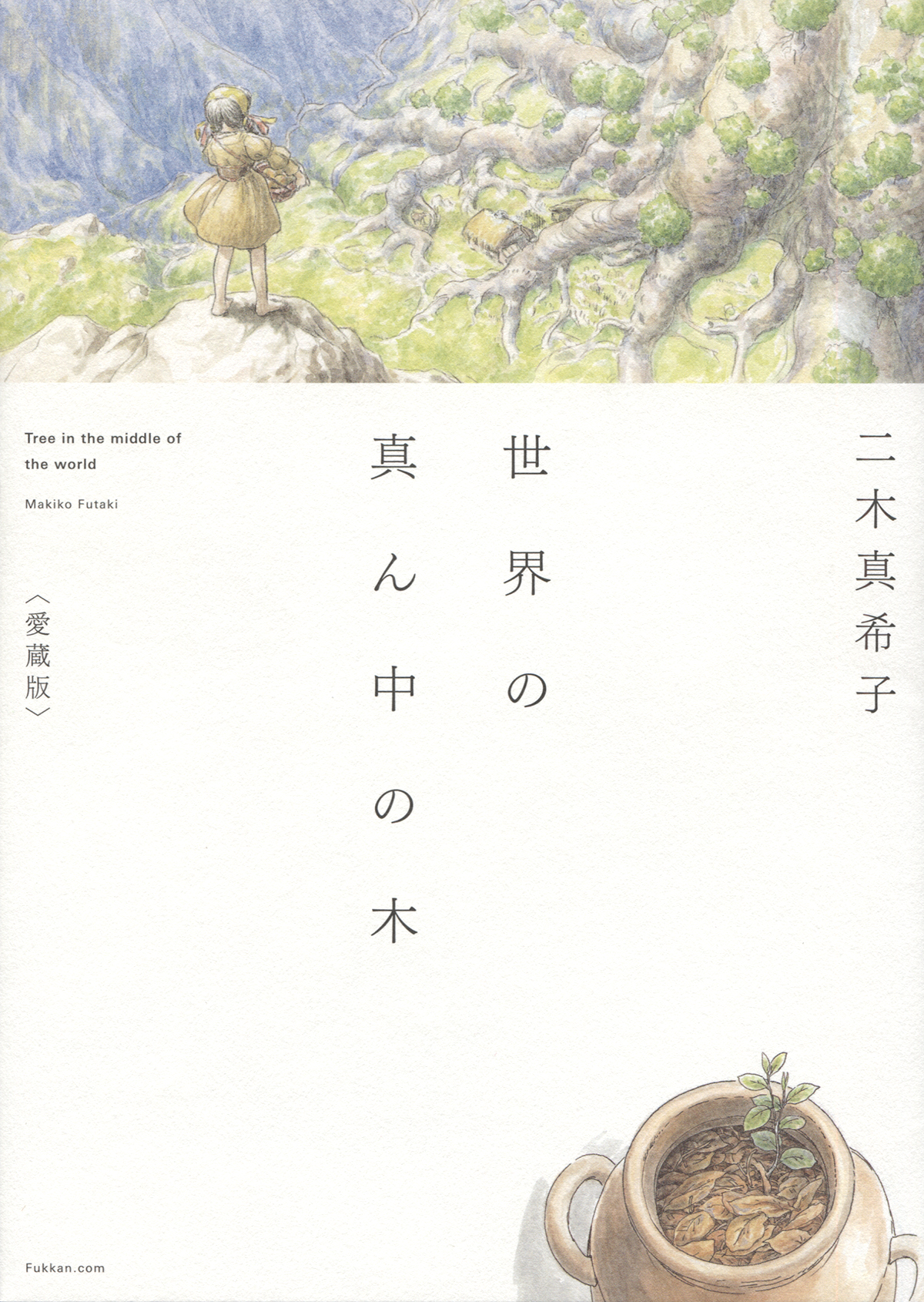
世界の真ん中の木 (Tree in the Middle of the World) is a lushly illustrated picture book written and drawn by Makiko Futaki, a former animator at Studio Ghibli. Originally published in 1989, this book is now available in a beautiful hardcover edition that allows the full glory of the artwork to shine.
In the Afterword to the original softcover edition published by Animage, Futaki wrote that she was inspired to create this story after visiting the Yakushima natural heritage forest, where she conducted visual research for My Neighbor Totoro. Despite its young protagonists and verdant greenery, however, Tree in the Middle of the World is a complex ecofable that has more in common with Princess Mononoke.
A preteen girl named Cici lives in the mountains with her grandmother. Their small cottage lies at the base of the gargantuan “tree in the middle of the world,” and their modest livelihood is supported by its ecosystem. One year, the tree’s cycle of seasons goes strangely awry, and the sapling Cici attempts to grow from one of the tree’s seeds withers. Hoping to learn more about the malady affecting the tree, Cici resolves to speak with the legendary golden bird that lives in its uppermost branches.
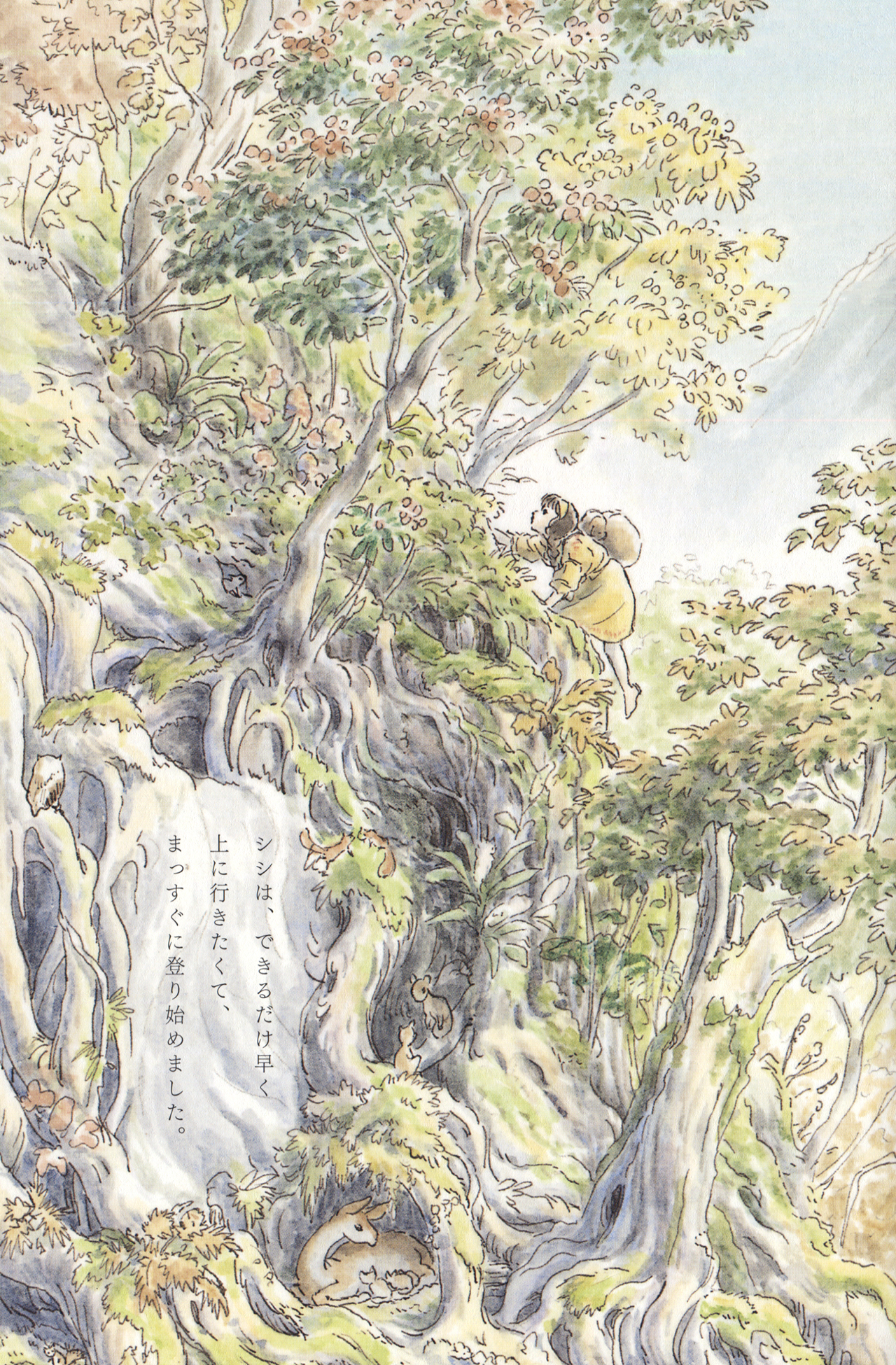
During her epic three-day climb, Cici realizes that the state of the tree’s health is far more dire than she suspected. To make matters worse, she seems to be followed by a young archer from the steppes named Dimo. Dimo is an inexperienced speaker of Cici’s language, but he manages to communicate that he intends to kill the very bird she seeks. Thankfully, Cici does not have to bear her worries alone. Early in her climb, she gains a travel companion in the form of a talking frog whose avuncular good nature serves as a welcome relief from the hardships of her journey.
When Cici finally finds the golden bird, she learns that it has gone insane in its old age, and the putrescence it sheds from its rotting feathers is the cause of the tree’s sickness. Just as he intended, Dimo appears in the nick of time to slay the bird, which answers Cici’s question with its dying breath – in order to save the tree, Cici must venture underground to scatter the tree’s seeds below its roots.
This is a fearsome undertaking, to be sure, but Dimo promises to lend his aid. The two children thus embark on a second journey that proves to be just as dangerous as the first. Just when all hope seems lost in the darkness, Cici and Dimo arrive on the shore of a golden sea that might just be the very stream of life itself. Having succeeded in the quest, the two children return to the surface, where the first winds of spring greet them with verdant laurels of fresh greenery.
Although I’ve outlined the contours of the story, Tree in the Middle of the World is a substantial book whose plot contains a number of twists, turns, and quiet spaces for rest and contemplation in between. The writing is simple but evocative, especially during the portion of the story that takes place underground. Miraculously, every page boasts gorgeous illustrations, each of which is more magical than the last.
Tree in the Middle of the World reminds me a great deal of Hayao Miyazaki’s Shuna’s Journey, albeit with two key differences. First, the visual layout of Tree in the Middle of the World makes its text much clearer and easier to read than the text in Shuna’s Journey; and second, Futaki is far more focused on guiding the reader along a journey through the space of a fixed setting. Like Shuna’s Journey, however, Tree in the Middle of the World contains moments of genuine fear and menace that might not be appropriate for younger children.
Tree in the Middle of the World doesn’t skirt around the shadows of its themes. Like everything in nature, the life of the giant tree exists in cycles, as does that of the giant bird that nests in its branches. Sometimes, like Cici, we find ourselves at the end of a cycle, and there’s not much we can do to prevent the death and destruction we see everywhere around us. Still, it’s our responsibility to preserve the seeds of what we hold dear and plant them carefully in the hope that they will grow strong and healthy in the future when the cycle turns once again.
Tree in the Middle of the World is an uplifting and optimistic story guided by a fantastic sense of adventure. Through her luminous artwork, Futaki conveys the joy of being surrounded by green and growing things, and the action is easy to follow even if your Japanese reading ability isn’t perfect – or if you don’t read Japanese at all. If nothing else, it’s impossible to read Tree in the Middle of the World and not feel inspired to go outside and interact with the world with a renewed sense of hope and purpose.


 Contemporary Japanese Literature