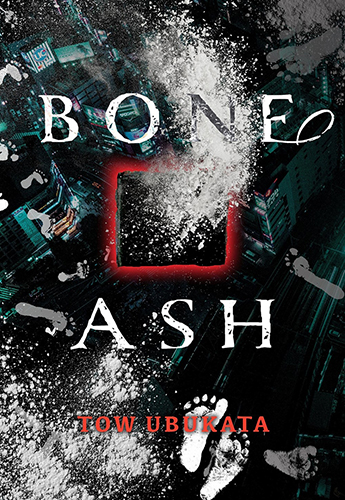
Tow Ubukata’s 2022 horror novel Bone Ash is a story about cursed architecture. The twist is that the architecture in question is the skyscraper outside Shibuya Station that was under construction during the mid-2010s. Deep under the construction site is a hole, and inside that hole is… Just some random guy? What’s he doing there? And what happens if he leaves?
Bone Ash’s everyman protagonist is a white-collar office worker named Mitsuhiro Matsunaga. Mitsuhiro is employed by the PR department of the development firm overseeing the aforementioned construction project contiguous to Shibuya Station, and his job is to ensure that all news is good news so that none of the project shareholders get cold feet. When a pseudonymous Twitter account starts posting creepy photos of the site with sinister captions about contractor injuries, the task of managing the situation falls to Mitsuhiro.
The first order of business is to track down the location of each photo to ensure that there aren’t any code violations. So far, so good. During his investigation, however, Mitsuhiro finds an odd door that isn’t in the floorplans, and behind the door is an impossibly deep staircase that eventually empties into a cavernous concrete space with a bare minimum of lighting. There’s a small Shintō shrine off to one corner, as well as a discarded piece of heavy machinery painted entirely white. And also a pit with a man chained to the bottom.
The man seems somewhat confused, but he insists that he’s happy to stay where he is. Somewhat against the man’s wishes, Mitsuhiro hauls down a ladder, hoists him out of the pit, and hauls him up the infinite staircase. Before he has a chance to recover from this exertion, a fire breaks out on site, and the man disappears.
When he files a report the next day, Mitsuhiro is informed that he entered a “ritual hall,” a space constructed to preserve a shrine (or other place of religious significance) on the land occupied by a large building. The man in the pit was a “mi-keshi,” something like a sin eater who would symbolically absorb the spiritual pollution caused by the displacement of deities. As long as a purification ritual is conducted properly by the appropriate religious authorities overseeing the ritual hall, everything should be fine. Unfortunately, Mitsuhiro has disrupted the ritual, and now there’s going to be hell to pay.
The scenario introduced by Bone Ash is incredible. The overview I’ve provided in four paragraphs is expanded in amazing detail over the span of about 170 pages, and these details are fascinating. Ubukata walks the reader through the deliciously liminal space of the ongoing construction site like a pro, all the while explaining the bureaucracy surrounding large-scale building construction in Tokyo in a way that genuinely caught and held my attention.
By the time the focus of the exposition shifts to the religious history surrounding the ritual hall in the earth under the building, I was hooked. The existence of creepy underground shrines sealing ancient calamities is a fun urban legend, and Ubukata’s skill as a writer is to ground this sort of fantasy in enough historical precedence to make it seem entirely plausible. I know this concept is silly, but as I read Bone Ash I was like Agent Mulder in The X-Files – I want to believe.
Bone Ash unfortunately falls apart once its focus shifts to Mitsuhiro’s attempts to deal with the curse he’s incurred, which influences his behavior in disturbing ways. Though he’s a convenient viewpoint character during the opening exposition, Mitsuhiro doesn’t have much of a personality, thus making his situation somewhat difficult to sympathize with.
I suppose the reader is supposed to identify with Mitsuhiro’s “everyman” qualities, but many of the author’s assumptions in this regard were lost on me. I don’t think it’s normal to feel compelled to work 15 hours a day, for example, nor have I ever been tempted to kill people for the chance to drive the company car.
Because I never really got a sense of who Mitsuhiro is supposed to be as a person, his cycle of making bad decisions for inexplicable reasons felt somewhat boring and repetitive. I get the sense that one solid conversation about what was going on could have gotten Mitsuhiro sorted out, but none of the other characters in the novel behave much more rationally than he does. In addition, though Mitsuhiro’s pregnant wife and young daughter become unwitting victims of his curse, they’re never allowed interiority and only exist to create complications.
I think what Bone Ash really wants to be about is the plight of unhoused people in Tokyo. Large-scale construction on top of open-air parks and other public gathering places often displaces communities of the unhoused, who are additionally exploited as day laborers with no recourse to legal reparations should something happen to them. Whether or not literal curses exist, Ubukata asks the reader to seriously consider the cumulative effect of this human misery, which is not only ignored but actively encouraged by Japanese politicians. Though this theme of housing precarity and labor exploitation is never fully developed, its introduction in the first half of the novel is handled with a remarkable degree of sensitivity.
In the end, it might seem odd to recommend Bone Ash only for the first 170 pages, but they’re really good pages! Despite my criticism of its narrative structure, I’d recommend this novel to anyone interested in the strange complications of urban architecture and the darker corners of Japanese religion and folklore – as well as to anyone interested in exploring uncanny spaces.
I’d like to extend my appreciation to Bone Ash’s translator, Kevin Gifford, whose smooth and confident style grabbed my attention from the first few pages of the novel. In addition, Wendy Chan at Yen Press has done a fantastic job with the book design, which is very cool and clever. I hope the care and attention given to this release helps Bone Ash find an enthusiastic audience of readers interested in the sort of well-researched urban legends and creepypasta stories that are perennially popular on YouTube and Reddit.
 Contemporary Japanese Literature