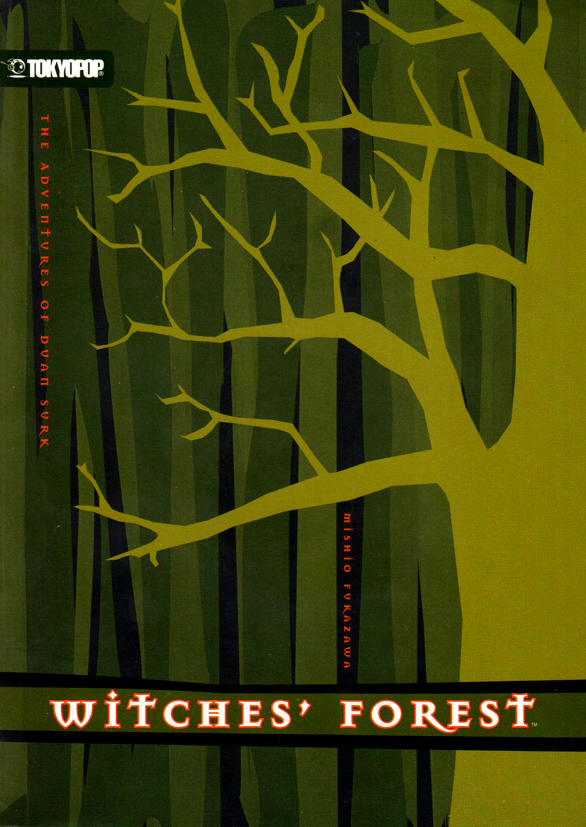
The Adventures of Duan Surk: Witches’ Forest

Witches' Forest

Title: The Adventures of Duan Surk: Witches’ Forest
Japanese Title: デュアン・サーク ― 魔女の森
(Duan Sāku: Majo no mori)
Author: Fukazawa Mishio (深沢 美潮)
Illustrations: Otokita Takao (おときた たかお)
Translator: Catherine Barraclough
Publication Year: 2006 (America); 1996 (Japan)
Publisher: Tokyopop
Pages: 328

This book is kind of stupid. It’s a mess of tropes and clichés liberally borrowed from the early Zelda and Final Fantasy games written in a style aimed at the lowest common denominator. There is no depth to the story, the characters, or the writing. Witches’ Forest is a light novel, and it reads like a light novel: shallow, superficial, and disposable by design.

Nonetheless, I think Witches’ Forest is an interesting and important book, especially in translation. Before I explain why, allow me to give a brief plot summary.

Duan Surk is an orphan in a world plagued not only by vicious man-eating monsters but also by war. He was raised in a small town by his brother Gaeley, a hale young man who took on various odd jobs to order to be able to provide medicine and care for the sickly Duan. The young Duan makes up for his lack of physical strength with an inquisitive mind; and, by the time he is fourteen, Gaeley is confident enough in Duan’s ability to make it in the world that he himself decides to leave the town in order to become a soldier. Gaeley is everything to Duan, so the young Duan decides to become a fighter like his brother. Duan fails the physical portion of the initial test of the Adventurer’s Club guild, but the army will take anyone, so off to the army he goes. After spending a year as a cook’s assistant, Duan returns to camp after spending the day gathering ingredients only to find his entire battalion vanished into thin air, leaving only empty tents and smoldering fires behind. He straps on a sword and rushes into a nearby forest with a vague plan of rescue in mind, but the forest is enchanted, and Duan soon finds himself hungry, lost, and in dire peril.

This is where we find our hero at the beginning of Witches’ Forest, but Duan soon stumbles upon two traveling companions: Olba October, a battle-hardened veteran adventurer in his twenties, and Agnis R. Link, a sixteen-year-old sorcerer with a penchant for fire magic who may or may not be a princess in disguise. Both of these characters are trying to get to the mansion at the heart of the forest, wherein two witches are said to dwell. Olba wants treasure, and Agnis wants revenge. Before they can reach the witches, however, they must brave the dangers of the surrounding forest and the traps set up in and around the house itself.

The adventures of the trio are solidly structured upon a foundation of RPG tropes and gameplay mechanics. Agnis is the perky refugee, Olba is the jaded older guy, and Duan is just about every main player-protagonist to ever appear in a JRPG. The characters randomly encounter monsters drawn directly from D&D dungeon master guides, and they earn experience points when they defeat these monsters. Their Adventurer Cards keep track of their experience points, and, when they earn enough, they gain a level. They are equipped with a full arsenal of Zelda items, from the port-o-lant (which “uses low-cost solid fuel made of Zora oil”) to the coily coily rope (“the definitive version of the hooked rope”), and Agnis in particular has to worry about running out of MP (“magic points,” or magical energy). The trio is accompanied by a flying baby dragon/fire lizard that can talk and use low-level healing spells and is somehow fuzzy despite being reptilian. The only thing the party doesn’t have is a bag of holding, as they’re constantly lugging their adventure gear around with them and getting into petty arguments over who has to carry what.

One of the most engaging parts of Witches’ Forest is Agnis’s backstory, which involves a heartbroken yet politically ambitious stepmother who sinks to Cersei Lannister depths of dastardly scheming. Within this family drama, characters change and grow and are faced with problems that have no obvious solutions. For the most part, though, the novel focuses on the three main characters running around and hitting things with swords and spells. Each of these battles requires some minor element of strategy but is relatively brief. Sentences are short and declarative. Each paragraph contains about three to six sentences. There are no anime-style illustrations, but the text is interspersed with various material drawn from its fantasy world, such as copies of the characters’ Adventurer Cards, advertisements for magical items, and overworld and dungeon maps. At the end of the book is a three-page bestiary of monsters that appear in the story, which is illustrated in a style highly reminiscent of mid-1990s fantasy anime like Record of the Lodoss War or Magic Knight Rayearth.

Witches’ Forest feels extremely dated, which makes sense, as popular culture has moved on in the almost twenty years since the book first came out in 1996. What makes the novel interesting is that it captures the spirit of its age so well. Neon Genesis Evangelion aired during the fall season of 1995 and ended up drastically changing the playing field; but, before that, many popular anime for the young adult demographic were based on light novels such as Slayers and Irresponsible Captain Tylor, which are just as goofy as they are epic. The humor, the fighting, the yelling, the zany adventures, and the group of ridiculously disorganized young people resolving volatile political stalemates entirely by accident are all strongly reminiscent of the anime of the time. It goes without saying that all of this media is closely connected to the themes and stylistic conventions of video games before they made the leap to the 32-bit era. In this way, Witches’ Forest is like a time capsule from a bygone era.

Tokyopop’s release of this book in translation also calls to mind the cultural atmosphere in the United States of a little less than ten years ago. Excitement over Japanese entertainment media such as anime, manga, and video games was almost visibly swelling as new anime conventions popped up every year and bookstores devoted an ever-increasing amount of shelf space to manga. The spark of interest in young adult fiction kindled by the Harry Potter books had leaped into a blazing inferno with the sudden popularity of the Twilight series, and the teenage demographic was on fire in terms of marketing value. Tokyopop was licensing one manga series after another, Viz Media was using its profits as capital to test new markets, and even the mighty Hachette Publishing Group was launching a new imprint devoted to all things manga. Tokyopop had begun to translate light novels, and certain titles, such as Yoshida Sunao’s Trinity Blood series and Ono Fuyumi’s Twelve Kingdoms series, were proving popular with crossover audiences. 2006, the year that Witches’ Forest was published in translation, was the absolute peak of the anime and manga industry in the United States (at least in terms of sales numbers). The market was diversifying and had the support of major retail chains, complaints about internet piracy and entitled fans were few and far between, and it seemed as if anything was possible.

As I wrote at the beginning of this review, Witches’ Forest isn’t written for those seeking a multilayered story, beautiful language, or thematic and allusive depth. Instead, it’s meant to be a quick and enjoyable read, and it serves its purpose admirably. As such, it’s a perfect representative of the literary medium of light novels. The market for light novels in Japan is relatively large, so books like the Duan Surk series, which aren’t particularly brilliant or original, can still thrive and reach a large audience. In the United States, however, the publishing market is tough and the market for young adult novels in translation is infinitely tougher. The crazy manga boom of the last decade was thus necessary for something like Witches’ Forest to appear on bookstore shelves.

Witches’ Forest is therefore an interesting cultural artifact that serves as a window into both the Japan of the 1990s and the United States of the 2000s. Its value as a tangible index of pop lit history aside, the novel is a lot of fun to read, especially for fans of video games and anime. For an older readers, the experience of reading the book may evoke a certain sense of nostalgia, while a younger reader might be able to enjoy the “what was old is new again” thrill of encountering tropes and narrative patterns that now fall slightly outside of the mainstream.

There are four books in the Duan Surk series, and all of them are available in English translation from Tokyopop. Although used copies can be found through various distributors, the best way to get your hands on new copies of all of the books in the series is through the anime retailer The Right Stuf, which is a treasure trove of out-of-print light novels in translation.

The Summer of the Ubume

Title: The Summer of the Ubume
Japanese Title: 姑獲鳥の夏 (Ubume no natsu)
Author: Kyōgoku Natsuhiko (京極夏彦)
Translator: Alexander O. Smith and Elye J. Alexander
Publication Year: 1994 (Japan); 2009 (America)
Publisher: Vertical
Pages: 320

Reading The Summer of the Ubume was like being in a trance. Honestly, it feels weird to not be reading the book right now, but I imagine that I’m going to be reading it again soon. I haven’t been this engrossed in a book since I read Harry Potter and the Deathly Hallows

Which is not to say that Summer of the Ubume is in any way like the Harry Potter series, aside from its sheer literary addiction quotient. On the surface, the book presents a simple “sealed room” murder mystery. Underneath, however, is mystery upon mystery upon mystery. Running through these mysteries is a current of Japanese folklore, especially folklore concerning spirit possession. The “ubume” of the title is the ghost of a woman who died in childbirth and carries out her grudge against still-living mothers by stealing their infant children. This trope is connected to the household of a family that is just about as gothic as they come, with frail maidens and hereditary curses and hidden murders set on the stage of an almost abandoned hospital, which was designed by an insane architect and almost destroyed during the wartime firebombing of Tokyo.

The Summer of the Ubume is set in 1952 in the Nakano area, which used to be a residential district on the northwest periphery of Tokyo, a stone’s throw away from the prisons, insane asylums, and black markets of Ikebukuro. Its narrator is a man in his early thirties named Sekiguchi, a freelance writer who specializes in essays on supernatural incidents. Sekiguchi is friends with the brilliant yet antisocial proprietor of the Kyōgokudō used bookstore (which is the name his friends use to refer to him). Sekiguchi is the Watson to Kyōgokudō’s Holmes, and a great deal of the book is devoted to their conversations concerning metaphysical matters, which end up having a great deal to do with the mystery at hand.

In the course of his work (which borders on yellow journalism), Sekiguchi has stumbled upon a rumor of a woman who, having been mysteriously deserted by her husband, has been pregnant for eighteen months. After asking several magazine editors about the source of the rumor, Sekiguchi becomes more intrigued. Due to a strange series of coincidences, the writer has the opportunity to meet the woman’s family, which is deeply dysfunctional in every possible way. As Sekiguchi learns more about these people, it turns out that his ties to them are deeper than he initially suspected.

The first chapter of the novel is a forty-page discussion of the supernatural between Kyōgokudō and Sekiguchi. Each page is dense with ideas and metaphysical language (not to mention text – the book’s margins are practically nonexistent), and neither Sekiguchi nor Kyōgokudō is presented in a particularly sympathetic light – Sekiguchi comes off as rather dense while Kyōgokudō is supremely abrasive. If the reader can weather this initial chapter, however, he or she will be rewarded with a deliciously convoluted mystery populated by a genuinely fascinating cast of characters. The action of the story reaches its climax 230 pages into the novel, which leaves 90 pages for the explanation of the mystery. Although this may seem like poor pacing, the explication is well-plotted, engrossing, and bizarre, reaching its own climax at the end of the novel.

The Summer of Ubume is Kyōgoku’s debut novel, and at times it does feel unpolished. The momentum of the story more than makes up for any flaws in the narrative’s structure, however. The occasional clichés implicit in the mystery (such as the uncertainty that is inevitably created when there are two almost identical sisters in a fictional family) are balanced by the writer’s unique take on the gothic genre. The novel’s setting in 1950’s Tokyo is fully taken advantage of by Kyōgoku, who skillfully renders the city as a sinister gothic landscape.

Although, as I mentioned, there is a greater emphasis on talking heads in this novel than is strictly necessary, the characters and setting are superbly handled, and the mystery is just about as addictive as they come. I can only hope that more of Kyōgoku’s work is translated into English as soon as possible.

Dōjinshi (Part One)

In a short series of essays, I would like to discuss Japanese dōjinshi (hereafter unitalicized) based on the work of Japanese director Miyazaki Hayao. I would also like to examine the relationship between fan works and the concept of auteurship. First I will give a brief explanation of what dōjinshi are and the place they occupy in Japanese subculture. Second, I will provide examples of several dōjinshi based on Spirited Away (千と千尋の神隠し), Howl’s Moving Castle (ハウルの動く城), and Ponyo on a Cliff by the Sea (崖の上のポニョ). Finally, I will explore the hermeneutical relationship between these dōjinshi and the original texts on which they are based, as well as the relationship between auteurs and fan creators.

Dōjinshi (同人誌), a word that might be glossed as “fan works,” or “fan manga,” are self-published, small-scale publications written by fans and for fans of a particular work (be it a movie, a book, a television series, or a video game) or of a particular romantic pairing possible within that work. For example, there are many dōjinshi based on J.K. Rowling’s young adult fantasy series Harry Potter, and many of these Harry Potter dōjinshi focus on a specific romantic couple, such as that formed by Harry’s two friends Ron and Hermione. As in the realm of American fan fiction, many dōjinshi explore the possibility of an alternate outcome of the events in the story of the original work. This leads, for example, to dōjinshi dealing with the formation of a romantic relationship between Harry and Hermione, or perhaps between Harry and his male rival Draco. Unlike American fan fiction, however, the vast majority of Japanese dōjinshi employ both the form and the conventions of manga. In the rare case that fan fiction is published as a dōjinshi, it is often accompanied by illustrations that are either drawn by the writer or by an artist commissioned by the writer.

Since the production of manga is a labor-intensive process, most dōjinshi artists operate within what are called “circles” (サークル), or groups. Although there are a number of “individual (個人) circles” consisting of only one person, most circles are made up of two or more people. The division of labor takes different forms within different circles. In some cases, the work of two or more artists operating separately from each other will appear in the same publication, while in some cases, secondary artists will help the primary artist with things like background detail and the application of screen tone. In many other cases, different teams of artists will publish different dōjinshi under the same circle name. In any case, a dōjinshi is just as likely to be attributed to a circle as it is to be attributed to a specific artist. On the back cover of this dōjinshi, we can see both the circle name and the names of the two artists who contributed to this particular work.

One of the main reasons why artists who create dōjinshi continue to operate within the circle system despite the prevalence of labor-saving digital artistic tools like Photoshop and individual-centered communication networks like deviantART is the continuing popularity of conventions like Comiket (コミケット), short for “comic market,” a three day event held biannually at Tokyo Big Sight. The first Comiket was held in 1975; and, since then, attendance at each event has risen from several thousand to several hundred thousand. Comiket is primarily an event for the purchase and selling of dōjinshi. Since there is a limited amount of space for dealers, many fledgling artists participate in events like Comiket as members of a circle, which gives them a greater chance of acquiring a dealer’s table. Although Comiket is the largest convention of its kind, numerous dōjinshi conventions occur throughout the year all over Japan. A notable example is the Comic City convention in Osaka.

Aside from these conventions, dōjinshi may be acquired year-round at chain stores specializing in used manga (such as Mandarake) and dōjinshi specialty stores, which tend to be located in major urban shopping districts, like Ikebukuro and Akihabara in Tokyo and Den Den Town in Osaka.

Dōjinshi specialty stores like K-Books tend to fall into two divisions, which reflect the preferences of the two main demographic groups of dōjinshi consumers. These two divisions are “meant for boys” (男性向け) and “meant for girls” (女性向け). Dōjinshi meant for boys are typically heavily pornographic in nature, and dōjinshi meant for girls generally focus on homosexual romantic relationships between male characters. This genre of dōjinshi (and, increasingly, mass market manga) is known as “B.L.,” which is an acronym for “boys’ love.” The line dividing “meant for boys” and “meant for girls” is not sharply drawn, however, are there does exist a large category of general audience dōjinshi that does not expressly cater to the conventions of either category.

Part Two
Part Three

Moribito: Guardian of the Spirit

moribito

Title: Moribito: Guardian of the Spirit
Japanese Title: 精霊の守り人
Author: Uehashi Nahoko (上橋菜穂子)
Illustrations: Yuko Shimizu
Translator: Cathy Hirano
Publication Year: 2008 (America); 1996 (Japan)
Publisher: Arthur A. Levine
Pages: 260

To hold the book Moribito: Guardian of the Spirit in my hands is something of a nostalgic experience. This may be because the book is published by the Arthur A. Levine imprint of Scholastic, which is also responsible for the beautiful hardcover editions of the Harry Potter books. Like its famous cousins, Moribito features beautiful binding and page design, as well as detailed and dynamic illustrations provided by the chic young illustrator Yuko Shimizu. At the end of the book is a list of characters, a list of places and terms, and a short yet intriguing note from the author. In other words, in terms of sheer physical beauty and craftsmanship, Moribito is a pleasure to read.

Thankfully, the actual content of the book is just as appealing, both to younger and to more mature readers. There is action, adventure, magic, intrigue, and a touch of romance with none of the pandering to adult sensibilities of what children should and shouldn’t read that generally clouds the narratives of Western children’s literature. Equally refreshing is the change of scenery from a whimsical fantasyland inspired by Western folklore to a fictional yet strangely believable setting drawn from East Asian (especially Japanese) geography, history, and mythology. Gone are the kings and knights of Western fantasy; in their place are the emperors and scholars of Chinese, Korean, and Japanese tradition.

One of the reasons why I personally like this book, however, is its strong female characters. The plot revolves around a young prince, Chagum, who is being hunted by his father, the Emperor of New Yogo, because he carries the seed of the land’s destruction within him in the form of a magical egg from Nayugu, a realm of spirits that overlaps the physical realm of humans. In order to save her son, Chagum’s mother enlists the services of Balsa, a spear-wielding bodyguard with three decades of fighting and hardship behind her. Aiding Balsa in her mission to protect the prince and discover the secret of the egg are Torogai, an old woman well-versed in lore and shamanistic magic, and Tanda, an herbalist and childhood friend of Balsa who heals her when she is injured in battle. Both Torogai and Balsa are extraordinary characters who have lived extraordinary lives, and they easily qualify as two of the most realistic yet appealing female characters I have encountered in literature. They are nothing if not the equals of the men they encounter, and it is their actions that drive the majority of the plot. This is not to say that the male characters are downplayed in any way; rather, the female characters are not driven into any stereotypically “female” behavior vis-à-vis their male counterparts.

Uehashi’s Moribito is courageous not just in its portrayal of female characters but also in its questioning of the Japanese myths of national founding and the imperial system. Even more than fifty years after Hirohito proclaimed that the Japanese emperor is not a god but rather the symbol of a nation, a great deal of controversy still surrounds the imperial institution in Japan. By uncovering the surprising reality behind the myths surrounding the creation of New Yogo, Uehashi indirectly encourages a more critical attitude towards Japan’s own national mythology.

Both children looking for entertainment and adults looking for something more will heartily enjoy every page of this book. And, should the reader decide that he or she wants more, there is a 26 episode, beautiful anime series (released in America by Media Blasters) that follows the events of the novel, as well as several other volumes in the series, the second of which is slated to be released in an English translation on May 1, 2009.

Chain Mail: Addicted to You

chain-mail

Title: Chain Mail: Addicted to You
Japanese Title: チェーン・メール―ずっとあなたとつながっていたい
Author: Ishizaki Hiroshi (石崎洋司)
Translator: Richard Kim
Publication Year: 2007 (America); 2003 (Japan)
Publisher: Tokyopop
Pages:209

Okay, I’ll admit it: when I came back home from Japan this past summer, I got really into Stephenie Meyer’s Twilight series. I know that many people like to complain about how the books are poorly written, misogynistic, heterocentric, painfully conservative, blah, blah, blah (I’m surprised no one has ever called them “phallogocentric” – that’s my personal favorite). First of all, the Twilight books are not poorly written; anyone who’s actually seen “poorly written” can attest to that fact. Second, I like to turn my feminist switch off when I read sparkly teenage vampire romance novels.

In any case, the Twilight series alerted me to the existence of the American genre of young adult fiction in a way that Harry Potter never did. (I think this is partially because I wouldn’t be caught dead reading “young adult fiction” when I was actually a “young adult,” but kids were a lot cooler seven or eight years ago.) I went to my local Borders and started doing market research, finding that, indeed, young adult fiction is a thriving genre, even though the vast majority of it is absolute crap. Perhaps the only good thing about the sudden popularity of the genre is that manga publishers like Tokyopop have started translating and publishing Japanese light novels.

A light novel is the Japanese equivalent of young adult fiction. These short, middle-school reading level books read like the plot of a manga, are often illustrated by noted manga artists, and are generally serialized like manga. Many popular anime, such as Slayers (スレイヤーズ) and The Melancholy of Haruhi Suzumiya (涼宮ハルヒの憂鬱) are adaptations of even more popular light novel series. Just as is the case with America, most light novels are absolute crap, and you will find a good selection of these less-than-stellar light novel series in Tokyopop’s catalog. Thankfully, the company has chosen to publish a few good light novels, even if they don’t have brand-name recognition.

One of my favorite offerings from Tokyopop is Ishizaki Hiroshi’s Chain Mail. Ishizaki has penned the text of several manga, most notably Miss Black Witch’s Halloween (黒魔女さんのハロウィーン), but he is also quite famous in Japan as an author of realistic fiction for young women. Although the plot of Chain Mail is somewhat far-fetched, this novel focuses on the development of its characters and their daily life as high school students in Tokyo.

What attracted me to this novel was its narrative structure. The narrative is divided between three narrators: Mai, Sawako, and Mayumi. These three girls, who may or may not know each other in real life, play a game in which they collaborate on a murder-mystery novel via posts made to an online message board on their cell phones (the internet is widely available on Japanese cell phones and has been for years). Thus, the narrative switches between the main story and the story that the girls are writing. Each girl is in charge of a certain character in the online story, and things get interesting when the events that happen to the characters in real life start to mirror the events they write into the story. There is never a hint of anything supernatural, but the blurred identities and real-life mysteries are quite uncanny.

Although only one of the three characters can be called sympathetic, I did feel a great deal of sympathy for each of them. Ishizaki doesn’t pull punches in his characterization and shows each of the three girls at her weakest moments. These three girls, who have been damaged by their families and the pressures forced on them at school, seek real friendship and connection through a cell phone game that had initially been created as a joke. Is the story pathetic? You bet. But it’s also touching and exciting, with lots of Nietzsche and Shibuya thrown in for good measure.

I would highly recommend Chain Mail to anyone interested in young adult literature, contemporary Japanese popular culture, or even Japanese literature in general. It’s a fascinating book, even if it doesn’t have pictures. Other fiction I would recommend from Tokyopop includes the Twelve Kingdoms series (by Ono Fuyumi), Kino’s Journey (by Sigsawa Keiichi) and anything written by Otsuichi, like Calling You or Goth. Tokyopop has recently taken down the “novels” section of its website, which makes me worry that the company doesn’t see a future for them, but I will go ahead and provide a link to their light novel catalog:

Tokyopop Catalog