The City and Its Uncertain Walls

In The City and Its Uncertain Walls, Haruki Murakami returns to an earlier era of his writing. Although ostensibly set in the present, there’s a timeless quality to this story and its characters, who move through their lives entirely offline and largely cut off from contemporary society. In both the setting and scenario, Murakami borrows heavily from his own twentieth-century fiction, making The City and Its Uncertain Walls feel like more of a pastiche than an original work.

The first section of the novel alternates between the narrator’s recollections of the past and his descriptions of a low-fantasy dreamscape of the eponymous walled city. In the real world, the narrator recounts the progression of his teenage romance with a girl who eventually revealed that she was suffering from severe depression before sending a farewell letter and disappearing from his life. In the dream world, the adult narrator enters the walled city the girl once built from her imagination and encounters a ghost of her sixteen-year-old self.

At an almost detail-by-detail level of fidelity, the walled city is lifted directly from the “End of the World” segments of Murakami’s 1985 novel Hard-Boiled Wonderland and the End of the World, while the bittersweet teenage romance is strongly reminiscent of his 1987 novel Norwegian Wood.

This was a slow opening for me, as it’s territory Murakami has covered many times before. Perhaps a different reader might have a different impression; but, since I’ve already read Norwegian Wood and Hard-Boiled Wonderland and the End of the World many times during the past two decades, I often found myself skimming through this section.

The story becomes somewhat more interesting in the second section, when the forty-year-old narrator wakes from the dream of the walled city, leaves his job at a book distribution company, and moves to a small town in the mountains of Fukushima prefecture to manage a privately owned library. The narrator is welcomed by the former head librarian, a gentle elderly man named Mr. Koyasu. With the support of the library staff, the quiet days pass pleasantly enough, but there’s something strange about Mr. Koyasu, who seems to come from nowhere as he pleases before returning to nothing at the end of his visits.

In many ways, this second section feels like a retread of Murakami’s 2017 novel Killing Commendatore, whose narrator undergoes a similar midlife crisis and moves to a small town in the mountains. There are also echoes of the rural library in Shikoku that serves as the setting for the last half of the 2002 novel Kafka on the Shore. Thankfully, this section doesn’t exhibit the same fidelity of borrowing as the first, and I was intrigued by the gradual reveals concerning Mr. Koyasu’s life and interest in the narrator.

Toward the end of the second section, it seems the plot will finally move forward when the narrator is introduced to one of the library’s most faithful patrons, a teenage boy on the autism spectrum. The boy knows about the walled town, and he wants the narrator to take him there. Unfortunately, this is when the story begins to lose its threads, and it falls apart into a tangle of long conversations in which characters repeat the same information without actually saying anything. Even at the abstract metafictional level of Murakami’s beloved “symbols” and “metaphors,” the ending feels rushed and unsatisfying.

In his “Afterword,” Murakami explains that he began The City and Its Uncertain Walls during the pandemic as a return to a story of the same title that he originally published in 1980. I understand the drive to return to familiar themes in order to view them from unexplored angles, but the problem with this novel is that there’s nothing new or different in its approach. If I were feeling cynical, I might even say that The City and Its Uncertain Walls feels as though it’s been assembled as something of a “Best of Murakami” album intended to market the author’s work to new readers.

I enjoyed the experience of reading The City and Its Uncertain Walls, but it didn’t resonate with me emotionally. More than anything, this book inspires nostalgia for Murakami’s earlier novels. Given the story’s refusal to address any social, political, or cultural developments since 1980, I’d say that “nostalgia” is probably going to be its main appeal for many readers. There’s value to seeking shelter in the imagination as a defense against the demands of neoliberal capitalism, but The City and Its Uncertain Walls has nothing to do with resistance; this is pure self-indulgence. As in the walled city of the narrator’s dreams, nothing much happens here, and time passes comfortably but without meaning.
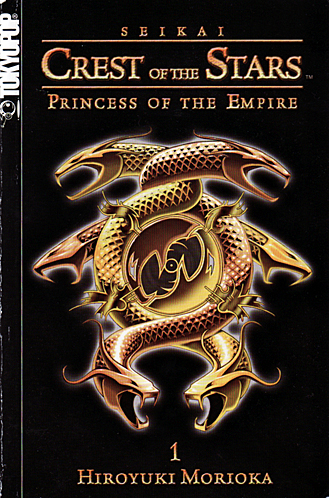
Crest of the Stars

Title: Crest of the Stars: Princess of the Empire
Japanese Title: 星界の紋章:帝国の王女 (Seikai no monshō: Teikoku no ōjo)
Author: Morioka Hiroyuki (森岡浩之)
Translator: Sue Shambaugh
Publication Year: 1996 (Japan); 2006 (America)
Publisher: Tokyopop
Pages: 212

I am a great lover of books, and I spend a great deal of my time reading. I genuinely enjoy almost everything I read, no matter what the genre, and rarely do I dismiss something as absolutely not worth reading. It is very easy for me to explain why I like a particular book, or what is valuable about a particular work, but I think that sometimes it’s important to also discuss what is mediocre, and what can be done better.

Morioka Hiroyuki’s Crest of the Stars series was recently held up to me as a paragon of Japanese science fiction. I wasn’t impressed with the translation of the first book in the series, Princess of the Empire, when it was released in the fall of 2006, but I decided to try it again. The series is massively popular in Japan, and it has quite a dedicated fan base in America as well. I have heard it described as a masterpiece of Tolkienesque proportions in several reviews; and, in my mind, there is no higher praise. Perhaps I had misjudged it four years ago.

Unfortunately, upon re-reading the book, that turned out not to be the case. Princess of the Empire starts off with a wonderful prologue, which briefly introduces the main character of the series in an interesting and beautifully described setting before launching into a short but fascinating account of the space journeys that led to the present moment. This history is then interrupted by action! intrigue! betrayal! and emotion! Unfortunately, this prologue is only sixteen pages long. What follows is 161 pages of utter garbage.

The teenage hero of the series, Jinto, arrives at a spaceport, where he is met by a beautiful blue-haired space elf named Lafiel. Lafiel takes Jinto to a space elf ship which will transport him to the space elf academy (Jinto, although genetically human, is politically an honorary space elf). The ship is attacked by a human group that seeks to oppose the space elf empire, and only Jinto and Lafiel escape. The ship is destroyed, and the unlikely pair (well, actually, very likely, considering that there are no other characters) is stranded on a small backwards planet. The end. Oh, and if you guessed that Lafiel is the princess of the space elf empire, you win a cookie.

You might be thinking, well, if Morioka spins 161 pages out of relatively nothing, then he must be a fairly talented writer with an eye for detail and a talent for dialog. Wrong. The Crest of the Stars series is known for its world building, and what Morioka has given us is 161 pages of almost unmitigated world building. The space elves are called Abh, they have a space empire, they have strange breeding practices, and they are genetically engineered to be beautiful, blue-haired, and psychic. That’s right, they are psychic space elves – which would perhaps be forgivable if there were more to them. Unfortunately, Morioka’s world building reads like a world history textbook written for fourth graders. Even when delivered in speech, the tone of this information is uniformly dry, essentialist, and uninteresting. Population statistics and general government details are provided, but nothing is said about culture, religion, art, lifestyles, political factions, diversity, philosophy, attitudes towards technology – or anything that the reader might actually care about. The clunky constructed language that annoyingly pervades the text is substituted for any real imagination. The almost complete lack of any visual imagery makes the book seem almost sterile, which I don’t think is a deliberate choice on the part of the author, whose writing is incessantly puerile:

Sure, Jinto had experience interacting with girls – he’d made a point on Delktou, in his own way. However, older women were still a complete mystery to him – especially gorgeous older women who were commanders of interstellar battleships. He couldn’t get his heart to stop racing.

In other words, instead of building a fictional world gradually while pulling his readers deeper into said world through plot thickening and character development, making them increasingly curious about the universe in which the characters live as they become increasingly attached to the characters themselves, Morioka completely forgoes plot and character development in order to construct his setting, which quite frankly feels like a cliché mix of Star Wars empire-and-princess driven space opera and Star Trek alien-culture-of-the-week episodic exploration adventure. The fact that the Abh are long-lived, pointy-eared, and dismissive of humans does not make Crest of the Stars Tolkienesque, unfortunately. In his postscript, Morioka states that he hopes “to make shameless sci-fi fans groan.” I’m pretty sure “groan” is the operative word here, since even Troy Denning’s novels set in the Star Wars universe are better written. Alas.

Princess of the Empire is everything I hate about the genre of young adult fiction, which tends to presume that its readers can’t handle complex plots, three-dimensional characters, figurative language, or middle school vocabulary. It could be argued that Japanese light novels are an entirely separate medium than young adult fiction; but still, there are infinitely better light novels out there. One of my personal favorites is Ono Fuyumi’s The Twelve Kingdoms series. A translation of the fourth installment, Skies of Dawn, was recently released a week or two ago, and I am happy to report that the series is only getting better with each successive book.

If it’s Japanese science fiction you’re looking for, then popular mainstream writers from Abe Kōbō to Ōe Kenzaburō to Miyabe Miyuki have successfully tried their hands at hard science fiction at one point or another. If you’re looking for the epic adventure and unparallel world building of Frank Herbert (or China Miéville), then check out Murakami Haruki’s Hard-Boiled Wonderland and the End of the World, which benefits from one of the most artistic and creative translations I have ever read. If you’re more in the mood for the intellectual short fiction of someone like Ray Bradbury (or Tim Pratt), then check out Tsutsui Yasutaka’s collection The Salmonella Beings from Planet Porno. If you’re in the market for lighter fare, I have been especially impressed by several of the translations I have read from an upcoming press called Haikasoru, which is an arm of Viz Media, an established publisher of manga intended for a slightly more mature audience than that targeted by Tokyopop.

In any case, to return to Princess of the Empire, it’s a morass of weak writing and tired stereotypes. Perhaps the Crest of the Stars series deepens in the second and third books, which are also available from Tokyopop, but I would rather spend my time reading all the cool new stuff that seems to be coming out almost every month. For those who want to know what all the fuss is about but don’t have the stomach to brave the light novels, there is always the Crest of the Stars manga trilogy (also published by Tokyopop). The manga are just as mediocre as the books – but at least the female characters provide the service of bending over to reveal themselves every few pages. Which, I suppose, is always a welcome distraction from heavy-handed world building and the overuse of a constructed language.

Kafka on the Shore

kafka-on-the-shore

Title: Kafka on the Shore
Japanese Title: 海辺のカフカ
Author: Murakami Haruki (村上春樹)
Translator: Philip Gabriel
Publication Year: 2005 (America); 2002 (Japan)
Publisher: Vintage International
Pages: 467

Kafka on the Shore is another Murakami novel about disappearing women. That, and penises – or, to be faithful to Gabriel’s translation, cocks. The “Kafka” of the title, “the world’s toughest fifteen year old,” gets a handjob from his (maybe) sister, has sex with his (maybe) mother, and fondles himself (maybe) half a dozen times in between. There are a lot of pages in this book, but there are a lot of cocks, too. Be forewarned.

If you can get past all that, Kafka on the Shore is an utterly charming book. In 2005, when Gabriel’s bestselling translation of the book was released in America, Kafka on the Shore was given a place on the New York Times’s “Ten Best Books of the Year” list and received the World Fantasy Award. I can’t help but wonder how much of this attention was simply a manifestation of the guilt and embarrassment of the American publishing industry, which failed to recognize Murakami’s genius as displayed in such monumental novels as The Wind-Up Bird Chronicle (ねじまき鳥クロニクル, 1995); but, in any case, a lot of people found this book to be utterly charming.

The plot of the novel is long and convoluted, and I see no need to go into it. I would much rather talk about what exactly I found charming about the novel. What I enjoyed the most were the parallel plot lines. Every odd-numbered chapter focuses on the fifteen-year-old runaway Kafka, and every even-number chapter focuses on the sexagenarian Nakata, a likable man who has been rendered mentally deficient by a strange incident in his childhood. Although the two plot lines never meet in anything but the most indirect and metaphysical way, Murakami handles the structure just as skillfully as he did in his earlier novel Hard-Boiled Wonderland and the End of the World (世界の終りとハードボイルド・ワンダーランド, 1985), and I found the experience of following the two stories to be very enjoyable.

The overall atmosphere of the novel was also quite enjoyable. Over the course of his career, Murakami has become more skillful at depicting the small details of everyday life in contemporary Japan, and the attention to setting in Kafka on the Shore should dispel any lingering doubts as to Murakami’s status as a “literary” writer. Particularly enjoyable were the early Nakata chapters, in which the fuzzy-headed old man wanders around Tokyo’s Nakano Ward looking for a lost cat. Nakata apparently has the ability to talk to cats, so he is employed in his neighborhood as a finder of missing pets. Following the details of his life through his muddled but quaint way of looking at the world is, as I have said before, utterly charming. Kafka’s experiences at a small, private library in Takamatsu are rendered in loving detail and will probably send bibliophiles directly to the internet, where they will compare prices on plane tickets to Shikoku. As a side note, the Komura Library described in the novel actually exists and is apparently every bit as pleasant and charming as Murakami makes it out to be.

I hope that I have been able to convince you that this novel is “utterly charming.” Indeed, despite some bizarre cameo appearances by Colonel Sanders and Johnnie Walker, Kafka on the Shore is not as dark as many of Murakami’s other novels and actually manages to break out of the Murakami cycle of privileging the world inside one’s own head above living in the real world. Miss Saeki, the disappearing woman of Kafka on the Shore, is elegantly mysterious and achingly eloquent concerning love, life, childhood, and memory. Her final fate is one of the many mysteries the reader must solve on his or her own, as, like the other supernatural elements in the novel, Murakami never quite satisfactorily explains it. Thankfully, this is another one of the charming points of Kafka on the Shore.