Summer, Fireworks, and My Corpse

Title: Summer, Fireworks, and My Corpse
Japanese Title: 夏と花火と私の死体 (Natsu to hanabi to watshi no shitai)
Author: Otsuichi (乙一)
Translator: Nathan Collins
Publication Year: 2010 (America); 1996, 2001 (Japan)
Publisher: Haikasoru
Pages: 350

I don’t know why I haven’t reviewed anything by Otsuichi yet. Tokyopop has released two collections of his short stories (Calling You in 2007 and GOTH in 2008), and Haikasoru released the collection ZOO, which is a major bestseller in Japan and ended up getting its own film adaptation, around this time last year. It might be that I haven’t reviewed his work before now because, even though his stories are fun and creative, they tend to be hit or miss. Also, they fall squarely into the genre of horror, which has gradually eroded away into “Dark Fantasy” or “Thriller” in the American market (the back cover of my paperback copy of Stephen King’s most recent novel, which involves murder, rape, cannibalism, and mass asphyxiation, tells me that it is “Fiction”). However, the majority of Otsuichi’s stories are pure shock horror of the type that might be found in magazines like Black Static or Macabre Cadaver, which might explain the “hit or miss” factor and also makes them difficult to review. If you like horror, you’ll like Otsuichi. If you don’t like horror, why would you want to read him?

The three stories in Summer, Fireworks, and My Corpse are still horror, but I feel like two of them are fleshed-out enough (what a lovely analogy for horror fiction) to appeal to a wider audience. The title story, which is seventy pages long, tells the story of a murder from the perspective of the dead person, who is surprisingly nonchalant about the whole thing. Being dead, however, she’s able to follow the thoughts and movements of her best friend, who inadvertently killed her, and her friend’s older brother, a budding sociopath who helps his sister hide the body. The pair isn’t exactly professional in their cover-up operation, so there are a lot of delightfully suspenseful moments in which they are almost, almost found out. The surprise ending is morbid but equally playful. The setting of the story, the forest surrounding a Shintō shrine, is used to full advantage. I think those small forests are the closest thing to a Shakespearean green world in contemporary Japanese fiction; every time one pops up in a story, you know that something weird and exciting is going to happen. (Another good example might be found in the manga Tenken, which is absolutely brilliant and should be read by everyone.) Not just the suspense and the setting but everything about the story is well executed, and it’s hard to believe that Otsuichi made his literary debut with it while still in high school.

The following story, “Yuko” (優子), is the usual Otsuichi fare. It’s short, grisly, and doesn’t make a whole lot of sense. If you’re the sort of manga fan or Lolita fashionista who’s into the mock horror and period trappings of titles like Yuki Kaori’s Godchild, though, you’ll dig the gothic atmosphere and the creepy, creepy doll parts.

And then there’s the two hundred page novella Black Fairy Tale (暗黒童話), which was published five years after the other two stories in a separate volume. For me, this story is the best part of the collection. The narrative switches between a traditionally styled fairy tale and a more modern one, which is itself told from several points of view. The main point of view is that of a high school student named Nami, who loses her memory along with her left eye in a freak accident. She receives an eye transplant and gradually realizes that she can see the memories of the eye’s former owner if exposed to certain triggers. The blurb on the book’s cover makes it seem like this element of the story is its primary source of horror, in an I see dead people sort of way; but, as Nami has lost her own memories, she can only live her life though borrowed memories, and she becomes emotionally attached to the scenes of someone else’s life that she sees through the transplanted eye, which belonged to a college student named Kazuya. Since Nami has effectively become a different person than she was before her accident, her school friends and family distance themselves from her, so she drops out of school and uses the savings left behind by her former self to travel to Kazuya’s hometown, a backwater village called Kaede. As with the shrine forest of Summer, Otsuichi makes good use of his setting in this small mountain town, perfectly capturing both the charm and the pathos of rural Japan.

Black Fairy Tale is more than a travel novel, however. Of course Nami wants to visit the places and meet the people she has seen through the eye’s memories, but she also knows that its former owner was murdered for seeing something he shouldn’t have. The reader knows this too, as the narrative shifts between Nami’s story and that of a man who has the ability to keep living things alive, no matter what he does to them. He uses this ability to experiment on the human bodies he keeps in his basement, which are somehow able to maintain their lives and their consciousness despite the terrible things that have been done to them. Nami knows that, if she finds the house whose basement she has glimpsed through her transplanted eye, she will be able to rescue the people there and also avenge Kazuya. There is obviously a great deal of suspense in Black Fairy Tale, but it’s handled in a more sophisticated and effective way than it is in Summer. The character development is much stronger, as well. The separate narrative threads are woven skillfully throughout the story, and the story’s various themes and systems of visual imagery mirror each other artfully. Black Fairy Tale is undoubtedly a horror story, but it’s also put together in a fairly literary way, and it appealed to me and stayed with me in a way that Otsuichi’s previously translated work has not.

In other words, the collection Summer, Fireworks, and My Corpse should be fun for both fans of horror and fans of fiction in general, and I don’t feel bad about recommending it to anyone. My only regret is that I didn’t write about it in time for Halloween…

Slum Online

Title: Slum Online
Japanese Title: スラムオンライン
Author: Sakurazawa Hiroshi (桜沢洋)
Translator: Joseph Reeder
Publication Year: 2010 (America); 2005 (Japan)
Publisher: Haikasoru
Pages: 210

Slum Online is a short novel about MMORPG gaming. I was skeptical of this concept at first, as I wondered how level grinding, ammunition collection, and/or interpersonal dialog along the lines of “omg n00b pwned” could be any less tedious in fiction than in real life (so to speak). Thankfully, the fictional game in question is a fighting game, and its setup and mechanics are both simple enough to be understood by a non-gamer and complex enough to not lose their freshness after two hundred pages.

I was also worried that, since the novel’s cover (which is a mirror of the original Japanese cover) sports a manga-style illustration, Slum Online would be nothing more than a light novelized plot worthy of an anime (whose plots and dialog tend to not work so well without the animation). Again, my worries were unfounded, since the story more or less eschews anime tropes and works fairly well as fiction that can be read by someone not familiar with the quirkiness of characters like Suzumiya Haruhi and Lina Inverse.

Slum Online follows an older teenager named Etsuro through his real and virtual life. In real life, he is a college student pursued by a classmate named Fumiko who is pursuing a blue cat through the streets of Shinjuku. In his virtual life, he is a karate fighter named Tetsuo who is pursuing a mysterious player known as Ganker Jack while being pursued by a ninja character named Hashimoto. The novel’s chapters alternate between Tetsuo’s real life and his virtual life, but there is little disconnect between the two; and, in the end, they come together quite nicely. It’s equally amusing for the reader to follow Etsuro through the backstreets and arcades of Shinjuku as it is to follow Tetsuo and Hashimoto through the alleyways and watering holes of the gaming world. Moreover, the cast of characters in either world is equally interesting, especially as they interact with each other across both worlds.

I wouldn’t call Slum Online science fiction, necessarily, and it doesn’t quite belong in the realm of cyberpunk, either. I found it quite realistic in its depiction of gaming technologies, their applications, and the cultures that surround them. Nobody is downloading anything directly into their brains or raving about the awesome theoretical potential of cyberspace. The characters go to school and go to work like anyone else, and the only men in black suits are the salary men on the commuter trains. Everyone knows what Google and Wikipedia and Playstation are. I personally found it refreshing to read a story about real kids playing video games. No one is a hacker, and there aren’t any cyber police; it’s just a kid and his game console and his online network.

There’s no nonsense in the book about not being able to tell the difference between the real world and the cyber world either, although Etsuro’s language occasionally betrays how his awareness of the real world is influenced by gaming. He describes hearing things in terms of “sound FX” and perceiving people’s faces in terms of polygons or anime-inspired designs. As he walks around Shinjuku, he remarks how convenient it is to not have to worry about running into invisible walls, and how in real life one can’t just approach someone and start a conversation as if he or she were an NPC. Despite (or more likely because of) his mild geekiness, Etsuro is an amusing and sympathetic narrator.

Slum Online should be a fun read for gamers, and I think it should even be a fun read for non-gamers, who won’t be alienated by any specialist vocabulary. The translation is smooth and readable, the narrative flows quickly and seamlessly, and the layout is professional and engaging. The only bad thing I might have to say about this book is that it tends to come off as male-dominated, but whatever – I enjoyed it anyway.

Crest of the Stars

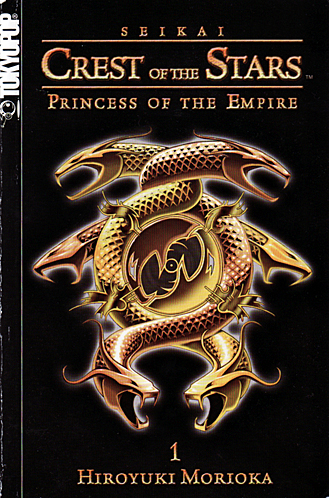
Title: Crest of the Stars: Princess of the Empire
Japanese Title: 星界の紋章:帝国の王女 (Seikai no monshō: Teikoku no ōjo)
Author: Morioka Hiroyuki (森岡浩之)
Translator: Sue Shambaugh
Publication Year: 1996 (Japan); 2006 (America)
Publisher: Tokyopop
Pages: 212

I am a great lover of books, and I spend a great deal of my time reading. I genuinely enjoy almost everything I read, no matter what the genre, and rarely do I dismiss something as absolutely not worth reading. It is very easy for me to explain why I like a particular book, or what is valuable about a particular work, but I think that sometimes it’s important to also discuss what is mediocre, and what can be done better.

Morioka Hiroyuki’s Crest of the Stars series was recently held up to me as a paragon of Japanese science fiction. I wasn’t impressed with the translation of the first book in the series, Princess of the Empire, when it was released in the fall of 2006, but I decided to try it again. The series is massively popular in Japan, and it has quite a dedicated fan base in America as well. I have heard it described as a masterpiece of Tolkienesque proportions in several reviews; and, in my mind, there is no higher praise. Perhaps I had misjudged it four years ago.

Unfortunately, upon re-reading the book, that turned out not to be the case. Princess of the Empire starts off with a wonderful prologue, which briefly introduces the main character of the series in an interesting and beautifully described setting before launching into a short but fascinating account of the space journeys that led to the present moment. This history is then interrupted by action! intrigue! betrayal! and emotion! Unfortunately, this prologue is only sixteen pages long. What follows is 161 pages of utter garbage.

The teenage hero of the series, Jinto, arrives at a spaceport, where he is met by a beautiful blue-haired space elf named Lafiel. Lafiel takes Jinto to a space elf ship which will transport him to the space elf academy (Jinto, although genetically human, is politically an honorary space elf). The ship is attacked by a human group that seeks to oppose the space elf empire, and only Jinto and Lafiel escape. The ship is destroyed, and the unlikely pair (well, actually, very likely, considering that there are no other characters) is stranded on a small backwards planet. The end. Oh, and if you guessed that Lafiel is the princess of the space elf empire, you win a cookie.

You might be thinking, well, if Morioka spins 161 pages out of relatively nothing, then he must be a fairly talented writer with an eye for detail and a talent for dialog. Wrong. The Crest of the Stars series is known for its world building, and what Morioka has given us is 161 pages of almost unmitigated world building. The space elves are called Abh, they have a space empire, they have strange breeding practices, and they are genetically engineered to be beautiful, blue-haired, and psychic. That’s right, they are psychic space elves – which would perhaps be forgivable if there were more to them. Unfortunately, Morioka’s world building reads like a world history textbook written for fourth graders. Even when delivered in speech, the tone of this information is uniformly dry, essentialist, and uninteresting. Population statistics and general government details are provided, but nothing is said about culture, religion, art, lifestyles, political factions, diversity, philosophy, attitudes towards technology – or anything that the reader might actually care about. The clunky constructed language that annoyingly pervades the text is substituted for any real imagination. The almost complete lack of any visual imagery makes the book seem almost sterile, which I don’t think is a deliberate choice on the part of the author, whose writing is incessantly puerile:

Sure, Jinto had experience interacting with girls – he’d made a point on Delktou, in his own way. However, older women were still a complete mystery to him – especially gorgeous older women who were commanders of interstellar battleships. He couldn’t get his heart to stop racing.

In other words, instead of building a fictional world gradually while pulling his readers deeper into said world through plot thickening and character development, making them increasingly curious about the universe in which the characters live as they become increasingly attached to the characters themselves, Morioka completely forgoes plot and character development in order to construct his setting, which quite frankly feels like a cliché mix of Star Wars empire-and-princess driven space opera and Star Trek alien-culture-of-the-week episodic exploration adventure. The fact that the Abh are long-lived, pointy-eared, and dismissive of humans does not make Crest of the Stars Tolkienesque, unfortunately. In his postscript, Morioka states that he hopes “to make shameless sci-fi fans groan.” I’m pretty sure “groan” is the operative word here, since even Troy Denning’s novels set in the Star Wars universe are better written. Alas.

Princess of the Empire is everything I hate about the genre of young adult fiction, which tends to presume that its readers can’t handle complex plots, three-dimensional characters, figurative language, or middle school vocabulary. It could be argued that Japanese light novels are an entirely separate medium than young adult fiction; but still, there are infinitely better light novels out there. One of my personal favorites is Ono Fuyumi’s The Twelve Kingdoms series. A translation of the fourth installment, Skies of Dawn, was recently released a week or two ago, and I am happy to report that the series is only getting better with each successive book.

If it’s Japanese science fiction you’re looking for, then popular mainstream writers from Abe Kōbō to Ōe Kenzaburō to Miyabe Miyuki have successfully tried their hands at hard science fiction at one point or another. If you’re looking for the epic adventure and unparallel world building of Frank Herbert (or China Miéville), then check out Murakami Haruki’s Hard-Boiled Wonderland and the End of the World, which benefits from one of the most artistic and creative translations I have ever read. If you’re more in the mood for the intellectual short fiction of someone like Ray Bradbury (or Tim Pratt), then check out Tsutsui Yasutaka’s collection The Salmonella Beings from Planet Porno. If you’re in the market for lighter fare, I have been especially impressed by several of the translations I have read from an upcoming press called Haikasoru, which is an arm of Viz Media, an established publisher of manga intended for a slightly more mature audience than that targeted by Tokyopop.

In any case, to return to Princess of the Empire, it’s a morass of weak writing and tired stereotypes. Perhaps the Crest of the Stars series deepens in the second and third books, which are also available from Tokyopop, but I would rather spend my time reading all the cool new stuff that seems to be coming out almost every month. For those who want to know what all the fuss is about but don’t have the stomach to brave the light novels, there is always the Crest of the Stars manga trilogy (also published by Tokyopop). The manga are just as mediocre as the books – but at least the female characters provide the service of bending over to reveal themselves every few pages. Which, I suppose, is always a welcome distraction from heavy-handed world building and the overuse of a constructed language.