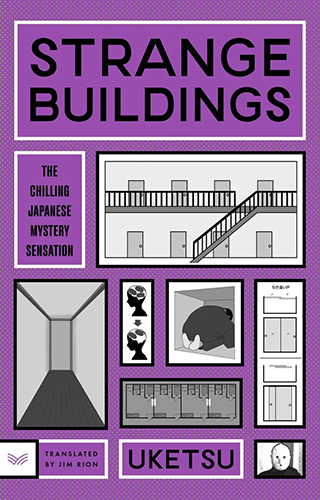
Strange Buildings, the 2023 follow-up to Uketsu’s smash hit Strange Houses, collects eleven illustrated stories about horror-themed architectural riddles followed by a lengthy exposition that reveals how these mysterious places are connected.
One of my favorite stories is “The Mousetrap House,” in which the wealthy heir to a large construction firm builds a luxurious mansion in order to kill a disabled elderly woman. If he puts a steep stairway next to the bathroom, he reasons, the woman will eventually lose her footing and tumble down the stairs.
When this eventuality fails to come to pass, he bullies his daughter into creating exactly the right set of conditions to make it happen. This horrible story is recounted decades later by the girl’s childhood friend, who was there on the night the old woman finally fell to her death.
I also enjoyed “The Watermill in the Woods,” which is presented as an old travelogue that recounts a curious building in the woods that’s nowhere near water. Its mechanical wheel instead powers the movement of an interior wall, but why would anyone need that?
This question is answered in the story “The House Where It Happened,” in which the frame narrator (who is styled as Uketsu himself) visits the old watermill in its current form as a remodeled modern house. When the village residents illuminate the shadows of the area’s history, the sinister purpose of the watermill becomes clear.
As in Uketsu’s other books, the overarching conspiracy is extremely silly. I don’t consider this a flaw, as there’s a certain sense of satisfaction in how delightfully outlandish the scenario is.
It should probably be said, however, that Uketsu is playing with acute cases of human misery as if they were Lego blocks. If one were to stage a gendered critique of this book, for instance, the ground is fertile. Still, I think it’s probably fair not to expect nuanced character portrayals from the weird architecture guy.
I enjoyed Strange Buildings, and I flew through this book as quickly as I could turn the pages. Jim Rion’s translation is compulsively readable, and I appreciate how Rion’s minor reconfigurations smooth over the “info dump” awkwardness of the original Japanese.
If you’ve never read Uketsu, Strange Buildings is a great introduction to the writer. If you’re already a fan, this is four hundred pages of the same, and it’s fantastic. Uketsu has found his niche, and it gives me joy to know that he’s out in the world being strange and living his best life.
Yōko Ogawa’s 2004 novel Burafuman no maisō (Brahman’s Funeral) is a story about the lonely caretaker of an isolated artist’s retreat who adopts a forest creature of indeterminate species. Though this short novel features many of the tropes common in bestselling stories of animal companions, it was awarded the Izumi Kyōka Prize for literary fiction that explores the darker side of the human condition.
On the first day of summer, the unnamed caretaker finds a forest creature outside the back kitchen door. The creature is injured, and he doesn’t object when the caretaker picks him up and takes him inside. In fact, the creature almost seems to be asking for help, and his puppylike tameness inspires the caretaker to adopt him as an indoor pet.
The mansion where the narrator lives and works used to belong to the wealthy owner of a publishing company, but it has since been converted into an artist’s retreat. After a conversation with the stonemason who maintains a permanent studio on the grounds, the narrator decides to name the creature Brahman after the Sanskrit word the mason has carved onto a gravestone.
While Brahman recovers, the caretaker keeps the creature in his room. The caretaker’s personal space is stark and empty, but Brahman finds ways to keep himself occupied by opening drawers and gnawing on the coat hangers in the closet. At night, Brahman sleeps on the bed while curled up against the caretaker.
Once Brahman figures out how to operate the door handle, the caretaker begins taking him outside. The scenes in which he describes the meadows and forests surrounding the retreat through Brahman’s eyes are gorgeously written. Brahman delights in the sun and the wind and the grass, and he especially loves the garden pond, swimming and diving to his heart’s content as the caretaker watches.
Though the caretaker seems amiable enough, he seems to have no friends save for the stonemason. Aside from the artists visiting the retreat, the only person the caretaker speaks with is the young woman who works at the small general store outside the train station. Though the caretaker clearly has a crush on her, she’s dating an older man who lives in the city, and all she wants is to move away from the isolated village. The caretaker clearly doesn’t have a chance with her, and his yearning for connection is poignant yet gently pathetic.
The purpose of contemporary popular pet fiction is to comfort the reader, often by anthropomorphizing the animals in service to the human protagonists. Burafuman no maisō is certainly beautiful and joyous in many places, but Ogawa has little interest in cozy vibes. To me, at least, this is an intensely gothic novel.
Brahman dies at the end, but hints of death suffuse the entire story. Aside from the artists’ retreat managed by the caretaker, the most notable feature of the town is its sprawling cemetery, which has a strange but poetic history.
Because the mountainside town has a plentiful supply of both stone and stone carvers, people who lived upriver once commissioned its artisans to create coffins for their dead. Stone coffins were difficult to transport, however, and so the remains would be placed in wooden coffins that were sent downstream to be buried in the hillside cemetery. The isolated village thus became the final resting place for the dead who were all but abandoned by the rest of the world, a description that mirrors the position of the caretaker himself.
Ogawa has something of a fetish for sensitive but lonely men, and I have to admit that the caretaker breaks my heart a little. Along with having no name, he also seems to have no family, nor any past at all. What he has instead is an old family portrait photo that he buys from a Sunday antique market in the town square. The traveling merchant gives him an old wooden frame to go with it, so the caretaker hangs the photo in his room, where he sits on the bed and imagines the lives of the long-dead family. The only living joy in the caretaker’s life comes from his interactions with Brahman.
The genre of “cozy pet fiction” is almost always about people. As such, it often treats animals as human, even going so far as to give them human narrative voices so that the reader can better understand the human characters they observe. Burafuman no maisō does the opposite by using its nameless human narrator as a vehicle to document the short life of Brahman.
Though a human reader can never perceive the world in the way that an animal does, Ogawa asks us to sympathize with Brahman through the narrator’s documentation of his umwelt: what he sees and tastes and smells, and how he reacts to the world. To the caretaker, the behavior of other humans makes little sense, but he joyfully devotes himself to chronicling Brahman’s appearance and behavior through a series of annotated lists of observations with titles such as “Brahman’s Tail,” “Brahman’s Meals,” and “Brahman’s Footsteps.”
And finally, through no fault of his own, the caretaker is forced to close his account with a list titled “Brahman’s Funeral.” Through Brahman’s death and subsequent burial in a tiny stone coffin, Ogawa succeeds in making the reader care deeply about a semi-wild animal that was never anthropomorphized in any way. I appreciate the thematic artistry, but it’s nevertheless a difficult ending.
Hikaru Okuizumi (author of The Stones Cry Out) writes in his postscript to the Kodansha paperback edition that Ogawa more than likely started this short novel during a literary festival in the small French town of Fuveau, where she apparently bowed out on a large group dinner to stay alone in her room and write. This makes perfect sense to me, as Okuizumi’s anecdote accurately reflects the tone of the story. Despite Brahman’s death and the caretaker’s loneliness, Burafuman no maisō dwells in the quiet and contemplative corners of the gothic genre, and this short novel feels like a small but meditative retreat.
In the woods, there is a castle. The castle was once the residence of the landowning family that ruled the area. During the war, it was the headquarters of a resistance movement. Now it sits empty and abandoned. The castle is so deep in the woods that most people couldn’t find it if they tried. No one tries, however, as the woods are filled with child-snatching imps. Strange noises come from the woods, and occasionally strange people as well.
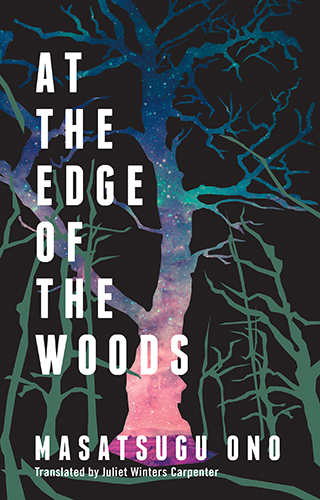
Masatsugu Ono’s At the Edge of the Woods is a novel about dread and anxiety. There’s no plot, nor is there any sort of story. Instead, Ono presents four episodes in the life of a father left alone with his young son while his wife is away. There’s no chronological order to the four chapters, which all occur at roughly the same time, and there’s no meaningful change in the personalities of the characters. Rather, the story development involves the slow intensification of an atmosphere of foreboding.
The nameless father who serves as the narrator is Japanese, as is his wife, who is pregnant with their second child. The wife has flown back to Japan to visit her parents, leaving her husband and son in an unspecified European country that reads as Germany-coded. The family has taken up residence at the eponymous edge of a vast forest in a rural area dotted with small towns.
The country is now at peace, but its neighbors are not so lucky. Long lines of refugees stream across the borders, seemingly unhindered by local authorities. It’s entirely possible that some of these refugees have camped out in the woods next to the narrator’s house, but it’s difficult to say for sure. It’s equally difficult to specify the origin of the odd sounds constantly emerging in the forest.
Characters drift in and out of the narrative, leaving behind very little of themselves save for strong emotional impressions. The disabled daughter of a bakery owner has good intentions but struggles to make herself understood. The postal worker who delivers the mail relates grotesque stories to the father, who suspects the man might be reading and discarding his wife’s letters. A neighboring farmer has always been kind to the narrator’s family, but his son reports that he once saw the man tie a dog in a burlap sack and beat the poor creature to death.
Perhaps the most striking of these characters is an elderly woman that the narrator’s son invites into the house. She appears seemingly from nowhere, and she vanishes just as mysteriously. While she’s in the house, though, she becomes a living symbol of the narrator’s anxieties regarding his ill-fitting role as the solitary caretaker of a young child in a foreign land:
Overcome, the old woman buried her face in her hands. She trembled violently, and a sob escaped her. I looked up. The kitchen windows were all closed. And yet in the air there hovered the sour smell of decayed leaves from deep in the woods, leaves that would never dry out. Steam rose from the old woman. The steam was not from her tea. A puddle spread at her feet. (20)
In his “Introduction” to The Oxford Book of Gothic Tales, Chris Baldick neatly summarizes the genre as an expression of the fear that the horrors of prior eras will not remain comfortably in the past. At the Edge of the Woods presents the readers with a range of Gothic tropes to heighten the sense of uneasy suspicion that, even in the most progressive of European countries, there is no escape from misery and cruelty. While the back-cover copy of At the Edge of the Woods calls the novel “an allegory for climate catastrophe,” this feels like a bit of an interpretive reach. Instead, Ono seems to be suggesting more broadly that, even in our bright society sustained by futuristic technologies, we’re never that far away from the edge of a large and unknowable forest.
At the Edge of the Woods can be difficult to read, and it’s probably not for everyone. Speaking personally, though, I love this book, and I’ve read it on the winter solstice every year since it was published in 2022. Ono’s writing is gorgeously atmospheric, and the legendary Juliet Winters Carpenter has done a dazzling job with the translation. If you appreciate the sort of quiet, eerie, and darkly suggestive Japanese Gothic writing typified by Yoko Ogawa’s short story collections Revenge and The Diving Pool, I’d recommend At the Edge of the Woods as the next step on a shadowed path into the liminal spaces in the penumbra of modern civilization.
Retrograde collects five short stories and one novella written by a young Osamu Dazai and gorgeously translated by Leo Elizabeth Takada.
The novella, Das Gemeine, follows a 25yo student studying French literature who aspires to become a writer himself. While hovering around an amazake stand in Ueno Park and hoping to catch the attention of the young woman who works there, the narrator meets another student, a violinist who barely attends class at all. The violinist’s friend, himself a painter, warns the narrator not to believe any of the violinist’s tall tales about his supposed talent.
The three young men decide to start a literary journal together (along with their pathetically unattractive acquaintance Osamu Dazai), but petty personality conflicts crash the project before it can get off the ground. Feeling hopelessly at a loss in letters and in love, the narrator meets a sad fate that may not have been entirely an accident.
One of the many myths surrounding Osamu Dazai (the author, not the character) is that he considered himself to be a failure rejected by the mainstream literary establishment. For better or worse, I can relate. I know from personal experience that, as an outsider, you often find yourself placing your work in the hands of upstart editors organizing projects that may, in all likelihood, never see the light of day. More often than not, things fall apart precisely because the creative team had big dreams but no practical skills to realize their ambitions.
I myself am something of a coward who immediately walks away from that sort of unpleasantness, but my familiarity with creative collaboration mishaps makes me respect the truth of the story Dazai tells in Das Gemeine, which is remarkably well-observed. The characters in this novella are deeply frustrating and more than a little cringe, but they’re 100% real – this is exactly what it’s like to work with creatives in their twenties who build castles in the air but haven’t yet developed the artistic discipline to commit their visions to paper. Bless their hearts.
The five shorter stories in the collection read like something that the narrator of Das Gemeine might actually have written. A 25yo man dies tragically and is mourned by his beautiful wife. A college student sits for the final exam of a French literature class he never attended. A high school student obnoxiously flirts with café waitresses but swiftly loses a fight with a grown man who’s not interested in his sophomoric bullshit. A teenage boy experiences a sexual awakening when the circus comes to town. Each of these stories is only a few pages long, and their unguarded sincerity contributes to their charm.
The closing story, “Blossom-Leaves and the Spirit Whistle,” is about two sisters in love with an idealized version of a man who only exists on paper until the strength of their shared storytelling summons his ghost to appear under their window… perhaps. I appreciate this story’s clever touch of Todorovian fantasy, and I’m always here for unapologetic gothic pathos. This aesthetically luxurious story is classic Dazai, in that it’s exactly the sort of work that’s contributed to his popularity among generations of students. I myself am not immune, of course, and this is by far my favorite piece in the collection.
In their “Translator’s Afterword,” Takada describes Dazai’s writing style as “a casual conversation with someone familiar,” and they explain that they want their translation to feel as if they’re “doing this just for you,” the reader. Takada gets the tone exactly right, rendering Dazai’s straightforward prose into an invitation to sympathize with the writer and his characters even despite their naked sincerity. I’ve never responded to overly “literary” renditions of Dazai’s prose, but I found myself flying through this translation. It’s fantastic.
I also want to highlight the care and attention that One Peace Books has put into the layout and typeset of this book, giving the words on the page exactly the room they need to breathe. Retrograde is a lovely object to hold in your hands, so much so that it might even spark the same youthful enthusiasm for literature that Dazai so aptly captures in his early fiction.
Much love to Leo Elizabeth Takada and One Peace Books for breathing fresh life into these classic stories from the 1930s. Retrograde is an admirable achievement, and I hope it brings the work of a fascinating author to new readers.

 Contemporary Japanese Literature