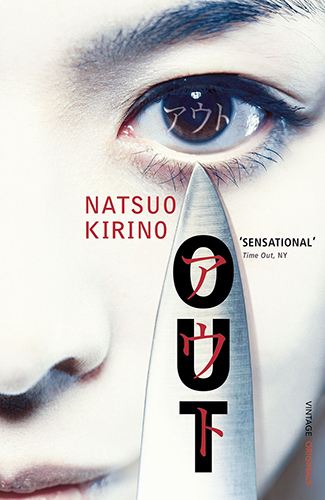
Natsuo Kirino’s 1997 novel Out is a story about four women who get away with murder… sort of. Though they manage to fly under the radar of the police, the women inadvertently come to the attention of several dangerous figures on the fringes of organized crime. Each of the women manages to find a way “out” of the situation, but none of them escapes unchanged.
Masako Katori used to work at a corporate bank; but, despite her intelligence and competence, she was forced to leave her job due to severe gender-based discrimination. After devoting so much of her life to her work, she doesn’t know what to do with herself when she’s at home with her emotionally distant husband and shut-in son, so she works the night shift at a food processing plant that assembles bento lunches for convenience stores.
Masako has formed a friendly group with three women who work the same shift. Yoshie is a widower who’s forced to care for her bedridden mother-in-law, Kuniko is obsessed with fashion and burdened by debt, and Yayoi is the mother of two young children who works at the factory to compensate for her husband’s gambling addiction. When Yayoi finally snaps and kills her abusive husband, she confesses to Masako, who enlists Yoshie and Kuniko to help her conceal the crime and dispose of the body.
Given that the women work in a food processing plant, it’s not as difficult as you might expect for them to drag the body into the bathroom, chop it into compact bits, and then neatly double-bag it for disposal. Masako’s plan to cover up the murder works so well that it might not have been discovered at all if Kuniko hadn’t discarded some of the bags in a public park.
The police quickly identify a suspect: Satake, a former yakuza who opened a nightclub and a dubiously legal gambling den in Shinjuku after a stint in prison. Several witnesses saw Satake get into a fight with Yayoi’s husband on the night he disappeared, so he’s taken into custody and held for questioning. By the time he’s released, there’s no way he’d be able to reopen his businesses, and he becomes obsessed with revenge.
Meanwhile, a yakuza-adjacent loan shark named Jumanji figures out the women’s secret by connecting the dots between the loan he granted to Kuniko and Yayoi’s signature on the paperwork as a guarantor. Instead of going to the police, Jumanji sees the potential for a black-market business opportunity. He approaches Masako, who isn’t entirely against the possibility of coming into possession of enough money to escape her current life completely. Unfortunately, the yakuza are far more difficult to escape than the police.
The premise of Out was inspired by a real-life unsolved crime known as the Inokashira Park dismemberment incident, which occurred in 1994 and has since achieved the status of an urban legend, particularly in relation to the relative absence of public trashcans in Tokyo. As in her novels Grotesque and Real World, Kirino is interested in the individual human lives behind sensationalist news stories, especially in terms of how actual people might be driven to commit horrible crimes when pressured by the severe social issues erased in mass-media coverage.
Economic and emotional precarity are major themes in Kirino’s writing, and nowhere are they more visible than in Out. Yayoi has no one to turn to for help dealing with her abusive husband, especially not with two young children to care for, and matters eventually move beyond her control. Masako has spent her entire professional life being told that her work isn’t good enough, so she jumps at the opportunity to take care of business in a concrete way that will actually benefit someone. Meanwhile, Kuniko is saddled with crushing debt, while Yoshie works herself to the bone to care for her mother-in-law and teenage daughter. Neither Kuniko nor Yoshie wants to help Masako execute the grim task of disposing of a body, but they need money and feel they have no choice.
At the food processing plant where they work, all four women are dehumanized. The labor they perform is mechanical and mindless, and they’re only valued for their bodily cleanliness, which is checked and double-checked during various workplace inspections. Working at night pays more and grants the women time to manage their caretaking responsibilities during the day, but the graveyard shift unfortunately serves to create an even greater sense of distance between the women and mainstream society. Perhaps ironically, the only person who sees Masako and her work friends as actual people is a Brazilian migrant worker who barely speaks Japanese. Otherwise, they have only each other to rely on in a society that has no sympathy for adult women who need to work to earn money.
For better or worse, each of the women finds a way out of her unfortunate circumstances, although probably not in the most optimal way. Not all of the characters survive to the end of the novel; but, on the bright side, they do manage to get away with murder. And good for them, honestly.
Out is on the longer side of Japanese fiction in translation – 400 pages in the American edition, and close to 500 pages in the UK edition. Still, not a single page is wasted, and the threads of the plot are neatly untied and sheared away until the core of the story is exposed as the women’s fundamental struggle for survival. What Kirino manages to do with this story is to begin with a horrific premise and then gradually bring the reader over to the side of the criminals, complicated and (deeply) flawed people though they might be.
I’ve read Out four or five times since I first discovered it in English translation, and this book still manages to surprise me every time I return to it. Natsuo Kirino is an absolute master of suspense fiction, and Out is social critique at its finest. It’s difficult to believe that this novel is almost thirty years old, because it still feels incredibly sharp and relevant.