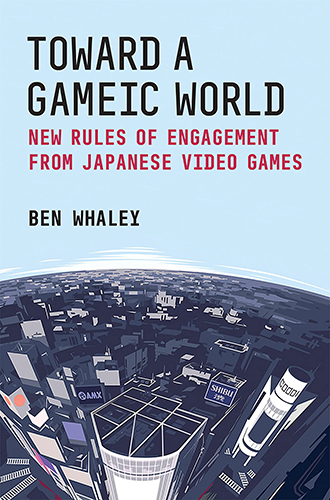
Ben Whaley’s 2023 monograph Toward a Gameic World: New Rules of Engagement from Japanese Video Games presents four case studies of how the virtual narratives of Japanese video games encourage engagement with social and political issues in the real world. Drawing on Katherine Isbister’s 2016 How Games Move Us: Emotion by Design, as well as a wealth of other recently published work in the burgeoning field of Game Studies, Whaley positions “engagement” as one of the primary means by which a video game conveys its message to the player.
“As I use it in this book,” Whaley explains in the Introduction, “‘engagement refers to a game’s capacity to evoke actual feelings of overcoming, guilt, complicity, or shared connection from a fictional experience of trauma.” The resulting study is not only a fascinating reading of key texts in the emerging canon of Japanese video games, but also a convincing argument for how Japanese games are able to engage transcultural audiences in political concerns ranging from youth precarity to environmental disasters.
The first chapter, “Limited Engagement,” asks interesting and culturally relevant questions about the politics of representing disaster in its discussion of the conversation surrounding the Disaster Report series of action-adventure games. Representations of apocalypse are often critiqued as being “disaster porn” meant to titillate viewers, but this chapter offers an alternate interpretation of the effects that experiencing such stories can have on individual players, as well as broader currents of historical memory.
“If mass-scale disasters conveyed in newspaper photos and YouTube videos represent collective narratives that run the risk of flattening the individual victims and individual narratives,” Whaley writes, “then video games like Disaster Report offer players the potential to rebuild some of this context by hearing lost voices, inhabiting lost bodies, and experiencing lost narratives, if only in virtual space.” In other words, the player engagement demanded by video games can serve as a means of presenting environmental disasters not as an abstract concept, but as a personally meaningful concern. The controversial Disaster Report series of games thus facilitates empathy for real-life survivors while also providing an education on disaster preparedness and survivor outreach.
The book’s fourth chapter, “Connective Engagement,” focuses on how social connections are modeled by the networked gameplay elements of The World Ends With You, a 2007 RPG set in an urban fantasy version of Shibuya. The game’s protagonist is a socially isolated teenager who suffers from depression and seems well on his way to becoming a hikikomori. While it’s easy enough to tell a story about a young person finding friendship, it’s much harder to break out of a toxic spiral of isolation in real life. The narrative of The World Ends With You acknowledges this challenge, and its gameplay cleverly models what this process actually entails.
Whaley demonstrates that, in addition to helping socially withdrawn players feel seen and recognized, the game’s networked features have the potential to encourage players to actively seek out other people in physical space, as wireless connections between Nintendo DS consoles are meaningfully rewarded within the world of the game. With its sensitive cultural study, this chapter is an antidote to sensationalistic accounts of mental health in Japan, as well as a welcome contribution to the ongoing scholarship concerning how online engagement in the communities surrounding networked games can positively affect the mental health of young people (and not-so-young people) who would otherwise feel alienated and alone.
Where the empathy of this book falls short is in the second chapter’s discussion of the 2011 visual novel / puzzle game Catherine. Catherine is a deeply misogynistic and openly transphobic video game, and critical responses to its story and characters have been mixed. While Catherine’s almost comically misogynistic treatment of its cisgender female characters is questionably open to argument and interpretation, the way the game handles a prominent transgender character is unequivocally hateful and extremely distressing. It’s therefore odd to see Catherine presented as a model of empathy.
My recommendation to readers would be to skip this chapter entirely. The author isn’t writing with malice; rather, it can often take many years to research, assemble, and publish an academic book, and scholarship that felt fresh a decade ago sometimes ages poorly. I will admit that I’ve occasionally found myself in a similar situation when I look back at my own work. This is simply the danger of writing about contemporary political issues, but it’s no reason not to create scholarship that’s relevant to the current moment.
Without sacrificing the quality of its research, Toward a Gameic World is accessible to general-audience video game fans interested in sustained critical analysis. (I didn’t mention the book’s third chapter in this review, but Metal Gear Solid fans are in for a special treat.) The book is also accessible to scholars who know little about video games but want to incorporate them into their classes. I think the first chapter on depictions of environmental disasters, “Limited Engagement,” would make an especially excellent reading for undergraduates. Whaley also offers many strong examples of how to integrate online conversations into academic literature reviews and textual analysis.
Toward a Gameic World takes the serious cultural topics addressed in a key selection of video games and, with sensitivity and grace, transforms their analysis into a surprisingly entertaining and enjoyable discussion. One might even say that it’s quite an engaging read.

 Contemporary Japanese Literature