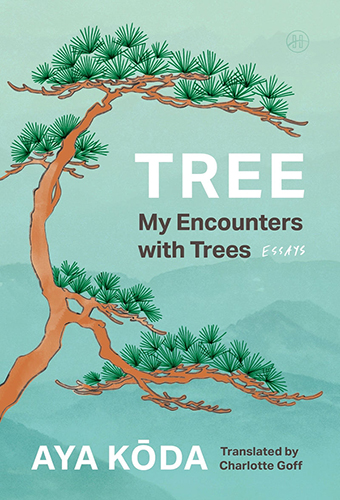
Tree: My Encounters with Trees

Aya Koda’s posthumous 1992 essay collection Tree, which has been translated with sensitivity and grace by Charlotte Goff, brings together fifteen short autobiographical essays about the author’s visits to famous trees and forests in Japan.

Koda, who was born in 1904, was primarily famous as a novelist and short story writer. She was most active in the late 1940s through the 1950s, when she documented the changing family dynamics of the postwar period through her fiction. Koda focused on shifting social mores through the lens of women’s work and material culture, especially clothing.  

Koda brings the same power of observation and gentle good humor to her accounts of her travels across Japan in order to satisfy a long-held curiosity about trees, forestry, and environmental science, as well as the professionals who work in these fields. As she explains her project in her own words…

It has only been a few years since I first started walking through the woods, hoping that as I encountered different trees I would be able to draw inspiration from them. I had been lucky enough to receive support and guidance from experts each time, and so in a few short years I had been afforded the chance to spend considerable time wandering the forest feeling moved by all sorts of wonderful trees.

In “Yakusugi,” Koda visits Yakushima, a World Heritage Site known for its luxuriant vegetation and the mountainous evergreen forest that inspired the Studio Ghibli film Princess Mononoke. Koda is specifically interested in visiting the Jomon Sugi, a cryptomeria cypress tree that’s at least two thousand years old (and may be much older). After braving the muddy mountain slopes, Koda is surprised to find that the tree is far from majestic, but what she calls its “squat ugliness” is impressive in its own way.

In “At Abe Pass,” Koda walks along the Abe Pass hiking trail, which is known for its views of Mount Fuji. Instead of visiting during the peak of the autumn foliage, Koda goes in May, when the leaves of the maple trees will hopefully be fresh and green. Unfortunately, the vicissitudes of nature can’t be predicted, and the maple trees are completely bare when she arrives. Koda still documents her trip with good humor, taking note of the smaller plants that are budding and flowering while also remarking on the river below, which has a tendency to complicate the postcard-perfect scenery by flooding and causing landslides.

For the reader, Koda’s essays can feel like secondhand forest bathing, but it’s also interesting to study the snapshots of cultural and natural history that she has preserved in her writing. For Koda, aesthetic appreciation is just as important as ecological understanding, and she describes her essays as an attempt to pass on a way of seeing nature that she developed as a child…

I grew up in a farm village on the outskirts of Tokyo, which is why there were always plants around. There were crops from the rice paddies, of course, scrubs of various small trees springing up alongside irrigation channels, areas of land cultivated by gardeners, and, as well as all this, just about every house had some form of greenery in or around it. Children could learn about trees and plants without even trying.

What separates Koda’s essays from a shallow appreciation of attractive landscapes is her willingness to address the more violent aspects of nature. The most powerful example is the essay “Volcanic Ash,” in which Koda visits Sakurajima, the location of a small town that has historically benefitted from the hot springs and fertile soil created by the island’s active volcano. After one of the major eruptions in the 1980s, Koda went to observe the effects of the falling ash on the plants. “It must be an extreme nuisance,” she says wryly; but, “as a natural phenomenon, you cannot simply ask it to stop.”

Though discussions of climate change had already begun in Japan in the 1980s, Koda doesn’t address this issue directly. Instead, in a very relaxed and apolitical way, she stresses the importance of learning to coexist with the environment, even when it’s inconvenient or destructive to human enterprise. By imbuing scientific curiosity with emotional warmth, Tree serves as a gentle and welcoming invitation to live attentively alongside the natural world. Aya Koda’s clear-eyed essays offer readers an entertaining and nostalgic tour of Japan’s forests, but they also provide a model for observing nature with respect and resilience.

The Easy Life in Kamusari

Japanese Title: 神去なあなあ日常 (Kamusari naa naa nichijō)
Author: Shion Miura (三浦 しをん)
Translator: Juliet Winters Carpenter
Publication Year: 2012 (Japan); 2021 (United States)
Press: Amazon Crossing
Pages: 197

Eighteen-year-old Yuki Hirano has just graduated from high school, but he has no ambitions in life or plans for college. Not wanting him to become a hikikomori, his mother enrolls him in a special year-long forestry training program in rural Mie Prefecture. Unlike Yuki’s home in Yokohama, the tiny mountain village of Kamusari has no convenience stores or cell phone reception, just trees as far as the eye can see.

Yuki receives a warm welcome into the home of his supervisor, Yoki Iida, but he wants nothing to do with Kamusari. Forestry work is difficult and dangerous, and Yuki doesn’t have any particular knack for the job. Other employees of Nakamura Lumber judge him for his mistakes and make him feel like an outsider. The only other person his age, a schoolteacher named Nao, isn’t remotely interested in becoming friends with him. There’s nothing in Kamusari except work, and Yuki is so exhausted by the physical labor that he falls asleep right after dinner.

As he continues working, however, Yuki gradually learns to appreciate the warm hearts of the villagers and the wild beauty of the mountain forest. He becomes accustomed to the slower pace of life in Kamusari, and he’s eventually inducted into the village’s religious traditions. The Easy Life in Kamusari is divided into four chapters, one for each season, and Yuki is keenly observant of how the natural world changes around him. He has to be, as his life and livelihood now depend on his connection to the forest.

Like Shion Miura’s 2011 novel The Great Passage about an earnest young dictionary editor, the protagonist’s gender is central to the fantasy of accidentally stumbling into a meaningful and fulfilling career. And The Easy Life in Kamusari is, without a doubt, a fantasy.

All of the conservative and “traditional” aspects of society in Kamusari are quaint and charming. There’s no poverty or bigotry or bullying. Yuki isn’t gay, so he doesn’t have to deal with the locals equating homosexuality to sexual deviance. Since Yuki isn’t female, he doesn’t have to do a second shift of cooking and cleaning and childcare, which means he can fall asleep after dinner without ever having to worry about the fact that the nearest grocery store is a forty-minute drive away.

If you’re thinking, “Wow, that must be nice,” then rest assured that it is. It’s very nice! That’s the fantasy.

The Easy Life in Kamusari is a light read, and nothing unpleasant happens. An older worker isn’t happy with Yuki being included in village activities, but he’s shut down quickly by Yuki’s supervisor and coworkers, who support and protect him. There’s a bit of darkness in Nao’s character, but the reader never hears her story, as Yuki decides that it’s not his problem. Everyone in the village seems to expect that Nao will allow Yuki to have sex with her despite her lack of interest in a relationship, but he doesn’t force the issue, thankfully.

The Easy Life in Kamusari is a coming-of-age story about a boy becoming a man through manual labor and religious ritual, and the narrative perspective is staunchly masculine. Unlike its boisterous cinematic adaptation, the novel refrains from sex puns about wood, but it nevertheless expresses a strong gender dichotomy. Yuki’s sense of belonging is tied to his gradual incorporation into male spaces that exclude women, and female perspectives are not introduced into the story. If you’re sensitive to how “tradition” can trap people in gender roles and unwanted relationships, especially in isolated rural areas with no tolerance for more progressive worldviews, The Easy Life in Kamusari may not be for you.

Still, if you can accept the limitations of the narrative perspective, it can be nice to indulge in the fantasy of “traditional” masculinity as recounted in the light and gentle storytelling of a female author. No one gets hurt, either by toxic masculinity or in a gruesome forestry accident.

Speaking of which, the other fantasy presented by The Easy Life in Kamusari is the fantasy of living in harmony with nature. Forestry work is fairly dangerous in reality, as are wild animals, diseases carried by insects, and extreme weather conditions. While I admire the research Miura did for this novel, I can’t help but wish that she had been willing to explore a more nuanced and realistic portrayal of rural life and agricultural labor. Japanese cedar plantations have been harshly criticized by domestic and international environmental groups, and it would have been interesting to see these issues acknowledged and discussed from the perspective of people withing the industry. In addition, I would have liked to see a hint of the ongoing discussion about Japan’s aging rural population, perhaps in terms of what it means to have so many older people doing such dangerous work so far away from any healthcare resources.

But again, The Easy Life in Kamusari is a fantasy. It’s a charming and pleasant novel, and I thoroughly enjoyed it. I read a few pages at a time, and I’d always come away refreshed by the beauty of Miura’s writing and Juliet Winter Carpenter’s translation. Although I wish the story were more engaged with the realities of its setting, I would happily recommend The Easy Life in Kamusari as a light read to anyone interested in nature writing, Japanese religion, or a heartwarming story of growing up and finding one’s place in the world.