The Deer King: Survivors

Nahoko Uehashi’s fantasy epic The Deer King is the story of two characters who find themselves caught in an ongoing conflict fought on two fronts – an imperial war for conquest, and the spread of a mysterious disease.

The Deer King works best when it focuses on its primary viewpoint character, a middle-aged warrior named Van who lost his homeland when he was captured in battle and sent to the imperial salt mines to work and die as a slave. After the mines are attacked by black wolves, Van passes out and wakes to find he is the sole survivor – with one exception, a small child named Yuna who was stuffed into an oven in the kitchens aboveground.

With Yuna in tow, Van escapes into the forest, where he encounters an injured traveler who has been abandoned by his pyuika, a cross between a deer and a reindeer that Van’s people have traditionally ridden like horses. When Van befriends the missing pyuika, the traveler invites him back to his village to teach everyone how to raise the animals properly. Van agrees, and he and Yuna find peace in the isolated village. Unfortunately, the ongoing war is not far behind them, and Van begins to manifest strange abilities that pull him in the direction of the black wolves.

Van’s portions of the story are wonderful. Van is a careful observer of the world around him, and his perspective allows the reader to appreciate the details of the natural environment while learning about the cultures of the people who live on the borders of the empire. Despite his background as a military leader, Van is primarily concerned with establishing peaceful human relationships. This facet of his character allows worldbuilding to occur organically through conversations about mundane matters. 

Unfortunately, The Deer King becomes borderline incomprehensible when it shifts to the secondary viewpoint character, a young and brilliant physician named Hohsalle who seeks to combat the deadly disease supposedly spread by the phantasmic black wolves that attacked Van. Hohsalle’s chapters are exposition dumps filled with fantasy names and places and ranks that feel uncomfortably decontextualized.

All of the characters operating within the empire have lords, and they also have servants, and their servants have servants, and their lords have family histories. To my dismay, all of these characters are presented as though the reader were already familiar with their relationships. What could have been an interesting medical drama is thus buried under a slurry of fantasy names and meaningless titles.

I had the same problem with Uehashi’s novel The Beast Player, a coming-of-age story that’s interesting and compelling right up until the point when the narrative suddenly shifts to the machinations of a dozen new characters active in the succession drama of a large and labyrinthine imperial court. The poor pacing and uneven structure of both novels render their stories unnecessarily difficult to follow, which is a shame. 

In addition, while I’m always hesitant to critique Japanese-to-English translation, I feel that veteran translator Cathy Hirano’s signature style of simple and lucid clarity might not be the best fit for a work of epic fantasy. When I read fantasy, I want the prose to be at least a little purple, with the beauty (or darkness) of the language reflecting what’s unique about the world imagined by the author. I also want the characters to have distinct voices, especially if they’re coming from vastly different cultures. I personally feel it’s something of a drawback for the translation of The Deer King to be so smooth, as I’d prefer the writing to have more texture.

The Deer King: Survivors is only the first half of the story, but I don’t think I’m going to read the second volume. Even though the novel contains numerous themes that interest me, such as the ecological impact of war and the moral compromises of marginal communities resisting oppression, the flawed execution of these themes failed to hold my attention.  

What I’d strongly recommend is for anyone interested in the premise of The Deer King to check out the animated cinematic adaptation, a breathtakingly beautiful film that deserves far more attention than it’s received. The movie version of The Deer King is on par with Princess Mononoke in terms of its depiction of a green world filled with mystery and populated by sympathetic characters who are doing their best to understand one another despite their competing goals.

Unlike the original novel, the pacing of the movie is excellent. Many of the side characters and their subplots have been cut or simplified, thereby allowing the physician Hohsalle to shine like the star he’s meant to be. The film version of The Deer King is the sort of animation for intelligent adults that harks back to an earlier generation of filmmakers like Satoshi Kon and Mamoru Oishii, and I can’t help but wish that the original novel had been able to meet the same standard.
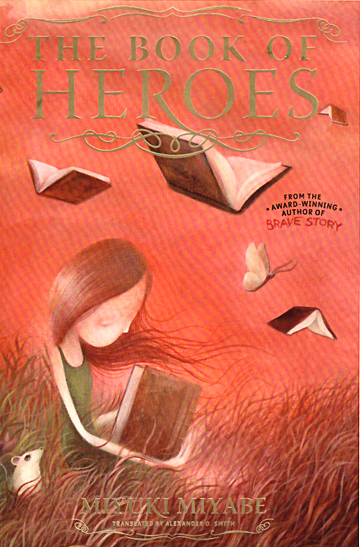
The Book of Heroes

Title: The Book of Heroes
Japanese Title: 英雄の書 (Eiyū no sho)
Author: Miyabe Miyuki (宮部 みゆき)
Translator: Alexander O. Smith
Publication Year: 2010 (America); 2009 (Japan)
Publisher: Haikasoru
Pages: 352

Before the earthquake hit Japan, I was drafting a review of Miyabe Miyuki’s Brave Story. I was going to say something along the lines of that, while many male-centered epic novels (like Wizard’s First Rule) are sex fantasies supported by the bare-bones scaffolding of fantasy tropes, Brave Story is not like that at all. I was also going to say something to the effect that Miyabe does realism much better than she does fantasy, at least in Brave Story, where the “Frodo in the Shire” (or “Wataru in a suburb of Tokyo”) segment is much more interesting than the actual adventures in the fantasy world of Vision. And then I was going to conclude that the book did not need to be eight hundred pages long, and that Miyabe could have used some serious editing, since the reader does not need to know what every character is thinking at any given time.

But then I thought, why write a review of a promising book that turned out to be dishearteningly mediocre? Life is short, and there is more to the world than picking apart the idiosyncrasies of genre fiction. One of the great things about fantasy literature is that, when done correctly, it can inspire courage, and hope, and bravery. And since everyone following the events in Japan could probably use a “brave story” right now (I know I could), I am instead going to review Miyabe’s much shorter (and, in my opinion, much better) fantasy novel The Book of Heroes.

The Book of Heroes is about Yuriko, whose older brother Hiroki snapped under pressure, knifed a classmate, and then disappeared. In the fallout of the incident, Yuriko’s family has been suffering from media overexposure, while Yuriko herself has had to drop out of middle school because of bullying. In the midst of this chaos, there has been no sign of Hiroki. Worried about her older brother, Yuriko ventures into Hiroki’s room and is approached by a talking book named Aju, who drops a few cryptic hints concerning Hiroki’s whereabouts. These hints lead her to her reclusive uncle’s cabin in the mountains, which is filled with rare books, many of whom can also talk.

These books tell Yuriko that her brother has become a Summoner, a being who can channel the evil King in Yellow, who sows discord wherever he goes. The King in Yellow is not an easy threat to quell, as he is one half of the Hero, the archetype who inspires brave and great deeds. To prevent her brother, who believes himself to be the Hero, from summoning the King in Yellow, Yuriko must become an allcaste, an adventurer with the ability to travel between worlds. Yuriko learns that all worlds (including her own), are created from fictions, and so she must travel through and into books in order to chase down Hiroki.

Yuriko’s journey begins in the third chapter (about eighty pages into novel), when she is transported to The Nameless Land, a kind of land beyond time where monk-like “nameless devouts” spin the wheels that cycle stories throughout the many worlds. This might sound as if The Book of Heroes is wading waist-deep through a meta-textual philosophical sludge, but the novel’s self-reflexive fantasy is actually quite fascinating. Miyabe’s descriptions of both modern Tokyo, The Nameless Land, and the fantasy book world that Yuriko enters are beautiful and striking. There is a sense of wonder in the storytelling, but also an appropriate sense of urgency. The odds that Yuriko faces are overwhelming, but she is accompanied by the book Aju, who temporarily takes the form of a mouse, a older male guardian and guide called Ash, and a nameless devout whom Yuriko names Sky. Each of these three supporting characters has his own story to tell, and each of them is as interesting and important as Yuriko, who really comes into her own as a protagonist over the course of the book.

As she grows stronger, Yuriko learns that her power does not come without a price, and the answers to her many questions are difficult and painful. The novel’s ending is bittersweet yet satisfying, and the endgame revelations are heartbreaking yet thought-provoking. Thankfully, the story is compelling enough to keep the reader feverishly flipping pages all the way through. Honestly, if you are in need of a break from current events that you can come back from refreshed and re-energized, The Book of Heroes is an excellent story to immerse yourself in. It’s got the same sort of quiet yet driving mystery and the same sort of exploration of fantasy with real-world implications as the anime series Haibane Renmei or Lev Grossman’s novel The Magicians. I cannot give it higher praise than that, although I should mention that Haikasoru has done a beautiful job publishing the book, and Alexander O. Smith’s translation is beyond excellent (as it was in Brave Story).

If you’re reading this alongside articles of the death and destruction in Japan and find my review of a fantasy novel trifling and tasteless, then I will hang my head, apologize, and humbly suggest Murakami Haruki’s short story “The Seventh Man,” which is published in the Blind Willow, Sleeping Woman collection but immediately available in several “unofficial” translations through a quick search on Google. “The Seventh Man” is about a memory of a tsunami, and its primary themes are terror, helplessness, and guilt – which I suppose is the other side of the “brave story” of disaster survival offered by The Book of Heroes.

Regarding the situation in Japan, I think Matt Alt makes an excellent point when he says, Don’t Panic. The best coverage of the quake and its aftermath from a personal level that I have read thus far has been on the blog Adventures in Gradland (which is a fantastic read even when its author isn’t being the most sane and level-headed person to post about what must be a terrifying series of experiences). This post over at The Lobster Dance contains a list of links for more reliable news sources, as well as information on charities (the word on the street is that Second Harvest seems to be doing the right work, right now). The art historian over at A Man with Tea has taken this opportunity to reflect on what might be lost in Japan, as well as why we need to keep calm and carry on. Finally, Daniella Orihuela-Gruber has issued an appeal for donations over at All About Manga, which is accompanied by a plan to make a difference. As for me, all I can do is cheer my friends and the people of Japan on from a distance. You guys are amazing, and you can survive anything!