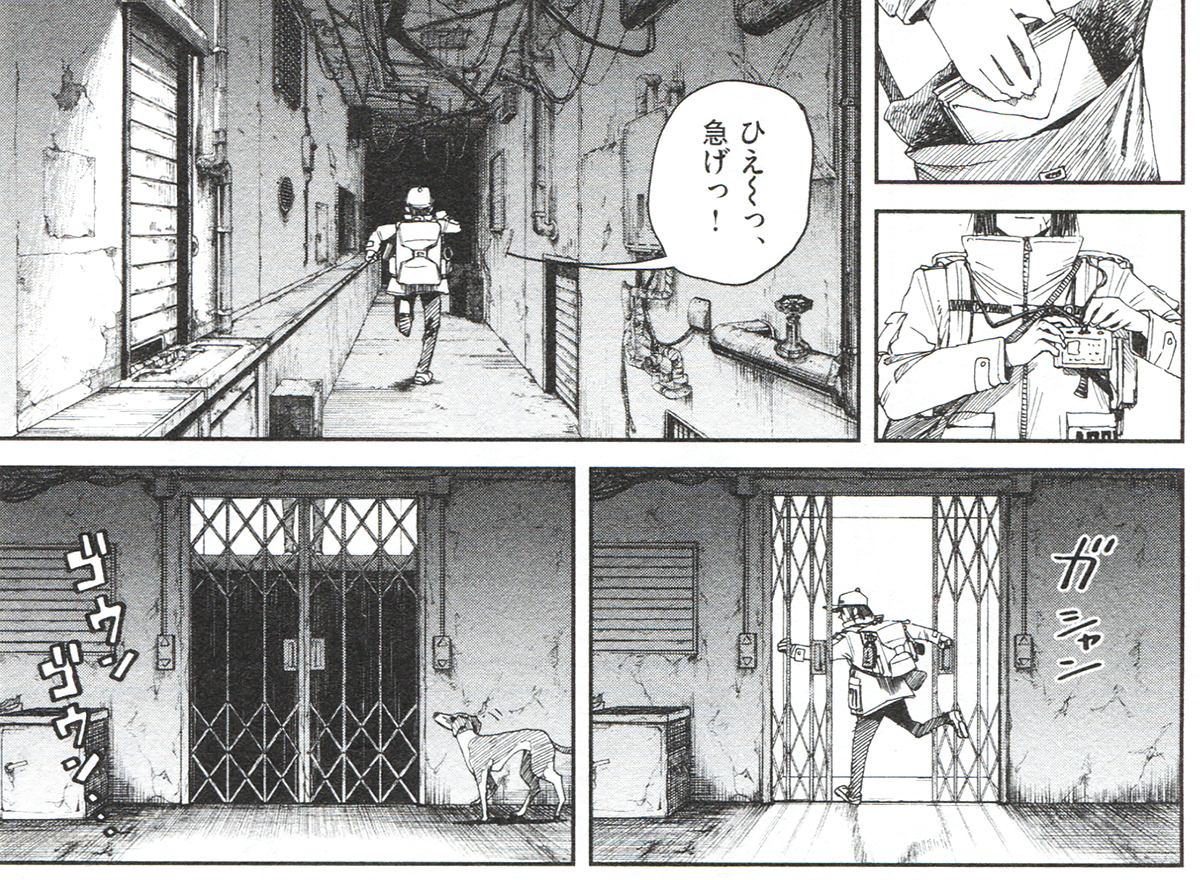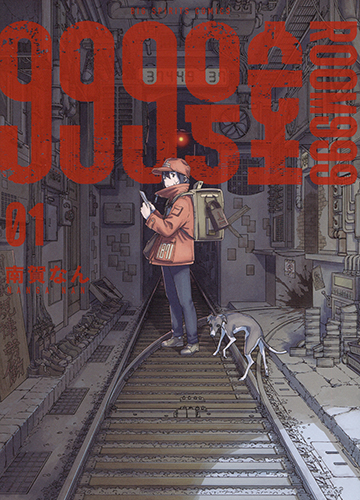
Nanga Nan’s manga Room 999, whose first four chapters were published as a tankōbon paperback in May 2026, is a spectacular debut. As advertised on the book’s obi promotional band, Room 999 has been praised by artistic luminaries such as Inio Asano and Naoki Urasawa. Though Room 999 exhibits thematic similarities to the work of Asano and Urasawa, particularly in the realm of social critique, this manga is pure dystopian science fiction set in a nightmarish residential complex the size of a large city.
Courier #1871 lives somewhere in the middle of the decaying stacks of this massive structure, where he earns his living by delivering letters to the other residents. Though young and possessed of remarkable levels of energy and optimism, Courier #1871 appears to be a normal human. His appearance is unique, however, as most of the other residents exhibit varying degrees of deviation from a standard body structure.
The primary focal character of the opening chapter is an amalgamation of ten human bodies that form a protean ball of flesh capable of extending itself (himself? themselves?) into tendrils capable of moving with frightening speed. Courier #1871 incurs this entity’s displeasure by failing to deliver a letter to one of the ten people incorporated into the amalgamation, which explodes with sadness and rage. He therefore ventures down into the local sewer and waste treatment pit to recover the missing letter so that the entity can be appeased and the day’s work can be successfully completed.
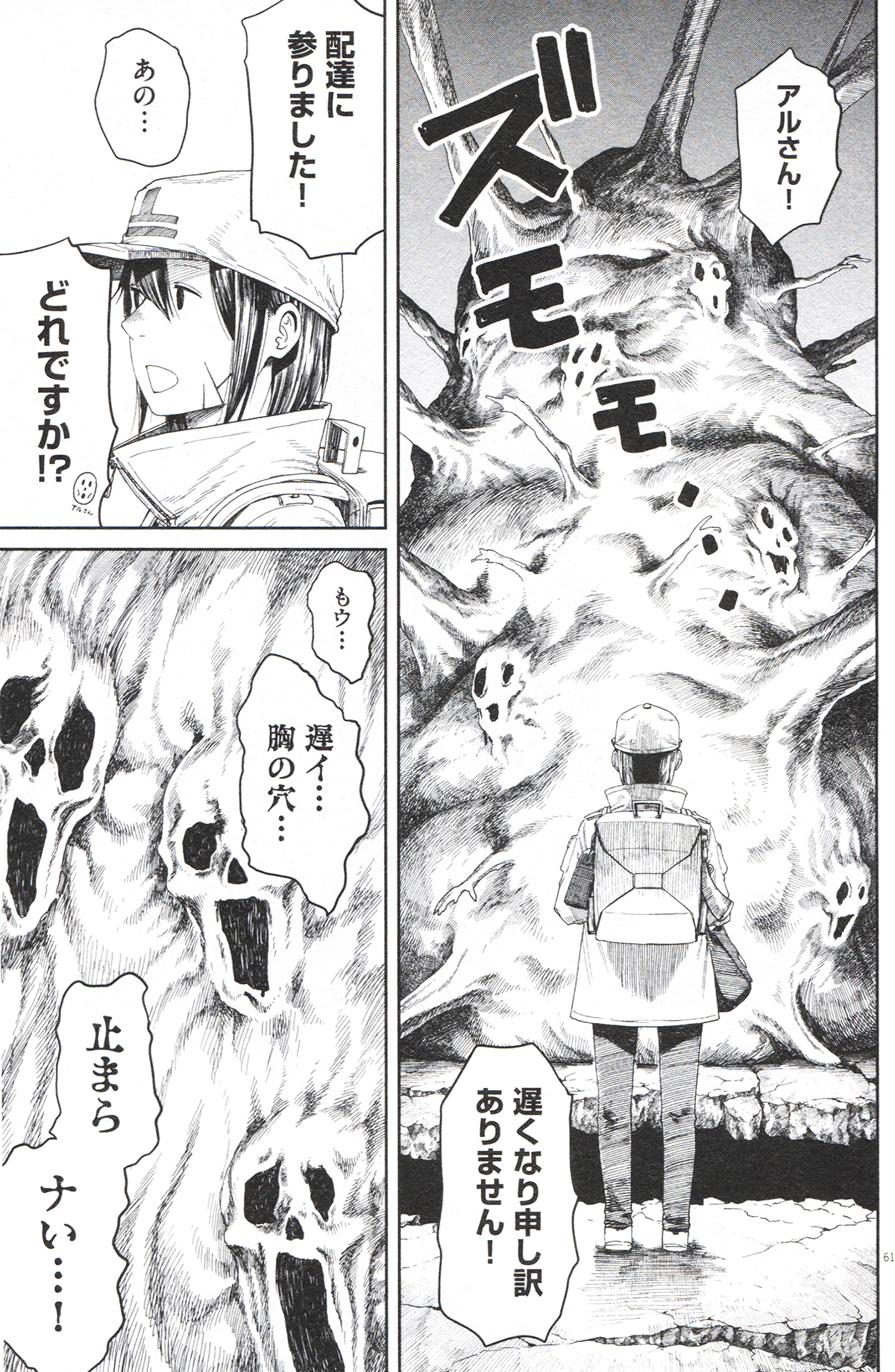
Despite the threats to his life, Courier #1871 treats the amalgamation with kindness and respect, never failing to address it with keigo honorific language. I feel that, even more than its grotesque imagery, it’s Courier #1871’s unflappable good nature that gives Room 999 a strong sense of character as a manga. While plenty of sci-fi manga showcase intense body horror, Room 999 is relatively unique in its ability to normalize characters with an incredible range of personalities and body shapes, many of whom aren’t remotely humanoid.
The true horror of Room 999 comes not from its characters, but rather from the dystopian nature of its grungy futuristic setting. This isn’t simply a matter of the megastructure’s general state of disrepair (which is oddly charming) or the variety of forms that human bodies have taken (which are also charming); rather, the horror lies in the authoritarian government of this world’s society, whose will appears to be enforced through ideology instead of coercion. Residents of the nameless city / factory / apartment complex are woken every morning with an announcement broadcast over speakers installed in every home that encourage people to “work for the benefit of the nation.” And this is indeed what they do, seemingly without objection.
Each day’s labor is rewarded with a “People’s Ticket,” five thousand of which can be exchanged for permission to live in a high tower whose residents are entitled to luxurious accommodations, state-of-the-art medical care, and as much delicious food as they can eat. Collecting these tickets is a challenge, however, as exchanging them is also the only way to receive food. Unlike the citizens living in the central tower, normal people are limited to meals expelled from machines in the form of canned “standard rations” that are indistinguishable from dog food.
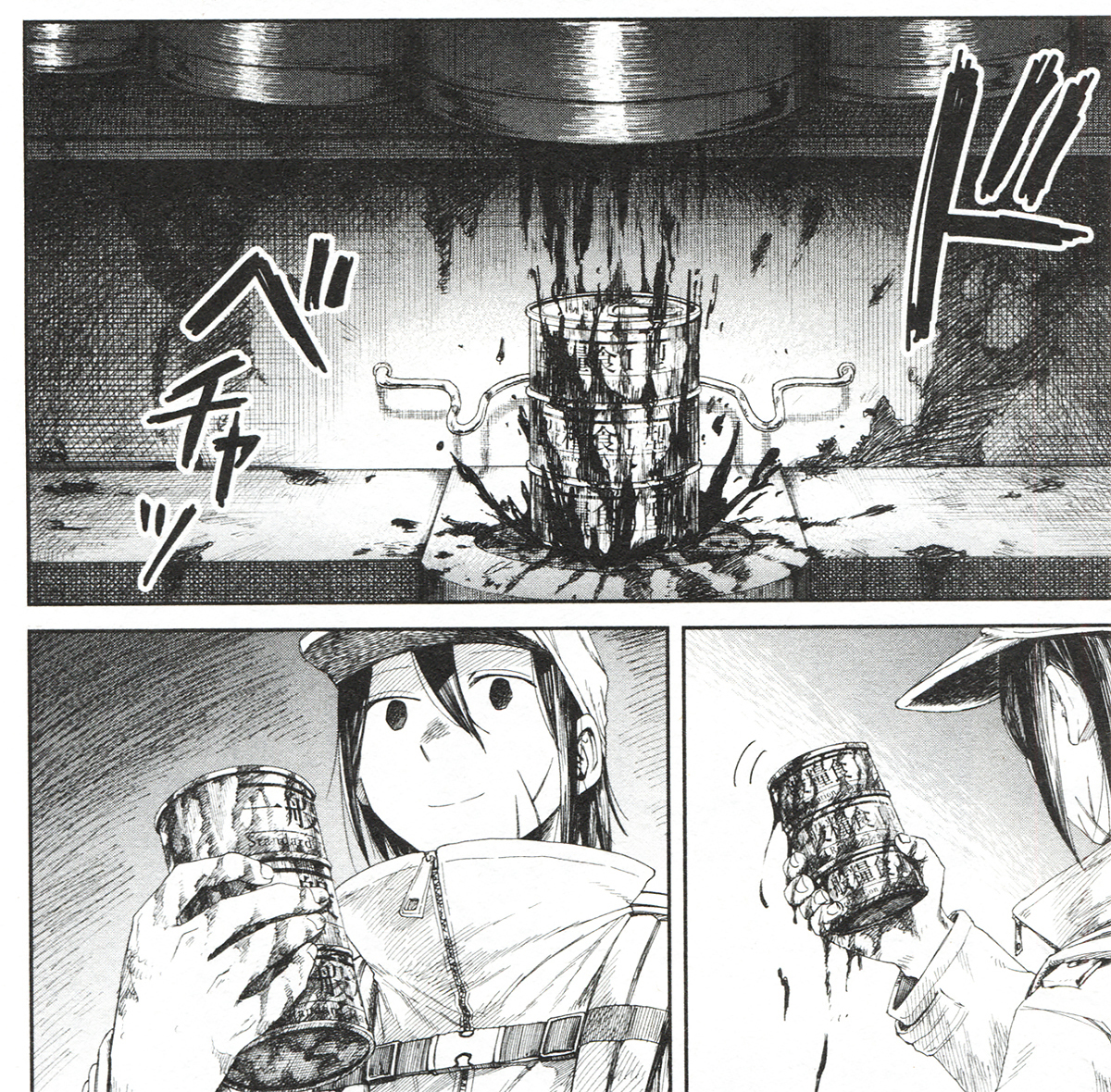
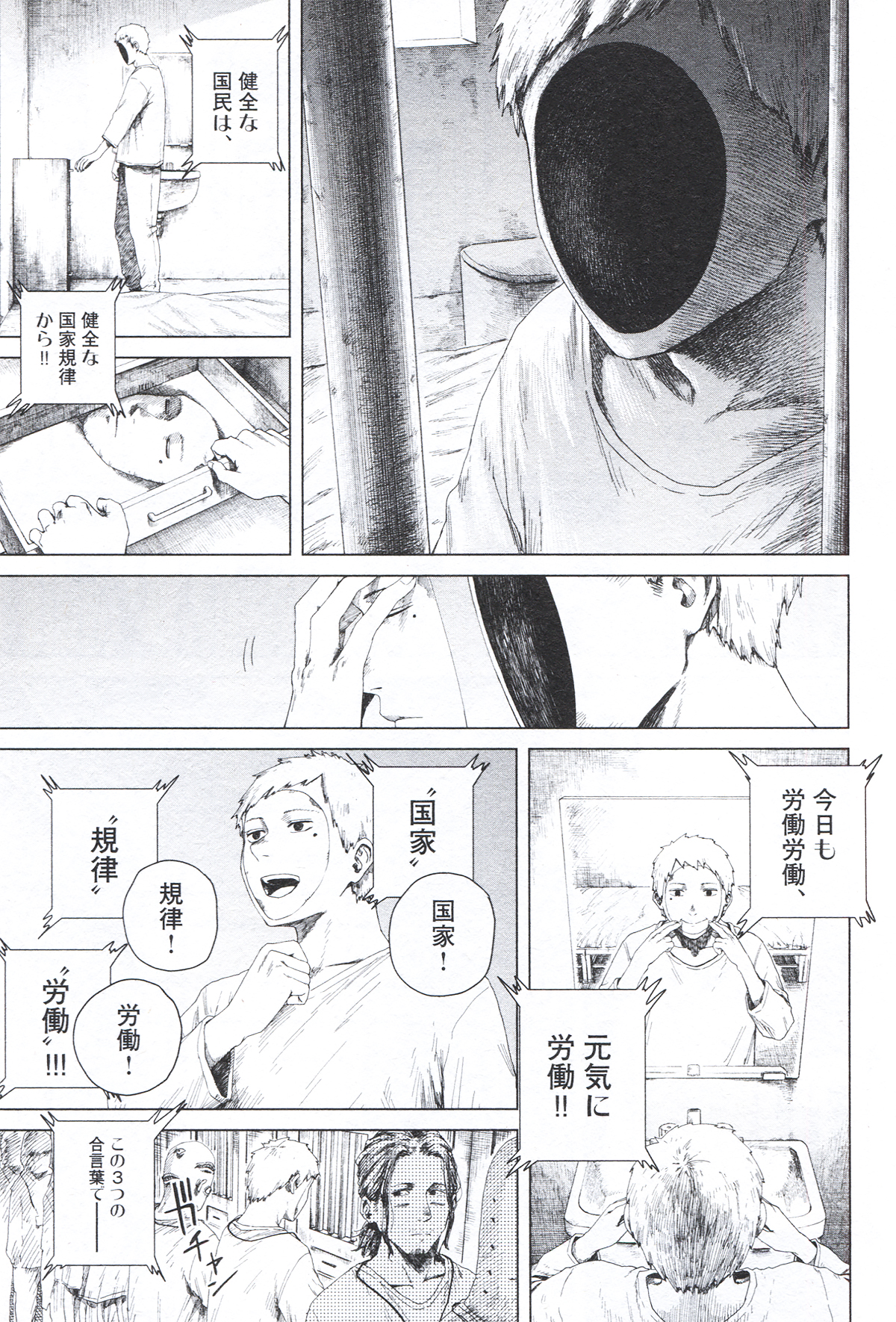
The language used by the government in its ubiquitous broadcast announcements is quite disturbing. The state refers to itself with the word 国家, which – like the German word Reich – has deeply unpleasant connotations. To continue the analogy to twentieth-century fascism, the constantly broadcast refrain of “labor” (労働) and “discipline” (規律) gave me strong Arbeit macht frei vibes that I didn’t care for at all.
Courier #1871 seems to enjoy his job, which is admittedly presented as an entertaining series of adventures, but it might be difficult to say the same of the city’s other residents. This is especially the case for the characters in the manga’s third chapter, who occupy prison cells while they’re granted the “opportunity” to live in one of the high-intensity labor areas where the standard rations are manufactured. Even more disturbing than the working conditions of this horrible factory is the compliance of the workers, many of whom have wholeheartedly bought into the state ideology.
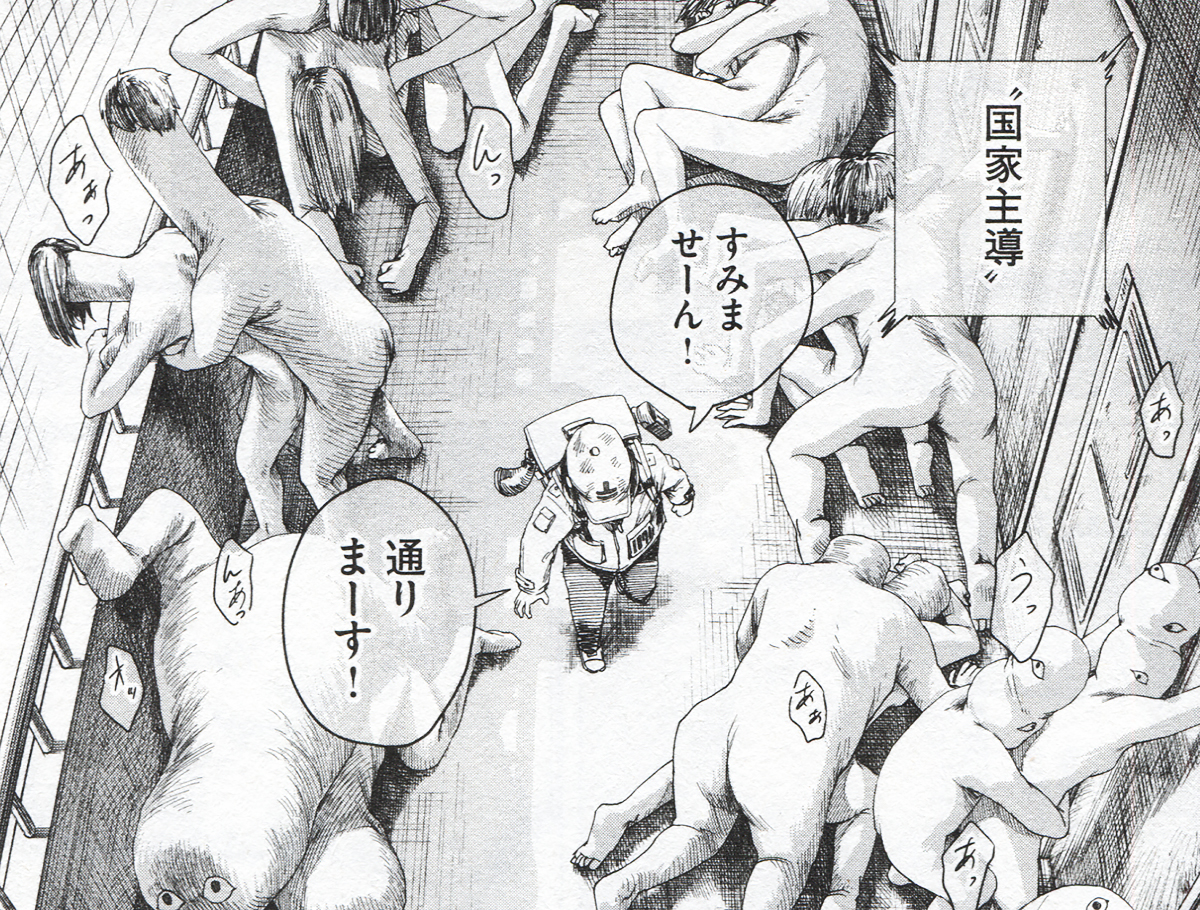
The fourth chapter explores the theme of compliance with state-mandated orders in the context of an even more upsetting scenario: compulsory copulation.
Having read the first three chapters of Room 999, I was surprised that this manga wasn’t immediately licensed for translation and international distribution, but the fourth chapter might explain the hesitation, I think. This episode isn’t about sexual assault, necessarily, but “consent” wouldn’t be the right word to apply to the duty the city’s residents have been instructed to perform on the special days when mandatory labor is replaced with mandatory sex.
Despite the strong suggestion that this all-day sex must be performed in public, most people don’t seem to mind. Courier #1871 (whose age is unclear) is exempt from this duty, as his job is to deliver a steady supply of stamina-boosting drinks to everyone on his postal circuit. Many of the people he visits are dutifully enjoying themselves, but Courier #1871 also encounters two young women who aren’t happy about the demands being made on their bodies. Nothing overtly upsetting happens, but the manga makes it clear that some people do in fact suffer on account of state policies concerning reproduction.
I have a longstanding interest in Japanese feminism, and I’m profoundly troubled by the Japanese government’s frustrating series of responses to the country’s steadily falling birthrate. I have to admit that I actually loved the “compulsory copulation” chapter of Room 999. This story is drawn and written with a remarkable degree of sensitivity, but I could almost feel the heat of the artist’s anger rising from the pages. Like, is this really what the Japanese government expects from its younger generations? To make babies entirely for the benefit of the state? And what would that look like, exactly? Would it look like this?
Despite the power of its themes and message, I don’t want to convey the impression that Room 999 is entirely polemical. Even with its elements of dystopian horror, this manga has a surprisingly warm tone, as well as numerous small moments of humor. Courier #1871 is a charming and sympathetic character, and he’s often accompanied by a sweet dog named Toto with an above-average ability to solve problems. In the closing “Room 999 Broadcast” section that the artist uses to respond to reader comments, they write in comically large font that “Nothing bad will EVER happen to Toto,” who is apparently modeled on their own family dog. So it’s not all bleak, then.
Nanga Nan speculates in the “Afterword” to this first volume that they might belong to the last generation of artists to draw manga by hand, and they explain that Room 999 was partially inspired by their disdain for the drive toward efficiency and standardization in creative spaces. Because of the nature of social media, they add, every statement effectively becomes a part of the public domain, no matter how personal it might be. They therefore wanted to draw a manga about handwritten letters, while at the same time telling a story that is itself like a letter in its messiness and complications.
When read in this context, the visually dystopian aspects of Room 999 assume a different tone. Even though an authoritarian state enforces conformist rules to make everyone the same, each body and personality is stubbornly unique. The state makes grim promises of perfection, but the lived environment is organic, and its Brutalist lines are broken by gentle decay. Courier #1871’s world is perhaps the logical endpoint of our own, and that’s not ideal. Still, Room 999 suggests that state ideology can only reach so far; and, despite everything, human connection will always survive.