The Tatami Galaxy

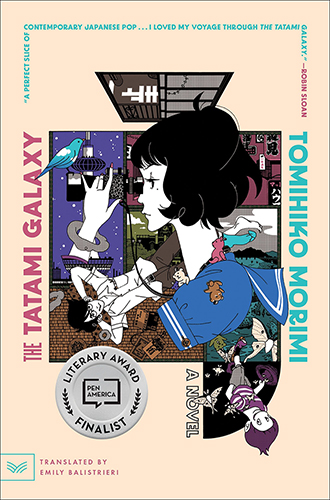
The Tatami Galaxy is a magical realist comedy set in Kyoto in the early 2000s. The author, Tomihiko Morimi, is famous for his over-the-top characters and offbeat urban fantasy, and The Tatami Galaxy takes the reader on a wild ride through a set of parallel universes.

The unnamed narrator is a third-year student at a university in Kyoto. He came to campus, he says, with dreams of pursuing a rose-colored student life full of friends, scholarship, and wholesome extracurricular activities.

This is not how things turned out, unfortunately. After joining a student club that he didn’t quite click with, the narrator develops a friendship with a fellow student named Ozu, a slimy but charming manipulator who drags him into all manner of unsavory plots.

What would happen, the narrator wonders, if he had joined another club? Could he have escaped Ozu’s influence and enjoyed his ideal rose-colored campus life?

The Tatami Galaxy collects four versions of the narrator’s story. At the beginning of each version, the narrator joins a different student club. Though the details are different, the characters remain the same.

The narrator never manages to break his “black thread of fate” with Ozu; but, then again, that’s not really what he wants. After all, what good is a rose-colored campus life without friends?

The Tatami Galaxy is very silly and sweet, and it also feels like a window into what college was like before the pandemic. Remember the world before neoliberal enshittification really started to take hold? Remember when eating out was cheap, drinking was fun, and your life wouldn’t be completely ruined by a few bad grades and stupid mistakes?

As a university professor myself, it’s painful to see how exhausted my students are, and it’s wild to think about how different everything was even ten years ago. The Tatami Galaxy is a perfectly preserved time capsule, and it’s as good of an opportunity as any to remember that college isn’t supposed to be about optimizing your metrics. If you aren’t drunkenly setting off fireworks at a rival student club across a river on a warm spring night, the author argues, you’re wasting your chance at a rose-colored campus life.

I really love Emily Balistrieri’s short “Note from the Translator” at the end of the book, in which she discusses how much fun it was to translate Tomihiko Morimi’s distinctive style of writing and sense of humor. This joy definitely comes through on the page, and Balistrieri’s translation feels remarkably fresh and energetic.   

If you’re interested, the (subtitled) anime version of The Tatami Galaxy is free to watch on YouTube (here). It’s something of a cult classic, and with good reason. The art and animation are unique and creative, and the voice acting is genius. Still, I have to admit that the visual eyestrain is intense. The anime boasts the same high energy and twisted sense of humor as the original novel, but mercifully (for those of us past our student days) the book version is much easier to enjoy at a chill and relaxed pace.  

Overlord: The Undead King

Overlord, Volume 1: The Undead King
Japanese Title: オーバーロード 1 不死者の王 (Ōbārōdo 1: Fushisha no ō)
Author: Kugane Maruyama (丸山くがね)
Translator: Emily Balistrieri
Illustrator: so-bin (@soubin)
Publication Year: 2012 (Japan); 2016 (United States)
Publisher: Yen Press
Pages: 246

Overlord is about a normal man from near-future Japan who becomes trapped in an MMORPG. It’s a typical isekai story, but there’s a twist. Instead of valiant hero who must learn to fight monsters, the protagonist is the monster, and his goal is nothing less than to take over the world.

The premise of Overlord is fairly standard. An MMORPG called Yggdrasil that was developed to take advantage of an immersive “neuro-nano interface” is scheduled to go offline after a successful twelve-year run, but a max-level player and guild master who calls himself Momonga (after a supremely adorable species of flying squirrel) decides to stay logged in until the last second. Momonga is not forced out of the system but remains inside the virtual world, and he quickly realizes that he’s unable to leave. He has no friends or family outside of Yggdrasil, so this is not as distressing for him as it could be. Nevertheless, he decides to “take over the world” in an attempt to find other players who may have become similarly trapped inside the game.

I’m not sure I can recommend Overlord to someone looking for a more literary type of fantasy. To begin with, there’s a fair amount of geeky talk concerning game mechanics like quickcasting and debuffer immunities, especially early in the novel. Overlord assumes that its reader is already familiar with MMORPG culture and the conventions of the isekai genre. If none of this is new to you, however, the way the novel fast travels through issues that aren’t pertinent to the immediate plot (such as “where am I” and “how did I get here”) is a welcome change of pace.

This novel is an unabashed power fantasy. Not only is Momonga inhumanly strong on his own terms, he now possesses all of the magical treasures left behind by his guildmates. On top of that, all of the powerful level bosses in the dungeon formerly occupied by his guild are tripping over themselves to swear allegiance to him. Momonga can heal the sick, raise the dead, summon dragons, and make all of his subordinates (male and female) swoon at his very presence.

There’s a bit of boob grabbing and panty wetting, but it’s very silly and feels perfunctory, almost as if it’s something that the author felt he needed to check off a list. For the most part, Momonga is a decent person who’s not particularly interested in romancing the (dubiously?) sentient NPCs who were originally created by his friends. He’s a “demon king” in title and appearance only – although he doesn’t hesitate to kill an entire battalion of mercenary soldiers who attack a civilian village later in the novel.

The real power fantasy explored by Overlord has very little to do with swords and sorcery, however. Rather, the novel is essentially a story about what it means to be a good boss. All of the fantasy-themed gaming business aside, what Momonga needs to figure out is how to become an effective leader who is able to work efficiently while maintaining the respect of his subordinates. The decisions he makes concerning matters such as when to intimidate people and when to let things slide are interesting, and they form the core of the story, whose conflicts have fairly low stakes – at least in the opening volume.

The Overlord light novel franchise has sold millions of copies in Japan. It was also adapted into an anime series in 2015, with its third season airing in 2018. The illustrator, @soubin, has a massive following on social media, not in the least because of his stylish fan art for anime like Neon Genesis Evangelion and Attack on Titan. The first volume of Overlord was originally serialized online, and it reads a bit like fanfiction with the serial numbers filed off. If you enjoy this type of writing, Kugane Maruyama’s novel is a decadent treat.

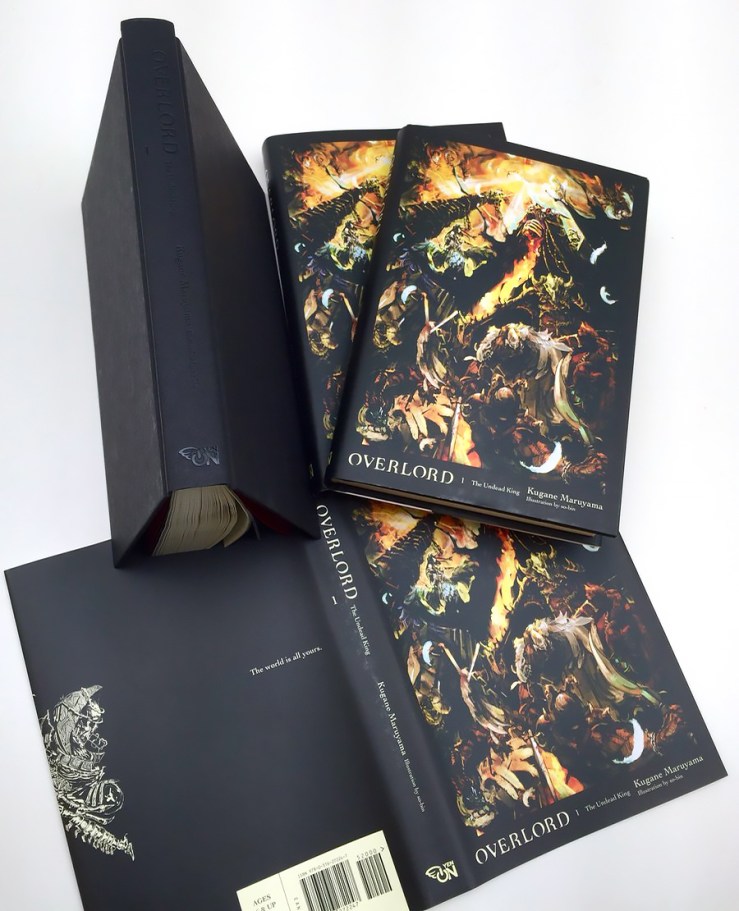
I should add that I’m extremely impressed by the quality of the hardcover edition of this book. Yen Press always does a fantastic job with its physical publications, but Overlord is something special. There’s a beautiful pull-out map at the beginning, character profiles at the end, and a full-color illustration on the cover page of every chapter. I have to admit that I’m not sure why Overlord has been singled out for this sort of “collector’s edition” treatment – aside from its massive popularity, of course – but I’m not complaining. Yen Press has currently published twelve volumes in the series, and each is as devilishly handsome as the last.

(Image from the Yen Press official Twitter account)