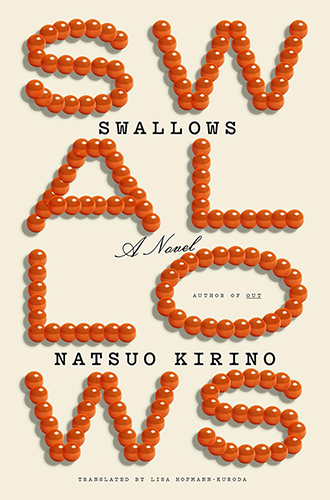
Swallows

Natsuo Kirino’s 2022 novel Swallows follows an impoverished young woman who becomes a surrogate birthmother for a high-performing couple on the cusp of middle age.

Riki works a full-time temp job as a receptionist at a general hospital, but she can only barely make rent in an aging apartment building in Tokyo. Her parents back in Hokkaido don’t have any money, and she’s completely on her own after leaving a toxic romantic relationship. Her best friend at work, Teru, isn’t doing much better, especially not with an unreliable boyfriend who pressures her to do sex work on the side so she can pay the interest on his debts. 

To raise money, Teru registers to sell her eggs under the auspices of a Japan-based fertility service, and she attempts to persuade Riki to join her. Riki is tired of eating bargain convenience store food, wearing third-hand Uniqlo clothing she buys online, and being harassed by the shitty men who live in her garbage apartment building – so she agrees.

Riki’s application attracts the interest of a company representative who thinks she’d be the perfect fit for a married couple looking for a surrogate birthmother, Motoi and Yuko Kusaoke. Riki has doubts about this situation, which is only dubiously legal to begin with, but the Kusaokes offer her a life-changing amount of money. Once Riki has signed a contract, the husband, Motoi, becomes overbearing in his need to control Riki’s private life; and, to spite him, she has casual sex before receiving his sperm. When she becomes pregnant with twins, she can’t be entirely sure that Motoi is the father. To make matters even more complicated, Yuko feels more sympathy for Riki than she does for her husband, and she’s considering ending the marriage.

Swallows is more suspenseful than you might suspect. Who is the father of the children? Will Motoi and Yuko separate? Will Riki carry the pregnancy to term? And, if she does… what then?

Despite its strong forward momentum, the narrative pacing of Swallows is uneven. The story takes a while to get going, and the opening in particular feels like a series of political talking points in an essay about economic precarity in contemporary Japan, especially in relation to young women. Moreover, perhaps because the author is using the characters to present an argument, they seem to change their position every time a new circumstance arises. While it’s fair to harbor ambiguous feelings about a major life decision, this back-and-forth drags down the middle third of the novel, which feels about fifty pages too long.

Still, Kirino isn’t wrong about the challenges facing young women in Japan, nor is she exaggerating the absurdities surrounding fertility treatments and procedures. I’ve been watching these discussions evolve in academic circles for the past decade, and it’s cathartic to see Kirino come out swinging as she demonstrates the effects that abstract political policies can have on real people. Even as someone who doesn’t live in Japan and isn’t interested in pregnancy, I was still captivated by the human drama played out on the stage of individual lives.

For me, the star character of Swallows is Ririko, Yuko’s friend who works as a professional artist specializing in erotic shunga paintings. Ririko is asexual, aromantic, and only interested in sex as a visual motif in her art. As such, her perspective on romance and pregnancy feels original and refreshing, especially in contrast to the constant waffling of the other characters. 

In addition, the scenes with Ririko are where Lisa Hoffmann-Kuroda’s translation shines especially brightly, as Ririko’s rough language (especially concerning sex) is humorous and colorful without ever stumbling into the realm of coarse or cringe.

Ririko’s family owns a small suburban hospital, and she operates a studio on the property. After Yuko introduces her to the now-pregnant Riki, Ririko invites her to live in the hospital while doing light part-time work as her administrative assistant. This portion of the novel is almost utopian, as Riki is cared for in her pregnancy by what is essentially a commune – a community of (mostly elderly) people who provide companionship and support while Riki does untaxing but important work in exchange for room, board, and a small salary. 

I really enjoyed this part of Swallows not just because of the warm and cozy vibes (by which I mean the fourth-act narrative cooldown necessary to heighten the impact of the fifth-act narrative resolution), but also because I appreciate that Kirino offers a practical and viable solution to the very real issues pertaining to economic precarity that dissuade so many women from even considering pregnancy.

Swallows might be an interesting book to pair with Sayaka Murata’s novel Vanishing World; but, without getting into why Vanishing World’s treatment of pregnancy and Japan’s demographic shift is so disappointing, I have to admit that I infinitely prefer Kirino’s speculative but still grounded application of utopian imagination.

Even if you’re not interested in the topic of pregnancy in Japan, you might be surprised by how much suspense the author manages to generate with the question of whether or not the protagonist will carry her pregnancy to term. Swallows isn’t one of Kirino’s most plot-focused or psychologically astute novels, perhaps, but I still flew through this book, which keeps the reader guessing until the literal last page. Which is fantastic, by the way. Good for her.
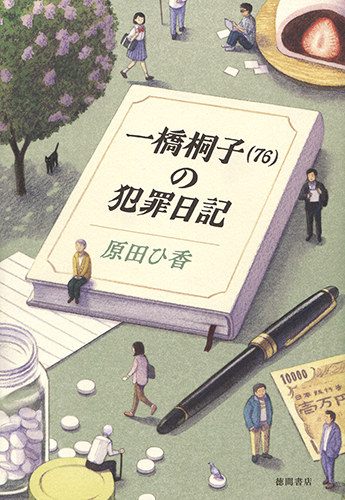
一橋桐子の犯罪日記

Hika Harada’s 2020 novel Hitotsubashi Kiriko (76) no hanzai nikki, which I’ll refer to as “Kiriko’s Crime Diary,” is the story of the eponymous Kiriko Hitotsubashi, who has found herself alone and in trouble at age 76. After her closest friend dies and her life savings are stolen, Kiriko decides that her best option is to spend her remaining years in prison. The only problem is that, before she goes to prison, Kiriko first needs to commit a crime.

Kiriko has been single all her life, but she jumps at the chance to share a house with her best friend Tomo, whose husband has died of a heart attack. Unfortunately, after two years of friendly companionship, Tomo dies of cancer, and Kiriko’s signature seal, bank passbook, and account holdings are stolen by a young man who asks to enter her house to pay respects to Tomo’s memorial. To add insult to injury, Tomo’s two sons treat Kiriko like garbage as they remove the furniture and cookware she shared with Tomo from her house.

Kiriko is left destitute, and she’s forced to use the last bit of money she has left to rent a subsidized apartment in a privately owned building for the elderly. She can barely afford groceries, and her new neighbors are difficult and unpleasant. Despite her age, Kiriko is as healthy as a horse, and she doesn’t seem to be in any danger of dying soon. She decides that being in prison would be preferable to becoming homeless, so she resolves to live a life of crime.

For the most part, Kiriko’s Crime Diary is a comedy that follows a sweet-natured and sensible woman as she does her best to get arrested. Kiriko has standards, and she doesn’t want to commit any sort of crime that might cause actual harm. She tries shoplifting from a chain grocery store, counterfeiting money with a convenience store photocopier, and scouting targets for a dubiously legal moneylender – all to no avail.

Over the course of her attempts to solicit advice regarding how to commit a crime, Kiriko ends up befriending all sorts of people, from the owner of the office building where she works as a janitor to a high school girl who volunteers to be kidnapped to punish her negligent parents. Between one thing and another, Kiriko ends up attracting the attention of a semi-retired yakuza boss, who uses intermediaries to contact Kiriko before finally meeting her in person.

One of the major subplots of the novel involves a man around Kiriko’s age who becomes entrapped in an elaborate “marriage scam” by a younger woman who drains his finances and then disappears. The man is crushed by disappointment, and the members of the poetry club Kiriko once attended with her friend Tomo have to band together to figure out how to help him. Along with Kiriko’s own troubles, this episode highlights the lack of a social safety net for many elderly people in Japan.

The theme of elder precarity becomes especially critical with the approach of Kiriko’s 77th birthday, which marks the start of her formal age of retirement. The janitorial company that employs Kiriko forces her to quit, depriving her of her only means of supporting herself. If Kiriko has no job and no one to serve as a guarantor for her rental contract, what is she supposed to do, exactly? Is her only recourse to start working with the yakuza?

Thankfully, Kiriko’s Crime Diary has a happy ending. All of Kiriko’s friends show up during a climactic scene to offer support and advocacy, and Tomo’s daughters-in-law apologize for the way she was treated by her late friend’s sons. All the loose ends are neatly tied, and Kiriko might even get to have a lovely winter romance with the handsome yakuza boss. I usually shy away from this sort of sentimentality, but why shouldn’t Kiriko have the best of all possible endings?

When I was working on one of my dissertation chapters about Natsuo Kirino’s gritty crime novel Grotesque, one of my readers asked me why Kirino’s characters all have to be so miserable. That was a fair question, and my answer was something along the lines that Kirino’s novels express the reality of the despair faced by many older adult women who find themselves completely devalued by society.

While I still believe that the tonal bleakness of Kirino’s style of critique is necessary and important, I also think that the happy ending of Kiriko’s Crime Diary is a welcome counterpoint. What Harada archives through this gentle comedy is to model one possible solution to elder precarity. Namely, if the neoliberal Japanese state is so utterly useless in providing social welfare, people must aggressively resist twentieth-century social conventions to form communities for mutual aid.

This support benefits not just elderly people, but also multigenerational networks. As much as Kiriko gains from her friendships with the owner of the building she cleans and the teenage girl she “kidnaps,” these characters also benefit from having Kiriko in their lives. It would be a shame, Harada suggests, not to have at least one friend like Kiriko.

Relearning how to make friends while relying on the kindness of strangers isn’t going to be a feasible solution for everyone, of course, but it’s a damn sight better than going to prison. And, if someone like Kiriko is considering prison, what are we even doing as a society? Even with a marvelously happy ending, Kiriko’s Crime Diary offers a social and political critique that’s difficult for even the most conservative reader not to agree with.

Hika Harada has enjoyed a productive career, and she’s won numerous awards for her fiction and screenplays. It’s no surprise that Kiriko’s Crime Diary was a bestseller that has found a place on all sorts of recommendation lists. This story will definitely appeal to readers outside of Japan, and it’s perfect for the same readership that enjoyed Killers of a Certain Age (which is fantastic, by the way).

Harada’s novel Dinner at the Night Library is going to be released in English translation in September 2025, and I’m looking forward to reading it. Kiriko’s Crime Diary is a genuinely fun and charming story, and I’d love to see it appear in translation too.

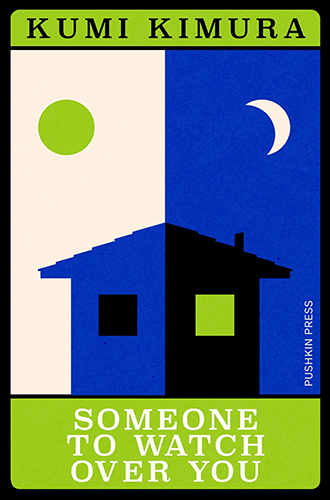
Someone to Watch Over You

Kumi Kimura’s 2021 novella Someone to Watch Over You is a subtly unnerving story about the strangeness of the Covid pandemic.

46yo Tae lives alone in her deceased parents’ house in a small town in northern Japan. She formerly worked as a middle school teacher, but she left the job after the death of one of her students. Now she lives on her inherited savings while leaving the house as infrequently as she possibly can.

Tae’s solitary lifestyle is unaffected by the onset of the Covid pandemic, but the “stay home” orders were followed by three unpleasant incidents in quick succession. An older man who’d just retired is found dead in an apartment on Tae’s street, and someone paints graffiti on the front wall of Tae’s house. Tae also receives an odd message from the father of the deceased student on her answering machine. These three incidents blend together into a paranoid fantasy that convinces Tae that she’s being stalked.

After a handyman named Shinobu treats Tae with kindness while cleaning her bathroom drain, Tae asks him to guard her house. Shinobu, who desperately needs the cash, readily agrees. During the pandemic, he’s been forced to live in the garden shed of his parents’ house, which is currently occupied by his brother’s family. Shinobu’s sister-in-law won’t talk to him, and his niece is weird and creepy in a way particular to young teenage girls.

Tae eventually asks Shinobu to move into her house so he can keep watch full-time, but this arrangement is supremely awkward. Both Tae and Shinobu are deeply damaged people, and Tae’s insistence on maintaining social distancing rules inside her own home stunts the development of any sort of friendly relationship between them. By the end of the novel, the reader wonders if Shinobu is any better off at Tae’s house than he would have been living rough.

To speak personally, a sudden change in employment forced me to scramble to move to a different city in April 2020. Due to social distancing, I had no opportunity to form and renew social connections, and the following two years were intense and unpleasant.

Someone to Watch Over You doesn’t reflect my individual circumstances, but it perfectly conveys the sense of displacement and alienation I experienced during the pandemic. It’s validating to see this sort of surreal experience taken seriously, especially since I definitely wasn’t alone in having a bad time during the lockdowns. I don’t think it’s healthy to dwell in past trauma; but, at the same time, the cultural expectation to pretend that all of this didn’t happen four years ago can sometimes feel maddening.

The back cover of Someone to Watch Over You promises “an unlikely connection” and asks if Tae and Shinobu can “become one another’s refuge,” thus suggesting the possibility of a heart-warming conclusion to the story. This does not happen, not by a long shot. While I fear that some readers may be disappointed by the weirdness of the ending, I appreciate that the author didn’t pull her punches. The Covid pandemic was indeed strange and unpleasant, and Someone to Watch Over You is one of the truest fictional accounts of the pandemic I’ve encountered.

Someone to Watch Over You is well-written and carefully translated, and I found myself fascinated by the dysfunctional characters and pulled along by the downward momentum of their story. This disturbing little book is compelling in its use of the pandemic as a stage for exploring the darker mysteries of mundane life, and I admire how Kimura revisits this particular moment of history without the comforting lens of nostalgia.