Silent Singer

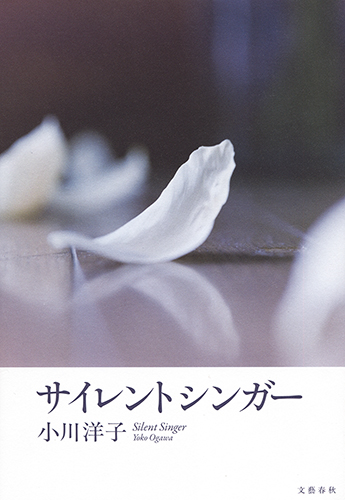
Yōko Ogawa’s 2025 novel Silent Singer (Sairento Shingā) is a bittersweet story about a woman named Ririka who lives alone in a mountain forest near a community of people devoted to silence. Ririka is a professional singer, but she never makes a name for herself, only taking freelance jobs that require a performer with an anonymous voice. Though the singer and the silent community eventually fade into obscurity, Ogawa celebrates the beauty and dignity of their lives, as well as the significance of creativity that never finds an audience.

On an isolated mountain in the countryside, a group of people calling themselves “The Introverts’ Club” have bought a parcel of land and formed a community named Acacia Fields, which is devoted to quiet and simple living. The Acacia Fields community isn’t a religious organization; rather, they’re normal people committed to the philosophy that “silence soothes the soul.” Anyone can join as long as they’re content never to speak in the presence of others.

Ririka lives in an old house next to a forest adjoining Acacia Fields, where her grandmother is employed as the gatekeeper. The gatekeeper’s job is to communicate with people from the outside world while also managing a small store that sells produce, pastries, and other items produced by the community, which raises livestock and maintains extensive gardens.

While her grandmother manages in the gatehouse, Ririka has the run of Acacia Fields. She spends hours with the aging doctor of the community’s small clinic, who isn’t bound by a vow of silence and reads to her while teaching her “finger language,” a simple form of sign language used by the community. Though her mother committed suicide after being abandoned by her father, Ririka enjoys a happy childhood divided between the public school in the town below the mountain, the doting care of her loving grandmother, and the quiet but genuine affection of the people living at Acacia Fields.

Ririka discovers her path in life during a sheep shearing session at Acacia Fields, when she’s asked to sing a simple lullaby to help keep the animals calm. She performs beautifully and enjoys herself immensely. A town official who attended the event is impressed by Ririka’s singing, and he asks her to record a similar song to be played over the municipal loudspeakers every evening at 5pm. Though no one knows the singer is Ririka, the song is so well-received that the tradition continues indefinitely.

Shortly after she graduates from high school, Ririka’s grandmother passes away. Ririka remembers her grandmother by visiting her Puppet Garden, which the old woman created after a child went missing in the mountain forest one summer. To soothe the boy’s spirit, Ririka’s grandmother fashioned five dolls from discarded household objects and placed them at the center of a small grove. For Ririka, the Puppet Garden serves as a place of quiet meditation. 

Ririka takes over her grandmother’s position as the Acacia Fields gatekeeper while supplementing her income through various freelance jobs passed along by her voice instructor. In each case, Ririka is recommended because of her relative anonymity. Ririka sings jingles for television commercials, performs anime theme songs, records vocal tracks for idol groups, and even provides the voice of a talking children’s toy. Though she doesn’t seem to realize it, Ririka is quite successful as a professional singer, but she never leaves her home on the mountain.

As an adult, Ririka strikes up a romance with the security guard at the parking lot where she keeps her car. On their first date, Ririka takes him to the Puppet Garden, whose dolls are in a severe state of decay. Instead of being creeped out, the security guard is charmed. He’s a good match for Ririka, as he has an odd hobby of his own – piecing together carefully curated scrapbooks devoted to the lost works of famous authors.

The only shadow over the relationship is that Ririka finds herself unable to sing for her boyfriend. She can only sing, she explains, if her audience isn’t a living human. Meanwhile, with few young people moving to the mountain, the Acacia Fields community is in danger of being claimed by entropy and senescence.

Silent Singer resonates with echoes of the Studio Ghibli charm of Mina’s Matchbox; but, as is often the case with Yoko Ogawa’s work, a major theme of the novel is the gentle beauty of decay. Ririka’s house is slowly falling apart, as are the dolls in her grandmother’s Puppet Garden. The agricultural holdings of Acacia Fields are gradually diminishing, and the members of the community are growing old. Regardless, the village remains peaceful, as does the surrounding forest, especially in contrast to the absurdities of the freelance work Ririka takes as a singer. 

In many ways, Silent Singer reminds me of Haruki Murakami’s 2023 novel The City and Its Uncertain Walls, especially in its aggressive refusal to engage with contemporary technology. It could be the case that the nostalgic settings of the two novels are simply a product of the preoccupations of two aging writers, but that’s not how these stories feel to me.

At this point in the death spiral of our capitalist hellworld, I’m bone-tired of “progress” that dehumanizes everything it touches. Meanwhile, Murakami’s narrator leaves his corporate job to work in a small-town library in Fukushima prefecture, while Ririka remains loyal to her home in a quiet mountain forest, which provides a refuge from the profit-driven demands of the entertainment industry. And good for them! I am here for characters who do not give a single fuck about social media or self-branding.

While it might be a stretch to call Silent Singer “anticapitalist,” this is a story about the value of creativity at the margins, as well as the beauty of art without an audience. Ogawa’s obsession with the decay that creeps in at the edges of isolated communities and individual lives can sometimes feel uncomfortable, but let it be uncomfortable! There’s nothing cozy about the richness of human experience, and the care and attention Ogawa devotes to the slow endings of her stories is one of the great pleasures of her work. The work of Ogawa’s “silent” creatives may be unremarked, but it’s far from unremarkable.

Mushishi

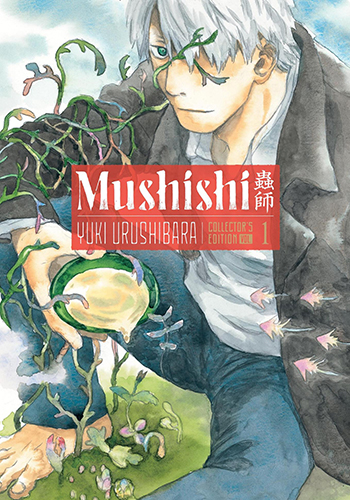
Yuki Urushibara’s ten-volume manga series Mushishi is a gentle but eerie collection of short stories about the uneasy relationship between humans and the natural world. Originally serialized between 1999 and 2008, Mushishi is now available in a series of hardcover Collector’s Editions from Kodansha, which has done a marvelous job with the release.

Mushishi is set in Japan during an unspecified time around the late nineteenth century. Some people wear Western clothing and smoke cigarettes, but traditional ways of life still persist in isolated rural areas, which seem untouched by time.

Ginko is a mushishi (“mushi scholar”) who travels to remote villages to study and document “mushi,” a collective term for a variety of lifeforms that exist partially in our world and partially in the realm of the supernatural. Like germs or bacteria, mushi are tiny and exist unseen by the vast majority of people. Problems arise when mushi form large colonies, especially within human bodies. Even as he studies and admires mushi, Ginko is often compelled to eliminate them in order to restore health to their human hosts.

As is the case with non-supernatural illnesses, people severely impacted by mushi often find themselves unable to return to normal life. In the manga’s second story, “The Tender Horns,” people living in a village deep in the mountains find that they go deaf in one ear when the snow falls. Ginko tells the village chief that this is the result of a mushi called “Un,” which lives in human ear canals and eats sound. This is a temporary inconvenience for most people, but one woman was so deeply impacted that she died. Now her son seems to bear the same affliction, which has manifested as a set of small horns on his forehead.

The tone of Mushishi occupies a liminal space somewhere between nostalgia and horror. Many of the stories have happy endings, but they’re nevertheless pervaded with the uneasiness of living at the edge of an unseen world that has little regard for human life. Mushi, which are something in between plants and animals and spirits, act in keeping with their nature, which is simply to grow and replicate. To most mushi, humans are little more than substrate.

Some species of mushi seem to possess something akin to sapience, however, and their relationship with humans is complicated. One of my favorite stories in the opening volume of Mushishi is “The Traveling Swamp,” in which a marshland appears and disappears seemingly at will. When Ginko studies the pattern of the manifestations on a map, he realizes that the colony of mushi is traveling through underground waterways. The young woman who appears and vanishes with the mysterious swamp has become saturated with the mushi, which have welcomed her as a companion on their journey to the sea.

What Ginko sees of mushi growth and behavior is akin to many written records of Japanese folklore, such as The Legends of Tono and Tales of Times Now Past, in which inexplicable things happen to people seemingly at random. In a time before modern science and infrastructure, the natural world was just as dangerous as it was awe-inspiring. As much as people in rural areas were dependent on nature for their livelihood, they were also at its mercy.

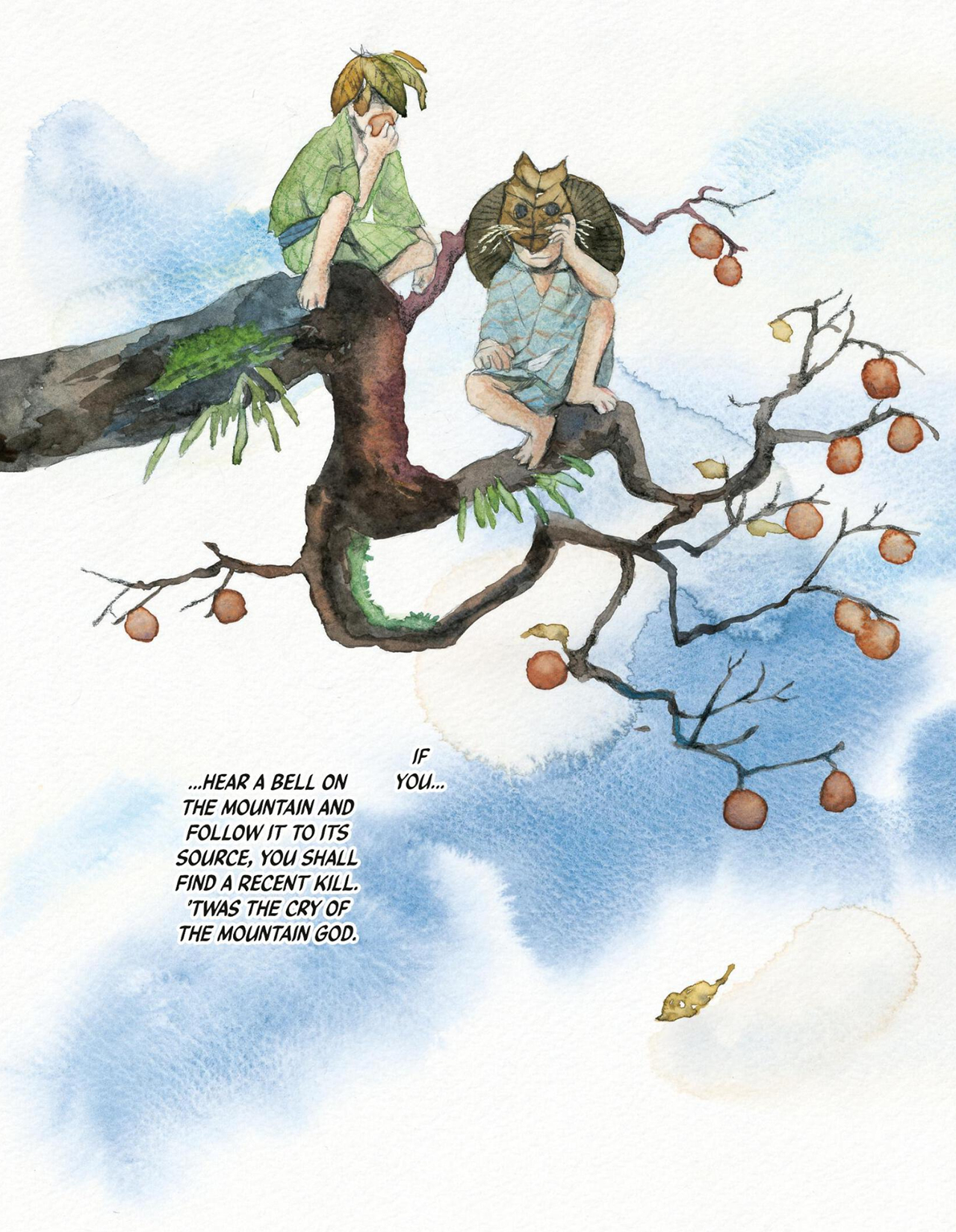
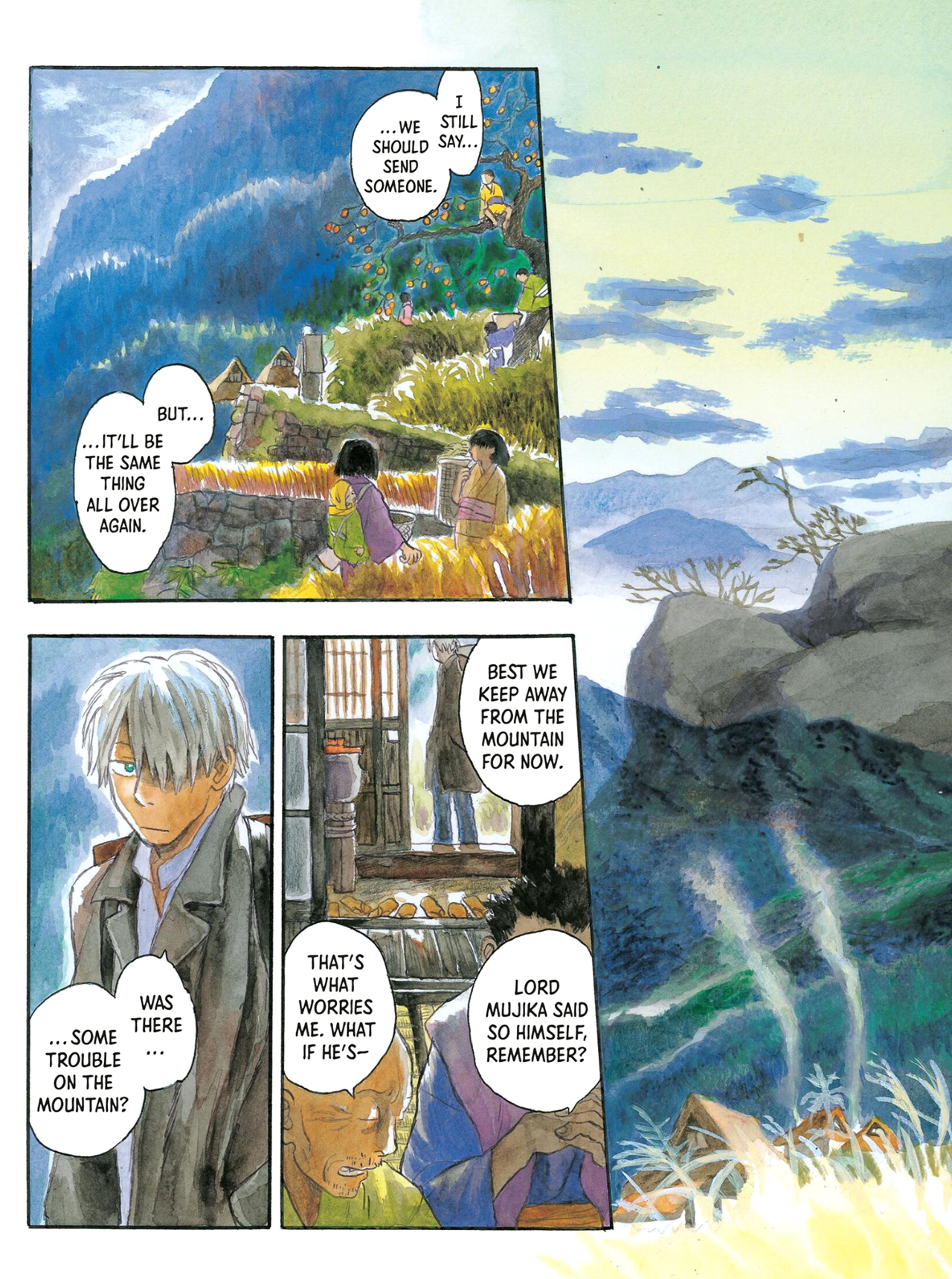
Yuki Urushibara’s artwork delights in wild spaces, from mountain roads to deep forests to ocean vistas to overgrown villages, and her depictions of premodern architecture and clothing are equally impressive. Urushibara is especially skilled with the use of etching and screentone to convey a sense of dim lighting while still using enough contrast to creatively highlight the focal points of each composition. The inkwork is truly impressive, as are the watercolor inserts, and Kodansha’s release of the manga allows Urushibara’s art to shine.

If you’d like to bask in the twilit atmosphere of a deep mountain forest, I might also recommend watching an episode or two of the Mushishi anime (available on Crunchyroll in the U.S.), which is extraordinarily well-produced. The anime is slow and quiet and isn’t for everyone, perhaps, but there’s really nothing else like it.  

Udon: Unknown Dog of Nobody

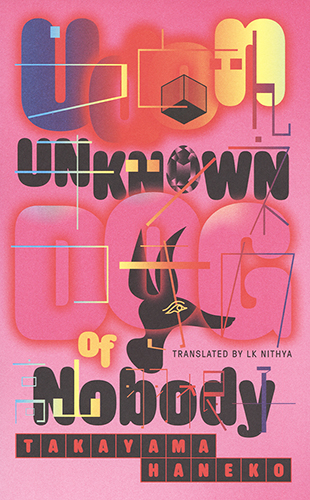
Haneko Takayama’s short story Udon: Unknown Dog of Nobody, published by Strangers Press as a stand-alone chapbook in their Kanata series, follows three sisters connected by their love for their family dog, Udon.

On their way home from school, Kazue and Misa find a newborn puppy abandoned in a styrofoam box. Horrified by the sorry state of the creature, they decide to rescue it. The way they see the matter, leaving the animal to die isn’t an option.

Seven days later, the puppy is still alive. Kazue and Misa’s younger sister Yoko goes to the pet store to get dog food, but she doesn’t know how many cans to buy. What if she gets too many, and the dog dies? After she buys just one can, she meets a classmate who assures her that, “When you care for things, they don’t die as easily as you might think.”

The next chapters provide snapshots of the sisters growing into adulthood as they continue to nurture small relationships with people and animals. In the final chapter, Kazue and Yoko take the train to snowy Toyama City to attend their grandmother’s funeral, where they’re immediately surrounded by the warmth of their extended family. Fifteen years after being rescued, Udon is a gross little gremlin, but he’s still alive and happy. 

At the end of the story, Kazue reflects on “the many living things they’d raised, not to eat, not because they were useful. Creatures that weren’t human, weren’t in need of preservation.” She comes to the conclusion that there’s no need for animals to have “value” to be cared for, an observation that would seem trite if not for the dramatic opening of the novella, in which the author presents the newborn Udon as little more than a slimy mass of hideously squally meat.

Haneko Takayama’s fiction has been nominated for a number of prestigious awards, and she won the Akutagawa Award for her 2020 novel The Horses of Shuri, a speculative meditation on the connections between human culture and ecological history that reminded me of Hideo Furukawa’s Belka, Why Don’t You Bark. I’m happy to see Takayama’s fiction in translation, and LK Nithya has done a marvelous job, deftly balancing the casual dialogue of the sisters with the literary touches of the narrative prose. I was also impressed by how smoothly the translator was able to handle the brief touch of science fiction at the end of the story, which was nowhere near as surprising as perhaps it should have been.

Udon: Unknown Dog of Nobody is a slim but striking chapbook that presents an intriguing and artfully translated story about what it means to share our space with animals. If nothing else, after all the cozy books about cats, it’s nice to have a story about a dog for once!

Tree in the Middle of the World

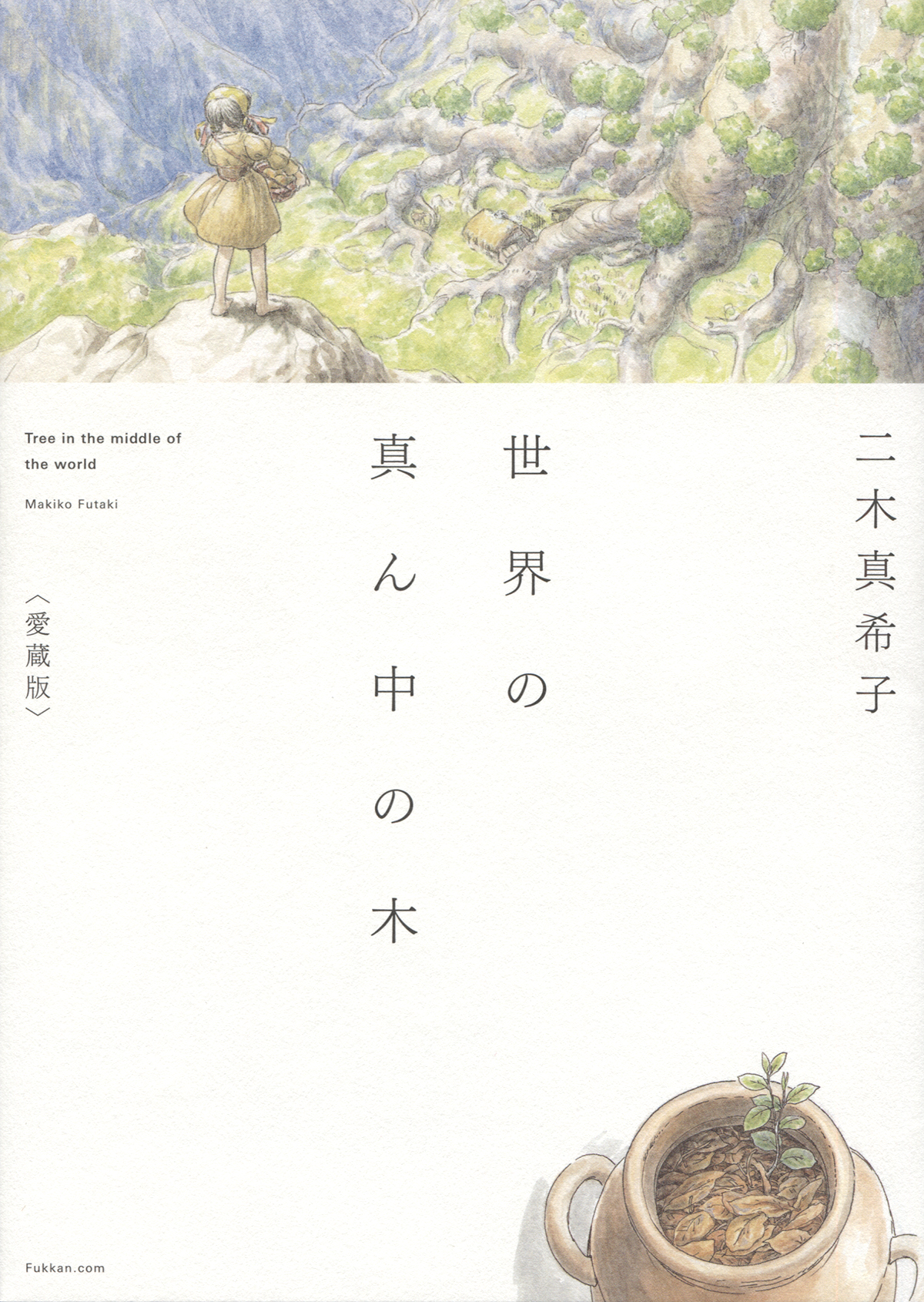
世界の真ん中の木 (Tree in the Middle of the World) is a lushly illustrated picture book written and drawn by Makiko Futaki, a former animator at Studio Ghibli. Originally published in 1989, this book is now available in a beautiful hardcover edition that allows the full glory of the artwork to shine.

In the Afterword to the original softcover edition published by Animage, Futaki wrote that she was inspired to create this story after visiting the Yakushima natural heritage forest, where she conducted visual research for My Neighbor Totoro. Despite its young protagonists and verdant greenery, however, Tree in the Middle of the World is a complex ecofable that has more in common with Princess Mononoke

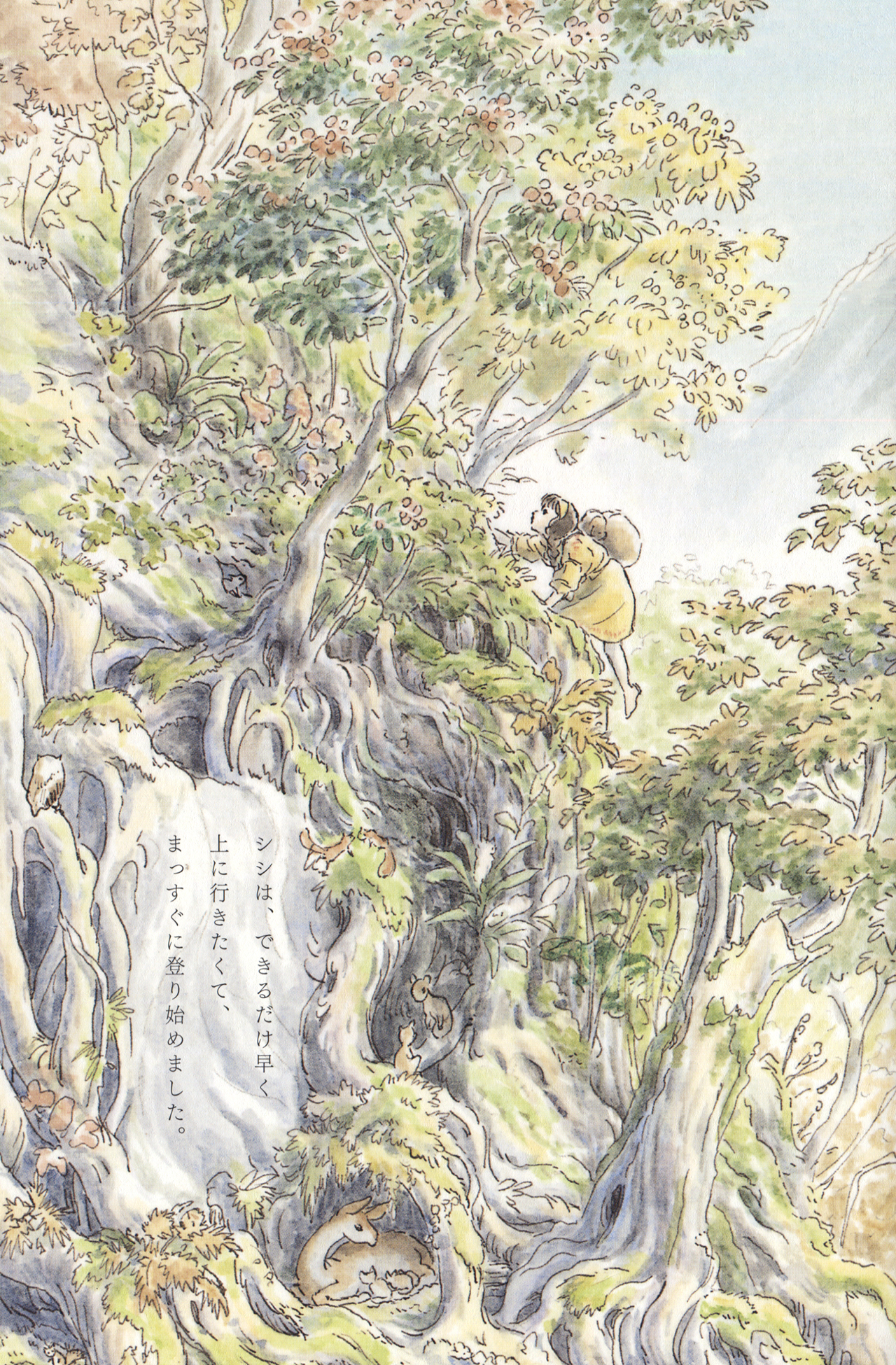
A preteen girl named Cici lives in the mountains with her grandmother. Their small cottage lies at the base of the gargantuan “tree in the middle of the world,” and their modest livelihood is supported by its ecosystem. One year, the tree’s cycle of seasons goes strangely awry, and the sapling Cici attempts to grow from one of the tree’s seeds withers. Hoping to learn more about the malady affecting the tree, Cici resolves to speak with the legendary golden bird that lives in its uppermost branches.

During her epic three-day climb, Cici realizes that the state of the tree’s health is far more dire than she suspected. To make matters worse, she seems to be followed by a young archer from the steppes named Dimo. Dimo is an inexperienced speaker of Cici’s language, but he manages to communicate that he intends to kill the very bird she seeks. Thankfully, Cici does not have to bear her worries alone. Early in her climb, she gains a travel companion in the form of a talking frog whose avuncular good nature serves as a welcome relief from the hardships of her journey.

When Cici finally finds the golden bird, she learns that it has gone insane in its old age, and the putrescence it sheds from its rotting feathers is the cause of the tree’s sickness. Just as he intended, Dimo appears in the nick of time to slay the bird, which answers Cici’s question with its dying breath – in order to save the tree, Cici must venture underground to scatter the tree’s seeds below its roots.

This is a fearsome undertaking, to be sure, but Dimo promises to lend his aid. The two children thus embark on a second journey that proves to be just as dangerous as the first. Just when all hope seems lost in the darkness, Cici and Dimo arrive on the shore of a golden sea that might just be the very stream of life itself. Having succeeded in the quest, the two children return to the surface, where the first winds of spring greet them with verdant laurels of fresh greenery.

Although I’ve outlined the contours of the story, Tree in the Middle of the World is a substantial book whose plot contains a number of twists, turns, and quiet spaces for rest and contemplation in between. The writing is simple but evocative, especially during the portion of the story that takes place underground. Miraculously, every page boasts gorgeous illustrations, each of which is more magical than the last.

Tree in the Middle of the World reminds me a great deal of Hayao Miyazaki’s Shuna’s Journey, albeit with two key differences. First, the visual layout of Tree in the Middle of the World makes its text much clearer and easier to read than the text in Shuna’s Journey; and second, Futaki is far more focused on guiding the reader along a journey through the space of a fixed setting. Like Shuna’s Journey, however, Tree in the Middle of the World contains moments of genuine fear and menace that might not be appropriate for younger children.

Tree in the Middle of the World doesn’t skirt around the shadows of its themes. Like everything in nature, the life of the giant tree exists in cycles, as does that of the giant bird that nests in its branches. Sometimes, like Cici, we find ourselves at the end of a cycle, and there’s not much we can do to prevent the death and destruction we see everywhere around us. Still, it’s our responsibility to preserve the seeds of what we hold dear and plant them carefully in the hope that they will grow strong and healthy in the future when the cycle turns once again.

Tree in the Middle of the World is an uplifting and optimistic story guided by a fantastic sense of adventure. Through her luminous artwork, Futaki conveys the joy of being surrounded by green and growing things, and the action is easy to follow even if your Japanese reading ability isn’t perfect – or if you don’t read Japanese at all. If nothing else, it’s impossible to read Tree in the Middle of the World and not feel inspired to go outside and interact with the world with a renewed sense of hope and purpose.

Tree Spirits Grass Spirits

Tree Spirits Grass Spirits collects twenty-one autobiographical stories about plants by the celebrated Japanese-American poet Hiromi Ito. As the translator, Jon L Pitt, explains in the book’s preface, these stories were originally serialized from 2012 to 2013 in a highbrow Japanese literary magazine, but Ito’s prose is lively and accessible. Each of the stand-alone stories in Tree Spirits Grass Spirits is gentle and thoughtful, and the collection is a breath of fresh and green summer air.

Ito divides her time between the cities of Encinitas in southern California and Kumamoto on the southern island of Kyushu in Japan. Each region has a unique climate and ecosystem, and Ito is fascinated by the plants that grow in both environments, from yucca and agave to camelia and hydrangeas to grass and mold. Ito’s stories touch on botany and natural history, but their primary focus is on humans, especially the humans in Ito’s own family.

Among my favorite of the stories is “Baobab Dream,” which recounts a challenge that many people have experienced with houseplants. As Ito puts it: “They are at their most beautiful when you first purchase them, and they get progressively shabbier and shabbier, even if you take care of them. And then, at some point, they wither away and die.” 

And then, when you go to a garden store to get new plants to replace the old ones, it can be a challenge to identify what you’ve purchased. This is how Ito came into the possession of a mystery tree that she and her daughters resorted to calling “the baobab tree.”

While conducting research on what the tree might actually be, Ito considers the Latin names of various plants and arrives at the conclusion that botanical categorizations of plants often don’t make much practical sense. How are tulips and green onions members of the same botanical family, for instance? This confusion of taxonomy yields to broader meditations on how certain species are categorized as “invasive” as opposed to “naturalized,” and how this reflects Ito’s own experiences as someone who moves between cultures. In the end, however, such abstract concerns are secondary to the beauty of the plants themselves:

In the park next door, the mountain lilacs were at their peak. The peach trees and plum trees and cherry trees were blooming in folks’ yards. The roadsides were bright yellow from the acacias. The bushes of sweet-scented geranium in my own garden, too, had suddenly grown dense and were so thick that they seemed to be sweating, steeped in a green that surrounded one or two pink buds – swelling with each coming day and trying to open up any minute now.

Ito’s vivid descriptions of the physicality of the natural world carry over to her reflections regarding how it feels to be a human moving through the environment. This is one of the many reasons why I love the story “Kudzu-san,” which is about the kudzu growing in the neighborhood around Ito’s house in Kumamoto. As anyone who’s encountered the aggressively leafy vines can attest, kudzu is filled with vitality. If you cut it down, it will grow back twice as quickly, and its fuzzy tendrils are constantly creeping into unexpected places.

Ito remarks that there’s a certain lasciviousness to kudzu, so she searches for references to the plant in literary sources such as the Man’yōshū poetry anthology and the Tale of Genji. Such references are scarce, but Ito is intrigued by a chance mention of the famous Heian-period court magician Abe no Seimei, whose mother was supposedly a fox. In Japanese folklore, foxes are shapeshifters known for their sexual allure, so it seems only fitting that Seimei’s mother is poetically associated with the visual motif of kudzu. Ito’s own encounters with kudzu are likewise filled with startling physicality:

The vines we crushed in the morning lay as they were, and stood back up erect in the evening, swaying their stems and moving in on women – I had seen this, as well. They were more like snakes than plants. Even more than snakes, they resembled those eels that sway in the ocean. There are stories in old books about snakes that enter women’s bedchambers at night, and one about a snake that slid into a woman’s vagina after she had climbed a tree. Couldn’t all those stories be about kudzu?

What I admire about Ito’s stories is that, despite the poetic beauty of her writing, her meditations often progress in strange and unexpected directions without forcing symbolism or allegory onto the natural world. Ito observes her environment closely and looks inward as she describes what she sees, but the mycelial networks between her associations expand unseen below the surface of her writing. Just as autobiography often inspires self-reflection in the reader, Ito’s “phyto-autobiography” inspires an observation of ourselves in a larger context that doesn’t always follow human logic.

Tree Spirits Grass Spirits is a welcome companion to anyone interested in going outside and seeing the world around them from a fresh perspective. Jon Pitt’s translation gracefully conveys Ito’s casual style by allowing space for the rhythm and mouthfeel of each sentence, and it’s not an exaggeration to say that every paragraph is a joy to read. Almost all of the stories are less than ten pages long, and it’s a pleasure to dip into the collection whenever you’re in the mood to open your eyes and shift your viewpoint to a less anthropocentric frame of reference.

Tree Spirits Grass Spirits is published by Nightboat Books, and you can check out the book’s page (here).