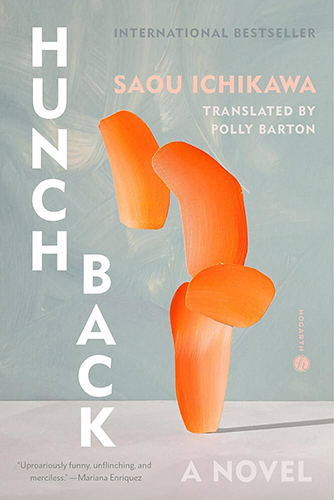
Saou Ichikawa’s 2023 novella Hunchback is a striking work of fiction and a major contribution to the literature of disability. Ichikawa’s brutally honest depiction of her disabled protagonist’s physicality is magnetically compelling and thrusts the reader into a world where the conveniences of the able-bodied cannot be taken for granted.
Shaka is a resident of Group Home Ingleside, a private care facility established by her wealthy parents. Shaka owns the facility, and she collects income from several rental properties in the investment portfolio she’s inherited. In addition, she’s sitting on a trust fund so large that it has to be distributed across several banks.
Despite her wealth, Shaka’s disability confines her to a small studio apartment. While working on a PhD in Disability Studies, Shaka amuses herself by vent-posting on Twitter in between sessions of writing hardcore pornography. She donates her income to the food banks that serve unhoused people, sometimes directly and sometimes in the form of bulk orders of seasoning. Even homeless people deserve food that tastes good, she reasons.
Even as she emphasizes with the disadvantaged, Shaka describes the reality of her own physicality in painstaking detail. Because of muscular atrophy, she’s unable to breathe on her own. Due to social distancing during Covid, leaving the care facility is out of the question. Her PhD coursework is entirely online, and she digitizes academic texts with the aid of a book scanner, as it’s impossible for her to hold heavy books for long periods of time.
And why shouldn’t we have digital copies of books, Shaka demands. When the literati bemoan the digitalization of the written word, who does that benefit, exactly? Shaka’s litany of complaints against the ableism of academia is one of the many currents of anger that drive Hunchback forward. Shaka’s anger breaches the surface at regular intervals, forcing the reader to think critically about the entrenched ableism of the world many of us take for granted.
Despite being engaged in a life of the mind, Shaka has one dream – to become pregnant and then get an abortion. While she’s not particularly interested in the fantasy sex she narrates in her shallow and disposable smut stories, there’s something about the particular physicality and “human-ness” of pregnancy that she finds intriguing.
A golden opportunity falls into Shaka’s hands when a young male caretaker named Tanaka reveals that he’s been stalking her on Twitter and secretly reading her erotic fiction. Unfortunately, Tanaka is the worst sort of incel. Not only can he not get a girlfriend, he only became a caretaker because he couldn’t cut it in the corporate world. In his eyes, he’s just as failed by society as Shaka – who, he snaps, enjoys wealth most people could never dream of.
Out of mutual hatred, Shaka and Tanaka orchestrate a tryst. As you might imagine, it doesn’t end well. Suffice it to say that, if you’re looking for an uplifting message, you won’t find it here.
The end of Hunchback mirrors its beginning, with a prolonged description of a sexual encounter. The book’s closing scene is ostensibly narrated by Tanaka’s sister, who takes on a sense of personal responsibility for her brother’s crime of murdering a disabled woman in a care facility by literally choking her to death with his cum.
I can’t help but suspect that this is once again Shaka writing erotica, albeit with a slightly more literary bent. The scenario is still improbable, but now she’s writing more for herself, fleshing out the characters (so to speak) by imbuing them with personalities and backstories.
Her encounter with Tanaka may have been an abject failure, but Shaka still desires “human” experiences and contact with the broader world. After all, writing – even writing erotica – is about so much more than coming up with a story and posting it online. Shaka never becomes a softer or kinder person, nor would I want her to. What she gains is motivation to be more present in the outside world as she sharpens her insight and hones her craft.
Ichikawa writes based on her own experience as a disabled person, and Shaka’s voice is focused, specific, and driven. Shaka’s narration pulls the reader through the story with sharp observations and darkly comedic drama, and the steady forward momentum is just as entertaining as it is compelling. In many ways, Hunchback reminds me of Convenience Store Woman, and I’d recommend this book to readers who are receptive to unexpected charm and aren’t afraid to have their comfortable perceptions of reality challenged.

 Contemporary Japanese Literature