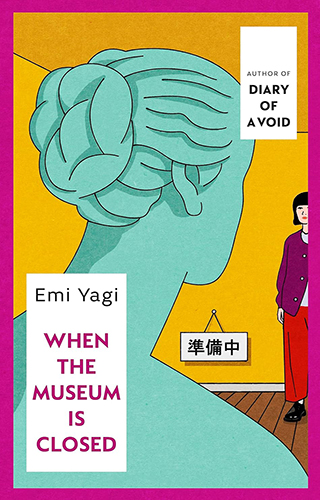
When the Museum Is Closed

Emi Yagi’s 2023 novel When the Museum Is Closed is a refreshing work of magical realism about a shy young woman who falls in love with a statue of Venus. The twist is that the statue loves her back, and – even more miraculous! – their love story has a happy ending.

Rika is a recent college graduate who works in the freezer department of a warehouse for processed food. She sees this as the perfect job for three reasons. First, she never has to talk to anyone. Second, she can take pre-prepared food home from her job, so she rarely has to cook. And third, an invisible yellow raincoat suddenly appeared over her clothing in elementary school, and she’s found it almost impossible to remove in public. The heavy vinyl fabric keeps her body temperature high, but that’s not a problem in an industrial freezer.

The only variation in Rika’s days comes from her part-time job. Once a week, Rika takes the bus to a local museum to have an hour of conversation with a statue of Venus. Venus only speaks Latin, but Rika enjoys a freedom with the dead language that she’s never found in Japanese. Though Rika is shy at first, she and Venus become friends, and they eventually fall in love.

Unfortunately, there’s a bit of a situation with a man named Hashibami, the museum curator in charge of the statue. He wants Venus all to himself, and he never wants her to change – he doesn’t want her to learn modern languages, and he certainly doesn’t want her to learn about the world outside the museum.

Venus therefore makes a deal with Hashibami. If he can get Rika to fall in love with him, she’ll allow him to fire Rika from the conversation job. Regardless, Rika isn’t interested in men, nor does she allow Venus to push her away. What Rika wants is something else entirely, and her relationship with Venus has given her the courage to chase their mutual joy.

The fantastic elements of When the Museum Is Closed are presented as entirely mundane, and it’s easy to take them at face value. At the same time, the love story between Rika and Venus resonates at an allegorical level with the experience of having a queer crush on someone who’s friendly and flirtatious yet seemingly unattainable. It’s the crush you have on an older coworker, or the crush you have on an internet friend, or the crush you have on the gayest girl you’ve ever met who is, inexplicably, married to a man. It doesn’t really matter that Venus is a statue, as anyone who’s experienced queer longing can relate to Rika’s situation. At the same time, Emi Yagi’s Venus is animated by her own distinct personality and undeniably lovely.

I’m sure that When the Museum Is Closed could also be read as an allegory for how women tend to be treated in male-dominated artistic and curatorial spaces, but the story is far more concerned with Rika’s subjective experience of her own individual life. I especially enjoyed the subplot involving Rika’s friendship with her landlord, a quirky but kind elderly woman who needs home care assistance, and I appreciated the understanding Rika develops with the neglected young boy who lives next door. Though Rika’s invisible yellow raincoat is unique to her, she’s far from the only person carrying unseen baggage, and it’s not necessarily the case that this is a problem that needs to be fixed.

When the Museum Is Closed is a short but expertly paced novel that moves quickly yet still allows the reader enough time to appreciate each scene. Its premise is intriguing and well-executed, and Yuki Tejima’s delightful translation captures the author’s tone perfectly, both in Rika’s deadpan observations and Venus’s mature flirtations. Readers who enjoyed Emi Yagi’s novel Diary of a Void will be pleasantly surprised by When the Museum Is Closed, which features the same sharpness and clarity of writing augmented by lovely moments of sweetness.

Diary of a Void

Diary of a Void is about a woman in her mid-thirties who lies about being pregnant and decides to run with it. Emi Yagi’s short novel isn’t quite a comedy, but it’s sharp and insightful and a lot of fun to read.  

Shibata is a relatively normal person whose hobbies include going to live shows and drinking with friends. She works at a small distribution company that specializes in cardboard paper cores. Even though she’s been working at the company for a few years, her male colleagues still expect her to handle menial jobs such as making coffee and distributing mail. These chores are especially annoying when she’s trying to complete her actual work by a deadline, and she often ends up staying at the office until late in the evening.

Shibata is a full-time salaried employee, but her colleagues treat her like a part-time “office lady” simply because she happens to be female. She finally snaps when her manager stops by her desk and interrupts her to ask that she clear the dirty coffee cups from a meeting room. Why can’t the men in her office take their own coffee cups to the kitchen, Shibata wonders. If the manager has enough time to pester her, why can’t he pick up the cups himself? Why can’t he ask one of her junior colleagues?

After her manager bothers her about cleaning the cups one too many times, Shibata tells him that she’d prefer not to. The smell of cigarettes in the meeting room makes her nauseous, she says, because she’s pregnant. Not only does her manager take this statement seriously, but everyone in Shibata’s office suddenly starts treating her like a human being instead of a servant. She therefore decides to keep the lie going, a decision that seems less like a malicious falsehood and more of a reasonable survival strategy.

Despite the novel’s title, it’s hard to think of Shibata’s imagined pregnancy as a “void.” She applies for a maternity badge and keeps a pregnancy diary in order to lend credence to her story, but she’s not lying to herself. What Shibata is doing is finally leaving work early enough to cook dinner instead of scrounging for leftovers from the nearly-empty shelves of a late-night supermarket. She makes time for get-togethers with friends and subscribes to Amazon Prime to catch up on all the movies she’s always wanted to watch. She treats herself to nice meals on the weekends, and she makes friends at a local “mommy aerobics” class to stay in shape.  

During the day, Shibata has an easier time at work, where her colleagues have finally started to make the effort to share the office chores. At night, she goes on long walks and reflects on her life and what it might mean to be a mother. Toward the end of the novel, Shibata encounters a friend from her aerobics class who has taken to walking with her sleepless infant late at night in order to prevent the baby from making noise. This exhausted woman delivers a cri de coeur about the state of motherhood in Japan, and every single word she says is true. I won’t spoil Shibata’s response, but it’s very good.

The author’s depiction of Japanese workplace culture is fascinating in its specificity while still being relatable to anyone who’s suffered through an office job, and the reader doesn’t have to be female to appreciate Shibata’s frustration with gendered double standards, which put the male characters in a number of awkward situations as well. In the end, Shibata isn’t a sage or a saint – she’s still the sort of morally dubious person who would lie about being pregnant. Some of Shibata’s takes on social issues aren’t great, and she occasionally comes off as unfairly judgmental, but her realness keeps her grounded as a narrator.

Save for a few choice depictions of clueless men at Shibata’s office and equally clueless expectant mothers, Diary of a Void isn’t particularly satirical or comedic, but nor is it heavy or depressing. Like Shibata herself, the reader occasionally has to run with the story of a fake pregnancy without asking too many questions. Still, Diary of a Void is an interesting journey with a fun ending. The novel resists sentimentality at every turn, and I found it gratifying that no life lessons are learned by Shibata or anyone else. Shibata is a great character, but the reader is the one who experiences a major change in perspective. Translators David Boyd and Lucy North convey Shibata’s dry wit and merciless observations with pitch-perfect tone and style, and the closing line is an absolute banger.