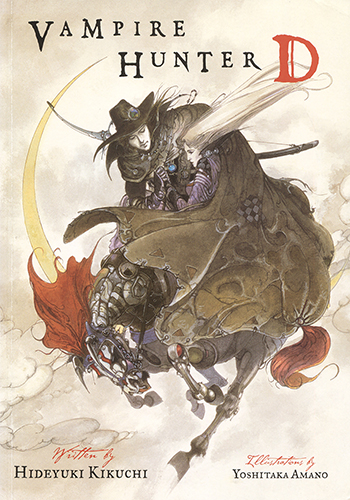
Vampire Hunter D is the first in a (still-ongoing) series of science fantasy novels written by Hideyuki Kikuchi and illustrated by the legendary Yoshitaka Amano. This first volume was published in 1983; and, in 1985, it was adapted into a film-length, direct-to-video animation that became a cult classic in the 1990s, when circles of genre fiction fans discovered ultraviolent sci-fi anime like Akira and Ghost in the Shell.
I will admit that I was never able to get into the anime, whose art style doesn’t appeal to me personally, but I recently became interested in the novel series after rereading Gene Wolfe’s The Book of the New Sun. Wolfe’s tetralogy is perhaps the defining work of the “dying earth” genre of speculative fiction, in which human civilization has decayed to a medieval level after a global disaster in the far future.
Vampire Hunter D is set roughly ten thousand years in the future, when what remains of humankind lives in isolated settlements supported by barely-functional robots and occasionally policed by traveling bounty hunters sent from the Capital, which is filled with ruins but nevertheless seems to be the last city of any size. The story takes place on the Frontier, which has a pseudo-American “Weird West” sort of atmosphere that will perhaps be familiar to fans of Stephen King’s Dark Tower series.
Lurking above the ranches and saloons and cowboys are the remnants of a European-style aristocracy, who live in gigantic castles fortified by hypermodern surveillance technology. The Nobility, as they’re called, are immortal. Through various genetic alterations, they’ve come to resemble mythical vampires, and they’re proud to refer to themselves as such. Though the scattered Nobility are capable of artificially manufacturing their own nutrition, they have grown cruel and proud, and some terrorize humans for sport.
Doris Lang, a seventeen-year-old girl who manages her late father’s ranch outside of a small and dusty town on the Frontier, has fallen victim to the attention of the local vampire lord, Count Magnus Lee. Knowing that it’s only a matter of days before she’s either taken by the vampire or exiled by her fellow townspeople, Doris stands on the highway and waylays travelers in hopes of finding a professional hunter who specializes in handling monstrous mutants.
In a brilliant stroke of luck, the first hunter Doris encounters is one of the greatest, a vampire hunter who goes simply by the initial “D.” Though he appears to be a beautiful young man, D is a mixed-species dhampir who possesses the superhuman powers of vampires without most of their weaknesses. For his own mysterious reasons, D consents to be “hired” by Doris for no other payment than room and board.
The ancient Count Magnus, who is backed by his beautiful but deadly daughter Larmica, will not be easy to defeat. To make matters even more complicated, vampires are the least of the dangers threatening the humans who live on the Frontier, and D will also have to contend with werewolves, witches, outlaws, and lynch mobs if he hopes to keep Doris safe. There are eight chapters in Vampire Hunter D, and each presents its own unique set of villains. All of these threats eventually converge into a perfect storm of danger; but, in the end, it all comes down to a battle between D and the vampire lord.
There’s a great deal of action in Vampire Hunter D, all of which is translated in a quick and punchy style by Kevin Leahy. There’s a somewhat shonen manga style to the action scenes, in which each of the characters performs a series of special attacks that have a rock-paper-scissors way of canceling one another out. I’m not generally a fan of action scenes in prose fiction, but Kikuchi’s sense of pacing is excellent, as is the creativity devoted to D’s opponents.
I’m also impressed by how lowkey horny this book is. Stories about vampires are infamously erotic, but Vampire Hunter D has a more universal Frank Frazetta style of sexualization. Gender, age, and even species don’t matter; everyone gets the same “Vaseline on the camera lens” treatment. As with the monster-of-the-week action scenes, I found this 1980s pulp fiction style of writing to be extremely charming.
It’s perhaps because of the nostalgic charm that I didn’t mind the story’s relative lack of psychological depth or complexity. Though she’s capable of defending herself against lesser monsters, Doris is a classic damsel in distress, and D remains mysterious from start to finish. D’s opponents seem to be evil simply because they’re evil, and even Count Magnus doesn’t have a personality that goes deeper than the usual vampire tropes. His daughter Larmica is granted a modicum of character development, but this is sadly limited. Still, the gothic expressions of the “dying world” setting are fantastic, and I appreciate that the world itself has far more character than the actors who drive the plot.
I’m given to understand that, as a series, Vampire Hunter D leaves behind its formulaic action-oriented structure after the first few volumes. I read the first volume around the time it was originally published in English translation in 2005 and didn’t think much of it, but I find it far more compelling now that I’m older and have a better understanding of the story’s genre tropes, as well as how Hideyuki Kikuchi fits into a timeline of Japanese dark fantasy that’s recently come to wider international attention with the 2022 video game Elden Ring.
Dark Horse Books has published the first thirty books in translation, which are currently being collected into ten omnibus volumes. The first novel stands alone, and it’s a relatively quick read. I’d definitely recommend Vampire Hunter D to dark fantasy genre fans, as well as to anyone curious about the roots of JRPG video game tropes and imagery.