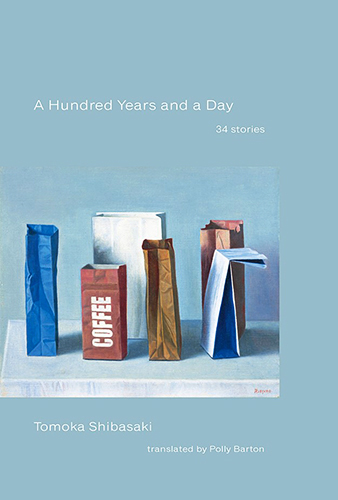
A Hundred Years and a Day

In October 2024, Matt Alt published an article in Aeon titled “The Joy of Clutter.” Instead of decrying the unsightliness of visual complexity, Alt argues that clutter has its own unique beauty, “an ecstatic, emergent complexity, born less from planning than from organic growth, from the inevitable chaos of lives being lived.”

Alt’s essay is illustrated with photos contributed by Lee Chapman, who captures evocative images of the chaotic interiors of tiny family-owned restaurants located in shopping arcades lined with shuttered storefronts. Chapman’s photos coincide with a trend on social media that expresses nostalgia for the Japan of the late twentieth century, with posts often tagged as “Shōwa Retro.”

Tomoka Shibasaki’s A Hundred Years and a Day delights in the aesthetic of gentle decline exemplified by Shōwa Retro, and the 34 stories in the collection express nostalgia for people and places left behind in the past. Shibasaki invites the reader to walk through depopulated residential neighborhoods and stroll along abandoned shopping arcades. Half-empty cityscapes are dotted with buildings filled with clutter. Aging adults sift through the belongings of their deceased parents. Siblings who’ve drifted apart make clumsy attempts to reconnect by alluding to half-forgotten memories. Students study and then discard the small artifacts of the people who came before them.

Even reading through the book’s Table of Contents is like flipping through a card catalog in an old library, with each story’s title being a concise description of its premise. To give an example, the first story is titled:

“One summer during a long rainy spell, student number one from class one and student number one from class two discover mushrooms growing in a flower bed next to a covered walkway at their school; two years after leaving school they bump into each other, but after that, ten years pass, twenty years pass, and they don’t meet again”

“One summer” is a translucently beautiful piece of writing with imagery so clean and clear that I could almost feel the seasonal humidity on my skin. The story conveys the delicate specificity of a single moment captured in time. The moment dissipates and disperses as the world moves on, but the memory lingers.

An intriguing play on this theme is in the nineteenth story…

“I feel like I want to see the places that someone else saw, he said; I like thinking about places I’ve been to once but no longer know how to get to, or places that you can only access at certain times, I feel like there must be some way of visiting the places that exist only in people’s memories”

…which is about a woman who travels to a small seaside town to give a presentation at an academic conference. While walking back from the local shrine, she has a brief conversation with a child who will be the last ever student to graduate from the municipality’s junior high school. Years later, the child (now grown) encounters an artistic diorama that recreates a fictional version of their hometown that appeared in an old novel written by the academic’s deceased mother. While studying the artwork, this person (referred to by the story as “the last child”) is surprised by the liveliness of the reconstructed memory:

The last child crouched down and peered into the alley running between the wooden houses. It looked a lot like the alleyways that they knew from their childhood. They felt as though it was a path they’d been down before. As the last child was still staring down the passage, a cat ran across the alleyway where the stone steps were. The last child gasped in surprise, and stood up. A cicada flew in through the window, attached itself to the wall, and began to screech.

“I feel like I want to see” is a wandering ramble across time and memory, but most of the vignettes in A Hundred Years and a Day are much more focused on the history of a specific place. One of my favorites is the twenty-second story…

“A man opens a café in a shopping arcade, dreaming that it will become like the jazz café he used to frequent as a student; the café stays open for nearly thirty years, then closes down”

…which, despite the title, is about the young woman who takes over the original café by the university. The interior of the café is almost comically outdated, as are the records left behind by the previous owner. The new owner isn’t familiar with the musicians whose posters still hang on the walls. Regardless, the café is still lively, and the new owner finds herself thinking, at the end of the story, that “this is what I wanted to do.”

If I had to guess, I’d say that the reason why this sort of Shōwa Retro story has such a strong appeal is because it rejects the performative glossiness of mass media while embracing the beauty of real, everyday settings. The aesthetic also disrupts the modern myth that progress is not just desirable, but inevitable. Things don’t always get “better,” Shibasaki demonstrates, nor do endings always happen with a bang. 

A cursory reading might suggest that Shibasaki is trafficking in low-effort cultural nostalgia, but I don’t think that’s the case. The imagery presented by each story in A Hundred Years and a Day feels very deliberate, like it’s smashing a smartphone screen with a hammer. This is fiction to be enjoyed slowly, and I appreciate the contemplative space Shibasaki has opened for the reader.

When discussing the texture of Shibasaki’s writing, it’s important to acknowledge the artistry of Polly Barton’s English translation. Japanese literary writing is notorious for its nested sentence structure, which can feel unintentionally Proustian if translated literally. It takes a keen eye and a delicate touch to understand whether Japanese sentences are interminably lengthy because the language is simply written like that; or whether a sentence like one of Shibasaki’s story titles is a deliberate stylistic choice. Barton has done truly amazing work with A Hundred Years and a Day at a sentence-by-sentence level, allowing the reader to enjoy Shibasaki’s distinctive style while still maintaining a casual, conversational tone.

Most of the stories in A Hundred Years and a Day occupy fewer than ten pages, and they read like accounts passed from one person to another by word of mouth. Spending time with this collection feels like calling an elderly relative and listening to them talk about a restaurant closing in your old neighborhood, or about how they saw someone that you once knew as a child in the newspaper. There’s no real beginning or end to the stories, nor is there any discernible sense of structure. Still, the theme of human connection runs through Shibasaki’s work like a gentle current, drawing the reader forward along on the steadily flowing stream of time.

I’d like to extend my gratitude to Stone Bridge Press, which provided an advance review copy of this book. A Hundred Years and a Day will be published on February 25, 2025. You can learn more and read a preview on the book’s webpage (here).

The City and Its Uncertain Walls

In The City and Its Uncertain Walls, Haruki Murakami returns to an earlier era of his writing. Although ostensibly set in the present, there’s a timeless quality to this story and its characters, who move through their lives entirely offline and largely cut off from contemporary society. In both the setting and scenario, Murakami borrows heavily from his own twentieth-century fiction, making The City and Its Uncertain Walls feel like more of a pastiche than an original work.

The first section of the novel alternates between the narrator’s recollections of the past and his descriptions of a low-fantasy dreamscape of the eponymous walled city. In the real world, the narrator recounts the progression of his teenage romance with a girl who eventually revealed that she was suffering from severe depression before sending a farewell letter and disappearing from his life. In the dream world, the adult narrator enters the walled city the girl once built from her imagination and encounters a ghost of her sixteen-year-old self.

At an almost detail-by-detail level of fidelity, the walled city is lifted directly from the “End of the World” segments of Murakami’s 1985 novel Hard-Boiled Wonderland and the End of the World, while the bittersweet teenage romance is strongly reminiscent of his 1987 novel Norwegian Wood.

This was a slow opening for me, as it’s territory Murakami has covered many times before. Perhaps a different reader might have a different impression; but, since I’ve already read Norwegian Wood and Hard-Boiled Wonderland and the End of the World many times during the past two decades, I often found myself skimming through this section.

The story becomes somewhat more interesting in the second section, when the forty-year-old narrator wakes from the dream of the walled city, leaves his job at a book distribution company, and moves to a small town in the mountains of Fukushima prefecture to manage a privately owned library. The narrator is welcomed by the former head librarian, a gentle elderly man named Mr. Koyasu. With the support of the library staff, the quiet days pass pleasantly enough, but there’s something strange about Mr. Koyasu, who seems to come from nowhere as he pleases before returning to nothing at the end of his visits.

In many ways, this second section feels like a retread of Murakami’s 2017 novel Killing Commendatore, whose narrator undergoes a similar midlife crisis and moves to a small town in the mountains. There are also echoes of the rural library in Shikoku that serves as the setting for the last half of the 2002 novel Kafka on the Shore. Thankfully, this section doesn’t exhibit the same fidelity of borrowing as the first, and I was intrigued by the gradual reveals concerning Mr. Koyasu’s life and interest in the narrator.

Toward the end of the second section, it seems the plot will finally move forward when the narrator is introduced to one of the library’s most faithful patrons, a teenage boy on the autism spectrum. The boy knows about the walled town, and he wants the narrator to take him there. Unfortunately, this is when the story begins to lose its threads, and it falls apart into a tangle of long conversations in which characters repeat the same information without actually saying anything. Even at the abstract metafictional level of Murakami’s beloved “symbols” and “metaphors,” the ending feels rushed and unsatisfying.

In his “Afterword,” Murakami explains that he began The City and Its Uncertain Walls during the pandemic as a return to a story of the same title that he originally published in 1980. I understand the drive to return to familiar themes in order to view them from unexplored angles, but the problem with this novel is that there’s nothing new or different in its approach. If I were feeling cynical, I might even say that The City and Its Uncertain Walls feels as though it’s been assembled as something of a “Best of Murakami” album intended to market the author’s work to new readers.

I enjoyed the experience of reading The City and Its Uncertain Walls, but it didn’t resonate with me emotionally. More than anything, this book inspires nostalgia for Murakami’s earlier novels. Given the story’s refusal to address any social, political, or cultural developments since 1980, I’d say that “nostalgia” is probably going to be its main appeal for many readers. There’s value to seeking shelter in the imagination as a defense against the demands of neoliberal capitalism, but The City and Its Uncertain Walls has nothing to do with resistance; this is pure self-indulgence. As in the walled city of the narrator’s dreams, nothing much happens here, and time passes comfortably but without meaning.

Under the Midnight Sun

under-the-midnight-sun

Title: Under the Midnight Sun
Japanese Title: 白夜行 (Byakuyakō)
Author: Higashino Keigo (東野 圭吾)
Translators: Alexander O. Smith and Joseph Reeder
Publisher: Minotaur Books (a division of St. Martin’s Press)
Publication Year: 2016 (America); 1999 (Japan)
Pages: 560

This guest review is written by Tyran Grillo (@TyranGrillo on Twitter).

Although Naoko was the first novel by Keigo Higashino to appear in English, it wasn’t until The Devotion of Suspect X that an energetic following of the author grew among Anglophone readers. Subsequent novels by Japan’s salaryman-turned-mystery writer, however, left fans hungry for something different, as the clothes of his popular Detective Galileo were beginning to wear thin. Enter the gruffer Sasagaki, whose investigation of a 1973 murder in Osaka starts him on a 20-year chase after the truth. The circumstances surrounding said murder play on the classic locked room scenario, as the body of a man is discovered by children playing in an abandoned building.

Our body of interest was once the property of Yosuke Kirihara. The owner of a pawn shop, the unfortunate Yosuke has left behind a son, Ryo, and a wife, Yaeko. Sasagaki immediately suspects the latter, due to a seeming lack of emotion toward her spouse’s death. Ryo, for his part, is broken by the loss, and offers little in the way of helpful information. Even as Sasagaki fears for the boy’s future, he cannot help but marvel at Yaeko’s performance. As he watches her late husband’s funeral procession from a respectable distance, he thinks to himself, “The strange attraction of a woman in mourning…. If she’s trying to play the part of the beautiful young widow, she’s doing a knockout job.” Such statements may be common hardboiled fare but here set the tone for an unnecessarily chauvinistic slog of a novel. Sasagaki’s suspicions turn to Fumiyo Nishimoto, the last person to have seen Yosuke alive, and her daughter Yukiho is described in such perverse terms that it’s all this reader could do not to gag on their persistence.

Yukiho and Ryo, in the wake of a tragedy that has affected them both, become our main protagonists. We follow their diverging paths out of the nostalgic ignorance of the 1970s into adulthood. Along the way, Higashino introduces us to a chain of new characters, some of whom feel unnecessary as false witnesses. Each subsequent chapter throws new names into the mix to throw us off the scent. Ryo goes on to become a bootleg video game manufacturer, while Yukiho goes on to become a male fantasy of femininity.

Therein lies a fundamental problem of the narrative. Like all of the women in Higashino’s testosterone zone, she is little more than the sum of her apparently siren-esque charms, which Yukiho hones in service of being what she is called from the start: a “perfect lady.” On the surface, one might read this as a noble critique of the ways in which women are expected to live up to idealized images of beauty, but assertions of this point reach a level of absurdity that make the story nearly impossible to finish. For while Yukiho’s beauty is doubtless the very epitome of feminine perfection, she is also described as having “thorns in her eyes,” and, as our omniscient narrator so dutifully explains, a “true lady would never have eyes like that.” In other words, a “true lady” cannot be prone to dark thoughts or ever have an off day; she must maintain a perfect and consistent exterior, if only to please the men around her.

Higashino’s descriptions of the mature Yukiho are striking in their blatant vacillation between praise and condemnation, not to mention their occasional slip into racial stereotypes. To give an example: “Yukiho looked down at the table. She had long eyelashes. Some of the people in the club said she looked like one of those French porcelain dolls. The comparison was admittedly apt, with the exception of her Asian eyes.” When a younger detective by the name of Imaeda picks up where Sasagaki left off years ago, his first look at Yukiho reminds him of the “women he’d seen in old foreign films” and makes him wonder “where she got her seemingly natural elegance and grace. What had polished her to gleam so brightly?” More than overstating Yukiho’s beauty, such language elevates it to farce, so that the woman herself no longer functions as a human character.

When Yukiho finally marries, her husband Makoto cheats on her by falling for a temp who works at his company. Not only does this downplay Yukiho’s tireless attempts to live up to perfection, it undermines her intelligence in choosing a suitable life partner, a point further stressed when we learn that Makoto, who admits to having an inferiority complex around his savvy wife, has beaten her in a drunken rage that he conveniently forgets. In addition to being entirely out of her husband’s character, this disclosure comes across as a desperate attempt to elicit pity for a woman of whom by this point we have no idea what to think.

Anytime a female character is described, the reader can be sure to learn a lot about her body, and Yukiho is no exception. Rather than add to knowledge of her character, as his visualizations of men do, Higashino indulges in details that have no bearing on her psychological profile. In an awkward scene of lovemaking between Yukiho and her husband, for instance, we get this: “Her breasts were soft and bigger than you might think to look at them.” Does this detail matter? Only to a voyeuristic narrator who takes pleasure in it.

Yukiho is animalized, as when she is compared to a cat for her “feline eyes.” When she later becomes a suspect, she is variously likened to a “black rose,” an “evil flower,” and ultimately an “artificial flower,” as if the combination of intelligence and femininity were a surefire recipe for malice. Although one might argue that Higashino is simply playing with the femme fatale trope like so many before him, it is far too convenient that Yukiho’s beauty, which for most of the novel has been seen as a divine gift inherent to her every fiber, suddenly ceases to be real once it’s revealed as a mask hiding an actual human being. Such classical sexism precludes any progressive tendencies that might be attributed to Under the Midnight Sun.

The issue of its depictions of female characters aside, problems abound in the novel’s structure and pacing. Aside from being too long for its own good – there is, for example, a full page of unnecessary dialogue between Yukiho’s college classmate and a future boyfriend about how wet one gets by either walking or running in the rain – it pads out a foreseeable conclusion with unrealistic conceits. The result is a novel whose flaws are, like Yukiho’s much-discussed features, bigger than you might think to look at them.

In addition, Detective Sasagaki is a rather uninteresting lighthouse decorating a coastline of possible perpetrators. We understand that he is skillful at his job, but his obsessive interest in this case feels somewhat out of place, given what we know about him. Then again, mistakes have been made on both sides of the equals sign that would have brought his suspicions to a verdict much sooner, and perhaps subconscious awareness of this drives him to overcompensate for the embarrassment of what ends up being a simple explanation. As in any mystery of this length, it’s the actions of investigators who unwittingly build a complex wall around the truth that allow murderers to get away with what they do for so long. As the story progresses, the plot becomes so unbelievable that it feels like a letdown when one reaches the tail end of its denouement.

Ironically, the novel’s meandering tendency is also its greatest strength, and the clearest justification of its author’s fame. Higashino makes it easy to keep track of an ever-growing cast of characters – almost to a fault, because many revelations, at least to this reader, were clear from many pages away. Above all, the book provides a fascinating cross-section of late twentieth-century Japan, tracing trends in manga, television shows, video games, and other popular arenas of technological production through a key transitional period in the nation’s history. Higashino juggles multiple arcs and implications with ease, and the reverse engineering required to put them all together will satisfy even some avid mystery fans, to be sure.

As a published translator of Japanese fiction myself, I feel compelled to note that none of my criticisms are the fault of Alexander O. Smith and Joseph Reeder, who have done an admirable job rendering Higashino’s often-terse and idiomatic prose into fluent English. The novel reads smoothly, handles cultural differences with tact, and evokes the original’s grittiness with clarity. If anything, it was the quality of their work that kept me engaged.

In the end, Under the Midnight Sun is a lackluster story with little payoff. As for the back cover copy’s comparisons of this book to Les Misérables and Crime and Punishment, I can only say these constitute a deception as criminal as the novel they are describing.

Under the Midnight Sun will be released on November 8, 2016. Review copy provided by St. Martin’s Press.

* * * * *

Tyran Grillo is a Ph.D. candidate at Cornell University, where his research focuses on the (mis)representation of animals in contemporary Japanese literature. He has translated nine books from Japanese into English, five of which have been published. The most recent of these is the science fiction masterpiece Mr. Turtle by Kitano Yūsaku. Tyran is also an avid blogger, having to date written over one million words of criticism on music, books, and film at ecmreviews.com.