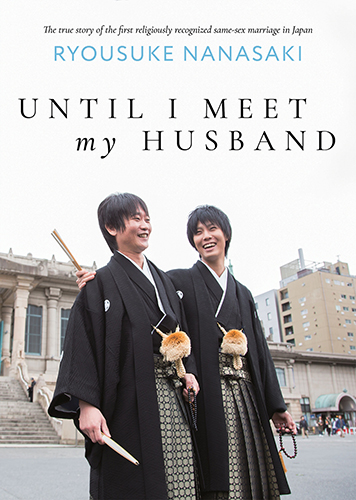
Until I Meet My Husband is a collection of short autobiographical essays by Ryousuke Nanasaki, an activist who established LGBT Community Edogawa in 2015 and a wedding planning company called Juerias LGBT Wedding in 2016, both of which contributed to Tokyo’s Edogawa ward officially recognizing same-sex partnership by issuing marriage certificates.
Nanasaki lays out his motivations for becoming an activist toward the end of the book, but the majority of his essays are humorous stories about life and love. As Nanasaki explains in the final chapter, “In Place of an Afterword,” he wants readers to understand the “raw, uncut truth” of queer identity, which is that gay people experience happiness and make mistakes like everyone else.
As a result of Nanasaki’s honesty, the essays in Until I Meet My Husband are immensely entertaining and compulsively readable. Many of the stories will be familiar to queer Millennials, from receiving a stern lecture from a well-meaning teacher in elementary school to dating other closeted queer kids in high school to falling a little too hard for your first serious partner as an adult. Nanasaki leans hard into friendship drama, relationship drama, and family drama, but he’s so funny and good-natured that you can’t help but support him through his misadventures.
Molly Lee’s translation is pitch perfect, conveying the confidence and enthusiasm of Nanasaki’s voice in natural English that’s a pleasure to read. Along with the original essay collection, Seven Seas has also released the manga adaptation, which features dreamy artwork by BL manga author Yoshi Tsukizuki.
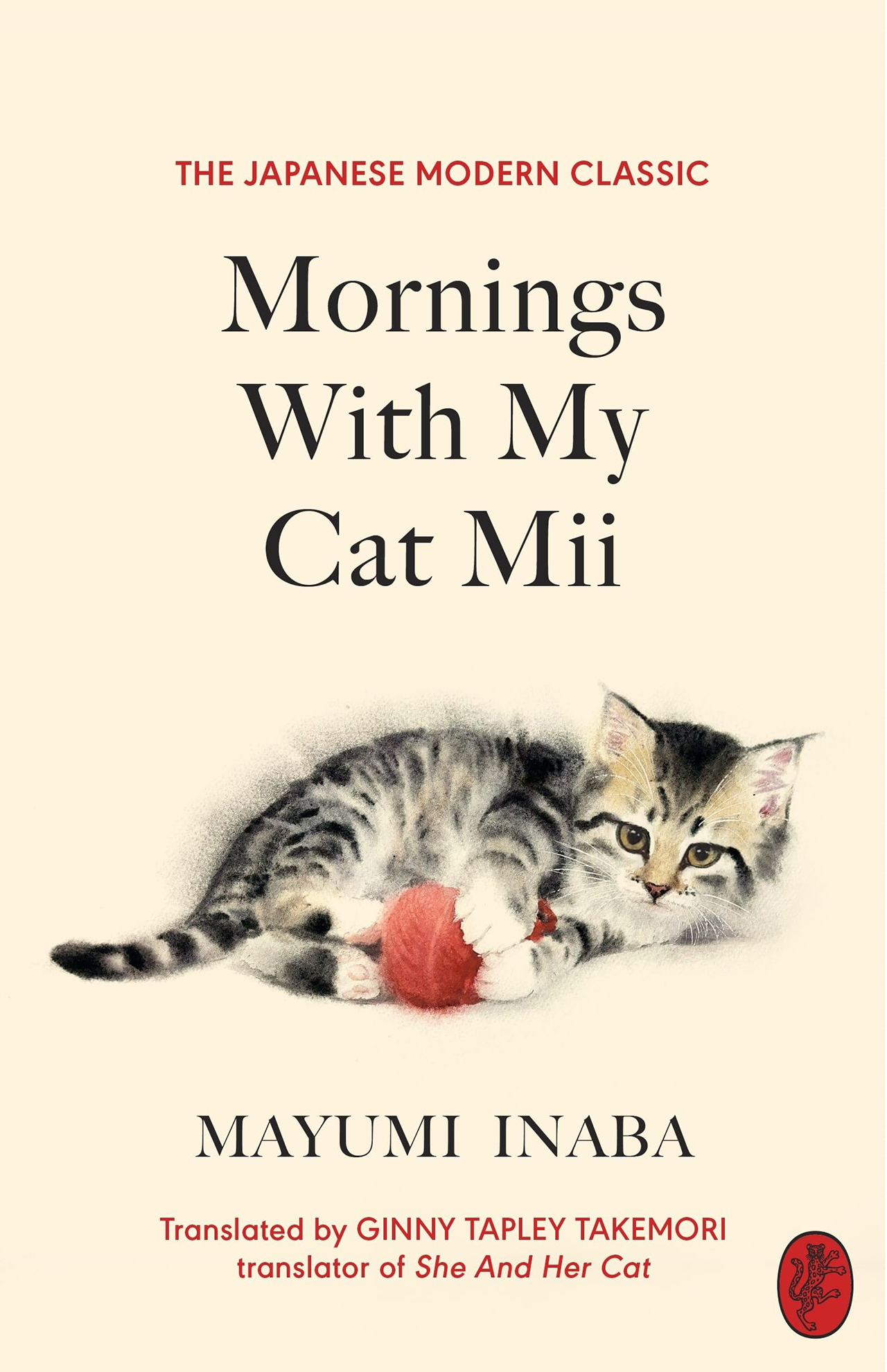
Cats are adorable creatures, it’s true. It’s also true that they’re a little magical. Unfortunately, the experience of caring for a cat isn’t all sunshine and rainbows, and there’s a lot of cleaning involved. Mayumi Inaba’s autobiographical essay collection Mornings With My Cat Mii is a beautifully written attempt to capture the not-always-rosy reality of sharing your space with a cat while doing your best to manage your life as a human.
In the summer of 1977, Inaba follows the cries that drift in through her window and discovers a ball of fluff stuck at the top of a fence along the bank of the Tamagawa River in western Tokyo. Since it’s freezing outside, she takes the kitten home. Inaba names her “Mimi,” or “Mii” for short, after her constant crying. Despite her precarious childhood, Mii goes on to live for almost twenty years, accompanying the author through major developments in her personal life and career.
Mayumi Inaba (1950-2014) worked in a number of creative industries while publishing stories, essays, and poetry. The opening essays in Mornings With My Cat Mii are about the milestones in Inaba’s life as she divorces her husband in Osaka to focus on her career in Tokyo. As time passes, Inaba begins to devote more attention to her friendships and psychological wellbeing, a shift in priorities represented by her growing love for Mii.
Mornings With My Cat Mii is far from wholesome, however. Inaba is nothing if not honest about the vicissitudes of life. Sometimes you and your partner grow distant. Sometimes you get kicked out of your house by your landlord. Sometimes people abandon animals. And sometimes you have to bear witness to your pet’s slow decline toward death.
A major element of Inaba’s commitment to honesty are her raw descriptions of the mess of keeping an animal in your house. Sometimes, for example, your entire apartment is going to smell like cat urine. Sometimes you have to scrub puke out of the carpet. Sometimes you have to extract your cat’s feces with your own hands.
Regardless, Inaba always finds a silver lining and an interesting story to tell. I especially enjoyed her essay “The Pet Sitter,” which provides an intriguing glimpse into the thriving industry of petcare services in Japan while digging its heels into the silliness of celebrity pet therapists. I also love “The Winter Break,” which describes a trip Inaba took to the countryside with her sister so Mii could touch grass and frolic in nature. The essay “Moving House” stands out as a playful description of a typical day in young Mii’s life in Inaba’s old house in the west Tokyo suburbs, which were still filled with pockets of nature in the 1970s.
Each essay is less than ten pages long, and most of them feature several verses of a poem as a postscript. Ginny Tapley Takemori has done a marvelous job translating Inaba’s poetry. Just be aware that some of these poems might make you a bit misty-eyed, especially if you’re feeling sentimental about the death of a pet of your own.
I’m generally not a fan of Japanese cat books, but Mornings With My Cat Mii isn’t bubblegum pop about how all of life’s problems can be magically solved by a cat. Rather, this is messy and honest nonfiction about the hardships of pursuing a creative career as a single woman. Still, Inaba manages to find moments of sweetness in life, which she generously shares with the reader in her soft and shining prose.
Tree Spirits Grass Spirits collects twenty-one autobiographical stories about plants by the celebrated Japanese-American poet Hiromi Ito. As the translator, Jon L Pitt, explains in the book’s preface, these stories were originally serialized from 2012 to 2013 in a highbrow Japanese literary magazine, but Ito’s prose is lively and accessible. Each of the stand-alone stories in Tree Spirits Grass Spirits is gentle and thoughtful, and the collection is a breath of fresh and green summer air.
Ito divides her time between the cities of Encinitas in southern California and Kumamoto on the southern island of Kyushu in Japan. Each region has a unique climate and ecosystem, and Ito is fascinated by the plants that grow in both environments, from yucca and agave to camelia and hydrangeas to grass and mold. Ito’s stories touch on botany and natural history, but their primary focus is on humans, especially the humans in Ito’s own family.
Among my favorite of the stories is “Baobab Dream,” which recounts a challenge that many people have experienced with houseplants. As Ito puts it: “They are at their most beautiful when you first purchase them, and they get progressively shabbier and shabbier, even if you take care of them. And then, at some point, they wither away and die.”
And then, when you go to a garden store to get new plants to replace the old ones, it can be a challenge to identify what you’ve purchased. This is how Ito came into the possession of a mystery tree that she and her daughters resorted to calling “the baobab tree.”
While conducting research on what the tree might actually be, Ito considers the Latin names of various plants and arrives at the conclusion that botanical categorizations of plants often don’t make much practical sense. How are tulips and green onions members of the same botanical family, for instance? This confusion of taxonomy yields to broader meditations on how certain species are categorized as “invasive” as opposed to “naturalized,” and how this reflects Ito’s own experiences as someone who moves between cultures. In the end, however, such abstract concerns are secondary to the beauty of the plants themselves:
In the park next door, the mountain lilacs were at their peak. The peach trees and plum trees and cherry trees were blooming in folks’ yards. The roadsides were bright yellow from the acacias. The bushes of sweet-scented geranium in my own garden, too, had suddenly grown dense and were so thick that they seemed to be sweating, steeped in a green that surrounded one or two pink buds – swelling with each coming day and trying to open up any minute now.
Ito’s vivid descriptions of the physicality of the natural world carry over to her reflections regarding how it feels to be a human moving through the environment. This is one of the many reasons why I love the story “Kudzu-san,” which is about the kudzu growing in the neighborhood around Ito’s house in Kumamoto. As anyone who’s encountered the aggressively leafy vines can attest, kudzu is filled with vitality. If you cut it down, it will grow back twice as quickly, and its fuzzy tendrils are constantly creeping into unexpected places.
Ito remarks that there’s a certain lasciviousness to kudzu, so she searches for references to the plant in literary sources such as the Man’yōshū poetry anthology and the Tale of Genji. Such references are scarce, but Ito is intrigued by a chance mention of the famous Heian-period court magician Abe no Seimei, whose mother was supposedly a fox. In Japanese folklore, foxes are shapeshifters known for their sexual allure, so it seems only fitting that Seimei’s mother is poetically associated with the visual motif of kudzu. Ito’s own encounters with kudzu are likewise filled with startling physicality:
The vines we crushed in the morning lay as they were, and stood back up erect in the evening, swaying their stems and moving in on women – I had seen this, as well. They were more like snakes than plants. Even more than snakes, they resembled those eels that sway in the ocean. There are stories in old books about snakes that enter women’s bedchambers at night, and one about a snake that slid into a woman’s vagina after she had climbed a tree. Couldn’t all those stories be about kudzu?
What I admire about Ito’s stories is that, despite the poetic beauty of her writing, her meditations often progress in strange and unexpected directions without forcing symbolism or allegory onto the natural world. Ito observes her environment closely and looks inward as she describes what she sees, but the mycelial networks between her associations expand unseen below the surface of her writing. Just as autobiography often inspires self-reflection in the reader, Ito’s “phyto-autobiography” inspires an observation of ourselves in a larger context that doesn’t always follow human logic.
Tree Spirits Grass Spirits is a welcome companion to anyone interested in going outside and seeing the world around them from a fresh perspective. Jon Pitt’s translation gracefully conveys Ito’s casual style by allowing space for the rhythm and mouthfeel of each sentence, and it’s not an exaggeration to say that every paragraph is a joy to read. Almost all of the stories are less than ten pages long, and it’s a pleasure to dip into the collection whenever you’re in the mood to open your eyes and shift your viewpoint to a less anthropocentric frame of reference.
Tree Spirits Grass Spirits is published by Nightboat Books, and you can check out the book’s page (here).
Title: A Quiet Life
Japanese Title: 静かな生活 (Shizuka na seikatsu)
Author: Ōe Kenzaburō (大江健三郎)
Translator: Kunioki Yanagishita and William Wetherall
Publication Year: 1990 (Japan); 1996 (America)
Publisher: Grove Press
Pages: 240
About a month ago, a friend for whom I have a great deal of respect said that she doesn’t like Ōe Kenzaburō’s A Quiet Life. She argued, essentially, that the novel has no forward momentum and that she couldn’t bring herself to care about the characters, especially the narrator, whom she considered silly and a bit too passive. These are all genuinely valid criticisms; but, since I happen to rather like the novel (and since I haven’t read anything else that has caught my attention recently), I thought I might defend it a bit. Of course, a book that labels itself with the title “A Quiet Life” isn’t for everyone, but I feel like there’s so much interesting stuff going on in the novel that the lives of the characters are anything but quiet.
First of all, let me say that this novel does not fit neatly into Ōe’s other work. There is very little here that is overtly political (like Hiroshima Notes), very little having to do with Pacific War era ideological confusion in the forests of Shizuoka (like in the stories of Teach Us to Outgrow Our Madness), and exactly zero sleeping around with your former lover while your wife is in the hospital after having just delivered a baby that you are plotting to kill (à la A Personal Matter). Ōe’s oeuvre tends to be a bit intense, so I really appreciated reading something a bit more…quiet.
Also, there’s a really cool film adaptation directed by Itami Jūzō, the guy who directed Tampopo (1985) and A Taxing Woman (1987). It turns out that Itami was Ōe’s brother-in-law, oddly enough. But I digress.
A Quiet Life is about the author’s family. Ōe refers to everyone by nicknames, but the essential family structure is the same. A genius writer living in the suburbs of Tokyo tries to commit suicide, so his exasperated wife, who catches him in the act, persuades him to accept a year-long writer-in-residence position at a university in California. The couple leaves behind their three children, and the narrator, Ma-chan, is one of these children. She is twenty years old, writing her college graduation thesis on the interwar French writer Louis-Ferdinand Céline, and responsible for the care of her quick-witted younger brother O-chan and her mentally-handicapped older brother Eeyore. While O-chan comes and goes like the wind, Eeyore requires a bit more attention, especially as Ma-chan comes to suspect that he feels abandoned by their parents. A Quiet Life follows Ma-chan and Eeyore through the summer after their parents leave, with Eeyore attending music composition lessons, Ma-chan working on her thesis, the pair attending a funeral in their father’s home village in Shizuoka, and other various aspects of the family’s daily life. This daily life is spiced with such incidents as Eeyore’s capture of a neighborhood pervert, the composition teacher’s ventures into socialist activism, and Eeyore’s swimming lessons, conducted by a handsome young instructor for whom Ma-chan quickly develops a crush.
Throughout the novel run Ma-chan’s thoughts and commentary on a variety of works of film and fiction, including Andrei Tarcovsky’s Stalker, the religious poetry of William Blake, and Michael Ende’s novel The Neverending Story, not to mention a forty-page rumination on Céline. I enjoyed these discussions, which were more often than not carried out in the form of lively conversations between Ma-chan and Eeyore’s music composition teacher, but I imagine how this sort of intratextual literary criticism might derail the forward momentum of the story for people who simply don’t care for that sort of thing in their fiction.
In my opinion, however, the main point of the novel isn’t its plot or its intellectual discussions, but rather the development of the relationship between Ma-chan and Eeyore. The two are obviously close; but, when Ma-chan assumes the role of Eeyore’s primary caregiver and babysitter, she finds herself repeatedly frustrated with her brother. She suspects that Eeyore himself might be the neighborhood pervert, for example, and occasionally resents him for claiming the bulk of her parents’ attention and preventing her from getting closer to boys like the swimming instructor (who actually turns out to be a creep). Eeyore, despite his idiosyncrasies, has his heart in the right place and in fact turns out to be perhaps the most interesting character to come out of Ōe’s work. Ōe’s portrayal of him, both through his words and actions and through his sister’s perception of him, is both complex and sympathetic. Ma-chan may be passive (or she may simply be a normal if somewhat oversensitive twenty-year-old college student), but Eeyore is anything but, and he emerges as the real star of the novel.
At a meta-textual level, I found not only Ōe’s portrayal of Eeyore but also his decision to use the voice of a semi-adult woman (modeled after his own daughter) for his narrator to be quite interesting. Is it realistic? Is it convincing? Why in the world would he choose to employ such a narrator? Regardless, Ma-chan is much more than the typical shōjo heroine, and A Quiet Life is much more than the typical home drama. The translation is smooth, and the narrative flows fairly quickly, jumping effortlessly from one tableau to the next. Although A Personal Matter will probably continue to hold the place of honor in the work of this Nobel Prize winning author, I feel like A Quiet Life is a close second.


 Contemporary Japanese Literature