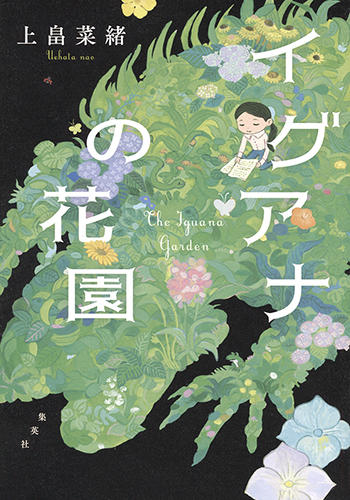
The Iguana Garden

The Iguana Garden (イグアナの花園) is the second novel by Nao Uehata, whose 2020 magical realist story しゃもぬまの島 (Shamonuma Island) won the Subaru New Writer Award with high praise from Miyuki Miyabe. In The Iguana Garden, as in Uehata’s debut novel, a young woman who is able to speak with animals navigates a difficult relationship with her family. Instead of a mythical creature like the shamonuma, however, the protagonist of The Iguana Garden talks with her pet iguana as she hesitates on the border of adulthood.

Misono Yatsuguchi has a strange ability – she can hear the voices of small animals, especially reptiles. Though she feels at home in the garden of her family’s sprawling estate, she has trouble talking with other people. Misono’s father, a botanist who teaches at the local university, encourages her interest in the natural world and introduces her to his fellow professors, who befriend her and share their research.

When Misono’s father dies of a sudden heart attack, she’s left alone with her mother, an heiress who has inherited her family’s ikebana traditions along with their wealth. Misono’s mother is just as bad at connecting with people as Misono herself, so she unofficially adopts one of her ikebana students, a girl in high school named Tsubame, to act as her assistant. Tsubame moves into the estate and becomes something like an older sister to Misono.

Misono tries to make friends with the other girls in her elementary school class, but they find her lack of emotional expression creepy and begin bullying her in an attempt to provoke a response. When their pranks reach a point that Misono finally finds unacceptable, she resolves never to make friends again.

After these opening chapters, the story begins in earnest. Misono is a graduate student studying animal behavioral science at the university where her father once taught. She’s moved out of her mother’s estate and lives in a small atelier that her father once used to house his botanical samples and garden. Misono has remodeled the space as an open terrarium for her fully grown pet iguana, Sono, with whom she shares easygoing subverbal conversations.

The calm of Misono’s quiet life is shattered when her mother abruptly announces that she has terminal cancer. In the year she has left to live, she wants Misono to get married.

For someone like Misono, who reads as asexual and on the autism spectrum, dating is nothing less than a disaster waiting to happen. In distress, Misono allows herself to be taken to a post-seminar drinking session, where she gets blackout drunk and ends up inviting a friendly but financially strapped student named Kinoshita – who goes by Kiki – to live with her in the atelier. Kiki doesn’t mind the cramped space, or the free-roaming iguana, or even Misono’s personality quirks. In exchange for room and board, Kiki says, she’ll help Misono navigate the challenges of dating.

What follows is a semi-comedic gauntlet of mishaps that, more than anything, validate Misono’s asexuality and justify her prioritization of non-romantic relationships, especially with other women like Tsubame and Kiki. During this process, Misono ends up reconnecting with a childhood acquaintance who tells her that his secondhand experience with Misono’s bullying inspired him to become a teacher specializing in the education of neurodivergent children.  

Throughout the story, Sono the iguana offers commentary and wise advice. While I was reading, I wondered whether Sono was actually speaking, or whether Misono had created the persona of Sono as a trauma response to her father’s death.

At the end of the novel, Misono’s mother reveals that she can also hear the voices of animals, and that her demand for Misono to get married came from a private conversation with Sono, who wanted to create a catalyst for her human to learn how to connect with other people. Whether Misono’s mother is telling the truth is open to interpretation, but the result is the same – Misono manages to find her community, understand her parents, and figure out what she wants to do with her life without having to worry about romance or marriage.

It’s all very wholesome, honestly. I’m usually not a fan of sentimental stories, but the end of The Iguana Garden genuinely warmed my heart. “All the women become friends and no one gets married and no one has to worry about money and everyone lives happily ever after” is a good ending, all things considered.

I feel like there might be a bit too much trauma (and supremely awkward dates) in The Iguana Garden for this book to be considered “cozy fiction,” but I also feel like this novel is probably the closest to cozy cat fiction that you can get for all the girls who like dinosaurs instead of cats. The author never explicitly identifies Misono as asexual or on the autism spectrum, thereby avoiding the tricky issues of labels and identity politics, but all the classic markers are there for readers who understand them. Personally speaking, I was happy simply to watch a young woman like Misono find friendship and acceptance, but I imagine that readers who see aspects of themselves in Misono will appreciate the advocacy and allyship that the author offers with this story.

Putting all of that aside, The Iguana Garden combines the fantasy of being comfortably wealthy and living in a beautiful plant-filled atelier with the tension of wondering what will happen with Misono’s mother, who initially seems cold and unapproachable but gradually becomes more sympathetic as Tsubame helps Misono learn more about her late father. Sono the iguana, who comes off as a cranky but kind-hearted old lady, is a lot of fun, and Kiki radiates pure charisma as her good sense and good humor keep the story moving forward. Through it all, Nao Uehata delights in descriptions of the verdant nature and healthy plants that surround the characters.

The Iguana Garden is a beautiful book, and I’d love to see it translated (ideally along with Uehata’s debut novel Shamonuma Island). I feel like this story reflects something that a lot of pro-diversity advocates have been saying for a long time, namely, that “difference” doesn’t necessarily have to be subversive. Given all the bestselling cozy cat fiction in the world, it’s wonderful to see the nonconformist iguana girl find a similarly comfortable place for herself. She deserves a happy ending too!
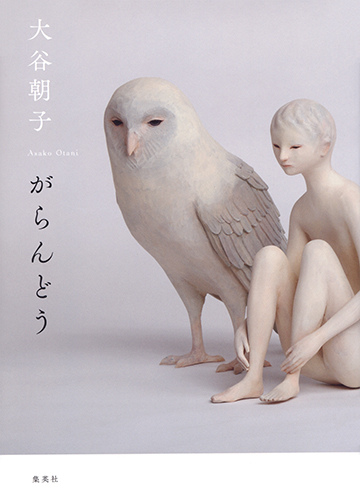
がらんどう

Asako Ōtani’s novella Garandō (がらんどう), which won the 46th Subaru Literary Prize in 2023, follows two 40yo women as they settle into a cozy life as adult flatmates.

Hirai recently moved in with her friend Suganuma, who suggested that they live together so they can afford a nicer apartment. The two women met as adults through their shared fandom of the boy band KI Dash, and they managed to remain friends during the pandemic despite drifting away from their other friends and family members.   

Hirai works in an office, while Suganuma is a self-employed artist who uses a 3D printer to create custom memorial figurines of her clients’ deceased pets. The two women share chores and meals, sometimes cooking for each other and sometimes going out to eat. Although they’re not romantically involved, they often fall asleep together in the living room while watching KI Dash performances on DVDs that they play on an old PlayStation 2.

When Suganuma’s star idol suddenly marries an adult video actress, Hirai takes her flatmate to the beach for a breakup vacation. Afterward, Suganuma begins dating a married man she met at the hotel bar. Hirai is jealous but understands that this is simply the way of the world.

In resignation, Hirai signs up for a dating app, but this goes poorly. Her lack of success is partially because she’s aggressively targeted by someone involved in a multi-level marketing scam, but it’s mostly because Hirai is about as asexual and aromantic as someone can be. She has a vague aspiration of having a child one day, but is that really what she wants?

For Hirai’s birthday, Suganuma ends her relationship with the sleazy married man and uses her 3D printer to manufacture a baby as a gift for her flatmate. The story closes in much the same place it began, with the two women happy and secure in one another’s company. The title of the novella, Garandō, means “empty,” and it most directly refers to the hollow centers of Suganuma’s 3D-printed figurines. This title might at first be taken to refer to the relationship between Hirai and Suganuma as well, but their friendship is anything but hollow.

Because really, what’s to stop two adult women from spending their lives happily together as flatmates? Why do two people need to be married or related in order for it to be “normal” for them to live together? Is your life really “empty” if you don’t get married and have children?

More than anything, Garandō reminds me of Banana Yoshimoto’s bestselling 1988 novel Kitchen, which presents alternate models of modern families while comforting the reader that, even if you’re not “normal,” life is still well worth living. Granted, Hirai and Suganuma are older than the characters in Kitchen, and they’re not living in the lap of Japan’s bubble-era luxury. In addition, Ōtani’s writing style is relatively sardonic and dry, especially when compared to the bubblegum pop of Kitchen. Still, Garandō is a positive story about two weirdos who manage to find happiness. Even if their lives don’t follow the standard model, they’re doing okay.

At a slim 112 pages, Garandō is a quick read. Ōtani has a wonderful sense of pacing, juxtaposing scenes of comfort inside the home with scenes of (highly relatable) social awkwardness in the outside world. I really enjoyed this book, which pulls off something I appreciate – the normalization of “difference” without resorting to sentimentality or melodrama.

What Ōtani demonstrates in this meticulously crafted novella is that people like Hirai and Suganuma are less uncommon than you might think, and that’s cool. And honestly, given that a house and a nuclear family have become distant dreams for many of us, why not join them? 

Convenience Store Woman

Title: Convenience Store Woman
Japanese Title: コンビニ人間 (Konbini ningen)
Author: Sayaka Murata (村田 沙耶香)
Translator: Ginny Tapley Takemori
Publication Year: 2016 (Japan); 2018 (United States)
Publisher: Grove Press
Pages: 163

Keiko Furukawa is 36 years old and has been working at the same convenience store for almost two decades. She loves the job, which suits her perfectly. Keiko has never fit in and constantly finds herself at a loss for how to talk with other people, but human interaction is governed by detailed rules and a prewritten script in the perfectly ordered world of the convenience store. “A convenience store is a forcibly normalized environment where foreign matter is immediately eliminated,” Keiko explains, adding that she appreciates this sense of distance from unnecessary social and emotional disturbances (60). The structured environment of the convenience store provides Keiko with a safe space in which she can perform work that she finds satisfying, meaningful, and helpful to other people.

At its core, Convenience Store Woman is a novella about the dignity of a job that many people find trivial and demeaning. Keiko takes obvious pride in the convenience store where she has worked since it opened eighteen years ago, and it’s not difficult to share her enthusiasm as she cheerfully describes seemingly banal tasks such as preparing food, restocking shelves, and greeting customers. Unlike the confusing and conflicting expectations imposed on her by the outside world, Keiko knows exactly what needs to be done in the convenience store, and she knows exactly when and how to do it. She often remarks on the feeling of satisfaction her experience and competence give her. For example, at the beginning of the novel, Keiko declares…

It is the start of another day, the time when the world wakes up and the cogs of society begin to move. I am one of those cogs, going round and round. I have become a functioning part of the world, rotating in the time of day called morning. (4)

Keiko pays close attention to the smallest details of the self-contained environment of the store, and her keen powers of observation allow her to appreciate the personalities and behavioral quirks of the customers. She does not judge or discriminate against anyone who enters the store and does her best to unobtrusively ensure that they are comfortable. She applies the same keen focus of her attention to her coworkers, mimicking their comments and speech patterns so that they find her friendly, companionable, and – most importantly – normal.

Convenience Store Woman doesn’t have an overarching plot, but its story is propelled forward by small scenes of conflict resulting from the friction between Keiko’s contentment and the expectations of other people. A crucial incident occurs during a backyard barbeque during which the husbands of Keiko’s high school friends have too much to drink and start laying into her for remaining in the same dead-end job without getting married. “The normal world has no room for exceptions and always quietly eliminates foreign objects,” Keiko later rationalizes as she thinks back on the conversation. “Anyone who is lacking is disposed of” (80). Keiko comes to the unfortunate realization that, by remaining unmarried and childless at 36, she has begun to stray so far outside of normative social expectations that she risks ostracization.

Partially because of this incident, Keiko feels pressured into inviting a thirty-something NEET named Shiraha to live in her apartment. Shiraha briefly worked at the same convenience store as Keiko but had been dismissed because of his poor performance. He had also, it turns out, been stalking some of the customers, and he continues to hang around the building even after he’s fired. Keiko views this as a threat to the harmony of the convenience store, so she takes it on herself to drag him to a family restaurant and try to talk sense into him. During this conversation, Shiraha echoes many of Keiko’s anxieties regarding social belonging, saying that he risks ostracization himself if he remains unmarried.

Although Shiraha is thoroughly unpleasant, Keiko invites him into her apartment and treats him like a pet, happy to tell the people in her life that a man has moved in with her. The circumstances aren’t ideal; but, as Keiko explains to the reader, “Deep down I wanted some kind of change. Any change, whether good or bad, would be better than the state of impasse I was in now” (94). The “impasse” Keiko faces has nothing to with wanting to advance in life; rather, the complications that arise from Shiraha’s presence trigger a crisis that forces Keiko to choose between becoming the person she is expected to be and her own unique sense of happiness.

Keiko reads as being on the autism spectrum, and her thought processes and behavioral patterns remind me a great deal of some of my friends and students with Asperger’s Syndrome. Keiko never explicitly identifies herself as being on the spectrum, however, and I get the impression that she would probably find the label distasteful. When she honestly informs a group of women that she has never been romantically attracted to anyone, they sympathetically respond that it’s become much more common and socially accepted to identify as asexual, and that they would understand if she were to come out as such, but Keiko finds this offensive.

I’d never experienced sex, and I’d never even had any particular awareness of my own sexuality. I was indifferent to the whole thing and had never really given it any thought. And here was everyone taking it for granted that I must be miserable when I wasn’t. (37)

To Keiko, she is no one but herself, and she has no interest in serving as a representative for anyone else. Be that as it may, I think people who identify as asexual or on the autism spectrum will find a great deal of resonance in Keiko’s experience of being misunderstood and pressured to conform to arbitrary expectations, often “for her own good.” Toward the end of the story Keiko grows increasingly annoyed at the irrationality of the people who claim that they are trying to help her, including her own sister, who is “far happier thinking her sister is normal, even if she has a lot of problems, than she is having an abnormal sister for whom everything is fine. For her, normality – however messy – is far more comprehensible” (133). Regardless of Keiko’s opinion as the narrator of her own story, I feel that she does in fact perform advocacy, especially in her insistence that her personality and life choices are not a result of psychological trauma and that she is, in fact, healthy, happy, and strong.

In an enlightening interview with Fran Bigman at LitHub, Sayaka Murata talks about her own experiences of working as a convenience store cashier as she has continued to publish more than a dozen books during the past fifteen years. “For me and also for Keiko it is both a utopia and a dystopia,” Murata explains. “It is a utopia where you can make people happy, make friends, or feel less gendered.” Customers don’t have to put on an act (or fancy clothes or makeup) to walk into a convenience store, and foreign customers and employees are welcome. For an employee who is unwilling or unable to conform to corporate-dictated guidelines, a convenience store can be a dystopia, but clearly defined behavioral standards are exactly what Murata’s narrator needs in order to feel like a well-adjusted member of society. To anyone who’s ever felt that life might sometimes be a little easier if there were a rulebook, it’s easy to see the appeal of the utopian aspects of the convenience store environment.

Identity politics aside, Convenience Store Woman provides an entertaining glimpse into the mind and worldview of a fascinating character. Many parts of the novel are humorous, while others are uncomfortably cringe-inducing. More than any sort of social critique, however, Murata offers her readers finely detailed observations of the human beings inside a Japanese convenience store, which is a marvelous ecosystem unto itself.