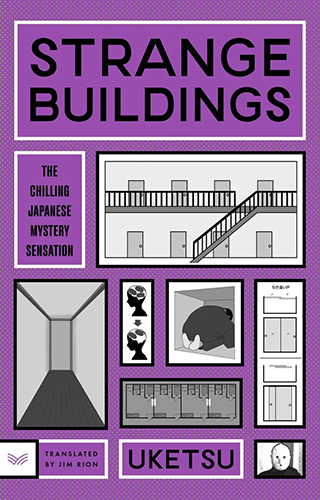
Strange Buildings, the 2023 follow-up to Uketsu’s smash hit Strange Houses, collects eleven illustrated stories about horror-themed architectural riddles followed by a lengthy exposition that reveals how these mysterious places are connected.
One of my favorite stories is “The Mousetrap House,” in which the wealthy heir to a large construction firm builds a luxurious mansion in order to kill a disabled elderly woman. If he puts a steep stairway next to the bathroom, he reasons, the woman will eventually lose her footing and tumble down the stairs.
When this eventuality fails to come to pass, he bullies his daughter into creating exactly the right set of conditions to make it happen. This horrible story is recounted decades later by the girl’s childhood friend, who was there on the night the old woman finally fell to her death.
I also enjoyed “The Watermill in the Woods,” which is presented as an old travelogue that recounts a curious building in the woods that’s nowhere near water. Its mechanical wheel instead powers the movement of an interior wall, but why would anyone need that?
This question is answered in the story “The House Where It Happened,” in which the frame narrator (who is styled as Uketsu himself) visits the old watermill in its current form as a remodeled modern house. When the village residents illuminate the shadows of the area’s history, the sinister purpose of the watermill becomes clear.
As in Uketsu’s other books, the overarching conspiracy is extremely silly. I don’t consider this a flaw, as there’s a certain sense of satisfaction in how delightfully outlandish the scenario is.
It should probably be said, however, that Uketsu is playing with acute cases of human misery as if they were Lego blocks. If one were to stage a gendered critique of this book, for instance, the ground is fertile. Still, I think it’s probably fair not to expect nuanced character portrayals from the weird architecture guy.
I enjoyed Strange Buildings, and I flew through this book as quickly as I could turn the pages. Jim Rion’s translation is compulsively readable, and I appreciate how Rion’s minor reconfigurations smooth over the “info dump” awkwardness of the original Japanese.
If you’ve never read Uketsu, Strange Buildings is a great introduction to the writer. If you’re already a fan, this is four hundred pages of the same, and it’s fantastic. Uketsu has found his niche, and it gives me joy to know that he’s out in the world being strange and living his best life.
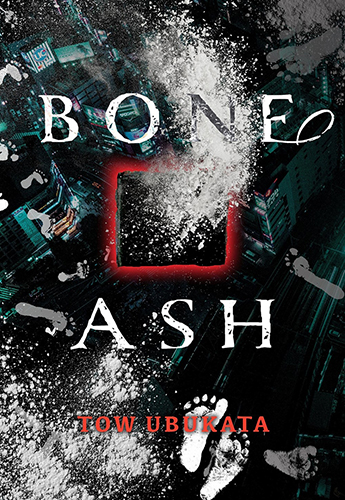
Tow Ubukata’s 2022 horror novel Bone Ash is a story about cursed architecture. The twist is that the architecture in question is the skyscraper outside Shibuya Station that was under construction during the mid-2010s. Deep under the construction site is a hole, and inside that hole is… Just some random guy? What’s he doing there? And what happens if he leaves?
Bone Ash’s everyman protagonist is a white-collar office worker named Mitsuhiro Matsunaga. Mitsuhiro is employed by the PR department of the development firm overseeing the aforementioned construction project contiguous to Shibuya Station, and his job is to ensure that all news is good news so that none of the project shareholders get cold feet. When a pseudonymous Twitter account starts posting creepy photos of the site with sinister captions about contractor injuries, the task of managing the situation falls to Mitsuhiro.
The first order of business is to track down the location of each photo to ensure that there aren’t any code violations. So far, so good. During his investigation, however, Mitsuhiro finds an odd door that isn’t in the floorplans, and behind the door is an impossibly deep staircase that eventually empties into a cavernous concrete space with a bare minimum of lighting. There’s a small Shintō shrine off to one corner, as well as a discarded piece of heavy machinery painted entirely white. And also a pit with a man chained to the bottom.
The man seems somewhat confused, but he insists that he’s happy to stay where he is. Somewhat against the man’s wishes, Mitsuhiro hauls down a ladder, hoists him out of the pit, and hauls him up the infinite staircase. Before he has a chance to recover from this exertion, a fire breaks out on site, and the man disappears.
When he files a report the next day, Mitsuhiro is informed that he entered a “ritual hall,” a space constructed to preserve a shrine (or other place of religious significance) on the land occupied by a large building. The man in the pit was a “mi-keshi,” something like a sin eater who would symbolically absorb the spiritual pollution caused by the displacement of deities. As long as a purification ritual is conducted properly by the appropriate religious authorities overseeing the ritual hall, everything should be fine. Unfortunately, Mitsuhiro has disrupted the ritual, and now there’s going to be hell to pay.
The scenario introduced by Bone Ash is incredible. The overview I’ve provided in four paragraphs is expanded in amazing detail over the span of about 170 pages, and these details are fascinating. Ubukata walks the reader through the deliciously liminal space of the ongoing construction site like a pro, all the while explaining the bureaucracy surrounding large-scale building construction in Tokyo in a way that genuinely caught and held my attention.
By the time the focus of the exposition shifts to the religious history surrounding the ritual hall in the earth under the building, I was hooked. The existence of creepy underground shrines sealing ancient calamities is a fun urban legend, and Ubukata’s skill as a writer is to ground this sort of fantasy in enough historical precedence to make it seem entirely plausible. I know this concept is silly, but as I read Bone Ash I was like Agent Mulder in The X-Files – I want to believe.
Bone Ash unfortunately falls apart once its focus shifts to Mitsuhiro’s attempts to deal with the curse he’s incurred, which influences his behavior in disturbing ways. Though he’s a convenient viewpoint character during the opening exposition, Mitsuhiro doesn’t have much of a personality, thus making his situation somewhat difficult to sympathize with.
I suppose the reader is supposed to identify with Mitsuhiro’s “everyman” qualities, but many of the author’s assumptions in this regard were lost on me. I don’t think it’s normal to feel compelled to work 15 hours a day, for example, nor have I ever been tempted to kill people for the chance to drive the company car.
Because I never really got a sense of who Mitsuhiro is supposed to be as a person, his cycle of making bad decisions for inexplicable reasons felt somewhat boring and repetitive. I get the sense that one solid conversation about what was going on could have gotten Mitsuhiro sorted out, but none of the other characters in the novel behave much more rationally than he does. In addition, though Mitsuhiro’s pregnant wife and young daughter become unwitting victims of his curse, they’re never allowed interiority and only exist to create complications.
I think what Bone Ash really wants to be about is the plight of unhoused people in Tokyo. Large-scale construction on top of open-air parks and other public gathering places often displaces communities of the unhoused, who are additionally exploited as day laborers with no recourse to legal reparations should something happen to them. Whether or not literal curses exist, Ubukata asks the reader to seriously consider the cumulative effect of this human misery, which is not only ignored but actively encouraged by Japanese politicians. Though this theme of housing precarity and labor exploitation is never fully developed, its introduction in the first half of the novel is handled with a remarkable degree of sensitivity.
In the end, it might seem odd to recommend Bone Ash only for the first 170 pages, but they’re really good pages! Despite my criticism of its narrative structure, I’d recommend this novel to anyone interested in the strange complications of urban architecture and the darker corners of Japanese religion and folklore – as well as to anyone interested in exploring uncanny spaces.
I’d like to extend my appreciation to Bone Ash’s translator, Kevin Gifford, whose smooth and confident style grabbed my attention from the first few pages of the novel. In addition, Wendy Chan at Yen Press has done a fantastic job with the book design, which is very cool and clever. I hope the care and attention given to this release helps Bone Ash find an enthusiastic audience of readers interested in the sort of well-researched urban legends and creepypasta stories that are perennially popular on YouTube and Reddit.
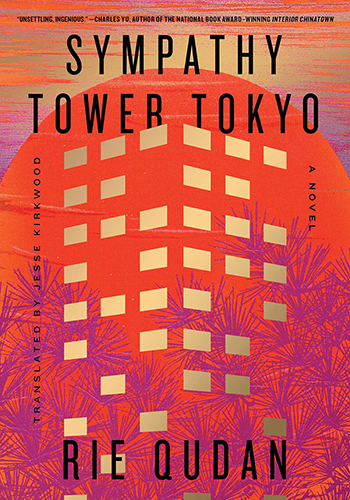
Rie Qudan’s short novel Sympathy Tower Tokyo, which was awarded an Akutagawa Prize in 2023, is a story about language, generative AI, and the culture war discourse surrounding the construction of a fictional prison facility in a high-rent area of Tokyo’s Shinjuku district.
Sara Machina is an artist and architect who wants to win the bid to design and build the eponymous “Sympathy Tower Tokyo,” a prison right in the middle of metropolitan Tokyo that will operate according to a utopian vision of providing state-mandated shelter to “homo miserabilis,” or people driven by economic precarity to commit crimes because they had no other options, Les Misérables style.
The main problem, in Sara’s eyes, is the name of the building, which is written in English and a mouthful to pronounce: Shinpashii Tawaa Toukyou. It’s also somewhat meaningless, Sara reflects, as are a number of other politically correct English terms that have replaced native Japanese expressions. Amusingly, she provides a list that includes examples such as negurekuto (neglect), which has replaced the formal term ikuji hōki (child abandonment) in public discourse.
Most of these loanword expressions don’t really change the meaning or public perception of the concept itself, but some do. “Homo miserabilis” is one such (fictional) example, having replaced the word hanzaisha, meaning “criminal.” Which is all well and good, Sara admits, but she still can’t envision a structure called “Sympathy Tower Tokyo.” If the building were to have a name that was more euphonic in Japanese, that would be a different story.
An appropriate name is provided by a beautiful young man who goes by “Takt,” a loanword from German used for an orchestra conductor’s baton. Takt became Sara’s casual boyfriend after she saw him through the display window of a luxury fashion store in Aoyama and point-blank asked him out; and, despite the difference in their ages, he does genuinely care for her.
While Sara frets over the intricacies of language, Takt has no qualms about using AI-built, the novel’s version of ChatGPT, to address any questions he might have. Despite his casual use of AI to understand the world and communicate with other people, Takt naturally and organically comes up with the expression Tōkyō-to Dōjō-tō (Tokyo City Sympathy Tower), which rolls off the tongue “like a spell from Harry Potter” and turns out to be exactly the inspiration Sara needs.
Sara’s design wins, and the tower is built on prime real estate for everyone to see. It is, she says, “the answer to the question posed by Zaha Hadid’s Olympic Stadium.”
Sara narrates the first and fifth chapters of the novel, while Takt narrates the second and fourth. The third chapter belongs to Max Klein, an American journalist covering Japan who’s gone freelance after being accused of making racist cultural generalizations. Takt is charmed by Max and begins adopting his speech patterns, while Sara (bless her heart) is mainly concerned about Max being fat and stinky and sweaty.
Max himself is a budget version of Hunter S. Thompson who seems to want to “tell it like it is” but unfortunately doesn’t possess the political acumen to make it as a mainstream reporter. In particular, Max is frustrated by what he sees as the tendency of Japanese officials (and Japanese people in general) to use smooth and politically correct language to mask their actual views and agenda.
While Max’s tirade is admittedly gauche, it seems to partially echo the author’s own views regarding excessive linguistic masking, which she expressed succinctly in an interview with The Guardian (here):
“There are people all around you who you would never think hold discriminatory views but actually do hold those views. A lot of Japanese people, on the surface, they know how to act in a way that makes them seem welcoming of diversity. And this discrepancy between what people think on the inside and what they say is a very distinctive feature.”
In other words, language is political, but the degree to which “correct” language can shape or reshape society is debatable. This question calls to mind the online conversations in 2022 surrounding Tetsuya Yamagami, the man who assassinated Shinzō Abe and attracted immediate widespread sympathy. While the murder itself was shocking, Yamagami’s motives were faultless. How, then, would it be appropriate to talk about him? Is someone like Yamagami truly a “criminal,” or rather a “homo miserabilis”? Regardless, the language we use to refer to people who commit crimes doesn’t change the fact that we feel compelled to incarcerate them, “Sympathy Tower Tokyo” though their prison may be.
Sara Machina was the victim of an assault that was never punished or even acknowledged, and she can’t quite reconcile herself to rhetorical towers built with politically correct language. Max goes five steps farther and expresses open disdain for the sort of wokeness that dictates that people who caused so much suffering to others aren’t properly treated like criminals but are instead allowed to live rent-free in a gorgeous luxury tower.
In the middle is Takt, the son of a high-profile “homo miserabilis” who ultimately decides to become a PR representative for the tower. Perhaps because he’s so used to consulting AI-built, his speech soon becomes just as smooth and beautiful as his face. When he begins to write about Sara Machina’s architectural genius, however, he finds that AI is insufficient, yet he can find no words in himself. This is fine with Sara, who (relatably) doesn’t wish to be perceived after becoming the target of sustained abuse on social media.
The plot summary I’ve given here doesn’t begin to do justice to the actual conflict of Sympathy Tower Tokyo, which revolves almost entirely around language. Both English-language and Japanese-language journalists have made a big deal about how “a portion of this award-winning novel was written by ChatGPT,” but this description is painfully misleading. When characters in the novel engage with AI-built, the program’s text was in fact generated by AI, as is appropriate. Although Qudan never has her viewpoint characters make a definitive statement about LLMs, the “smoothness” of machine-generated text is positioned as a mirror to the sort of “politically correct” language used by public officials to disguise and downplay critical issues in contemporary Japanese society.
In any case, Jesse Kirkwood’s translation is brilliant, and I very much appreciate the brief and informative “Translator’s Note” at the beginning of the book. Also, for what it’s worth, though the diegetic AI-built text may have been generated by an LLM, I didn’t get the sense that it was translated by one. If there’s any criticism to be directed at Sympathy Tower Tokyo, it’s that its emotional core is ephemeral and difficult to pin down. Perhaps ironically, the characters aren’t sympathetic; rather, their role is to serve as viewpoints along a spectrum of opinion. Still, Sympathy Tower Tokyo is a remarkably playful and intellectually stimulating book, and you can’t help but admire Qudan’s boldness in standing up and speaking to the current moment of culture war discourse.
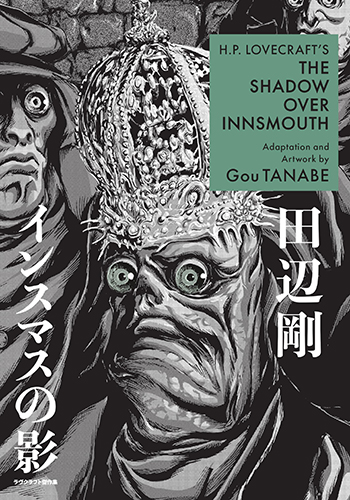
The Shadow Over Innsmouth is a gothic horror story in four acts. A college student on a self-guided architectural tour of New England takes an inexpensive bus that stops over in the isolated port town of Innsmouth. The student explores the town, and an elderly resident tells him about a wealthy sea captain who made an unholy bargain with ocean-dwelling fishpeople generations ago. The student is forced to stay in the town overnight, and the town’s hidden half-human residents chase him from his hotel. After successfully escaping Innsmouth, the student begins to question his own family lineage.
The writing in Lovecraft’s original 1931 novella can be difficult to parse, and the xenophobia of the narrative isn’t attractive to contemporary eyes. Regardless, this is an extremely influential story in the field of speculative fiction, with adaptations ranging from Alan Moore’s strikingly upsetting graphic novella Neonomicon to the ruined Fishing Hamlet of Bloodborne, not to mention countless stage plays, radio dramas, television episodes, indie films, video games, tabletop games, and even delightfully bizarre Christmas songs. Many of these adaptations, though excellent, assume a familiarity with the original that may not exist in an audience that isn’t already embedded in the speculative fiction fandoms of the twentieth century.
If you’re curious about Lovecraft’s work but put off by his prose, Dark Horse’s release of Gou Tanabe’s manga adaptation is an artistic marvel presented with an excellent translation in a handsomely published single volume.
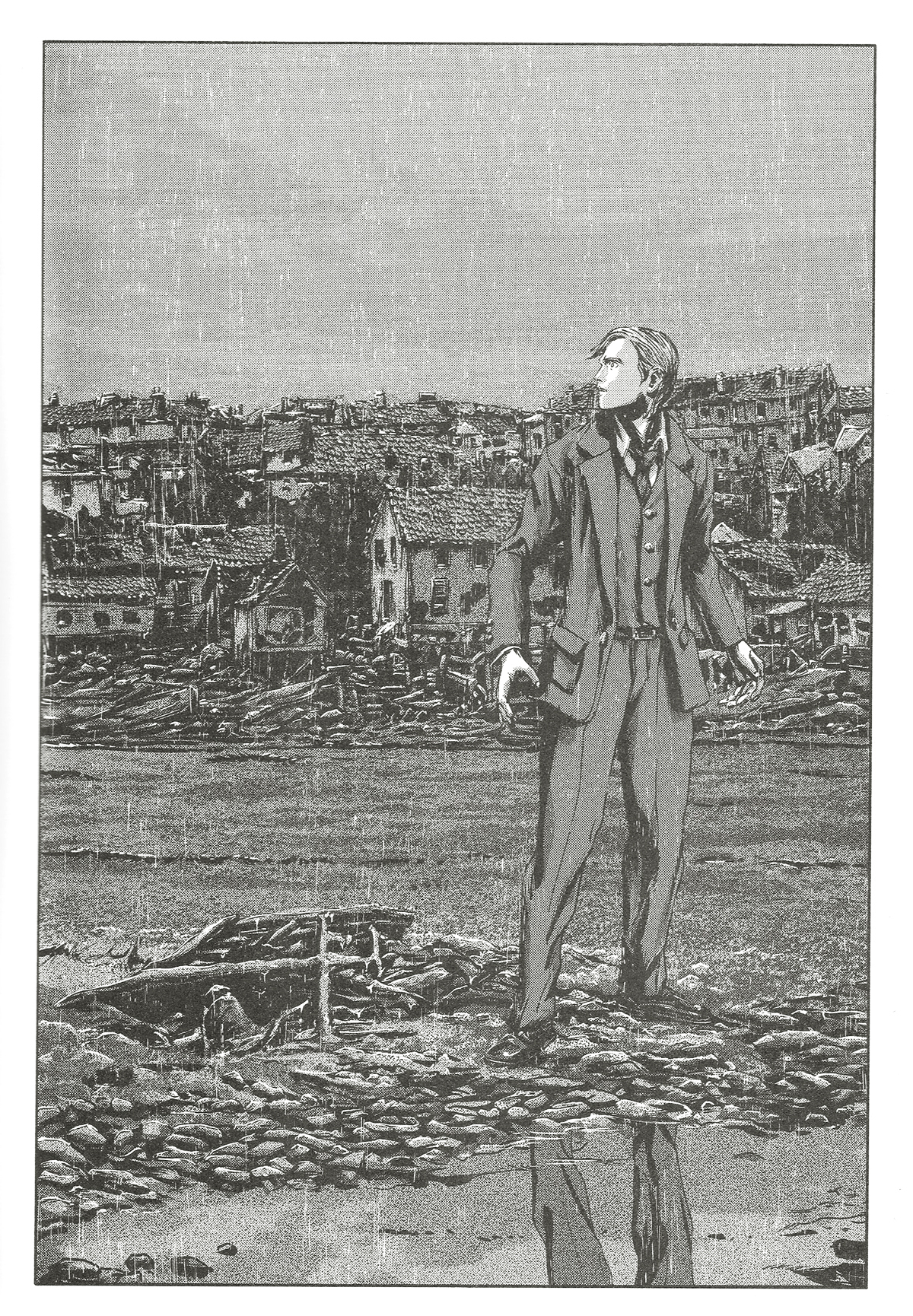
Tanabe’s adaptation of The Shadow Over Innsmouth brings the story to life with the distinctive visual language of horror manga while maintaining as much accuracy to the original as possible. Just like the story’s protagonist, Tanabe is fascinated by the architecture of the rotting Massachusetts town. The immaculately detailed cityscapes that sprawl across the pages encourage immersion into the horror of social and moral decay. Moreover, whereas Lovecraft only hints at what lies underwater, Tanabe is gleefully explicit in his depictions of throngs of fishpeople so horrific they’d make even Guillermo del Toro uncomfortable.
Tanabe’s The Shadow Over Innsmouth succeeds not only as a faithful retelling but also as a standalone work of gothic horror. By pairing Lovecraft’s oppressive atmosphere with his own meticulous draftsmanship, Tanabe bridges the gap between early twentieth-century weird fiction and contemporary horror manga. The manga adaptation of The Shadow Over Innsmouth preserves the unsettling allure of the original while offering both longtime fans and newcomers an invitation to experience Innsmouth’s decayed splendor in disturbingly compelling detail.
Keita Katsushika’s manga Higashi Tōkyō Machi Machi (東東京区区) is a leisurely walking tour of East Tokyo. As suggested by their pen name, the artist lives in Tokyo’s Katsushika Ward, which is known for the retro ambiance of its Shibamata district and its green and pleasant riverside walking paths. Keita Katsushika is keen to show the reader the quiet charm of the area while exploring the depth of its history and the diversity of its communities.
Higashi Tōkyō Machi Machi follows the adventures of three focal characters. 21yo Sarah is a college student majoring in Urban Studies, and 8yo Selam is the daughter of an Ethiopian immigrant who runs a small restaurant near her university. While Sarah and Selam are out on a walk one afternoon, they meet 13yo Haruta, a homeschooled student pursuing his interest in Tokyo’s history. The friendship between these three characters is sweet and uncomplicated, and their personalities facilitate different approaches to urban exploration.
The trio’s first walk together takes them to the Tokyo Skytree, where they’re able to look out over the neighborhood while studying a reproduction of an Edo-period artwork that depicts the region as it appeared in the past. Another adventure takes them to the former site of the Venice Market, a postwar black market that was created by laying boards over a drainage canal. Since then, a normal street was built over the water, and the area hosts a number of stores and restaurants catering to Tokyo’s immigrant populations. If you’re interested in the history of the Venice Market, you can check out a two-page preview of this section of the manga (here).
All three characters were born and raised in Japan, and no one ever treats them with anything less than kindness and respect. As Sarah writes in the opening to her senior thesis, the formerly depopulated areas of Northeast Tokyo have gradually become home to many immigrant communities, who have revitalized the neighborhoods where they settle. Instead of resenting the growth of their communities, many older residents are happy to share their knowledge and memories with curious young people.
For what it’s worth, this portrayal of gregarious retirees is true to my own experiences walking around Tokyo with friends. Whether you’re a visitor or a long-term resident, it doesn’t matter what your face looks like or how you dress. As long as you’re willing to listen, there will always be people willing to share their stories. The manga’s scenes of immigrant community gatherings are equally warm and friendly. It’s lovely to see the diversity of people and life experiences in Tokyo shown as what it really is – not as a social issue to be discussed when something bad happens, but rather as a normal and pleasant aspect of everyday life.
In many ways, Higashi Tōkyō Machi Machi reminds me of Kiyohiko Azuma’s manga Yotsuba&!, which follows the wholesome everyday adventures of a translator, his friends, and the young girl he adopted abroad. Just as in Yotsuba&!, the art of Higashi Tōkyō Machi Machi places simple and stylized characters into meticulously detailed backgrounds, thus helping the reader feel immersed in the cityscape of Tokyo and its suburbs.
The main difference is that Keita Katsushika’s manga is dense with text and reads more like a collection of illustrated essays than a story. Thankfully, the writing follows the standard shōnen manga convention of glossing the kanji with their hiragana pronunciations. As you might imagine, this is especially helpful with place names.
I’d recommend Higashi Tōkyō Machi Machi to anyone who’s interested in the history and culture of Tokyo. If you’ve read Jorge Almazán’s study Emergent Tokyo and are curious about how the urban design principles Almazán charted in West Tokyo neighborhoods have been adapted to the older neighborhoods in the east of the city, this manga was published for you specifically. Higashi Tōkyō Machi Machi is a treasure, and it’s a joy to explore Tokyo alongside its characters.
Emergent Tokyo: Designing the Spontaneous City is a fascinating study of urban space augmented by a wealth of photographs and illustrations. Jorge Almazán convincingly argues that, instead of being designed from the top down, Tokyo’s distinctive cityscape emerged from history and opportunity.
Almazán focuses on five distinguishing characteristics of Tokyo, from the famous zakkyo “mixed-use” highrise buildings that line the main boulevards to the dense shopping areas that crowd the bays between support columns under elevated train tracks. Each feature of Tokyo’s cityscape is illuminated by three case studies that are meticulously documented and analyzed.
My favorite chapter is about the narrow and winding ankyo streets of West Tokyo, which were built on top of old canals and have gradually become pedestrian oases. The most famous is Harajuku’s Mozart-Brahms Lane, the chill and ambient twin to Takeshita Street. As in the case of Mozart-Brahms Lane, ankyo streets have often become communal backyards for neighborhoods with flashier public faces.
I especially appreciate the Conclusion section, in which Almazán demonstrates that corporate-led urbanism has created unwelcoming and visually unappealing spaces that have none of the vibrancy of the more organic spaces fostered by collectives formed by homeowners and small business managers. While urban planning is still necessary, Almazán argues, emergent communities should not be stifled.
Emergent Tokyo isn’t a book for tourists, but I imagine it will be of interest to anyone who’s curious about urban design. Also, although some of the more academic text might fly above the heads of small children, I think Emergent Tokyo would be a wonderful book to give a kid. The illustrations and diagrams are truly fantastic, and they’re so immersive that I found myself disappearing into the details as I imagined walking through the Tokyo gorgeously laid out across the pages.
I learned about this book while doing research on the manga Hot Gimmick, which is about teenage romance and social hierarchies in company-owned danchi housing. If a certain living arrangement exerts such a strong influence on people’s lives that it can determine patterns of everyday interaction, I wanted to know more about what these danchi actually look like.
Danchi are apartment complexes. Unlike the stand-alone manshion apartment buildings found everywhere in the urban centers of Japan, danchi are sprawling arrangements of buildings situated in more peripheral locations such as suburbs and commuter towns. As seen from the windows of passing trains, danchi are almost monstrous, and I’ve always counted myself lucky to not have to live in one. After reading Danchi junrei, though, I’m now jealous of the people who have had the experience of living in a danchi.
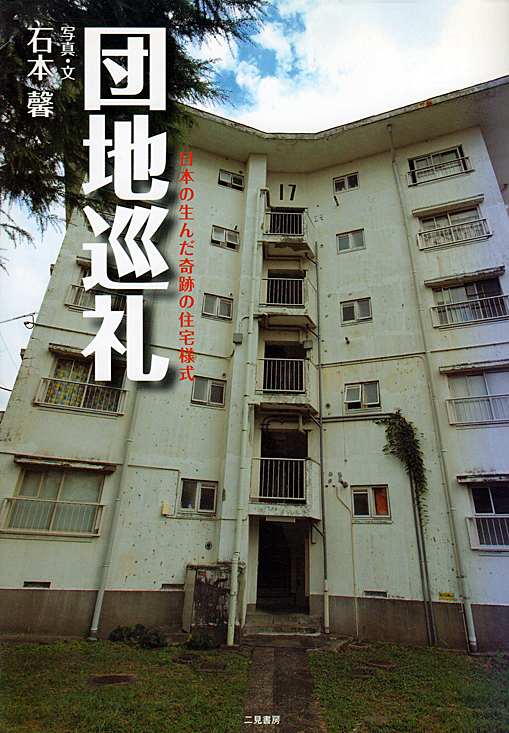
In Danchi junrei, or “danchi pilgrimage,” professional photographer Ishimoto Kaoru takes the reader along on his journeys into danchi complexes of various sizes and layouts. His pictures don’t beautify the buildings, but he does give the reader a sense of the charm and livability of the danchi he visits. Although the buildings themselves, which were constructed in the housing boom of another era (usually the late fifties), are often dilapidated, the backyards and balconies and inner courtyards and playgrounds of these danchi are filled with children, pets, greenery, and the evidence of the daily lives of the people who live in the complex, from hanging laundry to bicycles to discarded toys to graffiti.
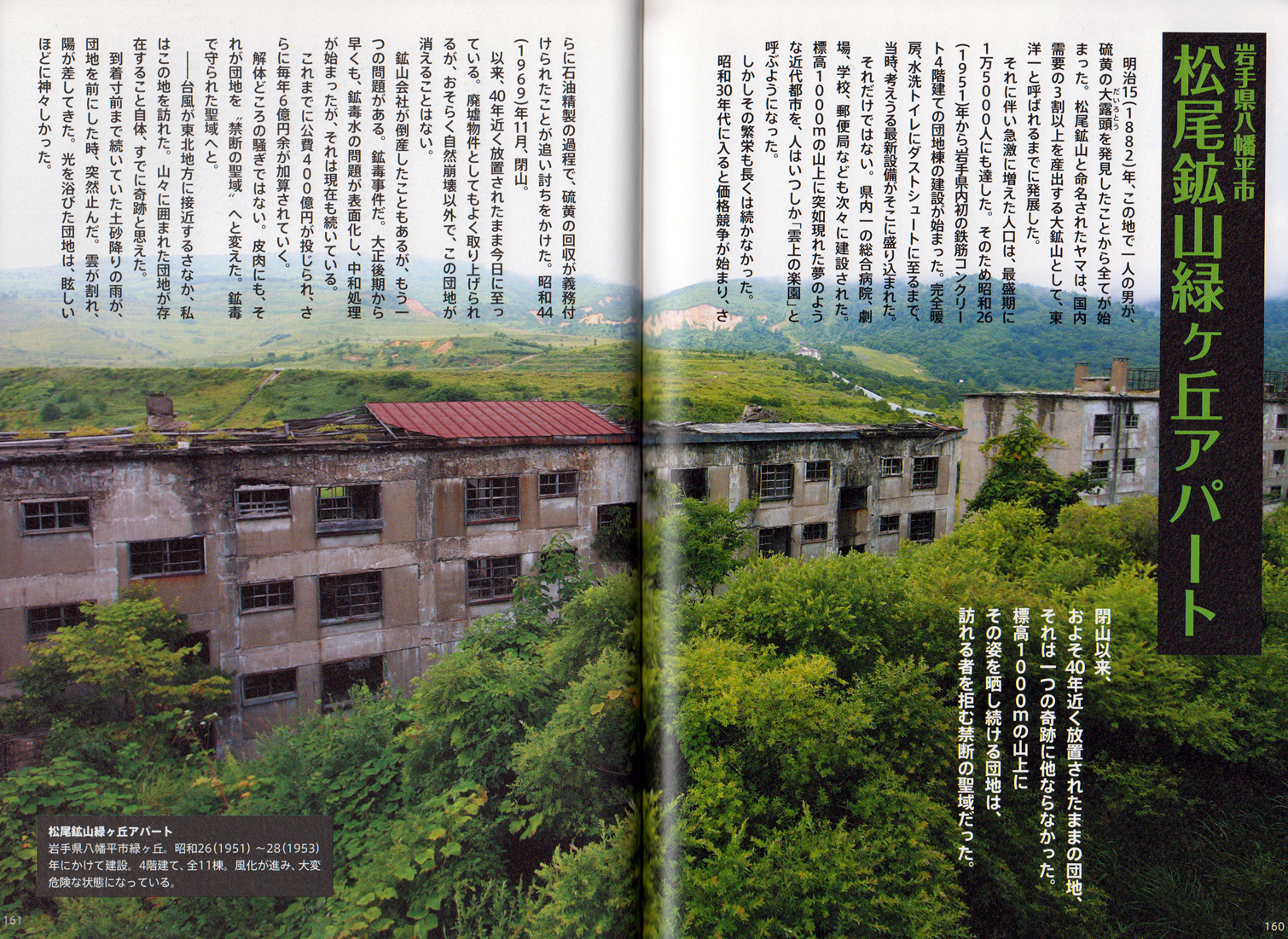
Of course, this is when there are people living in the danchi at all. Over the course of his pilgrimage, Ishimoto also visits complexes that are nearly abandoned, fully abandoned, or already demolished at the time of printing. Some of these danchi have historical significance, such as a structure in Daikanyama built in 1927 that was one of the first modern apartment complexes in Japan. Some of them, such as the “ghost danchi” in Meguro, are associated with urban legends and famous among people into haikyo, or the exploration of abandoned buildings. Although these derelict danchi are covered with rust and mold, they’re surprisingly well preserved, and one might think that people could still be living there were it not for the rampant, jungle-like plant growth that has filled the open spaces and started to encroach into the buildings themselves.
Ishimoto’s photographs are enhanced by his text. Each photograph is accompanied by an unobtrusive one-line description, and each set of photographs is introduced by a short paragraph of flavor text. What I really enjoyed reading, however, were the one-page descriptions of each danchi, which would usually include the history and occupancy status of the complex as well as any rumors that Ishimoto had picked up from fellow danchi enthusiasts or just people living in the neighborhood of the danchi in question. Ishimoto also describes his own experiences of walking around each danchi, which tend to be particularly interesting when the complex has been abandoned.
Ishimoto is an engaging writer, and the undoctored feel of his photography gives the reader a sense of proximity that wouldn’t be possible with more polished-looking set pieces. Danchi junrei is urban exploration at its finest, and I surprised myself by enjoying the book so much. I highly recommend it to people interested in Japanese cities and architecture. I might also recommend it to people interested in Japanese aesthetics, because you can’t get any more wabi-sabi than a deserted apartment complex slowly going to seed on the borders of Tokyo.
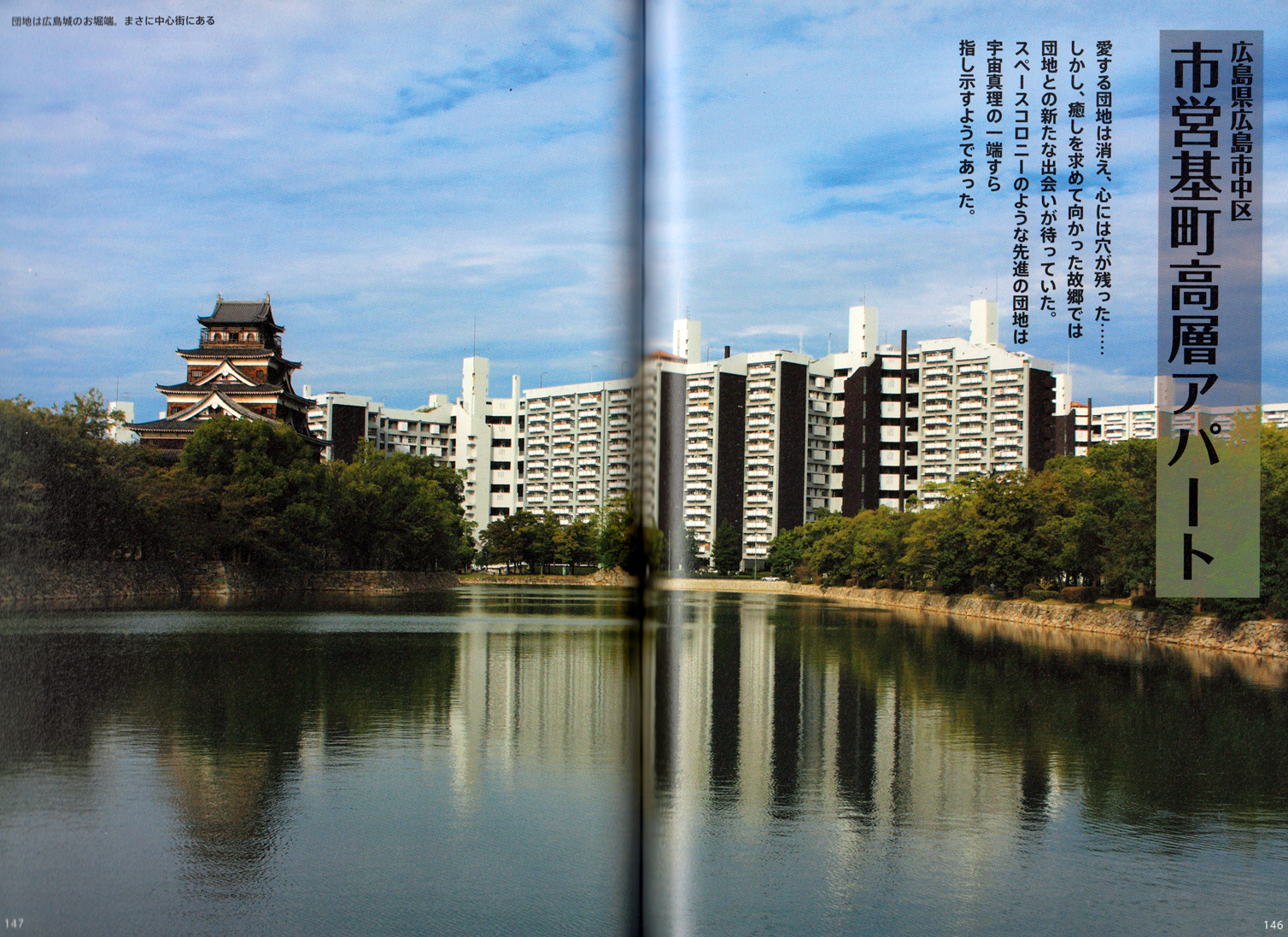
I should mention that Ishimoto ventures out of the greater Tokyo metropolitan area as well. Here are two examples from the end of the book…


 Contemporary Japanese Literature