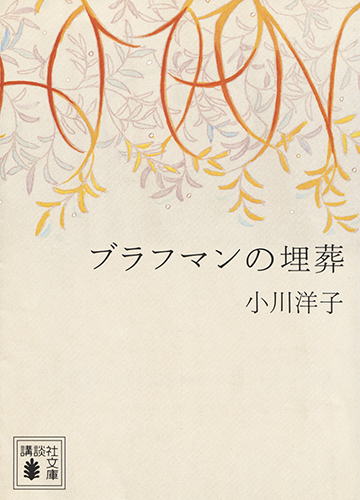
Yōko Ogawa’s 2004 novel Burafuman no maisō (Brahman’s Funeral) is a story about the lonely caretaker of an isolated artist’s retreat who adopts a forest creature of indeterminate species. Though this short novel features many of the tropes common in bestselling stories of animal companions, it was awarded the Izumi Kyōka Prize for literary fiction that explores the darker side of the human condition.
On the first day of summer, the unnamed caretaker finds a forest creature outside the back kitchen door. The creature is injured, and he doesn’t object when the caretaker picks him up and takes him inside. In fact, the creature almost seems to be asking for help, and his puppylike tameness inspires the caretaker to adopt him as an indoor pet.
The mansion where the narrator lives and works used to belong to the wealthy owner of a publishing company, but it has since been converted into an artist’s retreat. After a conversation with the stonemason who maintains a permanent studio on the grounds, the narrator decides to name the creature Brahman after the Sanskrit word the mason has carved onto a gravestone.
While Brahman recovers, the caretaker keeps the creature in his room. The caretaker’s personal space is stark and empty, but Brahman finds ways to keep himself occupied by opening drawers and gnawing on the coat hangers in the closet. At night, Brahman sleeps on the bed while curled up against the caretaker.
Once Brahman figures out how to operate the door handle, the caretaker begins taking him outside. The scenes in which he describes the meadows and forests surrounding the retreat through Brahman’s eyes are gorgeously written. Brahman delights in the sun and the wind and the grass, and he especially loves the garden pond, swimming and diving to his heart’s content as the caretaker watches.
Though the caretaker seems amiable enough, he seems to have no friends save for the stonemason. Aside from the artists visiting the retreat, the only person the caretaker speaks with is the young woman who works at the small general store outside the train station. Though the caretaker clearly has a crush on her, she’s dating an older man who lives in the city, and all she wants is to move away from the isolated village. The caretaker clearly doesn’t have a chance with her, and his yearning for connection is poignant yet gently pathetic.
The purpose of contemporary popular pet fiction is to comfort the reader, often by anthropomorphizing the animals in service to the human protagonists. Burafuman no maisō is certainly beautiful and joyous in many places, but Ogawa has little interest in cozy vibes. To me, at least, this is an intensely gothic novel.
Brahman dies at the end, but hints of death suffuse the entire story. Aside from the artists’ retreat managed by the caretaker, the most notable feature of the town is its sprawling cemetery, which has a strange but poetic history.
Because the mountainside town has a plentiful supply of both stone and stone carvers, people who lived upriver once commissioned its artisans to create coffins for their dead. Stone coffins were difficult to transport, however, and so the remains would be placed in wooden coffins that were sent downstream to be buried in the hillside cemetery. The isolated village thus became the final resting place for the dead who were all but abandoned by the rest of the world, a description that mirrors the position of the caretaker himself.
Ogawa has something of a fetish for sensitive but lonely men, and I have to admit that the caretaker breaks my heart a little. Along with having no name, he also seems to have no family, nor any past at all. What he has instead is an old family portrait photo that he buys from a Sunday antique market in the town square. The traveling merchant gives him an old wooden frame to go with it, so the caretaker hangs the photo in his room, where he sits on the bed and imagines the lives of the long-dead family. The only living joy in the caretaker’s life comes from his interactions with Brahman.
The genre of “cozy pet fiction” is almost always about people. As such, it often treats animals as human, even going so far as to give them human narrative voices so that the reader can better understand the human characters they observe. Burafuman no maisō does the opposite by using its nameless human narrator as a vehicle to document the short life of Brahman.
Though a human reader can never perceive the world in the way that an animal does, Ogawa asks us to sympathize with Brahman through the narrator’s documentation of his umwelt: what he sees and tastes and smells, and how he reacts to the world. To the caretaker, the behavior of other humans makes little sense, but he joyfully devotes himself to chronicling Brahman’s appearance and behavior through a series of annotated lists of observations with titles such as “Brahman’s Tail,” “Brahman’s Meals,” and “Brahman’s Footsteps.”
And finally, through no fault of his own, the caretaker is forced to close his account with a list titled “Brahman’s Funeral.” Through Brahman’s death and subsequent burial in a tiny stone coffin, Ogawa succeeds in making the reader care deeply about a semi-wild animal that was never anthropomorphized in any way. I appreciate the thematic artistry, but it’s nevertheless a difficult ending.
Hikaru Okuizumi (author of The Stones Cry Out) writes in his postscript to the Kodansha paperback edition that Ogawa more than likely started this short novel during a literary festival in the small French town of Fuveau, where she apparently bowed out on a large group dinner to stay alone in her room and write. This makes perfect sense to me, as Okuizumi’s anecdote accurately reflects the tone of the story. Despite Brahman’s death and the caretaker’s loneliness, Burafuman no maisō dwells in the quiet and contemplative corners of the gothic genre, and this short novel feels like a small but meditative retreat.
 Contemporary Japanese Literature