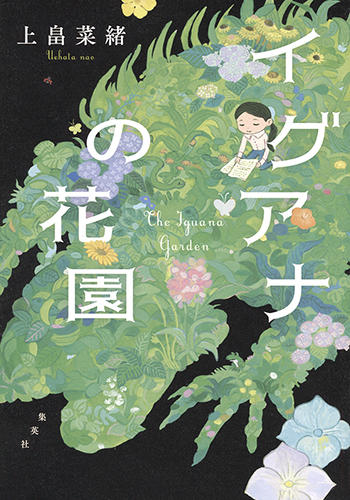
The Iguana Garden (イグアナの花園) is the second novel by Nao Uehata, whose 2020 magical realist story しゃもぬまの島 (Shamonuma Island) won the Subaru New Writer Award with high praise from Miyuki Miyabe. In The Iguana Garden, as in Uehata’s debut novel, a young woman who is able to speak with animals navigates a difficult relationship with her family. Instead of a mythical creature like the shamonuma, however, the protagonist of The Iguana Garden talks with her pet iguana as she hesitates on the border of adulthood.
Misono Yatsuguchi has a strange ability – she can hear the voices of small animals, especially reptiles. Though she feels at home in the garden of her family’s sprawling estate, she has trouble talking with other people. Misono’s father, a botanist who teaches at the local university, encourages her interest in the natural world and introduces her to his fellow professors, who befriend her and share their research.
When Misono’s father dies of a sudden heart attack, she’s left alone with her mother, an heiress who has inherited her family’s ikebana traditions along with their wealth. Misono’s mother is just as bad at connecting with people as Misono herself, so she unofficially adopts one of her ikebana students, a girl in high school named Tsubame, to act as her assistant. Tsubame moves into the estate and becomes something like an older sister to Misono.
Misono tries to make friends with the other girls in her elementary school class, but they find her lack of emotional expression creepy and begin bullying her in an attempt to provoke a response. When their pranks reach a point that Misono finally finds unacceptable, she resolves never to make friends again.
After these opening chapters, the story begins in earnest. Misono is a graduate student studying animal behavioral science at the university where her father once taught. She’s moved out of her mother’s estate and lives in a small atelier that her father once used to house his botanical samples and garden. Misono has remodeled the space as an open terrarium for her fully grown pet iguana, Sono, with whom she shares easygoing subverbal conversations.
The calm of Misono’s quiet life is shattered when her mother abruptly announces that she has terminal cancer. In the year she has left to live, she wants Misono to get married.
For someone like Misono, who reads as asexual and on the autism spectrum, dating is nothing less than a disaster waiting to happen. In distress, Misono allows herself to be taken to a post-seminar drinking session, where she gets blackout drunk and ends up inviting a friendly but financially strapped student named Kinoshita – who goes by Kiki – to live with her in the atelier. Kiki doesn’t mind the cramped space, or the free-roaming iguana, or even Misono’s personality quirks. In exchange for room and board, Kiki says, she’ll help Misono navigate the challenges of dating.
What follows is a semi-comedic gauntlet of mishaps that, more than anything, validate Misono’s asexuality and justify her prioritization of non-romantic relationships, especially with other women like Tsubame and Kiki. During this process, Misono ends up reconnecting with a childhood acquaintance who tells her that his secondhand experience with Misono’s bullying inspired him to become a teacher specializing in the education of neurodivergent children.
Throughout the story, Sono the iguana offers commentary and wise advice. While I was reading, I wondered whether Sono was actually speaking, or whether Misono had created the persona of Sono as a trauma response to her father’s death.
At the end of the novel, Misono’s mother reveals that she can also hear the voices of animals, and that her demand for Misono to get married came from a private conversation with Sono, who wanted to create a catalyst for her human to learn how to connect with other people. Whether Misono’s mother is telling the truth is open to interpretation, but the result is the same – Misono manages to find her community, understand her parents, and figure out what she wants to do with her life without having to worry about romance or marriage.
It’s all very wholesome, honestly. I’m usually not a fan of sentimental stories, but the end of The Iguana Garden genuinely warmed my heart. “All the women become friends and no one gets married and no one has to worry about money and everyone lives happily ever after” is a good ending, all things considered.
I feel like there might be a bit too much trauma (and supremely awkward dates) in The Iguana Garden for this book to be considered “cozy fiction,” but I also feel like this novel is probably the closest to cozy cat fiction that you can get for all the girls who like dinosaurs instead of cats. The author never explicitly identifies Misono as asexual or on the autism spectrum, thereby avoiding the tricky issues of labels and identity politics, but all the classic markers are there for readers who understand them. Personally speaking, I was happy simply to watch a young woman like Misono find friendship and acceptance, but I imagine that readers who see aspects of themselves in Misono will appreciate the advocacy and allyship that the author offers with this story.
Putting all of that aside, The Iguana Garden combines the fantasy of being comfortably wealthy and living in a beautiful plant-filled atelier with the tension of wondering what will happen with Misono’s mother, who initially seems cold and unapproachable but gradually becomes more sympathetic as Tsubame helps Misono learn more about her late father. Sono the iguana, who comes off as a cranky but kind-hearted old lady, is a lot of fun, and Kiki radiates pure charisma as her good sense and good humor keep the story moving forward. Through it all, Nao Uehata delights in descriptions of the verdant nature and healthy plants that surround the characters.
The Iguana Garden is a beautiful book, and I’d love to see it translated (ideally along with Uehata’s debut novel Shamonuma Island). I feel like this story reflects something that a lot of pro-diversity advocates have been saying for a long time, namely, that “difference” doesn’t necessarily have to be subversive. Given all the bestselling cozy cat fiction in the world, it’s wonderful to see the nonconformist iguana girl find a similarly comfortable place for herself. She deserves a happy ending too!
 Contemporary Japanese Literature