Natsuko Imamura’s Asa: The Girl Who Turned into a Pair of Chopsticks collects three short literary thought experiments that go to strange places. Each of the characters is missing something essential, and where that lack ultimately leads them is impossible for the reader to predict.
Asa, the eponymous “girl who turned into a pair of chopsticks,” has trouble getting other people to accept any sort of food that she’s touched with her hands. Meanwhile, Nami, the “Girl Who Wanted to Get Hit (and Eventually Succeeded),” is strangely unable to be touched by other people at all. Asa’s quest to understand what makes other people perceive her as unclean has fantastic consequences that become humorous in their absurdity, while Nami’s desire to be touched sinks her into a dark mire of self-harm.
In my favorite of the three stories, the protagonist of “A Night to Remember” claims to have spent fifteen years laying around and doing nothing after graduating from school. This woman is so lazy, in fact, that she spends the majority of the story casually slipping across the ontological boundary that separates human and animal. If “A Night to Remember” were a story about a cat, it would be super cute, but the narrator is definitely a person. The resulting uncanniness is superb.
It’s fitting that the collection’s Afterword is contributed by Sayaka Murata, the author of Convenience Store Woman and Life Ceremony. “These stories give the reader another way of seeing,” Murata writes, “transfiguring what you should be seeing, and sometimes contaminating it.” Like Murata, Imamura refuses to allow the reader to take “common sense” for granted. The stories in The Girl Who Turned into a Pair of Chopsticks thereby offer a glimpse into a strange world where socially acceptable normality doesn’t apply. Imamura’s visions are playfully surreal, occasionally upsetting, and never boring.
Chris McMorran’s Ryokan: Mobilizing Hospitality in Rural Japan is an academic monograph about gender and society that’s surprisingly entertaining and enjoyable to read. McMorran is an anthropologist at the National University of Singapore who spent more than a year working at an onsen hotel in the idyllic town of Kurokawa on Japan’s southern island of Kyūshū. His account of how such resorts operate is informed by his own experience, as well as a decade of talking to people with fascinating life stories.
McMorran is discrete and never exploitative, but he uses a fair amount of behind-the-scenes drama to illustrate the conflicting views at play in the construction and maintenance of Kurokawa’s fantasy of “traditional Japan.” Not every aspect of these traditions is worth preserving, especially the pressure placed on firstborn sons (and their wives) to inherit the family business, often at the expense of the ambitions of a family’s daughters.
Despite stubbornly persistent gendered expectations, one aspect of these onsen hotels that seems almost utopian is their willingness to employ women who might otherwise be in danger of falling through the cracks of society, such as divorcées and single mothers with small children. Even though McMorran tackles serious social issues, his approach is always sympathetic and accessible, and his writing is so crisp and clear that this study often feels remarkably akin to a literary memoir.
Ryokan: Mobilizing Hospitality in Rural Japan has the potential to be an entertaining read for fans of Japanese pop culture interested in indulging in a bit of armchair tourism while gaining a deeper understanding of contemporary Japanese society. To enhance the experience, I’d also recommend the gorgeous travel guide Onsen of Japan: Japan’s Best Hot Springs and Bath Houses, which perhaps might be enjoyed alongside a viewing of the beautiful slice-of-life anime movie Okko’s Inn.
A young woman named Kiyose was recently promoted to the position of manager at an independent café. She devotes her love and attention to the business, but all is not well. One of her employees is a constant source of frustration, and she hasn’t spoken to her long-term boyfriend Matsuki since they had an argument about how Kiyose should handle the situation.
One day, Kiyose randomly gets a call from the hospital informing her that Matsuki is in a coma. The nurse in charge of his care informs her that she’s the closest thing he has to a next of kin, so she dutifully goes to confirm his identity. During her visit, Kiyose learns that Matsuki suffered a head injury sustained under mysterious circumstances, and his only other visitors are two unrelated people she’s never met.
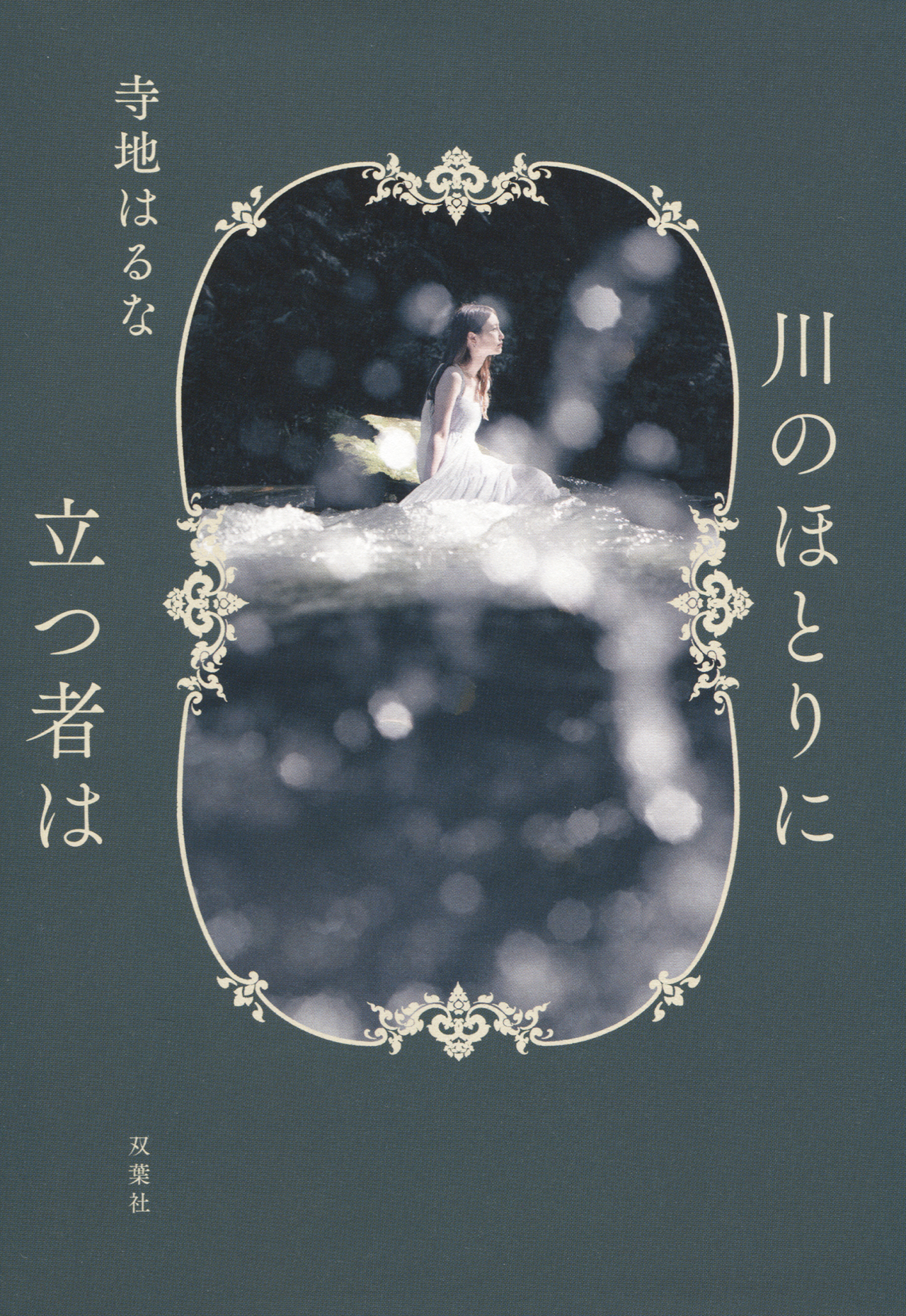
川のほとりに立つ者は initially seems as though it’s going to be a mystery about crime, but it’s actually a character drama about living with invisible disabilities, specifically ADHD and dyslexia. As Kiyose begins digging into Matsuki’s life, she learns that, despite being alienated from his uptight family of professional calligraphers, Matsuki was teaching an adult with dyslexia how to write so that he could pass letters to a woman trapped in an abusive housing situating.
The novel’s title is taken from the proverb 川のほとりに立つ者は水底に沈む石の数を知り得ない, “Those who stand on the river’s shore can never know the number of stones under the water.” After learning about the discrimination faced by Matsuki’s friend, however, Kiyose begins to understand how unfair it is to tell someone with a disability that they’re just being lazy and irresponsible. She realizes that she was being cruel to her employee, who had come out to her as having ADHD, and she resolves to make her café a more accessible and welcoming space while being kinder to the people in her life.
Although her work hasn’t yet been translated into English, Haruna Terachi is a prolific writer who has won a number of literary prizes since her debut in 2014. This is my first encounter with Terachi’s writing, and I enjoyed this short novel, especially the chapters that were narrated from Matsuki’s perspective. I also found it satisfying to watch the mysteries presented at the beginning of the story slowly unravel. That being said, I was unsatisfied with the novel’s conclusion that the solution to systemic discrimination falls on individuals, who simply need to “walk at the same pace” as people with disabilities.
Still, it’s always good to see sympathetic stories about disability – especially invisible disability – and I appreciate Terachi’s pushback against the toxic misconception that disabled people simply aren’t trying hard enough. Along with people interested in the experience of living with disability in contemporary Japan, I’d recommend this book to anyone looking for a fast-paced and wholesome character drama driven by hidden secrets brought to light.
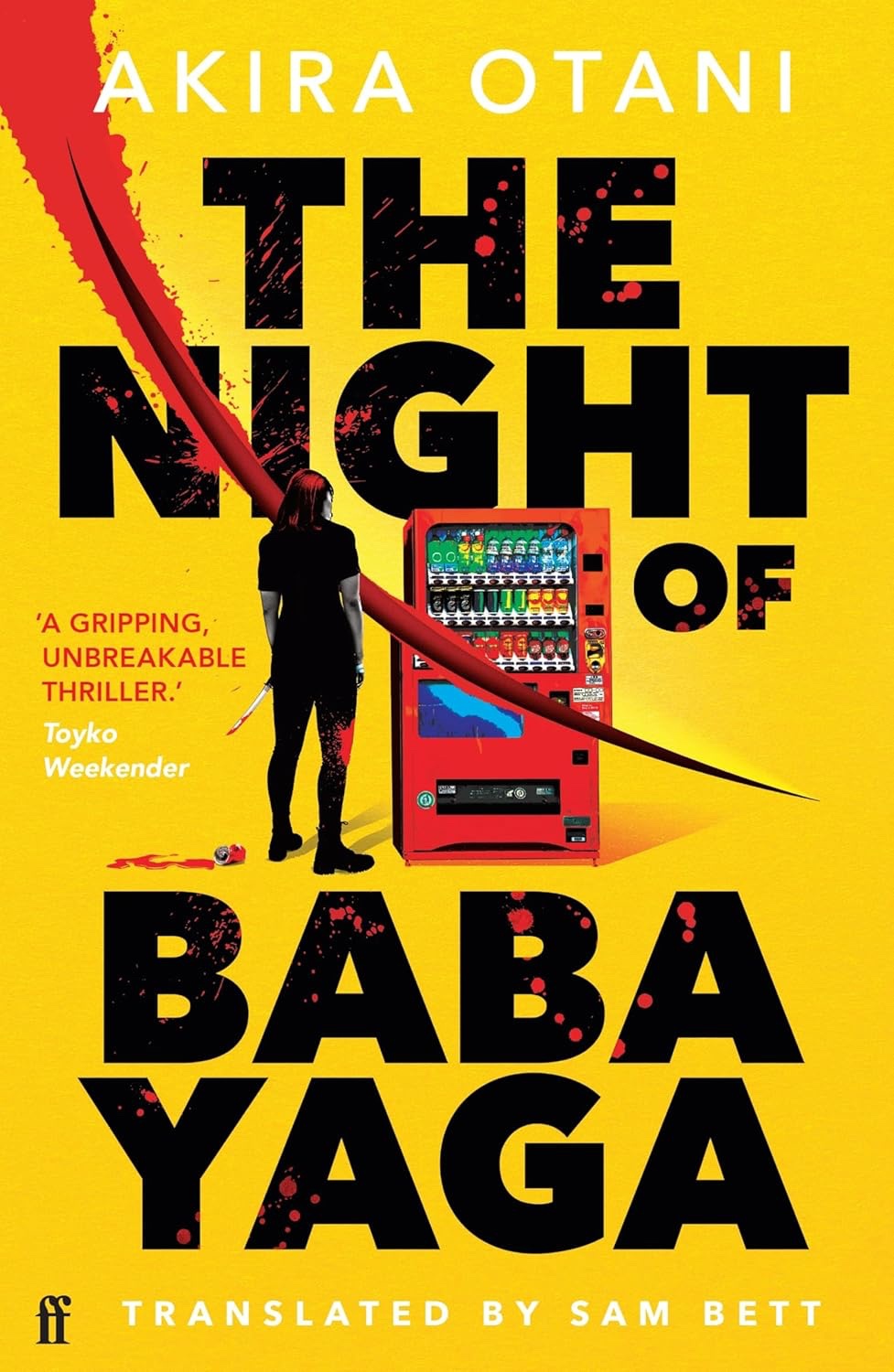
The Night of Baba Yaga is two hundred pages of violence, torture, and rape. All of the novel’s descriptions of violence, torture, and rape are graphically explicit; and again, there are two hundred pages of them. I enjoyed this book, but it’s not for everyone.
The bulk of The Night of Baba Yaga is set in Tokyo in 1979. A 22yo street brawler named Yoriko Shindo is pressed into the service of a notorious yakuza crime syndicate whose boss has ordered her to become the chauffeur for his precious only daughter, a prim-and-proper college student named Shoko. The yakuza boss assumes that, because Shindo is female, she won’t attempt to romance Shoko, but of course the two women fall in love and help each other escape the family.
I’d like to say that The Night of Baba Yaga is a love story, but it’s more of a series of fight scenes occasionally broken by scenes of torture and rape. The novel begins and ends with Shindo getting the shit beaten out of her, and most of the gaps in the fighting are created by the aforementioned torture and rape. I’m not saying this is a bad thing. The Night of Baba Yaga is what it is, which is a lesbian BDSM hurt/comfort fantasy in which male characters enact hurt so that female characters can provide comfort. Aside from the brief comfort scenes, there’s not much romantic chemistry or character development.
The Night of Baba Yaga is empowering for the woman who wrote it, no doubt, and I get the sense that there will be queer readers (such as myself) who will be amused to see this sort of openly horny fantasy in print. The Night of Baba Yaga isn’t empowering for any of the characters, however. Short interstitial chapters jump ahead in time, but I hope it’s not a spoiler to say that nobody gets a happy ending. Not in this sort of story. The tragedy is so over-the-top it’s Shakespearean.
Personally, I thought the ultraviolence was a lot of fun. The action is so gory and exaggerated that it’s difficult to take seriously, and The Night of Baba Yaga feels silly and campy in the same way that Takashi Miike movies like Ichi the Killer do. If you (like me) are a fan of the horror movie mindset that inspires you to cheer with delight when somebody’s hand gets chopped off, The Night of Baba Yaga delivers.
The translator, Sam Bett, has done an amazing job. Fight scenes are notoriously difficult to write, yet the translation is snappy and remarkably fast-paced. The character voices aren’t “natural” by any means, but they’re pitch-perfect for the genre. When it comes to descriptions of rape and violence, Bett doesn’t pull any punches. It’s an incredible translation, and I am in awe.
I’ve seen social media reviews hailing The Night of Baba Yaga as “an inspirational queer romance,” and it 100% most definitely is not that. Nobody does any learning or growing in this story, which has exactly zero social commentary. Rather, The Night of Baba Yaga is an adrenaline-laced lesbian power fantasy about being the most badass fighter you can be until you die. If you’re not the target audience, The Night of Baba Yaga probably isn’t for you. Like Wolverine, it’s the best at what it does, and what it does isn’t very nice. This short and compulsively readable novel gets in, gets messy, and gets what it came for.
Nahoko Uehashi’s fantasy epic The Deer King is the story of two characters who find themselves caught in an ongoing conflict fought on two fronts – an imperial war for conquest, and the spread of a mysterious disease.
The Deer King works best when it focuses on its primary viewpoint character, a middle-aged warrior named Van who lost his homeland when he was captured in battle and sent to the imperial salt mines to work and die as a slave. After the mines are attacked by black wolves, Van passes out and wakes to find he is the sole survivor – with one exception, a small child named Yuna who was stuffed into an oven in the kitchens aboveground.
With Yuna in tow, Van escapes into the forest, where he encounters an injured traveler who has been abandoned by his pyuika, a cross between a deer and a reindeer that Van’s people have traditionally ridden like horses. When Van befriends the missing pyuika, the traveler invites him back to his village to teach everyone how to raise the animals properly. Van agrees, and he and Yuna find peace in the isolated village. Unfortunately, the ongoing war is not far behind them, and Van begins to manifest strange abilities that pull him in the direction of the black wolves.
Van’s portions of the story are wonderful. Van is a careful observer of the world around him, and his perspective allows the reader to appreciate the details of the natural environment while learning about the cultures of the people who live on the borders of the empire. Despite his background as a military leader, Van is primarily concerned with establishing peaceful human relationships. This facet of his character allows worldbuilding to occur organically through conversations about mundane matters.
Unfortunately, The Deer King becomes borderline incomprehensible when it shifts to the secondary viewpoint character, a young and brilliant physician named Hohsalle who seeks to combat the deadly disease supposedly spread by the phantasmic black wolves that attacked Van. Hohsalle’s chapters are exposition dumps filled with fantasy names and places and ranks that feel uncomfortably decontextualized.
All of the characters operating within the empire have lords, and they also have servants, and their servants have servants, and their lords have family histories. To my dismay, all of these characters are presented as though the reader were already familiar with their relationships. What could have been an interesting medical drama is thus buried under a slurry of fantasy names and meaningless titles.
I had the same problem with Uehashi’s novel The Beast Player, a coming-of-age story that’s interesting and compelling right up until the point when the narrative suddenly shifts to the machinations of a dozen new characters active in the succession drama of a large and labyrinthine imperial court. The poor pacing and uneven structure of both novels render their stories unnecessarily difficult to follow, which is a shame.
In addition, while I’m always hesitant to critique Japanese-to-English translation, I feel that veteran translator Cathy Hirano’s signature style of simple and lucid clarity might not be the best fit for a work of epic fantasy. When I read fantasy, I want the prose to be at least a little purple, with the beauty (or darkness) of the language reflecting what’s unique about the world imagined by the author. I also want the characters to have distinct voices, especially if they’re coming from vastly different cultures. I personally feel it’s something of a drawback for the translation of The Deer King to be so smooth, as I’d prefer the writing to have more texture.
The Deer King: Survivors is only the first half of the story, but I don’t think I’m going to read the second volume. Even though the novel contains numerous themes that interest me, such as the ecological impact of war and the moral compromises of marginal communities resisting oppression, the flawed execution of these themes failed to hold my attention.
What I’d strongly recommend is for anyone interested in the premise of The Deer King to check out the animated cinematic adaptation, a breathtakingly beautiful film that deserves far more attention than it’s received. The movie version of The Deer King is on par with Princess Mononoke in terms of its depiction of a green world filled with mystery and populated by sympathetic characters who are doing their best to understand one another despite their competing goals.
Unlike the original novel, the pacing of the movie is excellent. Many of the side characters and their subplots have been cut or simplified, thereby allowing the physician Hohsalle to shine like the star he’s meant to be. The film version of The Deer King is the sort of animation for intelligent adults that harks back to an earlier generation of filmmakers like Satoshi Kon and Mamoru Oishii, and I can’t help but wish that the original novel had been able to meet the same standard.
Saō Ichikawa’s ハンチバック (Hunchback), which won the prestigious Akutagawa Prize for emerging writers, is about a woman with a congenital spinal condition who lives in a group home and posts her secret desires and frustrations on Twitter. It’s an amazing story and a brilliant piece of writing.
The protagonist, Shaka Izawa, has been provided for by her wealthy parents. Although she doesn’t need the money, Shaka works as a freelance writer, mainly penning reviews for stores and restaurants she’ll never be able to visit in person. She also writes explicit erotica, a selection of which opens the novella.
Hunchback is written in a playful and accessible style, but it asks serious questions about disability. Why shouldn’t Shaka create erotica? Why shouldn’t she experience desire? Why shouldn’t she have sex? These questions become less abstract when one of Shaka’s caretakers discovers her secret writing account, and she presents him with a proposition – she’ll pay him to have sex with her.
I was so intrigued by Shaka’s story that I read Hunchback (which is ninety pages long) in one sitting. Ichikawa’s description of the daily life of someone with severe mobility impairments is honest yet compassionate, and her anger at Japanese society’s ingrained ableism is powerful and resonant.
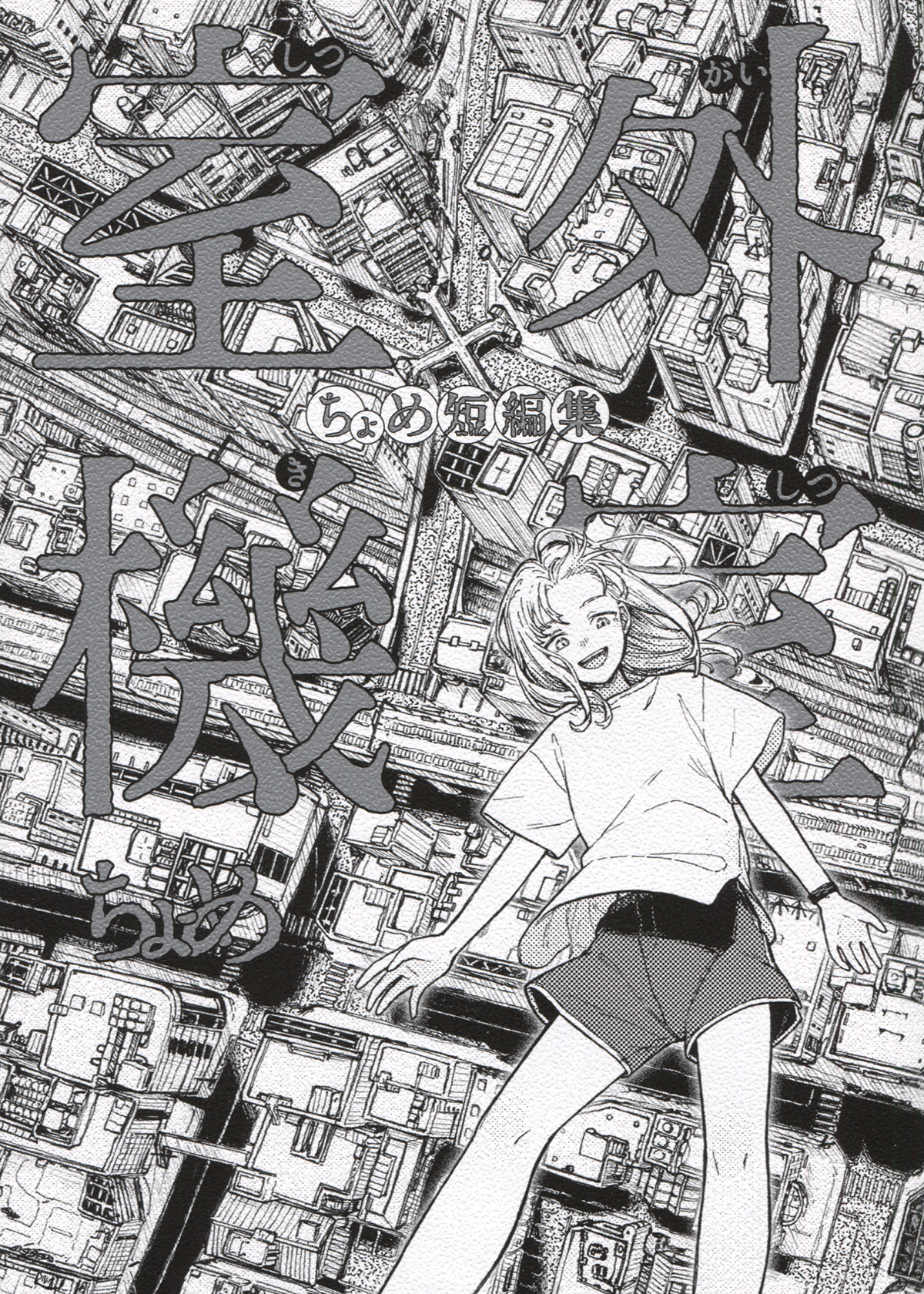
室外機室 collects four gorgeously illustrated magical realist stories drawn by an otherwise unpublished artist who goes by Chome. The stories transport the reader to a reality slightly removed from our own as each of the mundane protagonists catches a small glimpse of a hidden world.
I immediately fell in love with this collection from the opening pages of the first story, Tsugiho, in which a woman attends a large comic convention and finds a self-published minicomic that turns out to be brilliant despite its nondescript cover. The comic doesn’t seem to be documented anywhere online, so the woman starts writing a description. Her project quickly spirals out of control, however, as the pages of the small book seem to change each time she reads it. In the end, the woman’s essay transforms into an original illustrated short story, which she self-publishes and takes to the same comic convention where she found the mysterious comic that inspired her.
Speaking personally, I couldn’t describe the process of creative inspiration more accurately if I tried. What begins as a relatively straightforward act of casual appreciation can easily turn into something that has almost no relation to the original work at all, often to such an extent that the source is entirely forgotten by the end. In addition, it’s not always the case that creative inspiration comes from “the great works” of art and literature, as smaller and more specific stories can create a powerful sense of resonance and creative motivation even despite being unacknowledged by the broader culture. It’s nothing short of amazing that Tsugiho captures this aspect of creativity so perfectly in just twenty pages.
The two middle stories are thought experiments that are far more beautifully executed than they have any right to be. In 21g no bōken (which illustrates the manga’s front cover), a young woman dies and finds that her ghost is able to go anywhere and do anything. This story is primarily an excuse to illustrate the joy of absolute freedom of movement, but the ending is quite touching. Meanwhile, Konshin takes place almost entirely in a woman’s bedroom as she sits at her desk and listens to a strange radio broadcast from a parallel universe in which history has developed in an entirely different direction. The strength of this story lies in its writing, but the uncanniness of the broadcast is augmented by the visual coziness of the woman’s apartment.
The fourth and final story, Chika tosho tankenshō, is a seventy-page graphic novella that blew me away with its creativity and charm. A young woman doing research at the library drops her eraser, which bounces into the crack of a panel at the bottom of a bookshelf. The woman opens the panel to find a staircase. To the woman’s surprise, there’s an enormous library complex underground, but something about it is decidedly strange. The staff is wearing traditional Japanese clothing, and none of the books have titles. The young woman quickly arrives at the conclusion that this isn’t a place she’s supposed to be, but can she escape without being caught by the librarians? And what are all the mysterious books?
If I had the power to snap my fingers and make any manga appear in a licensed English translation, Shitsugai Kishitsu would be at the top of the list. This short story collection is a hidden treasure that easily stands its ground with the experimental but gorgeously polished work of emerging creators published by small presses like Silver Sprocket and Peow, and I could see any of these minicomics being released in the line-up of the ShortBox Comics Fair. Whoever the mysterious Chome may be, they’re creating brilliant and accessible comics that deserve an appreciative international audience.
Maru Ayase’s short magical realist novel The Forest Brims Over is about a young woman named Rui whose husband is a famous writer. Fed up with the words her husband puts in her mouth in his fiction, Rui swallows a handful of seeds that sprout from her body, gradually turning her into a forest.
Despite its fantastic premise, the story is firmly grounded in the psychological realism of the authors and editors who treat women as nothing more than literary symbols to be exploited for sales and awards. In the first four chapters, Rui’s transformation inspires significant shifts in the lives of the people in her husband’s literary circle. In the fifth and final chapter, we finally get to see Rui’s own perspective, and it’s brilliant.
I sympathize with Rui, whose every word is stolen from her by the literary professionals who conspire to confine her existence to a page of pulped paper. If Rui can’t speak in the language of the cultural elite, she’ll find another way of expressing herself, and the vast and mysterious array of life she produces is infinitely more vibrant than her husband’s formulaic literary fiction.
Rui’s husband may have the privilege of publishing award-winning books made of dead wood, but she is the roots and the leaves and the flowers and the wind. The Forest Brims Over is much more subtle and nuanced than perhaps I’m making it seem, but I personally found it joyful and liberating to be reminded that there’s much more room to grow outside the walls built by literary gatekeepers.
Shima Shinya’s four-volume sci-fi manga Glitch opens in a mundane setting in contemporary Japan: a high school student named Minato Lee (who uses they/them pronouns) has moved to a small rural town with their mother and younger sister Akira.
Minato notices that there’s something strange about their new home after a fragmented hole in reality emerges from the ceiling of her classroom. Two of Akira’s friends confirm Minato’s experience, telling them that only some people can see the distortions.
The group consults with the clerk of a neighborhood corner store, a mild-mannered man in flip-flops with a Biblically accurate angel for a face. He tells them that, since the town was constructed on top of open fields thirty years ago, various visitors have been emerging from a mysterious forest. He should know, given that he’s one of them, but the town’s glitches are a mystery to him as well.
Shima is a big fan of Star Wars and a co-author of The High Republic: The Edge of Balance manga series. Glitch captures the fun “weird little creatures in rundown environments” spirit of Star Wars, but the manga also engages with the deeper themes expressed in the movies, especially regarding how the small-scale actions of a diverse coalition are necessary to undermine the mundanity of evil.
Glitch handles its portrayal of diversity in a light-handed and clever way, and the “evil” confronted by the characters isn’t what readers might expect. While its story takes time to develop, the strength of Glitch’s art is immediately apparent, as Shima mixes the dynamic poses and expressions of Disney-style animation with the detailed backgrounds and dramatic panel compositions of indie manga.
Tomoko is only twelve years old when she loses her father to cancer. To learn to support herself, Tomoko’s mother attends a dressmaking school in Tokyo, where she lives in a student dorm. From 1972 to 1973, Tomoko is sent to live with her aunt in Ashiya, an upscale suburb between Osaka and Kobe. Her uncle is the president of an international soft drink company, and his house is extravagantly large and quite grand. Tomoko’s cousin Mina lives a charmed life marred only by her asthma, which is serious enough to necessitate frequent hospital visits.
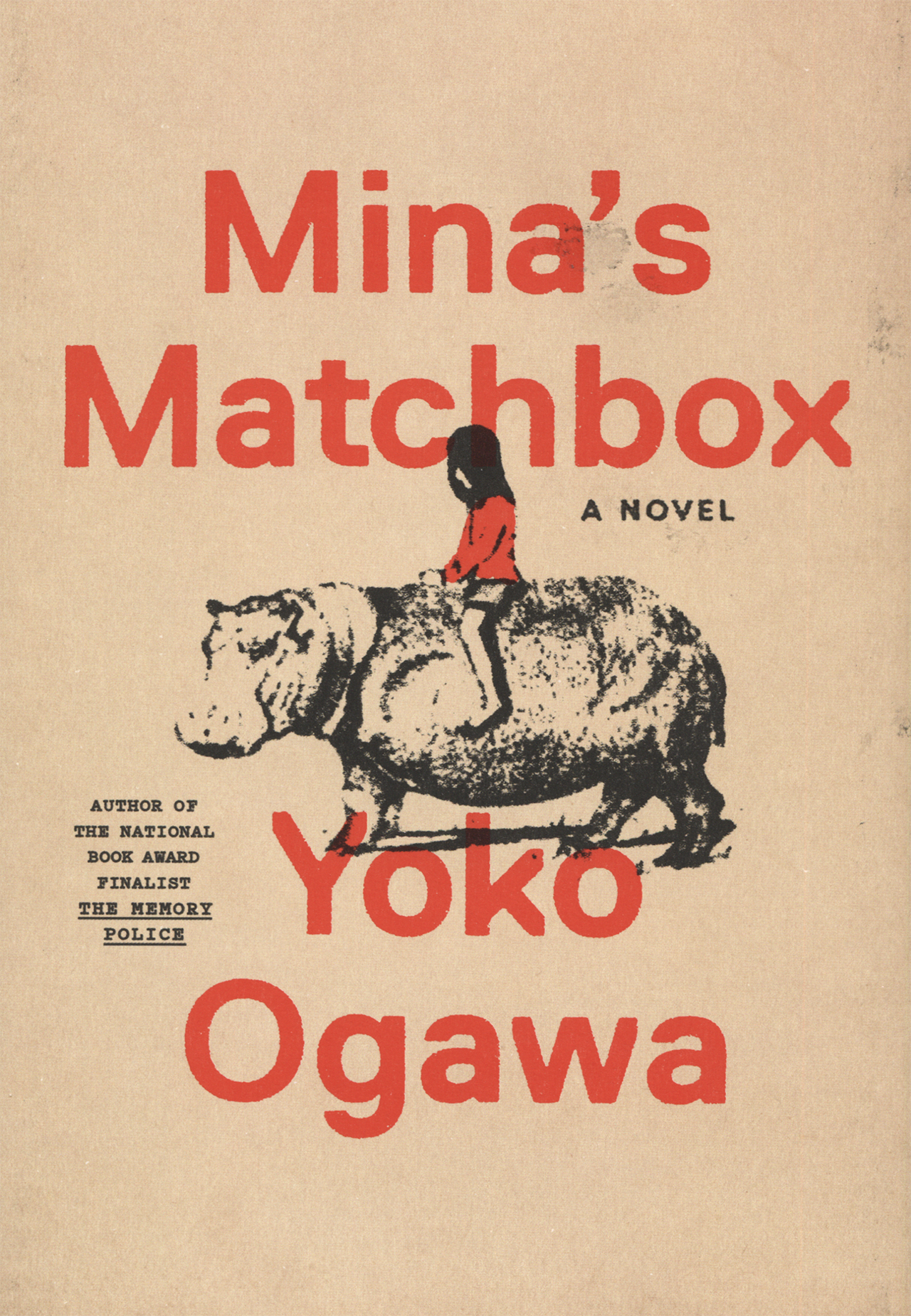
Mina’s grandmother Rosa emigrated from Germany in 1916, and the family’s house is filled with beautiful things, from foreign furniture and luxurious cosmetics to exotic Christmas paraphernalia to a room covered in Islamic tiles and used for a holistic health treatment called “light bathing.” Perhaps the most intriguing thing about the house is Mina’s pet, an aging Liberian pygmy hippopotamus named Pochiko who carries Mina to school every morning. The household is managed by Yone-san, an elderly woman who is ostensibly Rosa’s maid but can more properly be called her companion and life partner.
Tomoko’s aunt is attractive, elegant, and kind. Her uncle is handsome, friendly, and good-natured. The family’s groundskeeper and driver, Kobayashi, is a sweet and patient man whom everyone loves. The entire family welcomes Tomoko with style and grace, and she quickly becomes fast friends with Mina. The opening chapters of Mina’s Matchbox unfold almost like a Studio Ghibli movie, and I couldn’t help envisioning the characters in the style of When Marnie Was There.
To add to the magical atmosphere, Mina is thoroughly charming. She reads well above the level of a sixth grader and asks Tomoko to check out books from the local library like Yasunari Kawabata’s House of the Sleeping Beauties and Katherine Mansfield’s The Garden Party. Mina conveys her comments on these books to Tomoko, who shares them with the gentle young librarian she fancies.
Meanwhile, Mina has a crush on a deliveryman for her father’s company who drops by the house every week. During each visit, he gives Mina interesting matchboxes that he picks up on his rounds. Inspired by the graphics printed on the boxes, she writes short stories on paper that she uses to adorn the inside of the small containers she uses to store her collection. These stories are often fables about animals or other small creatures, and Tomoko loves them.
Mina’s Matchbox is a Yoko Ogawa novel, so it goes without saying that all is not well. Quiet tensions flow underneath the family’s beautiful surface, which is marred by the infidelity of Tomoko’s handsome uncle. To give herself a sense of purpose, Tomoko’s aunt combs through magazines searching for typos so that she’ll have an excuse to send letters of complaint. Mina’s older brother writes to the family from Switzerland but never mentions his father. In her devotion to Rosa, Yoneda-san almost never leaves the house and is frightened by everything outside of her immediate sphere of influence.
Nothing bad happens, and this definitely isn’t the sort of novel where the sick child dies. I hope it’s not a spoiler to say that both Mina and Tomoko go on to live happy lives. Aside from subtle but meaningful character development, Mina’s Matchbox doesn’t have much in the way of plot.
Regardless, this isn’t a slow novel. The pacing is excellent, and I finished the book quickly. In fact, I would have liked to spend more time with it. Every sentence is perfect, and each paragraph is a joy. Despite the child protagonists, Mina’s Matchbox has all the nuance of an adult perspective and steadfastly refuses to engage in melodrama. Reading this novel is like sitting outside and enjoying the sunshine on a warm spring day, and it’s a pleasure to follow the gradual progression of the small stories surrounding Mina and Tomoko as recounted in Ogawa’s impeccable prose.






 Contemporary Japanese Literature