Higashi Tokyo Machi Machi

Keita Katsushika’s manga Higashi Tōkyō Machi Machi (東東京区区) is a leisurely walking tour of East Tokyo. As suggested by their pen name, the artist lives in Tokyo’s Katsushika Ward, which is known for the retro ambiance of its Shibamata district and its green and pleasant riverside walking paths. Keita Katsushika is keen to show the reader the quiet charm of the area while exploring the depth of its history and the diversity of its communities.

Higashi Tōkyō Machi Machi follows the adventures of three focal characters. 21yo Sarah is a college student majoring in Urban Studies, and 8yo Selam is the daughter of an Ethiopian immigrant who runs a small restaurant near her university. While Sarah and Selam are out on a walk one afternoon, they meet 13yo Haruta, a homeschooled student pursuing his interest in Tokyo’s history. The friendship between these three characters is sweet and uncomplicated, and their personalities facilitate different approaches to urban exploration.

The trio’s first walk together takes them to the Tokyo Skytree, where they’re able to look out over the neighborhood while studying a reproduction of an Edo-period artwork that depicts the region as it appeared in the past. Another adventure takes them to the former site of the Venice Market, a postwar black market that was created by laying boards over a drainage canal. Since then, a normal street was built over the water, and the area hosts a number of stores and restaurants catering to Tokyo’s immigrant populations. If you’re interested in the history of the Venice Market, you can check out a two-page preview of this section of the manga (here).

All three characters were born and raised in Japan, and no one ever treats them with anything less than kindness and respect. As Sarah writes in the opening to her senior thesis, the formerly depopulated areas of Northeast Tokyo have gradually become home to many immigrant communities, who have revitalized the neighborhoods where they settle. Instead of resenting the growth of their communities, many older residents are happy to share their knowledge and memories with curious young people.

For what it’s worth, this portrayal of gregarious retirees is true to my own experiences walking around Tokyo with friends. Whether you’re a visitor or a long-term resident, it doesn’t matter what your face looks like or how you dress. As long as you’re willing to listen, there will always be people willing to share their stories. The manga’s scenes of immigrant community gatherings are equally warm and friendly. It’s lovely to see the diversity of people and life experiences in Tokyo shown as what it really is – not as a social issue to be discussed when something bad happens, but rather as a normal and pleasant aspect of everyday life. 

In many ways, Higashi Tōkyō Machi Machi reminds me of Kiyohiko Azuma’s manga Yotsuba&!, which follows the wholesome everyday adventures of a translator, his friends, and the young girl he adopted abroad. Just as in Yotsuba&!, the art of Higashi Tōkyō Machi Machi places simple and stylized characters into meticulously detailed backgrounds, thus helping the reader feel immersed in the cityscape of Tokyo and its suburbs.

The main difference is that Keita Katsushika’s manga is dense with text and reads more like a collection of illustrated essays than a story. Thankfully, the writing follows the standard shōnen manga convention of glossing the kanji with their hiragana pronunciations. As you might imagine, this is especially helpful with place names.

I’d recommend Higashi Tōkyō Machi Machi to anyone who’s interested in the history and culture of Tokyo. If you’ve read Jorge Almazán’s study Emergent Tokyo and are curious about how the urban design principles Almazán charted in West Tokyo neighborhoods have been adapted to the older neighborhoods in the east of the city, this manga was published for you specifically. Higashi Tōkyō Machi Machi is a treasure, and it’s a joy to explore Tokyo alongside its characters.

A Hundred Years and a Day

In October 2024, Matt Alt published an article in Aeon titled “The Joy of Clutter.” Instead of decrying the unsightliness of visual complexity, Alt argues that clutter has its own unique beauty, “an ecstatic, emergent complexity, born less from planning than from organic growth, from the inevitable chaos of lives being lived.”

Alt’s essay is illustrated with photos contributed by Lee Chapman, who captures evocative images of the chaotic interiors of tiny family-owned restaurants located in shopping arcades lined with shuttered storefronts. Chapman’s photos coincide with a trend on social media that expresses nostalgia for the Japan of the late twentieth century, with posts often tagged as “Shōwa Retro.”

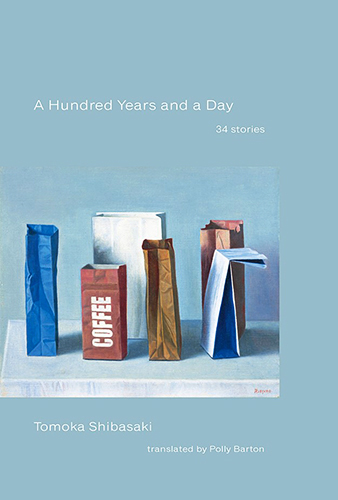
Tomoka Shibasaki’s A Hundred Years and a Day delights in the aesthetic of gentle decline exemplified by Shōwa Retro, and the 34 stories in the collection express nostalgia for people and places left behind in the past. Shibasaki invites the reader to walk through depopulated residential neighborhoods and stroll along abandoned shopping arcades. Half-empty cityscapes are dotted with buildings filled with clutter. Aging adults sift through the belongings of their deceased parents. Siblings who’ve drifted apart make clumsy attempts to reconnect by alluding to half-forgotten memories. Students study and then discard the small artifacts of the people who came before them.

Even reading through the book’s Table of Contents is like flipping through a card catalog in an old library, with each story’s title being a concise description of its premise. To give an example, the first story is titled:

“One summer during a long rainy spell, student number one from class one and student number one from class two discover mushrooms growing in a flower bed next to a covered walkway at their school; two years after leaving school they bump into each other, but after that, ten years pass, twenty years pass, and they don’t meet again”

“One summer” is a translucently beautiful piece of writing with imagery so clean and clear that I could almost feel the seasonal humidity on my skin. The story conveys the delicate specificity of a single moment captured in time. The moment dissipates and disperses as the world moves on, but the memory lingers.

An intriguing play on this theme is in the nineteenth story…

“I feel like I want to see the places that someone else saw, he said; I like thinking about places I’ve been to once but no longer know how to get to, or places that you can only access at certain times, I feel like there must be some way of visiting the places that exist only in people’s memories”

…which is about a woman who travels to a small seaside town to give a presentation at an academic conference. While walking back from the local shrine, she has a brief conversation with a child who will be the last ever student to graduate from the municipality’s junior high school. Years later, the child (now grown) encounters an artistic diorama that recreates a fictional version of their hometown that appeared in an old novel written by the academic’s deceased mother. While studying the artwork, this person (referred to by the story as “the last child”) is surprised by the liveliness of the reconstructed memory:

The last child crouched down and peered into the alley running between the wooden houses. It looked a lot like the alleyways that they knew from their childhood. They felt as though it was a path they’d been down before. As the last child was still staring down the passage, a cat ran across the alleyway where the stone steps were. The last child gasped in surprise, and stood up. A cicada flew in through the window, attached itself to the wall, and began to screech.

“I feel like I want to see” is a wandering ramble across time and memory, but most of the vignettes in A Hundred Years and a Day are much more focused on the history of a specific place. One of my favorites is the twenty-second story…

“A man opens a café in a shopping arcade, dreaming that it will become like the jazz café he used to frequent as a student; the café stays open for nearly thirty years, then closes down”

…which, despite the title, is about the young woman who takes over the original café by the university. The interior of the café is almost comically outdated, as are the records left behind by the previous owner. The new owner isn’t familiar with the musicians whose posters still hang on the walls. Regardless, the café is still lively, and the new owner finds herself thinking, at the end of the story, that “this is what I wanted to do.”

If I had to guess, I’d say that the reason why this sort of Shōwa Retro story has such a strong appeal is because it rejects the performative glossiness of mass media while embracing the beauty of real, everyday settings. The aesthetic also disrupts the modern myth that progress is not just desirable, but inevitable. Things don’t always get “better,” Shibasaki demonstrates, nor do endings always happen with a bang. 

A cursory reading might suggest that Shibasaki is trafficking in low-effort cultural nostalgia, but I don’t think that’s the case. The imagery presented by each story in A Hundred Years and a Day feels very deliberate, like it’s smashing a smartphone screen with a hammer. This is fiction to be enjoyed slowly, and I appreciate the contemplative space Shibasaki has opened for the reader.

When discussing the texture of Shibasaki’s writing, it’s important to acknowledge the artistry of Polly Barton’s English translation. Japanese literary writing is notorious for its nested sentence structure, which can feel unintentionally Proustian if translated literally. It takes a keen eye and a delicate touch to understand whether Japanese sentences are interminably lengthy because the language is simply written like that; or whether a sentence like one of Shibasaki’s story titles is a deliberate stylistic choice. Barton has done truly amazing work with A Hundred Years and a Day at a sentence-by-sentence level, allowing the reader to enjoy Shibasaki’s distinctive style while still maintaining a casual, conversational tone.

Most of the stories in A Hundred Years and a Day occupy fewer than ten pages, and they read like accounts passed from one person to another by word of mouth. Spending time with this collection feels like calling an elderly relative and listening to them talk about a restaurant closing in your old neighborhood, or about how they saw someone that you once knew as a child in the newspaper. There’s no real beginning or end to the stories, nor is there any discernible sense of structure. Still, the theme of human connection runs through Shibasaki’s work like a gentle current, drawing the reader forward along on the steadily flowing stream of time.

I’d like to extend my gratitude to Stone Bridge Press, which provided an advance review copy of this book. A Hundred Years and a Day will be published on February 25, 2025. You can learn more and read a preview on the book’s webpage (here).

Mimi ni sumu mono

Yoko Ogawa’s 2024 short story collection Mimi ni sumu mono (耳に棲むもの) is about quiet endings and the unremarked deaths of small things. The tone of these five stories ranges from gentle and elegiac to genuinely shocking.

I’d like to begin with the latter, as Kyō wa kotori no hi (今日は小鳥の日) is one of the most subtle yet surprising horror stories I’ve read in some time. The nameless narrator of this story addresses the reader directly as she welcomes us to the annual gathering of the Small Bird Brooch Society. Small bird brooches can be made in a variety of ways, she explains, but she crafts hers using the real beaks and talons of dead birds. There’s something truly sublime about watching their tiny bodies decay, she muses.

The narrator then explains how her predecessor, the first president of the Society, met his untimely end. His death involves the still-living bodies of small birds, but I dearly wish it did not. After recounting one of the more gruesome scenes I’ve encountered in literary fiction, the narrator cheerfully invites the reader to sit down and enjoy the banquet. She then points out a few notable members of the Society, each of whom has their own method of constructing small bird brooches. Perhaps you, dear reader, will feel right at home in their company.

The collection’s final story, Senkōsho to rappa (選鉱場とラッパ), is about a young boy who lives with his mother in the company housing of a rural ore processing plant. His mother works both the day shift and the night shift at the plant’s cafeteria, leaving him to his own devices. During the summer festival at a local shrine, the boy becomes enamored with a toy bugle offered as a prize at a carnival game. Without any money to play, he’s reduced to lurking at the corner of the tent and praying that, if he can’t win the bugle, then no one else does either.

The next day, the boy takes out his frustration on a stray dog begging for scraps near the back entrance of the cafeteria where his mother works. He kicks the poor animal so hard that he ruptures its stomach, and it dies. Later he returns to the festival, where he witnesses the sudden death of the old woman running the carnival game. He steals the bugle in the confusion and returns home only to realize that the toy is nothing more than cheap plastic that has been spraypainted gold. In his shame, the boy buries the bugle in a closet, just as he buried the dog he killed between the roots of an old tree.

Still, as he sits on the apartment balcony while waiting for his mother to come home, the boy fashions constellations from the lights of the processing plant and imagines the songs he would play in their honor if his bugle were real.

Mimi ni sumu mono reminds me of Ogawa’s first work to appear in English translation, The Diving Pool (2008). Although it’s difficult to classify these stories as “horror,” they’re all subtly but effectively unsettling. When we’re exposed to the small cruelties that hide in the hearts of normal people, we begin to see reflections of their inner darkness in the details of the world that surrounds them. Ogawa’s characters are people who have lost their sense of belonging. The world has moved on without them, leaving a quiet air of desperation and neglect in its wake.

Mimi ni sumu mono is twenty-first century gothic fiction at its finest, but it’s not all bleak. Like the boy in Senkōsho to rappa and the president of the Small Bird Brooch Society, Ogawa remains fascinated by the beauty that gleams through the horrors. At 132 pages, Mimi ni sumu mono is relatively slim, but I believe this collection’s brevity is to its credit. The book is like an art gallery that encourages the reader to take their time with each piece, lingering as long as they like without any pressure to rush forward.

Mimi ni sumu mono was written in collaboration with Koji Yamamura, an Academy Award nominated animator. Yamamura created the companion piece My Inner Ear Quartet, which is described as “a literary VR animated film with an interactive storyline” on its page on Steam (here). This interactive animation was showcased at a number of international animation festivals and won several awards in Japan and abroad. As Yamamura’s animation requires a VR headset to view, I can’t offer any comments, but its trailer on YouTube (here) and the expanded excerpt (here) suggest that Yamamura was successful in capturing the eerie tone and uncanny beauty of Ogawa’s stories.

Kanda Gokurachō Shokunin Banashi

The first volume of Akihito Sakaue’s manga Kanda Gokurachō Shokunin Banashi, which won the Tezuka Osamu New Creator Prize in 2024, collects five stand-alone short stories about the everyday lives of artisans during the Edo Period. As might be expected from a manga about craftsmanship, Sakaue devotes meticulous care and attention to creating an accurate visual depiction of the tools and techniques used in these traditional arts. 

Shokunin Banashi opens with a twelve-page account of a day in the life of a carpenter who creates and repairs wooden buckets. Although the work may seem unglamorous, the skill involved is readily apparent. An additional layer of accuracy lies in the fact that this story’s star craftsperson is female, as were many of the artisans who kept Edo period society functioning.

The next two stories feature a blacksmith who specializes in swords and an indigo dyer who dreams of creating her own fabric pattern designs. My favorite of these opening stories is the fourth, which follows a young but talented seamster who sews and binds the edges of tatami mats. Along with the rest of his team, he’s been hired to replace the tatami in a high-end establishment in the Yoshiwara red light district. The courtesans are impressed by the craftsman’s skill with his hands, but he remains focused on his craft and maintains an appropriate professional distance. Once he’s finished the job, however, he allows himself to be a little flattered. This is a cute story that’s also very sympathetic to the craft of the women who work in Yoshiwara.

The three-chapter story in the second half of the volume is a workplace drama about a company of contractors who specialize in laying plaster walls. This is intense physical labor that requires a good eye, a steady hand, and careful group coordination. The leader of the team, Chōshichi, is an undisputed master of her craft, but a new recruit, Jinsaburō, soon learns that there’s trouble among the ranks of her subordinates. A master craftsman himself, Jinsaburō supports Chōshichi during the construction of a townhouse. For the reader, this is a marvelous opportunity to get an inside look at each stage of how these houses were built.

I’d recommend Shokunin Banashi to anyone who enjoyed Fumi Yoshinaga’s Ōoku series, especially for the high quality of its historical representation and the subtlety of its human drama. I might also recommend Shokunin Banashi to any illustrator who’s interested in studying hands depicted in a variety of positions while manipulating all sorts of specific tools. The art in Shokunin Banashi is something special, as is the physical book itself, which was designed to be a beautiful object.

Edited to add: This manga has been licensed by Yen Press as Neighborhood Craftsmen: Stories from Kanda’s Gokura-chou. Excellent!

Strange Pictures

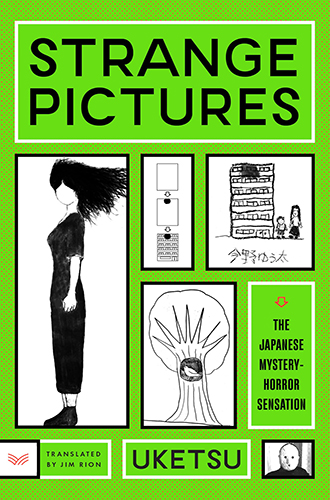
Strange Pictures is a compulsively readable horror mystery novel first published in 2022 by Uketsu, a mysterious masked YouTuber. This book is addictive, so much so that I accidentally spent an entire afternoon and evening reading it. So be warned – Strange Pictures is indeed strange, and it will hold you hostage.

In the five-page prelude that introduces the book’s premise, a psychology professor shows her class a photo of a picture drawn by a girl who killed her mother. The drawing is a childish self-portrait that shows the girl standing between her house and a tree. Although the picture seems completely normal at first, the professor zooms in on four small details that illuminate the girl’s inner state of mind. She makes the argument that, despite the abuse the girl suffered, she’s essentially a good person who never meant to hurt anyone. In retrospect, you can’t help but wonder how you didn’t notice these details of the drawing yourself.

This trick is an incredible sleight of hand. The same can be said of the following two chapters, both of which can be read as stand-alone short stories.

In the first chapter, “The Old Woman’s Prayer,” two college students in a small Paranormal Club discuss a curious blog they’ve found online. The blog is filled with cheerful observations of its writer’s everyday life. After a three-year hiatus, however, the blog closes with a mysterious post stating, “I can never forgive you.”

How did such a happy-go-lucky blog author arrive at such a mysterious statement? The five illustrations drawn by the author’s wife might just hold the key to the mystery. By themselves, they’re nothing special, but if you put them together in the right way…

The second chapter, “The Smudged Room,” features one of my favorite tropes, a creepy drawing made by a small child.

Five-year-old Yuta’s father recently passed away, and his preschool teacher is worried about the drawing he created for Mother’s Day. The picture shows a dark cloud hovering over the apartment building where Yuta lives with his mother, who is doing her best to care for Yuta with no family support. The matter comes to a crisis when Yuta suddenly disappears, and his teacher suspects that his mother may be keeping an unpleasant secret. What was Yuta trying to draw, exactly?

These two seemingly unrelated mysteries begin to coalesce in the third chapter, “The Art Teacher’s Final Drawing,” in which two sidelined newspaper employees become obsessed with the murder of a high school art teacher. The police dismissed the case due to a lack of evidence, but there is (of course) a drawing found in the teacher’s possession that was never fully analyzed. The younger reporter starts interviewing people who knew the teacher, thereby putting himself in grave danger.

Somewhere around the middle of this chapter, the story begins to strain credibility, but at this point I was fully invested and happy to be along for the ride. Uketsu has a gift for enabling the reader to suspend disbelief, and the Sherlock moment in the fourth and final chapter is incredible.

Strange Pictures is a bestselling cult hit in Japan and across Asia. I first heard about this book through word of mouth and read it in Japanese when it was first published. I was impressed by the clarity of Uketsu’s writing, which is simple and informative without being childish or condescending. Jim Rion has done an amazing job translating Uketsu’s distinctive style, with short declarative sentences pushing the reader forward at a brisk pace.

A large part of the mystery depends on the information that the narrative withholds from the reader, some of which is highly dependent on how Japanese works as a language. I’m impressed by how Rion manages to employ English to the same effect without the slightest trace of awkwardness. Reading Rion’s translation, I felt like I was encountering Uketsu’s story for the first time.

As long as you don’t mind losing a few hours to the addictive quality of the writing, I’d recommend Strange Pictures to anyone who enjoys puzzle box mysteries, creepy urban legends, and satisfying Sherlock Holmes style walkthroughs. I can’t overstate how much fun I had with this book, and I’m very much looking forward to Jim Rion’s upcoming translation of Uketsu’s debut novel, Strange Houses.

First Love

Rio Shimamoto’s 2018 novel First Love is a psychological mystery about a beautiful college student who has been arrested for the murder of her adoptive father. Although it tackles serious themes, this story is compulsively readable. All of the characters bring emotional baggage to the table, and Shimamoto teases out the reader’s sympathy as each of their histories is revealed.

Yuki Makabe is a clinical psychologist who specializes in parenting and childcare. She’s ambitious, and she’s on the verge of making a career transition to media appearances and popular audience articles. When Yuki’s brother-in-law, Kasho, is assigned to the high-profile case of Kanna Hijiriyama, a college student accused of killing her father, he asks Yuki to help him interview the young woman in order to ascertain her motive. Yuki’s prospective editor at a major publisher, a friendly young man named Tsuji, asks her to write about the case, so she agrees.

Yuki is happily married to an internationally famous photographer who supports her career by shouldering the majority of the responsibilities involved in the care of their son. Despite her loving relationship with her husband, Yuki has a troubled past with Kasho that neither of them is willing to discuss. While she and Tsuji work together on Kanna’s case, Yuki must navigate her strained relationship with Kasho, who is very charming but a bit of an asshole.

Kanna presents Yuki with another set of challenges. To begin with, Kanna can’t explain why she wanted to hurt her father, or even whether she intended to hurt him in the first place. But, if she never meant to attack him, what was she doing with a knife? To make matters more complicated, one of Kanna’s college boyfriends gives an interview to a tabloid magazine and says that Kanna went crazy after they broke up. Even Kanna’s own mother claims the young woman is crazy.

Yuki is convinced that Kanna is far from “crazy,” but the truth of the matter is elusive. Kanna is traumatized by the death of her father, and Yuki quickly realizes that the young woman’s trauma is much more extensive.

Based on the title of the novel and the relationship between Kanna and the person she may or may not have killed, a reader might suspect that there is underage incest involved. I hope I can be forgiven for spoiling the story by saying that, thankfully, this is not the case. Regardless, Kanna didn’t have a happy home life as a child. 

I’m afraid that some readers may find Kanna frustrating, but her portrayal feels extremely realistic to me. I definitely knew people like this in high school and college. Generally speaking, these girls (and occasionally boys) were intelligent and competent, but they had a habit of saying whatever they needed to say to diffuse an awkward situation. 

This behavior wasn’t “lying” or “being dishonest” so much as it was a manifestation of fawning, an alternative to the “fight or flight” response that’s common in young people who live in hostile home situations. Instead of fighting their parents or running away from home, “well-behaved” children and teenagers will contort their speech, emotions, and understanding of reality to ease tension. Issues often arise when this behavior carries over to romantic and professional relationships that would benefit from honesty.

Although this element of the story isn’t presented as a mystery to be solved, Yuki is confronted with the issue of whether Kanna truly consented to sex with two of the key romantic partners in her life. I can completely understand how the men involved might have understood Kanna’s words and behavior as expressing consent, but I also understand how Kanna could later admit that sex isn’t what she wanted, and that she was just going along with what was expected. As the author demonstrates, Kanna’s inability to understand her own boundaries is directly related to the emotional abuse she endured as a child.

Shimamoto doesn’t lean into an overtly feminist message, but there are multiple points in the story when Yuki comes into contact with the sort of ambient misogyny that might compel a vulnerable young person like Kanna to second-guess her own emotions and sense of self-worth. At the beginning of the novel, for example, Yuki reflects on a conversation between a male television producer and his younger female colleague that she overheard as she entered the studio.

As I was getting my makeup done, I examined my own features: not bad, but not particularly beautiful either. A face with no distinctive features. The only thing that stood out was my collarbone, protruding above my shirt.

I’d met that male producer several times previously, but he’d never once made eye contact with me. There were men like that everywhere in the television industry – men who wouldn’t engage in conversation with women they’d give less than an eight out of ten on looks. Men who thought nobody would notice this behavior. Or maybe they just thought it didn’t matter. These were men who had never suffered a single setback in their lives.

This is the sort of observation that, while eminently relatable to many people, would have Yuki called crazy if she spoke it out loud. It’s not “misogyny” or “sexism” if the male producer isn’t doing anything wrong, right? It’s not like he actually said anything offensive to Yuki, or to his younger colleague. This man’s behavior is rancid, but no one will ever call him out on it. Yuki has a supportive family and professional colleagues who aren’t human garbage, so she can cope. But what about Kanna, who hasn’t yet found a support network to replace her abusive family?

What Shimamoto criticizes in First Love are the gendered aspects of a social system that allows toxic men to flourish. First Love doesn’t offer easy solutions, but Shimamoto demonstrates that we can all be allies in pushing back.

Yuki’s husband is a prince from start to finish, and her editor Tsugi is able to see what happened to Kanna with clear eyes while re-evaluating his own perspective and never apologizing for the bad behavior of other men. Kanna’s defense lawyer Kasho has issues of his own due to childhood abuse at the hands of his mother, but he’s an adult who is capable of realizing his limitations – which is why he arranges for a series of meetings between Yuki and Kanna in the first place.

Without spoiling too much of the plot, First Love connects the stories of a number of characters who begin to question their past behavior in light of Kanna’s upcoming trial, and Shimamoto helps the reader to sympathize with these characters even when they behave badly. The point is not that men are evil or that women are innocent victims. Rather, it’s important to extend empathy instead of overlooking questionable behavior.

Putting the social relevance of the novel’s themes aside, First Love is a fun book to read. I got sucked into the story immediately. Like Yuki, I was instantly intrigued by the mystery presented by the death of Kanna’s father. Kasho’s defense argument during Kanna’s trial felt like a major revelation unfolding before my eyes, and I admire how carefully Shimamoto laid each brick in the wall. Louise Heal Kawai’s translation is featherlight and flawless and sets the tone perfectly.

I’d recommend First Love not just to fans of mystery and suspense, but to any reader interested in a compelling character drama that offers a number of different perspectives on family, mental health, and the darker aspects of everyday interactions that often go overlooked.

Kamimachi

Machiko Kyō’s Kamimachi (かみまち) was serialized from June 2019 to December 2022 and published as a two-volume graphic novel in August 2023. The story follows four homeless teenage girls who find themselves at a privately run youth shelter called Kami No Ie (“Family of God”) in the Tokyo suburbs.

Although he initially seems kind and welcoming, the middle-aged man who runs this shelter is a sexual predator, and he has assaulted and murdered one of his young charges prior to the beginning of the story. The ghost of this young woman, in the form of a Christian angel, helps the girls find the courage to escape the Kami No Ie shelter.

Each of the four main characters in Kamimachi has become homeless after escaping a toxic home environment.

Uka is the only child of a single mother who projects her loneliness and frustrated ambitions onto her daughter. The story begins as Uka leaves home and seeks shelter by means of a roomshare app. After a number of awkward situations, Uka comes to the attention of a group of men who use the app to recruit sex workers. These men force Uka into a situation in which she’s expected to trade a night at a short-term rental space for sex. She breaks out of the apartment and wanders the streets of Tokyo before finding herself at the Kami No Ie shelter.

Uka’s closest friend at the shelter, Nagisa, has been sexually abused by her stepfather for years. She finally flees from home after her mother witnesses one of these assaults and turns away in disgust.

Arisa was raised as a television idol by a single mother. After her mother’s sudden death in an accident, Arisa is given to the care of a talent manager who steals her inheritance and financial assets, leaving her destitute.

Yō is one of five siblings. She’s so neglected by her family and bullied by her brothers that she finds it preferable to sleep in subway stations. Eventually she stops returning home altogether.  

For each of these young women, Tokyo becomes a wilderness whose anonymous open spaces serve as a refuge from the enclosed interiors where they’re coerced into enduring abuse. Kyō draws indoor scenes using small panels with blank backgrounds, and these scenes often feature close-ups of the characters’ faces in moments of distress. Meanwhile, Kyō depicts outdoor scenes with large panels that frame the characters with trees and buildings. The expansive outdoor settings often serve as the stage for small moments of kindness and emotional clarity.

In Chapter Three, for example, Uka flees into the night after an attempted sexual assault at a roomshare apartment. After her escape, she wanders through the rain with nothing but the clothes on her back. Out of context, the rainy cityscape may seem bleak, but the large panels filled are a visual relief after the oppressively small and claustrophobic panels that depict the apartment.

One of the anonymous figures passing in the rain, whom the reader later learns is Yō, stops beside Uka to give her an umbrella. Page 71 opens with a close-up of Yō’s extended hand before spreading into an open panel in which Uka and Yō stand at the center of a composition framed by misty buildings and puddles on the concrete. The two small figures reaching out to one another are enclosed in a soft curtain of rain, and the sense of relief at being a part of a larger world is palpable.  

Chapter Seven contains a similar scene in which the open sky and background cityscape suggest freedom from the violence that occurs behind closed doors. Nagisa, who’d encountered Uka in a roomshare arrangement, takes Uka’s discarded uniform and attends school in her place. One of Uka’s former classmates approaches Nagisa, offers to share her lunch, and asks that Nagisa talk with her on the roof. Nagisa initially tries to be normal, showing the girl photos of her mother and stepfather’s new infant daughter.

During this scene, the panels become progressively smaller until Nagisa finally admits the truth about having left her family. The shift to a full-page panel depicting the city’s jumble of buildings spreading under the open sky signals Nagisa’s admission that something has to change. This moment also serves as the catalyst for Uka’s classmate to begin searching for her missing friend, a decision that ultimately results in Uka’s rescue from the Kami No Ie shelter.

The openness of Tokyo cityscapes in these scenes suggests that the sort of hidden abuse endured by these young women needs to be brought into the open and exposed to the light of public scrutiny. Along those lines, I can’t help but feel that Kyō’s depictions of outdoor spaces in Kamimachi also reflect the artist’s emotional response to the Covid pandemic. For people in precarious situations, being physically stuck inside often exacerbated the experience of feeling trapped within oppressive social systems.

As an artist who documented the pandemic years through evocative illustrations posted to Instagram, Kyō’s project is not simply to depict the beauty of architecture and greenery within the city, but also to comment on the importance of open outdoor “third places” for young people suffering from social pressure and economic strain. Kamimachi doesn’t provide easy solutions, but it’s cathartic to see the issue of youth precarity brought out into the open air. 

Machiko Kyō is a prolific and award-winning artist whose illustration collections have been celebrated by The Comics Journal (here). If you’re interested in reading more about the artist’s work, I published a short essay on her 2013 graphic novel Cocoon – whose animated adaptation is scheduled to premiere on NHK in Summer 2025 – on Women Write About Comics (here). Here’s hoping that English-language readers will be able to experience Kyō’s compelling and thought-provoking work in the near future.

Hoshikuzu Kazoku

Hoshikuzu Kazoku (星屑家族) is a two-volume graphic novel set in an alternate universe where parents are required to obtain a license to raise children. To qualify for a license, a prospective family is asked to undergo an audition with a homestay student. This auditor, who is often an orphan raised in a government-run facility, evaluates the family’s fitness by deliberately behaving badly and provoking difficult situations. 

An auditor who goes by Hikari is assigned to Daiki and Chisa Hirokawa, a young couple who live on the grounds of a Shinto shrine. During their initial interview, Daiki surprises Hikari by openly requesting that their family be denied a childrearing license. Daiki claims to be happy living with his wife as a couple, and he shares his suspicions that Chisa doesn’t actually want children. With that out of the way, Daiki says, the three of them can enjoy the homestay visit without any pressure or expectations.             

Chisa and Daiki genuinely seem to be happy together, but Hikari soon notices that Chisa is the target of a longstanding prejudice held by people in the neighborhood. Chisa’s mother killed her father when she was a child, and she’s been ostracized ever since. Along with her foster father, who once managed the shrine, Daiki was the only person who was kind to her. Now that she and Daiki have married and set up a household at the shrine, Chisa feels trapped within a community she can’t escape. Why, then, does she want a child so badly? And is it Hikari’s place to get involved?

Hoshikuzu Kazoku is a high-stakes family drama that presents a moral conundrum with no easy solutions. If the government creates regulations to ensure a well-ordered society, what happens to the people whose lives are more complicated than the provisions allowed by the legal code? If there’s room for flexibility in the bureaucratic system that enforces the law, who should have the right to grant exceptions? And more specifically, in a country witnessing its birth rate decline in response to the disintegration of community support structures, what are the limits of government intervention?

Even putting such questions aside, Hoshikuzu Kazoku is compelling by virtue of its problematic yet still sympathetic characters. Hikari, Daiki, and Chisa each bring loads of emotional baggage to the table, but they do their best to communicate to the limited extent of their abilities. Despite their many flaws and the odds against them, I wanted these characters to be happy.

Aki Poroyama’s writing, dialogue, and pacing are all excellent, and the visual language of the manga serves to set the mood and create dramatic impact. I wasn’t familiar with the work of this artist, and I was amazed by the polish of this graphic novel. I’d recommend Hoshikuzu Kazoku to mature readers looking for socially conscious speculative fiction driven by complicated human stories. 

Mornings With My Cat Mii

Cats are adorable creatures, it’s true. It’s also true that they’re a little magical. Unfortunately, the experience of caring for a cat isn’t all sunshine and rainbows, and there’s a lot of cleaning involved. Mayumi Inaba’s autobiographical essay collection Mornings With My Cat Mii is a beautifully written attempt to capture the not-always-rosy reality of sharing your space with a cat while doing your best to manage your life as a human.

In the summer of 1977, Inaba follows the cries that drift in through her window and discovers a ball of fluff stuck at the top of a fence along the bank of the Tamagawa River in western Tokyo. Since it’s freezing outside, she takes the kitten home. Inaba names her “Mimi,” or “Mii” for short, after her constant crying. Despite her precarious childhood, Mii goes on to live for almost twenty years, accompanying the author through major developments in her personal life and career.     

Mayumi Inaba (1950-2014) worked in a number of creative industries while publishing stories, essays, and poetry. The opening essays in Mornings With My Cat Mii are about the milestones in Inaba’s life as she divorces her husband in Osaka to focus on her career in Tokyo. As time passes, Inaba begins to devote more attention to her friendships and psychological wellbeing, a shift in priorities represented by her growing love for Mii.

Mornings With My Cat Mii is far from wholesome, however. Inaba is nothing if not honest about the vicissitudes of life. Sometimes you and your partner grow distant. Sometimes you get kicked out of your house by your landlord. Sometimes people abandon animals. And sometimes you have to bear witness to your pet’s slow decline toward death.

A major element of Inaba’s commitment to honesty are her raw descriptions of the mess of keeping an animal in your house. Sometimes, for example, your entire apartment is going to smell like cat urine. Sometimes you have to scrub puke out of the carpet. Sometimes you have to extract your cat’s feces with your own hands.

Regardless, Inaba always finds a silver lining and an interesting story to tell. I especially enjoyed her essay “The Pet Sitter,” which provides an intriguing glimpse into the thriving industry of petcare services in Japan while digging its heels into the silliness of celebrity pet therapists. I also love “The Winter Break,” which describes a trip Inaba took to the countryside with her sister so Mii could touch grass and frolic in nature. The essay “Moving House” stands out as a playful description of a typical day in young Mii’s life in Inaba’s old house in the west Tokyo suburbs, which were still filled with pockets of nature in the 1970s.

Each essay is less than ten pages long, and most of them feature several verses of a poem as a postscript. Ginny Tapley Takemori has done a marvelous job translating Inaba’s poetry. Just be aware that some of these poems might make you a bit misty-eyed, especially if you’re feeling sentimental about the death of a pet of your own.

I’m generally not a fan of Japanese cat books, but Mornings With My Cat Mii isn’t bubblegum pop about how all of life’s problems can be magically solved by a cat. Rather, this is messy and honest nonfiction about the hardships of pursuing a creative career as a single woman. Still, Inaba manages to find moments of sweetness in life, which she generously shares with the reader in her soft and shining prose.

とんこつ Q&A

とんこつ Q&A collects four stories by Natsuko Imamura, the author of The Woman in the Purple Skirt. Each of these stories is built on a cute and wholesome premise that develops in a dark and strange direction.

The title story is about a woman with social anxiety who creates a written script to help her navigate her job as a server at a small diner called Tonkotsu. Her efforts are aided by the recently widowed owner and his young son, who teaches the narrator to speak in Osaka dialect like his late mother.

The narrator’s script gradually expands beyond professional dialogue into everyday pleasantries, and she ultimately becomes a ghostwriter for the diner owner’s new wife. This scenario seems like a perfect set-up for a sweet and gentle romantic comedy, but it gradually becomes more disturbing as the narrator cheerfully crafts the diner owner’s new wife into a living doll.  

The three other stories in the collection are about middle school bullies whose punishment is far worse than their crime, an aggressively clueless wife who gets away with murder, and a very sketchy coworker. Imamura’s prose is smooth but cuts like a knife, and the situations she crafts are never what they seem. I wouldn’t say that these stories have twist endings, necessarily, but the way their wholesome coziness slowly sinks into social horror is fascinating to watch.