Japanese-to-English Translation Basics

Old Books

Once upon a time, when I was an undergraduate, I had the opportunity to take a translation seminar with one of the finest translators of Japanese literature into English. The course texts she selected for the seminar presented all manner of interesting translation challenges, and she brought in a number of fantastic speakers from the Kyoto-based Society of Writers, Editors, and Translators to discuss these challenges with our class. Unfortunately, I was not able to take full advantage of this seminar; it was as if these professional translators were teaching us translation calculus, and I still didn’t grasp basic translation algebra.

I just finished a tertiary round of edits for two major translation projects, and I’ve noticed a number of patterns in the areas I’ve repeatedly needed to adjust. Once I became aware of the currents my editing was following, I started to imagine that I was getting at some of the basic and fundamental issues of Japanese-to-English translation. If I could go back in time and give my fledgling translator self some advice, this is what I might say…

(1) Japanese sentences tend to begin with prepositional phrases and other subordinate clauses that separate the subject from the verb. Although sentence variety is important in English, simple subject-verb-object sentences are the foundation of muscular and fluent English prose. Consider splitting a sentence into two sentences if the sheer number and frequency of subordinate clauses render a literal translation of that sentence into a hermeneutic puzzle in English. Also, never be afraid to switch the order of words in a sentence if it sounds better to your ear, such as in the case of placing adverbs after verbs instead of in front of them.

(2) Letting the reader know that information is hypothetical or coming from a secondhand source is a common feature of Japanese, but an overuse of expressions such as “it seems,” “I heard that,” “someone said,” “it’s often said,” “perhaps,” and “maybe” tend to weaken English prose. If the information being presented is obviously a subjective impression or something that the narrator/speaker would have no way of knowing on a firsthand basis, it’s usually safe to omit the attribution markers.

(3) Adverbs, especially temporal adverbs, are much more tolerated in Japanese writing than they are in English writing. If adverbs or adverbial phrases such as “suddenly” or “after a while” are clear from the context, the translator should feel free to omit them. Also, if the meaning of an adverbial phrase can be transferred to a verb, such as in the case of “said in a loud voice” becoming “shouted,” then the translator should consider doing so. This is not diluting the author’s language but rather transforming strong writing in Japanese into strong writing in English.

(4) Avoid the passive voice whenever possible. If the subject of a passive sentence can be inferred, insert it into the sentence and change the verb to the active voice. The implications of the passive voice are interesting and valuable but can usually be deduced in other ways, and passive sentence structures are much more common and natural in Japanese than they are in English, where they can quickly become jarring to the reader.

(5) The literal translation of the triple and quadruple negatives of Japanese rhetoric sounds ridiculous in English, a language in which a single negative or positive statement is usually considered infinitely more articulate.

(6) Think twice about retaining honorific titles such as “san,” “kun,” “chan,” “buchō,” “kachō,” and “sensei” in your English translation. Such Japanese-isms can feel gimmicky, and often they are not necessary to convey the relationships between characters. Moreover, if honorifics are maintained in translation, it may still be difficult to make the reader aware of what it means when a name is used without honorifics. Japanese is well known for being able to express multiple levels of formality, but English is no slouch at conveying degrees of distance and friendliness, and the manner in which two characters speak to each other can mean much more to the reader than which honorifics they use.

(7) The written approximation of dialect is common in Japanese, but don’t try to “translate” dialect into an English equivalent unless you feel absolutely comfortable doing so. The written approximation of dialect in English will almost always appear goofy and corny to the reader. Different grammatical patterns, tonal registers, and word choices will usually help to convey dialect better than means such as replaced, duplicated, or truncated vowels.

(8) When faced with the task of translating untranslatable words, consider not translating them. You have a smartphone, your grandmother has a smartphone, your four-year-old daughter has a smartphone, and it’s not difficult to run a quick Google search for something like “kotatsu” or “umeshu.” Even without outside sources, your reader will generally be smart enough to get an approximate impression from the context. When it comes to brand names, it’s especially easy for the reader to figure out what’s being referred to from the context, and it’s generally best to leave them be without any footnoting or inserted explanation. In some cases, however, leaving a word untranslated can feel silly and pretentious to the reader, so it’s helpful to have an ideal reader in mind and cater to the presumed knowledge, tastes, and expectations of that reader.

(9) When it comes to puns, jokes, proverbs, idiomatic expressions, and made-up words, crowdsourcing translation solutions is always an option. This is why Al Gore invented the internet back in the eighties, so feel free to use social networking sites such as Twitter and Facebook as your own personal dictionaries of creative genius. Some of the problems you face in translating certain words may also be an issue of relative expertise, so there’s no shame in relying on other people for help if you need to know more about how to refer to certain foods, colors, meteorological phenomena, or American sci-fi stories from the seventies. Translation is just as much of a research project as it is an art, but there’s no need for research to be a solitary task in a lonely room full of dusty books (unless of course you’d like it to be).

(10) Make sure you do at least one read-through of your translation while completely separated from the original Japanese text. Even if you have a crystal clear translation of a certain word, expression, or passage, it’s all but worthless if it doesn’t gel with the rest of the English on the page. Also, if you can exchange favors for translation checking, proofreading, and copyediting, do so and count yourself fortunate. If your ideal reader is an actual person, then let her actually read your drafts. Translation is difficult and complicated work, and you might be surprised by the things you miss as you juggle multiple documents and languages.

Finally, don’t let anyone get you down with analogies about how a translation is like a woman who can’t be pretty and faithful at the same time, or about how reading a translation is like having sex while wearing a condom, or about how the translator does damage to a text by forcibly penetrating it with a phallus-pen. Such analogies are not only gross but also inane and banal. Translation is awesome, and being able to read things originally written in a different language is an amazing privilege for those of us who benefit from translation. Some of the best English prose I’ve ever read has come in the form of translated literature, to be honest. For what it’s worth, the word games and creative challenges of translation are also an enormous amount of fun.

If you’ve just started translating from Japanese into English, good luck! And check out the Kyoto Journal‘s wonderful piece They Who Render Anew for inspiration.

The Art of Video Games

The Art of Video Games

Title: The Art of Video Games from Pac-Man to Mass Effect
Authors: Chris Melissinos and Patrick O’Rourke
Year Published: 2012
Publisher: Welcome Books
Pages: 215

I am going to be critical of this book.

I actually really like The Art of Video Games; and, even though I wasn’t able to attend the exhibition, I think the curators who organized it are superheroes. There need to be more books and more exhibitions like this. Plenty of people have written about how fantastic the book is, and I especially enjoyed Becky Chambers’s review on The Mary Sue. Since she did such a great job of explaining what the book is and why it is great, I’m going to focus on the structure and organization of the book and why I think these elements are flawed.

In short, I don’t think the video games featured in this book should be collectively considered as canonical or representative of the entirety of the beauty and artistry of video games.

It is my personal opinion (and I am willing to be corrected if I am wrong) that there is a huge gap between the video-game-related knowledge of people who play video games and the video-game-related knowledge of people who don’t play video games. People who play video games will generally have spent hundreds (if not thousands) of hours engaging with video games, reading about video games, and discussing video games with other gamers in person and online. They will generally be fairly well informed about their areas of video game expertise and have strong opinions about the games they have played. Even gamers who don’t have the skill set to play certain games are assisted by online walkthroughs and “Let’s Play” videos on Youtube, and most gamers generally read or watch reviews of more games than they have actually played. This applies not only to “hardcore” gamers, but also to “casual” gamers who spend an hour or two every week fooling around with games on their tablets or smartphones. To gamers, people like Katie Couric and Lauren Simonetti, who make broad generalizations about video games without ever having played them, are being highly intellectually irresponsible – it’s like saying Shakespeare is all about killing and violence without having read more than the top paragraph of the Wikipedia page on Macbeth.

To non-gamers who want to know more about video games, a book like The Art of Video Games may seem like a great source of information and a reliable guide. Make no mistake, this beautifully published book, which features dozens of titles and developer interviews, is a great place to start, and the institutional weight of the Smithsonian lends an undeniable air of credibility to the endeavor. Nevertheless, this catalog is far from complete, and it reflects the biases of the exhibition’s curators.

What I would like to argue is that, although the selection of titles featured in The Art of Video Games is obviously not random, the video games featured in the book don’t collectively form any sort of artistic canon and should not be treated as such.

To begin with, the organization and selection criteria of the games considered for inclusion have resulted in several peculiar idiosyncrasies. The book is organized in two ways: first, by gaming generation and console; and second, by four arbitrarily demarcated genres of video games (target, adventure, action, and tactics). What this means is that video game consoles with relatively limited libraries (such as the Sega Dreamcast) are given equal representation with video game consoles with enormous libraries (such as the Sony PlayStation). Also, even though the four genres are so nebulous as to be almost completely meaningless, the curators did their best to ensure equal representation between genres. What this means is that successful and popular games will be excluded in order to include niche games that fit neatly into one of the four genres.

In order to get an idea of how this organization limits the games that appear in The Art of Video Games, consider the book’s section on the Super Nintendo and the Sega Genesis. The Super Nintendo sold 49 million units, while the Sega Genesis sold 29 million units across its eight different releases. Although the two systems had comparable libraries in terms of number of available titles, the Super Nintendo had far more bestsellers in terms of millions of units worldwide than the Genesis. (I am not making these numbers up, by the way.) Still, in The Art of Video Games, both the Super Nintendo and the Sega Genesis are represented by four games each.

The single most iconic game of the Sega Genesis is Sonic the Hedgehog, which almost single-handedly rescued the Genesis from complete obscurity. Because there can only be one “action” game included, however, Sonic the Hedgehog is missing from the catalog, as it has been supplanted in the action category by Gunstar Heroes, which is just as excellent a game as Sonic (and Sonic II) but far less well known or influential. The strict genre categories thus limit effective representation of the strengths of the system and the unique characteristics of its game library.

Meanwhile, on the Super Nintendo side of the 16-bit section, the games featured are Super Mario World, A Link to the Past, Star Fox, and… SimCity? In their introduction to the section, the curators directly refer to all of the glorious role-playing games that sprang up like mushrooms in the console’s library, but the game they selected to represent the glory of the golden age of the RPG is a port of a simulation game that was released for personal computers. The organization schemata simply do not allow for the type of flexibility that would allow for both A Link to the Past and one of the role-playing games for which the system is so well known.

In 2011, the curators launched a website with 240 preselected games, which were divided into the aforementioned four genre categories. The website placed an open call to the online public to vote on which games would be included in the exhibit. According to Chris Melissinos, the chief curator of the exhibit, more than four million votes were tallied, and thus the eighty games featured in the exhibition and the catalog were selected.

Although this information may make it seem as if the games were selected by popular vote, what people were allowed to vote on was in fact severely limited by the curator’s decisions. According to the criteria established by the curators, voters had to choose only one game from each genre, and there was no option to switch a certain game between genres or to suggest a game that wasn’t listed on the form. Such voting mechanics effectively established a rigid quota system, which shut out evergreen gaming mainstays such as the Final Fantasy franchise.

Another major limitation of the selection of games in The Art of Video Games is that it does not include games from handheld consoles. There is thus no Pokémon, which is the second most profitable video game franchise in the world (after Mario). None of the amazing work that Nintendo did with the phenomenally successful Nintendo DS system (as exhibited in games such as Phantom Hourglass and Bowser’s Inside Story) is mentioned, nor are the bestselling social games popular on the PlayStation Portable, such as the many titles of the Monster Hunter franchise. Smartphone and tablet games such as the groundbreaking Angry Birds series are also notably absent.

Another obvious limitation on the exhibition is took place in early 2012, which is already more than a year ago. Thus, the catalog includes BioShock but not BioShock Infinite, and Flower but not Journey.

Furthermore, there are no sports games, no fighting games, no lifestyle or party games (like Wii Fit or Guitar Hero), and no MMORPGs. It’s almost as if these sorts of games don’t fall into the category of “art” that the curators are trying to promote. On the other side of the spectrum, the catalog also excludes the more experimental and artsy games released for direct download on platforms like the Xbox Live Arcade, such as Limbo and Fez and Braid. Steam and its vast library of indie games are also not mentioned.

Finally, fan favorite games that never officially made it to the United States, such as Mother 3 and Terranigma, are completely ignored. Shūkan Famitsū magazine (probably the most respected video game periodical in Japan) ran a survey in 2006 polling Japanese gamers on their favorite games; and, to no one’s surprise, the list is dominated by Final Fantasy and Dragon Quest. No Dragon Quest titles appear in The Art of Video Games, however; and Final Fantasy X, which is at the top of the Famitsū list and extremely well received worldwide, is absent as well. The “visual novel” games that are popular in Japan (and popular abroad when they are imported and localized, such as in the case of 999: Nine Hours, Nine Persons, Nine Doors) are also ignored.

In fact, the entire project feels very centered on the United States. Of the fifteen creator interviews included in The Art of Video Games, none are with anyone working primarily in Japan or with a Japanese company. It’s almost as if Japanese people had nothing to do with video games at all. Of course the institution hosting the exhibition is the Smithsonian American Art Museum, but many (if not most) of the video games featured in the catalog are Japanese in origin, and Japanese industry professionals such as Kojima Hideo were invited to participate in the events surrounding the exhibition. The Art of Video Games therefore does a great job of demonstrating that Japanese video games are very popular with American gamers, but it doesn’t explain how or why this is.

As I wrote earlier, I admire and appreciate The Art of Video Games. It’s beautifully published, the gorgeous layout and page design make flipping through the book feel like an adventure, and the text is informative and concise.

Still, I hope I’ve given a convincing argument for why I think the collection of games featured in The Art of Video Games should not be considered canonical or representative of the relative merits of any single title included or not included. Moreover, the games represented are not necessarily the most innovative and influential video games to have ever been released. I believe that the inflexible organization and arbitrary genre-based selection criteria play an important role in what games made the cut for this exhibition and its catalog. As with any sort of “anthology” of this type, the selection of titles included has a great deal to do with the personal experiences and life histories of its compilers. I have to hand it to the curators: they did a fantastic job. My criticism of the book they’ve put together is not a result of any failure on their part, but rather indicative of the extraordinary development of video games as a medium of artistic expression.

Fujisan

Fujisan

Title: Fujisan
Japanese Title: 富士山 (Fujisan)
Author: Taguchi Randy (田口 ランディ)
Translator: Raj Mahtani
Year Published: 2012 (America); 2004 (Japan)
Publisher: AmazonCrossing
Pages: 191

In her Foreword, Taguchi states that she “wrote this anthology of stories as an expression of my veneration and appreciation for this life-affirming mountain; it is my personal tribute to Fujisan.”

Although Mount Fuji is in the background of each of the four stories collected in this volume, the main theme of these stories is an affirmation of life in the face of fairly extreme social maladjustment and malaise. “The Blue Summit” is about a convenience store worker who begins reflecting on his past experiences as a member of a religious cult after he survives an attempted robbery. “The Sea of Trees” is about three high school students with an interest in the occult who go hiking in the Aokigahara forest and come across a failed suicide. “Jamila” is about a public servant who is tasked with dealing with an old woman who lives in a house overflowing with garbage. “Child of Light” is about a nurse at a small gynecological clinic who ponders a teenage abortion patient she recently cared for as she climbs Mount Fuji with a group of older women. The characters of these stories all face death and the more unpleasant aspects of continuing to live and somehow manage to come out okay on the other side.

I liked the opening story, “Blue Summit,” for its description of the appeal of sanitized and familiar spaces like convenience stores and family restaurants to the broken people who seek refuge there in the small hours of the night. As the narrator says of the convenience store where he works as a night shift manager:

I like it here. This convenience store is my sanctuary. There’s a stillness here that’s like the stillness you find in the snowy, bleak plains of Siberia. […] The store’s open twenty-four hours and it’s menacingly bright. There’s no darkness. It’s all so gloriously digital. While intimacy and a sense of reality are effectively absent in the store, a minimum degree of comfort is always guaranteed. The convenience store is stabilized on a low-energy wavelength: it never betrays you. In a convenience store, you can silently snuggle up to the void. (3, 13)

In this story, the convenience store as a comforting space is juxtaposed against the nightmarish interior spaces of the people who enter it. The narrator is haunted by the memories of a friend he made when he was a member of a religious cult headquartered at the base of Mount Fuji who may have been killed by the group when he tried to defect. Kozue, one of the employees who works under the narrator, suffers from a fascination with dissection and enjoys watching herself bleed. As for the anonymous assailant who unsuccessfully attempts to rob the convenience store at the beginning of the story and later shows up with a baseball bat looking for revenge, the narrator suspects that what he’s ultimately after is a validation of his own existence, a concern that the narrator sympathizes with even as he is attacked.

My favorite story in Fujisan has to be “Jamila,” if only for its colorful descriptions of a gomi yashiki, or “garbage mansion,” in Susono City, a small municipality in the foothills of Mount Fuji. The narrator of the story, a native son who has left a corporate job in Tokyo to take a post at Susono’s Office of Environmental Quality, is tasked with dealing with a local hoarder’s residence. He hasn’t made much progress, partly because he is fascinated by the structure:

When I went to investigate the house of trash for the first time, a part of me was genuinely thrilled. I wanted to see for myself who the old garbage lady was, the one reputed to be a goblin, but when I arrived, the horror of it all simply defied imagination. It was a slice of nightmare lying exposed in the heart of a residential area lined with middle-class houses. What bothered me the most was the drabness of all the visible junk, especially in light of the fact that each and every one of the objects was at one time or another brand new. […] The trash, estimated to be sixty tons’ worth, was spilling over from the premises into the public road, where it bore an uncanny resemblance to the entrails of a road-killed cat. (108)

I really don’t find all this trash-hoarding that objectionable. I find it more interesting than, say, staying inside city hall. As I stood there, gazing vacantly, my eyes registered an entire universe of things: wire hangers, torn umbrellas, broken TVs, antennas, vacuum cleaners, plastic bags, tattered clothes, tricycles, flowerpots, bedpans, bamboo blinds, futons… The trash went beyond trash to become works of fantastic, sculptural art. (100)

As in “Blue Summit,” physical spaces have a close relationship with psychic spaces, and the narrator’s meditation on an old woman’s gomi yashiki reveals the disorganization of his own (possibly deranged) mind and the sociological state of a nation that produces and throws away so much physical, cultural, and human garbage.

If I had to describe these stories in one word, it would be “intense.” There’s a bit of navel gazing going on in Fujisan, but it’s never too cumbersome, and the collection’s four stories move quickly and capitalize on topical issues for emotional impact.

If you’re wondering about the publication quality of Amazon’s new translation publisher, AmazonCrossing, it’s actually fairly decent. The front and back covers of the physical version of Fujisan look like printouts of a mid-resolution PDF document, but the inside text is crisp and clear, and the page layout is clean and uncluttered. During the short promotional period when Amazon was offering the book for about as much money as a cup of tea at Starbucks, I also downloaded the digital version of the book from the Kindle store, and it looked great as well.

Several reviewers on Amazon have complained about the translation, but I didn’t mind it so much. There were a few sentences that were awkward (they mostly involved slang), but overall I think Raj Mahtani did a great job conveying the voices of Taguchi’s characters. I have read (and produced) a great deal of clunky awkward translatorese, and I know just how terrible it is, but nothing of the sort appears in Mahtani’s translation of Fujisan. The vast majority of the translated prose in the collection is clear and serviceable. It’s never going to win any literary awards, but Taguchi herself isn’t exactly a “literary” writer; she writes popular fiction, and her writing reads like popular fiction.

In any case, the translated narrative voices of Fujisan are similar to the translated narrative voice of Taguchi’s previously translated work, Outlet, and readers who appreciated the exploration of hidden spaces and raunchiness of Outlet will definitely enjoy Fujisan.

By the way, the author has her own website, which includes an interview translated into English. If you can read Japanese, her blog is also well worth browsing.

Another, Volume 1

Another

Title: Another, Volume 1
Japanese Title: Another (Anazā) 上
Author: Ayatsuji Yukito (綾辻 行人)
Translator: Karen McGillicuddy
Year Published: 2013 (America); 2009 (Japan)
Publisher: Yen Press
Pages: 254

If you’ve watched the Another anime and are looking for a quick answer regarding whether or not you should read the novel the anime is based on: Yes, you should read it. It’s a fun book and a quick read. It’s just as creepy as the anime, but it’s creepy in different ways. The basic plot is the same, but enough of the details are different to maintain a feeling of suspense.

Before I begin, I should say that this review only covers the first volume of a two-volume novel. According to Amazon, the second volume won’t be released until July 23, 2013. Since Another is a highly compelling mystery novel, and since the first volume doesn’t offer closure but instead only deepens the mystery, I might caution anyone who hasn’t already seen the Another anime series (which is available on Hulu) against reading the first half before the second half is available.

Another begins in April of 1998 in a small mountain town called Yomiyama. The narrator is Sakakibara Kōichi, who suffers from a lung disease called “primary spontaneous pneumothorax.” Since his father is spending a year abroad in India, Kōichi has moved from Tokyo to Yomiyama to live with the parents of his deceased mother. Before he can start ninth grade with his new class (the Japanese school year begins in April) at the North Yomi Middle School, however, Kōichi suffers a relapse of his disease and is hospitalized. While in the hospital, he is visited by two students from his class who badger him with a series of unpleasantly persistent questions about his background in relation to Yomiyama. Even more curious is his encounter with a strangely taciturn girl wearing a North Yomi uniform in the hospital’s elevator. This girl, Misaki Mei, is wearing a conspicuous eye patch and headed down to a part of the hospital basement that should be empty.

As soon as Kōichi is released from the hospital, his mother’s younger sister Reiko, who lives with Kōichi’s grandparents, sits him down and tells him the “North Yomi fundamentals,” the third of which is “you must at all costs obey whatever the class decides.” Kōichi, who had been bullied at his old school because of his family name, is uncomfortable with this rule; and, when he finally begins school, he is unpleasantly surprised when he realizes that everyone in his class is bullying Mei. No one acknowledges her presence in the classroom, and no one will discuss her with Kōichi. Kōichi gets hints that what is going on is more than mere bullying, however; the class’s treatment of Mei is somehow tied to a curse laid on the third class of the third year students at North Yomi.

Another is half horror and half mystery. The horror comes from the existence of ineffable supernatural phenomena, the grisly deaths of Kōichi’s classmates, and the looming inevitability of the class’s fate. The “you must at all costs obey whatever the class decides” dictum is majorly creepy as well. These horror elements lend a major sense of urgency to the mysteries Kōichi must puzzle out: Why is everyone ignoring Misaki Mei? What is the curse afflicting Class 3-3? How did the curse come about, and how does it work?

The answers to these questions are eventually revealed at the end of the volume. To be honest, the specifics of the curse don’t actually make a great deal of practical sense, but that’s okay – the setup and nature of the curse are clever and interesting. Since this is only the first half of the story, it goes without saying that not everything is revealed. In fact, the end of the first volume sets up an even more interesting mystery. The curse is apparently linked to one specific person in each class in which the curse is active, the so-called “casualty” (死者), but who could this be? The first volume doesn’t give the reader the necessary clues to figure this out, but it does hint at a particularly nasty moral dilemma that the reader can look forward to exploring in the second half of the story.

Another isn’t the most beautifully written book in the world. When compared to the anime, with its moody musical score, atmospheric lighting, and lush background images, the novel doesn’t seem to take full advantage of the potential creepiness of its setting in an isolated mountain town before the advent of widespread cell phone and internet use. What the novel does do is to deliver an additively readable young adult horror story that can also be read as a power fantasy of working through some of the more unpleasant aspects of ninth grade. A new kid transfers into a new class at a new school, and things are weird and awkward not because fifteen-year-olds are weird and awkward but because there’s a curse. The class seems to be bullying a shy girl who doesn’t fit in not because fifteen-year-olds can be terrible people but because there’s a curse. The homeroom teacher is sketchy and the librarian is spooky not because some adults have trouble dealing with fifteen-year-olds but because there’s a curse.

Class 3-3 is in its own little universe created by both unknowable supernatural forces and unstated institutional regulations, and everything the students in the class do is truly a matter of life and death. Under the veneer of normalcy created by daily routine, nothing is normal at all, and the sickly transfer student and uncanny quiet girl might just end up being the heroes who save everyone. It’s a fairly heady fantasy for anyone who’s ever that things at their middle/high school weren’t quite right. Even without the analogy to the implicit strangeness of ninth grade, the momentum of the race to get to the bottom of what’s going on at North Yomi Middle School is enough to keep anyone reading until the end.

Even though I know what happens, I’m still eagerly awaiting the second volume.

The Inugami Clan

The Inugami Clan

Title: The Inugami Clan
Japanese Title: 犬神家の一族 (Inugamike no ichizoku)
Author: Yokomizo Seishi (横溝 正史)
Translator: Yumiko Yamazaki
Publication Year: 2003 (America); 1951 (Japan)
Publisher: Stone Bridge Press
Pages: 309

Reading The Inugami Clan reminded me of sitting in my local public library as a kid in the early nineties and reading crime novels with yellowed pages and crappy covers that were always on the verge of falling off.

This novel is pure pulp. The sentences are short and declarative. The chapters are only a few pages long and always end with cliffhangers. The murders are fantastically improbable. The beautiful young female victim is always fainting. The ugly older women are pure evil. The men regularly walk around with assault weapons. The sexuality on display isn’t overt, but it’s always kinky. Someone gets murdered every five chapters. Even the paper Stone Bridge Press used for its publication of this translation has a deliciously pulpy smell. The pulp dial on this book goes up to eleven.

In other words, The Inugami Clan is both ridiculous and ridiculously entertaining.

The primary point-of-view character of the novel is Detective Kindaichi Kōsuke, an eccentric private investigator of strange appearance and stranger personal habits. (“Physically, he is a stammering, inconsequential fellow with nothing to recommend him, but his remarkable faculty for reasoning and deduction has been attested to,” the narrator says.) Because of the detective’s fame, he has been summoned to the Nasu Lake region (in Tochigi prefecture) by Wakabayashi Toyoichirō, a lawyer associated with the estate of the recently deceased Inugami Sahei, a local silk magnate. Before the lawyer arrives in Kindaich’s hotel room, however, the detective witnesses a beautiful woman going down with a sinking boat on the lake beside the hotel. This woman is Nonomiya Tamayo, who stands to inherit the entire Inugami fortune. Even though Tamayo is saved, Kindaichi returns to the hotel to find Wakabayashi dead from ingesting a poison that had been applied to the filter of one of his cigarettes. Someone is obviously out for blood, and it’s up to Kindaichi to figure out what’s going on before anyone else is killed.

Not that Kindaichi succeeds, of course. The detective’s “razor-sharp deduction skills” are no match for a long-held grudge, and the novel has plenty of time for an additional assortment of gruesome deaths. The Inugami family motto is “yoki koto kiku,” an expression that means “tidings of good fortune” but is also synonymous with the words “axe, koto, chrysanthemum” ( 斧・琴・菊 ), which is as good a set-up as any for a series of themed murders. The “axe” murder happens early on, and the reader is given the pleasure of anticipating what the “koto” and “chrysanthemum” murders will look like. It would be a shame if Kindaichi were to solve the case before the killer could complete the set, right?

Instead of pulling a “just add Sherlock” instant deduction, Kindaichi spends most of his time accompanying the family’s other lawyer, Furudate Kyōzō, to various formal meetings of the Inugami clan, which are full of drama.

It turns out that Inugami Sahei was a bit of an asshole. The man had three consorts who all lived with him, and each of these consorts bore him a daughter, each of whom in turn bore a son. Since none of these consorts was Sahei’s official wife, none of these grandsons is his official heir; and, in his will, Sahei leaves his entire fortune to Nonomiya Tamayo, provided that Tamayo marries one of his grandsons. Tamayo is the granddaughter of Nonomiya Daini, the head priest of Nasu Shrine, who took in Sahei when he was young and starving. Sahei had a very close relationship with Daini, and he had an even closer relationship with Daini’s wife, and he apparently loved Tamayo as if she were his own granddaughter. Sahei also had an (even more) illegitimate son with a much younger woman named Aonuma Kikuno (who apparently looked just like Tamayo); and, if Tamayo for some reason won’t marry one of Sahei’s other sons, then the majority of the fortune goes to this son, a man named Aonuma Shizukuma. Since both Aonuma Shizukuma and Inugami Kiyo, the oldest of Sahei’s grandsons, had problems with repatriation after the war ended, however, there are plenty of opportunities for confused identities.

As things stand, everyone has a motive to kill everyone else. It’s almost as if Sahei were trying to punish his three daughters for something – but for what? It quickly turns out that the Inugami clan is about as dysfunctional as families get, and there are plenty of family secrets for Kindaichi to uncover before he can figure out who’s trying to kill off everyone associated with Sahei’s will.

Even though most of action of the novel is generated by Sahei’s three grandsons, the three older Inugami daughters really steal the show. Inugami Matsuko, the reigning matriarch of the clan, is an especially powerful and compelling character. I can’t write too much about her without giving away the story, but let it suffice to say that she is awesome, and the social conflicts and historical crises that she represents add a layer of depth and thematic richness to the novel that it would otherwise have lacked had she been just another ugly and bitter old woman in a pulp mystery about silly murders.

I read The Inugami Clan while re-reading John Dower’s Embracing Defeat, and I found that Dower’s description of the political confusion and cultural liberation of the immediate postwar period in Japan resonated perfectly with the themes and atmosphere of Yokomizo’s novel. Dower’s chapter “Cultures of Defeat” (especially its sections on “Kasutori Culture” and the “Decadence and Authenticity”) was especially interesting in its discussions of postwar pulp magazines, the sexualization of literature, and the re-emergence of “erotic grotesque nonsense” as a mode of storytelling. As is the case with any good pulp novel, The Inugami Clan has its fair share of plot holes and obvious exaggerations, but an understanding of the book’s historical and cultural background goes a long way toward making these plot holes and exaggerations make sense. If you’re interested in classic Japanese mystery fiction, Sari Kawana’s Murder Most Modern: Detective Fiction & Japanese Culture, which was published back in 2008 by University of Minnesota Press, is an excellent cross-cultural study that’s a lot of fun to read (and, for an academic book, it’s actually fairly affordable). Even without all of the secondary literature, though, The Inugami Clan is a lot of fun to read. The novel is currently out of print, but it’s totally worth the effort to track down a copy.

From Five to Nine

From Five to Nine 1

Title: From Five to Nine
Japanese Title: 5時から9時まで (Goji kara kuji made)
Author: Aihara Miki (相原 実貴)
Publication Year: 2010 (ongoing)
Publisher: Shōgakukan
Pages (per volume): 190

From Five to Nine is the current project of Aihara Miki, whose manga Hot Gimmick and Honey Hunt have been published in English translation by Viz Media. Like Aihara’s earlier titles, From Five to Nine is a drama-filled exposé of the love lives of gorgeous young people going about their business in the trendy districts on the southwest side of Tokyo. From Five to Nine is serialized in Monthly Cheese!, an unfortunately named magazine that serves as a bridge between a shōjo readership of tweens captivated by stories of pure love and a josei readership of young women interested in the more physical aspects of romantic relationships. In accordance with the magazine’s house style, all of the characters in the manga are well dressed and ridiculously attractive, emotional and sexual tensions always run high, and chapters end on cliffhangers more often than not. In other words, From Five to Nine is highly entertaining, addictive reading. It’s designed to be.

What I think is interesting about this manga is the way it explores the conflicts between different gender roles and expectations of femininity through the love affairs of its main protagonist.

Sakuraba Junko, the leading lady, teaches during the evenings at an English language conversation school (Eikaiwa gakkō). Because of her friendly professionalism and almost native fluency, she’s considered to be one of the top instructors at her workplace, and her dream is to save up enough money to study abroad in America. Since Junko has passed through her early twenties without having settled down with a man, her grandmother has started to set her up on dates with potential marriage partners through a somewhat formalized process known as miai. To appease her grandmother, Junko spends her twenty-seventh birthday out on a miai date with a Buddhist monk named Hoshikawa Takane, who graduated from Tokyo University with a major in Indian philosophy. Junko is put off by what she sees as Hoshikawa’s snobbishness; but, thinking that their date is a one-time thing and that she’ll never see him again, Junko ends up sleeping with him on a lark. For Hoshikawa, however, that one night is the beginning of TRUE LOVE FOREVER.

Because this is a manga by Aihara Miki, Junko is fated to be the unfortunate object of nonconsensual manly persuasion concerning a relationship that she doesn’t particularly care for. Immediately after Junko gets back from her one night stand with Hoshikawa, she realizes that the deadline to move out of her apartment, whose building is slated for renewal, is fast approaching. When she goes to her grandmother for help, her grandmother suggests that she take temporary residence (geshuku) in a temple with connections to the family. Unfortunately, this temple is headed by Hoshikawa, who now wants to make Junko his temple wife (tera no yome). Being a temple wife is a full-time job, and a marriage to Hoshikawa would require Junko to give up her position at the English conversation school where she currently works, as well as her dream to study abroad. Essentially, if she were to marry Hoshikawa, Junko would have to give up the pleasures of her existence as an independent urbanite and spend her days cooking, cleaning, dressing herself in traditional clothing, setting out flower arrangements, and entertaining guests. Needless to say, she wants none of this. Hoshikawa won’t give up on her so easily, however, and he takes to stalking her, abducting her, and harassing her at both at home and at her workplace. One particularly unpleasant stunt Hoshikawa pulls is to lock Junko up in a small guesthouse separated from the main temple compound by an ornamental garden. In order to escape, Junko agrees to marry Hoshikawa; and, to keep him fooled regarding her true intentions, she makes a show of waking up early to devote herself to cleaning, all the while scheming of ways to get away from the temple.

Meanwhile, her college friend Mishima Satoshi, who has been assigned to his company’s branch office in America, shows up at Junko’s school in order to brush up on his English. Mishima has feelings for Junko and harbors a secret desire to take her to America with him; but, as Junko becomes more aware of Mishima’s intentions and her own reciprocal feelings for him, she surprises herself by becoming conflicted over leaving Hoshikawa and the life he’s offering her. Junko has also attracted the interest of one of her younger pupils, a wealthy student at an elite high school who cross dresses so effectively that only a small handful of his friends know that he’s actually male. This student, Satonaka Yuki, dislikes both Hoshikawa and Mishima and wants Junko to be able to stand on her own two feet outside of relationships with creepy stalker monks and alcoholic playboy salarymen.

This is high melodrama, of course, but what is interesting about Junko’s love life is how aptly it represents the push and pull between traditional and contemporary women’s roles. Should Junko give into social and sexual pressure and relinquish her independence and her dreams, or should she take advantage of a potential romantic partner’s kindness in order to break free of the constraints of living in Japan? Is it possible for her to somehow fend for herself without a social and economic safety net? Because of the romantic drama, the reader is able to experience the emotional attraction and anxiety of all of these possibilities. For example, when Hoshikawa does something ridiculous in order to (sometimes literally) lock Junko into a traditional gender role, the denial of agency that Junko suffers is viscerally upsetting to the reader. As it gradually becomes clear that Hoshikawa genuinely cares for Junko, however, it also becomes clear that Junko’s spirited resistance might be able change the way he sees the responsibilities and aspirations of the women of his generation. In this way, Hoshikawa serves as a representative of a society that is still primarily dominated by phallocentric interests. He’s scary, and his behavior is obviously psychologically unhealthy, but he can be persuaded to change by a woman smart enough and tough enough to take him on, even if she’s coming from a position of relative disadvantage. The sort of “he can change” mentality Junko comes to embrace is presented as being just as dangerous in the fictional world of the manga as it is in real life, but the alternative – “he will never change” – would be a bleak prognosis on the sort of patriarchal mentality Hoshikawa represents. The possibility that Hoshikawa can change himself as he learns that women are people too (gasp!) is an element of social optimism that serves as an emollient to the seemingly misogynistic sexual drama of the manga.

Two other female employees at Junko’s workplace, Yamabuchi Momoe and Mōri Masako, act as counterpoints to Junko’s situation by providing different attitudes towards employment, love, and marriage.

Along with Junko, Momoe is one of the most professional and sought after instructors at the conversation school, but she has a reputation for being standoffish and emotionally chilly. Although she’s all business in the office, she secretly loves yaoi manga. When Arthur Lange, a blond-haired foreign instructor from Britain, discovers Momoe’s hidden interests, he uses the threat of revealing her identity as a fujoshi to her boss to blackmail her into a relationship. Although Momoe enjoys fantasies of attractive, foreign-looking men being sexually aggressive and emotionally manipulative, the enactment of her fantasy is much more unpleasant in real life than it is in the pages of yaoi manga. Momoe is older than Arthur, but she has never had any romantic experience, and she constantly second-guesses her reactions to his teasing and bullying. She therefore often finds herself in the position of wondering how a woman her age should behave towards men, even though she wants nothing to do with them.

Masako, a receptionist at the English conversation school where Junko and Momoe teach, is a recent college graduate who, more than anything, wants to settle down with a boyfriend and become a housewife. Her coworkers tease her by calling her “Zexy,” a nickname taken from the title of a wedding and bridal magazine. Since Masako is attractive and intelligent, her standards for a partner are high, and she can’t find anyone her own age who meets them. Unfortunately, having cultivated an attitude of flirtatious approachability, she finds herself the constant target of unwanted male attention, especially in the form of sexual harassment from middle-aged men.

Junko’s English conversation school is thus a microcosm of Japanese society staffed by different women with different expectations, goals, and challenges concerning their futures. Although the manga focuses on its three main female characters, the male characters are also allowed enough interiority for the reader to see them working, talking to each other, and thinking about their own dreams and romantic problems. All of these characters work at cross purposes because of the artificial drama created by the manga artist, but their attitudes and emotional conflicts ring true to real social expectations and gender roles.

From Five to Nine is a fascinating exploration of contemporary Japan with enough intersecting plot lines, character development, and thematic subtlety to keep even the most demanding readers engaged. The obi bands around the manga covers tout the series as “a Tokyo version of Sex and the City,” and that should be recommendation enough for anyone seeking a fast-paced, hormone-fueled examination of gender roles in the twenty-first century.

From Five to Nine 2

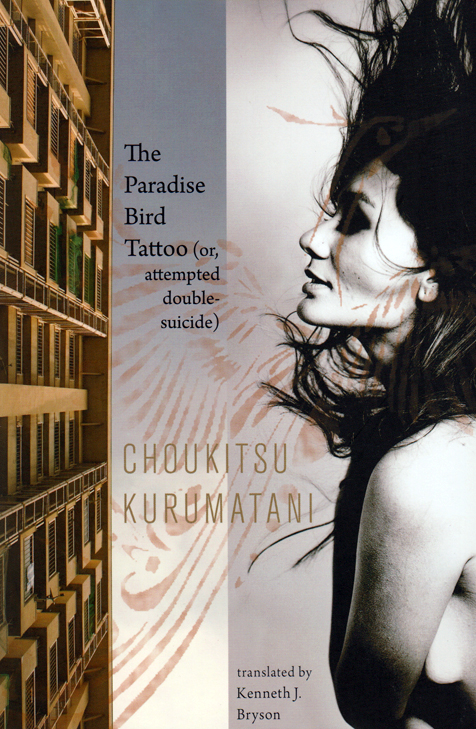
The Paradise Bird Tattoo

The Paradise Bird Tattoo

Title: The Paradise Bird Tattoo (or, Attempted Double-Suicide)
Japanese Title: 赤目四十八瀧心中未遂 (Akame Shijūyataki shinjū misui)
Author: Kurumatani Chōkitsu (車谷長吉)
Translator: Kenneth J. Bryson
Publication Year: 2010 (America), 1998 (Japan)
Publisher: Counterpoint
Pages: 225

I’m not going to lie – the first twenty pages of this book didn’t make me want to continue reading. The narrator of The Paradise Bird Tattoo, Ikushima Yoichi, is a graduate of an elite university who dropped out of society for reasons unknown, and he has all the charm of a thirty-three year old Holden Caulfield, which is to say not very much charm at all. Life sucks, he can’t get his shit together, he has no money, he goes from train station to train station with no rhyme or reason, people are disgusting, nobody likes him, he wants to assault salesgirls with scissors, and he might as well jump off a cliff.

On page twenty-one, Ikushima sits down for coffee with the woman who has agreed to temporarily employ and house him at the request of one of the narrator’s old friends. This woman, whom Ikushima refers to as “Seiko Nēsan,” owns a pub called Igaya in the Higashi-Naniwachō district of Amagasaki, an industrial suburb of Osaka located west of the Yodo River. As Seiko Nēsan tells Ikushima about how she used to be a pan-pan girl during the American occupation, the story begins to shift away from the narrator’s existential crisis and outwards to the other people who occupy the seedy little neighborhood where Ikushima now lives in a cheap backstreet apartment building.

Down the hallway is a room for by a prostitute for couplings that are oddly accompanied by what sounds like religious chanting. Across the hallway is a gruff tattoo artist named Horimayu who occasionally bursts into Ikushima’s apartment. An elementary school aged boy named Shimpei wanders around mostly unsupervised and alternately befriends and bullies Ikushima. A woman named Yi Mun-hyong, who goes by Ayako, lives in an apartment on the first floor and attracts Ikushima’s attention before entering into sexually charged yet emotionally complicated relationship with him.

As a an employee of Seiko Nēsan, Ikushima’s job is to sit in his apartment all day and skewer raw offal meat to be served later in her pub. Ikushima does so without complaining or seeking any sort of meaningful connection to the world around him, but he still ends up unwittingly getting pulled into the lives of the other people in the apartment complex and becomes trapped in relationships that he doesn’t fully understand. Seiko Nēsan asks him to retrieve a large amount of cash from the phone book in a public telephone booth, Horimayu pressures him into holding onto a mysterious sealed box, and Ayako enters his apartment one evening to have her way with him. By the second half of the book, Ikushima is way over his head into affairs about which he knows nothing.

The Paradise Bird Tattoo is a slow burning novel fueled mainly by the grungy atmosphere of the greater Osaka area of the late seventies. Ikushima’s narration contains details about his life in Amagasaki that make the book a pleasure to read. There’s a small sundries store in the same alley as Ikushima’s apartment that he doesn’t shop at because it’s too creepy for him, and the lady who runs it always gives him the evil eye from inside the store when she sees him. A group of cab drivers who spend most of the day gambling park their cars in an alley, but a woman whose house fronts the alley calls the police and has them tow all of the cars. Shimpei finds a toad and keeps it as a pet in one of the apartment drainage pipes until it dies. Seiko Nēsan comes over on a rainy day to have a beer, and she sings old Osaka folk songs rife with double entendre.

Kenneth Bryson’s tone and word choice captures the grittiness of the narrator’s style and attitude:

All I did day after day was cut up beef and pork organs and stick them on skewers. Sooner or later they would wind up in someone’s mouth, be digested inside his organs, and vanish into the toilet as excrement. I wasn’t sure what happened after that, but I assumed the reside would eventually be washed out into the ocean. It was just the same with the glamorous goods lining the shelves in the department stores and supermarkets; someday they would all become rubbish or shit. This was the essence of all human activity; this was why I could tell Seiko Nēsan in all honesty that I had no need for pleasurable pursuits.

The Paradise Bird Tattoo is a walk through the lives of people who live on the margins of society in a neighborhood that is as dangerous and desperate as those who inhabit it. Although the narrator can be a bit of a bore sometimes, the mindset that has led to his decision to abandon a middle class life is fascinating, as are the experiences he describes to the reader in full dirty detail.

Bødy

Bødy

Title: Bødy
Japanese Title: 躯 (Karada)
Author: Nonami Asa (乃波アサ)
Translator: Takami Nieda
Publication Year: 2012 (America); 1999 (Japan)
Publisher: Vertical
Pages: 192

If body horror makes you squeamish, you probably shouldn’t read this book.

If body horror fascinates you, you have come to the right place. Surgery, needles, public bathing, erectile dysfunction, heart attacks, concussions – Nonami Asa’s Bødy has it all.

Bødy collects five short stories, which are all about forty pages long. Each of these stories centers around the body-related neurosis of its protagonist. The short stories in Bødy remind me of the short stories of Patricia Highsmith (particularly those in The Animal-Lover’s Book of Beastly Murder and Little Tales of Misogyny) in that they feature tongue-in-cheek accounts of terrible things happening to people who probably deserve them. In “Blood,” a man who gets off on injuring others learns that he can also get off on injuring himself. In “Whorl,” a man planning on dumping his girlfriend is dumped by her after some mishaps involving an experimental treatment for baldness. In “Jaw,” a man consumed by his training to become a boxer is ultimately defeated by his own physical regimen. The opening story, “Navel,” is about a mother and her two daughters who blow through their savings in order to undergo a series of cosmetic surgical procedures. The last laugh, however, is on the husband and father who doesn’t notice that they look any different until it’s too late.

Although the tone of Bødy is far from jovial, it never takes its subject matter too seriously. With an escalating series of bad things happening to weak-willed and pathetic people, the humor in Bødy is as black as it gets. As soon as the reader thinks that things can’t get any worse for the characters, things get worse in the worst possible way. As a result, these stories are horrifying and fascinating at the same time.

Humor usually works best when the butt of the joke is in a position of power or otherwise represents the status quo, and an element of discomfort tends to creep in when the character being ridiculed truly is a victim. For this reason, the story “Buttocks” stands out for me as the most disturbing story in the collection.

Hiroe, the former queen bee teenage protagonist of “Buttocks,” suffers severe culture shock after she leaves her home in the country to attend a high school in Tokyo. She lives in a dorm, where she has trouble physically and mentally adjusting to a communal lifestyle. She didn’t want to leave home in the first place, her friends from middle school won’t talk to her anymore, and she learns that the only reason she’s able to live in Tokyo is because her father made a large donation to her school. When one of the other girls living in the dorm calls her fat, Hiroe develops an eating disorder. The reader, who is given intimate knowledge of Hiroe’s mindset and methods, sympathizes with the bulimic Hiroe’s improved self-image and sense of renewed control over her life. It actually seems as if the story will have a happy ending before Hiroe collapses and is revealed to be terrifyingly unhealthy. As her parents carry her out of the dorm, Hiroe overhears the same girl who had mocked her for having hips like a duck whispering how creepy she is now that she looks like a skeleton.

Hiroe may have bullied another girl in middle school, but she didn’t deserve this, and the punch line of “Buttocks” is chilling. In this story, the narrative pattern that characterizes the stories in Bødy is less tragicomic and more genuinely upsetting. It’s easy to laugh at the chauvinist pigs of the first three stories in the collection, but the teenage protagonists of the last two stories are genuine victims of forces beyond their control who receive no sympathy from other characters and turn to desperate measures in an attempt to exert some small measure control over their lives. The emotional range Nonami achieves within these stories is remarkable, as is the skill with which she treads the line between amusement and discomfort.

Nonami Asa is a fantastic writer, and I’m happy that more of her work is appearing in translation. She’s primarily known for her detective fiction in Japan, and Juliet Winters Carpenter’s translation of The Hunter is an good example of her gritty hardboiled style. Nonami’s other novel in translation, Now You’re One of Us, is creepy gothic horror that features the black humor and body horror of Bødy without the blunt, cringe-inducing needle-in-your-eye imagery. If you can handle literature with genuinely dark themes, it’s hard to go wrong with Nonami Asa, and Bødy is an excellent introduction to the writer’s work.

Yurei Attack!

Yurei Attack!

Title: Yurei Attack! The Japanese Ghost Survival Guide
Authors: Hiroko Yoda and Matt Alt
Illustrations: Shinkichi (Satoko Tanaka)
Page Design: Andrew Lee
Year Published: 2012
Publisher: Tuttle

This is the best book ever, and I love it.

Hiroko Yoda and Matt Alt, the authors of Yokai Attack!, have come out with another fantastic field guide to the supernatural phenomena of Japan. Everything about this book, from the selection of topics to the authors’ sense of humor to the colorful and creepy style of the illustrations, is wonderful, and the physical book itself is a work of art.

Like Yokai Attack!, Yurei Attack! is divided into four-page entries on famous ghosts, ghost stories, and haunted places. Each of these entries contains not just the legends associated with the ghost in question but also its real-world historical background, its method of attack, and a short section on “how to survive” (which is always appreciated). The second page of each entry is a full-page illustration, and photographs and woodblock prints are scattered across the rest of the pages. The entire book is printed in high-contrast full color, so the images and page layout are just as entertaining as the text.

The ghosts indexed include fictional characters from literature and kabuki plays, real historical figures, and legends that have arisen from historical events. Lady Rokujō from The Tale of Genji is catalogued (that’s her on the cover), as is Oiwa from the Yotsuya Kaidan. The outcast Heian noble Sugawara no Michizane, the crucified peasant Sakura Sōgorō, and the fallen soldiers of Saigō Takamori’s counter-revolutionary group make an appearance. You’ll visit haunted hotel rooms, weeping rocks, castle ruins, tunnels and waterfalls with terrible histories, and the “suicide forest” of Aokigahara. The range of material on offer in Yurei Attack!, which includes famous ghosts and hauntings as well as lesser known spirits and folklore, is incredible, and the authors treat all of their subjects with equal thoroughness and attention. It was immensely gratifying to me personally to learn the full stories behind the vague urban legends I had heard regarding places such as the Sunshine 60 building in Ikebukuro and the tiny shrine dedicated to Taira no Masakado in Tokyo’s Chiyoda ward.

I especially enjoyed “Chapter Five: Dangerous Games,” which deals with matters such as how to curse someone and how to summon ghosts. In this chapter, the reader can learn about Kokkuri-san (which sort of like an Ouija board), all the ways in which ghosts can manifest themselves in photographs, and how real estate agents deal with “houses with histories” (wake ari bukken or jiko bukken). Speaking of haunted houses, apparently agents are legally required to inform prospective buyers if something terrible has happened on the property. If, however, the house has been occupied – for however short a time – since the incident, they don’t have to say anything. Luckily there’s a website that can be consulted to make sure that the reduced price you’re being quoted for a property isn’t due to a ghost: Oshimaland. Good to know!

The opening of the book is really cool, as is its back matter. The five-page introduction is a well-organized discussion on yūrei that highlights trends without forcing any interpretation on the reader, and it’s followed by a seven-step guide to ascertaining if the strange ghostly presence in your life is indeed a yūrei. In the back of the book is a glossary of Japanese terms, a cool (and I mean really cool) photo collage of Japanese toys based on yūrei, a short section on the ofuda charms believed to be able to drive ghosts away, and a bibliography that is actually worth reading in its entirety. There’s also a short guide to the Japanese Buddhist hells, which are all lovingly illustrated.

I can’t exaggerate the awesomeness of the illustrations in Yurei Attack!. According to her short profile, the illustrator is an “active creator” of dōjinshi, or self-published comics. Shinkichi’s pictures do indeed have a sketchy, digitally colored feel, but this is not a bad thing by any means, and her slender-framed, angular chinned human (and not so human) figures are wonderfully expressive. What Shinkichi especially excels at is portraying all of the myriad calamities that can befall the human body. Blood, rotting flesh, missing teeth, emaciation, severed limbs, bloated skin, burn wounds, disfigurations, dangling umbilical cords, scalping, biting, rage, and extreme fear – Shinkichi does it all. The illustrations are generally more fun and dynamic than they are Stephen Gammell-style nightmare fuel, but they can occasionally be genuinely creepy. Shinkichi’s depiction of the frostbitten soldiers who died in a training exercise on Mount Hakkoda in Aomori prefecture in 1902 is particularly disturbing.

I can imagine small children being really upset by Shinkichi’s illustrations, but older children (such as myself) should find them morbidly delightful. I think kids would probably go nuts this book in general. The combination of colorful and imaginative imagery is perfect for a young reader, and the book eschews any serious discussion of adult topics such as sexuality and religion. The bound volume is fairly sturdy and can withstand hard usage (it is a field guide after all), so no worries on that end.

What I especially appreciated about Yurei Attack! is that asinine overgeneralizations about Japan and Japanese people are completely absent. Nowhere in the book will the reader have to suffer through idiotic statements about how “the Japanese have always revered nature” or how “funeral practices are very important in Japan” or how “there is no differentiation between good and evil in Japan.” It’s kind of nice. If nothing else, Yurei Attack! proves that it is entirely possible to write a fun cultural study of Japan for a broad audience without relying on meaningless stereotypes.

Isora from Ugetsu Monogatari

Isora from Tales of Moonlight and Rain

Thermae Romae

Thermae Romae

Title: Thermae Romae
Japanese Title: テルマエ・ロマエ(Terumae Romae)
Artist: Yamazaki Mari (ヤマザキ マリ)
Translation: Stephen Paul
Publication Year: 2012 (America); 2009-2010 (Japan)
Publisher: Yen Press
Pages: 372

This manga is fantastic.

There’s a drawing of a naked man on the cover (you can see his penis under the removable acetate), and there’s a chapter about Roman and Japanese phallus worship. There’s also a chapter about the Bar Kokhba revolt that’s sympathetic to the Romans. The manga tacitly acknowledges Roman homosexuality (Emperor Hadrian is an important character) and Roman slavery (Emperor Hadrian thinks it’s funny that his pet crocodiles have bitten his slaves). All of this is in the background, however; and, if you can get around it, you will love this manga. It’s like reading a super-awesome issue of National Geographic, except with time travel.

Thermae Romae is about Lucius Modestus, a Roman architect living in the first half of the second century who specializes in designing baths and balnea, or bath houses. At the beginning of the story, he sees his own time as possessing an inferior bathing culture and wants to return Rome to the glory days of bathing, but his designs are considered old-fashioned and unmarketable. While taking a breather in a public bath house after being fired from his job at an architectural firm, Lucius slips and is sucked through a water vent into a sentō, or public bath, in twenty-first century Japan. Lucius thinks the Japanese are just slaves from one of the lands that Rome has conquered (he calls them “flat-faces”), and the Japanese think Lucius is just another clueless foreigner (they call him “gaijin-san”), and thankfully no gaping time-travel-related holes open in time and space. Lucius is taught the joys of contemporary Japanese baths; and, after being sucked through another hot water vent, he returns to Rome to share his own adaptations of certain aspects of this culture, which prove popular with his fellow romans.

Although the story gradually develops over the course of the manga, it remains largely episodic. In each chapter, Lucius encounters a problem, is transported to contemporary Japan, learns about Japanese bathing culture, returns to Rome, and implements his own versions of what he saw in Japan to the amazement and delight of everyone involved.

Through these episodes, the reader gets to visit various parts of the city of Rome, as well as locations such as Emperor Hadrian’s mansion in Tibur, Trastevere (a small city on the banks of the Tiber River), and the Roman province of Judea. Also on offer are the hot springs of the Tōhoku region, including monkey hot springs and therapeutic hot springs for convalescents. In his accidental journeys to Japan, Lucius also finds himself in the bathroom of a private residence, a corporate showroom for bathtubs, and even an aquarium that uses the water from a natural hot spring to create a habitat for crocodiles and banana trees.

If exploring contemporary Japan and ancient Rome is half the fun of this manga, the other half is watching Lucius in action. Lucius, earnest to a fault, is a classic straight man who is very serious about everything and responds to every situation he finds himself in with utmost sincerity. Although his upright personality isn’t directly exploited for laughs, it occasionally leads to humorous situations, such as when Lucius takes off his clothes in inappropriate places (for science!) in modern Japan. Mostly, however, Lucius’s personality allows him to act naturally in situations that would otherwise be extremely awkward or uncomfortable. He’s a sympathetic character, and his intelligence and curiosity allow the reader to see and experience more than would be possible if Lucius were a more cynical or self-conscious person.

At first glance there seems to be an undercurrent of “everything in Japan is the best thing ever” running throughout the manga, but I don’t think the artist ever takes the story seriously enough for her celebration of Japanese bath culture to come off as jingoistic. Through Lucius, who is by turns clueless and comically sincere, Yamazaki pokes fun at both ancient Rome and contemporary Japan. The Romans thought they were the most civilized people in the world, but their culture is capable of improvement through outside influences; and, while Japan has a fantastic bathing culture, it’s not flawless either. If Emperor Hadrian trying to recreate the scenery of the Egypt in his private estate is a bit silly, so too is a Japanese zoo that grows bananas. Whether it’s foreign live-in caregivers for elderly people in Japan or Lucius’s frustrated wife leaving him for another man after he runs off to spend three years in Judea, the manga always treats its subject with gentle good humor.

Yamazaki’s art isn’t hyper-detailed, but it is pleasantly realistic. Although she uses screen tone, most of the texture in her drawing, such as the roughness of cloth or the movement of water or the blush on freshly bathed skin, is conveyed by pen strokes. She slightly abbreviates both line and texture in about half of her panels to give the page a clean and open feel and to draw attention to the more visually dense panels. There are always several pages in each chapter that display nothing more than talking heads, but Yamazaki is capable of conveying such a wide and deep range of emotion with facial expressions and body language that these pages never become oppressive or boring.

Perhaps the most pleasant surprise for me in Thermae Romae were the two-page essays at the end of each chapter. These essays, which are always accompanied by a handful of captioned images, offer the reader a few more details about the cultural and historical elements of the preceding chapter. Yamazaki supplements factual information with her experiences travelling through Europe and Japan and anecdotes about famous figures of the ancient world, and her essays are entertaining without ever becoming too personal or pedantic.

Yen Press has done a beautiful job with Thermae Romae. Although the book is a bit too large to comfortably read in the bath, the extra size is worth the better print quality. It’s also worth mentioning that Stephen Paul’s translation is superb. When I read the manga in Japanese earlier this year, I wondered how certain aspects of the text (such as the Tōhoku dialect spoken by a handful of secondary characters) could be handled in translation, and I think the translator and editorial staff did a wonderful job; the language in Thermae Romae is beautifully smooth with no awkward translatorese or corny attempts to reproduce dialect.

Thermae Romae is fantastic. I’m so happy this manga finally made it to America.