Strange Houses

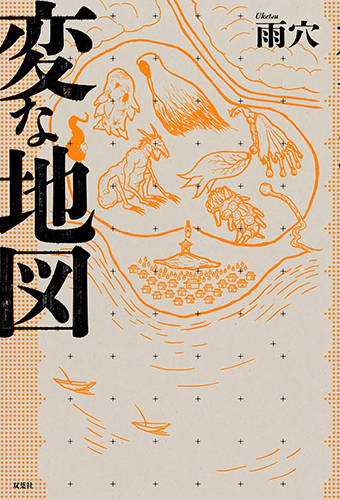
Strange Houses is a four-part horror mystery novel about houses with strange and uncanny floor plans.

Each of the four chapters takes the form of a series of conversations between the narrator, their architect friend, and various people who have been involved with the houses. The first three chapters explore three different houses with extra rooms and inexplicable gaps in the walls. These explorations are liberally illustrated with diagrams in which certain sections of the floor plan are highlighted and annotated to clarify the text.

Each of these stories is like a locked room mystery. Over the course of the chapter, the narrator’s architect friend performs a close reading of a floor plan while gradually building a theory concerning what sort of upsetting behavior that type of strange space might enable.

In the final chapter, it’s revealed that these houses are connected to an old and wealthy family with a terrible secret. I have to admit that I found this situation highly improbable, so much so that it comes off as almost cartoonish. The author is great at architectural walkthroughs but skimps on the character development, which contributes to the conclusion of the book feeling somewhat hollow. Still, there’s a lot of fuel for the reader’s imagination, and fans of gothic horror will have a lot to play with here.

I flew through Strange Houses and loved every page. The speculative conversations between characters are easy to follow; and, thanks to the diagrams, the spaces are easy to visualize. I enjoyed the slow build of the overarching mystery, and the revelations about the bizarre family at the center of the strangeness were beyond anything I expected.

It’s worth noting that the first story in Strange Houses was originally written as a script for a twenty-minute video on YouTube, which you can find with English subtitles (here). There’s also a manga adaptation, which has been scanlated and is available to read (here). And finally, I’d like to share a more substantial review of the original Japanese book that was posted on one of my favorite blogs (here).

I tend to think that Uketsu’s earlier novel Strange Pictures (which I reviewed here) is somewhat more successful as a work of fiction with three-dimensional characters whose bad behavior stems from understandable motives. In comparison, Strange Houses feels more like a puzzle box than a novel. Strange Houses is less a character-driven story than it is an imaginative architectural mystery, but its eerie atmosphere and clever narrative structure make it a fascinating read for fans of speculative horror and uncanny design.

ツミデミック

Michi Ichiho’s Tsumidemic (ツミデミック), which won the prestigious Naoki Prize for popular fiction in 2024, collects six stories about the atmospheric strangeness of the Coronavirus pandemic. While everyone’s attention was focused elsewhere, Ichiho wonders, what sort of intriguingly antisocial behavior might have been enabled by isolation?

The opening story, Chigau hane no tori (違う羽の鳥), has all the grim fascination of a viral urban legend. Yūto moved to Tokyo only to drop out of college, and now he works as a barker for a bar in Shinjuku. Unfortunately, business isn’t going well due to the pandemic. During another eerily quiet night, Yūto sees someone he knew back from middle school in Osaka, Nagisa Inoue. This is a shock, as Nagisa is supposed to have committed suicide by jumping onto the train tracks. As she and Yūto get drinks together, Nagisa explains her devious plot to flee from the grasp of her overbearing mother, which was far from a victimless crime. Yūto is no saint himself, and he inadvertently reveals why he immediately recognized someone he never talked to when they were classmates.

Romansu (ロマンス☆) is about a bored housewife named Yuri who develops a serious online gambling addiction of an unusual nature. Yuri hasn’t been able to find a new job since she left her previous position to give birth to her daughter, and the pandemic isn’t helping. She channels her frustration into a food delivery app called Miideri, which she treats like a gacha game. Will the person who makes her next delivery be one of the handsome men rumored to be employed by the service? While gambling on the slim possibility that a prince will arrive at her door bearing a bag from McDonald’s, Yuri attracts the unwanted attention of an unhinged delivery driver who has read exactly the wrong message into her frequent orders.

Rinkō (憐光) is narrated by the ghost of a high school student named Yui who, strangely enough, can’t recall how she died. Having materialized back into the world fifteen years after her death, Yui finds herself confused and alienated by the loneliness of the Tokyo streets and train stations during the pandemic. She therefore returns home to her mother’s house in the country. Her arrival coincides with a memorial visit from her friend Tsubasa, who is accompanied by their old homeroom teacher, Sugita. As Yui eavesdrops on their conversation, she learns that she died after mysteriously falling into a river during a rainstorm. Sugita knows what Yui was doing and where she was going, and Tsubasa wants him to know that she knows, too.

The collection takes a slightly more positive turn in the fourth story, Tokubetsu enkosha (特別縁故者), in which Kyōichi, the unemployed and impecunious father of a young son, attempts to weasel himself into the good graces of an elderly man whom he suspects is a money hoarder. Kyōichi, an affable himbo who has no business scamming anyone out of money, volunteers for the daily task of picking up a takeout lunch from one of the many bentō stores in the neighborhood. The old man knows exactly why Kyōichi approached him, and he resents him for not pursuing his ambition to enter the food service industry. Harsh words are exchanged; but, when push comes to shove, even a relationship built on ulterior motives is better than living alone as an elderly shut-in during a pandemic.

Shukufuku no uta (祝福の歌) is about a happily married middle-aged man facing a new direction in his life. Despite being a high school student, his daughter is pregnant, and she intends to keep the baby. Meanwhile, the man’s mother seems to be entering the permanent brain fog of senile dementia. His daughter, who has been gossiping with the other mothers in her grandmother’s apartment building, gets the sense that there’s something else going on. With any luck, it’s a problem that can actually be solved.

Sazanami Drive (さざなみドライブ) follows the IRL meetup of five people who connected on Twitter after their lives were disrupted by the pandemic. As they drive out to the country in a minivan, they share their stories of abandonment and alienation. Little do they know that one of their number has a secret agenda. He’ll do whatever it takes to disrupt the group’s grim plan for the trip – and hopefully save their lives in the process.

As indicated by the book’s title, the two themes guiding this collection are “crime” and “the pandemic.” Each of the characters is hiding something, and the reader never knows where anyone’s true intentions lie. Michi Ichiho, who began her writing career as an author of BL romance novels, isn’t unduly focused on creating mimetic fiction, and the scenarios are improbable at best. Still, the twist at the end of each story is a lot of fun, and the fantastical plot elements accurately convey the feeling of just how weird and unreal everything felt during the pandemic.

It appears that the English-language publication rights for this collection are currently up for grabs (more info here). Tsumidemic is a fast-paced and emotionally cathartic book, and it would benefit from a tone-sensitive translation that renders Ichiho’s dialogue-filled writing into snappy, Stephen King style prose. I hope someone picks it up.

Kamimachi

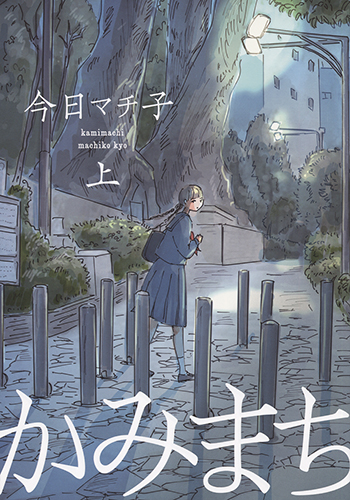
Machiko Kyō’s Kamimachi (かみまち) was serialized from June 2019 to December 2022 and published as a two-volume graphic novel in August 2023. The story follows four homeless teenage girls who find themselves at a privately run youth shelter called Kami No Ie (“Family of God”) in the Tokyo suburbs.

Although he initially seems kind and welcoming, the middle-aged man who runs this shelter is a sexual predator, and he has assaulted and murdered one of his young charges prior to the beginning of the story. The ghost of this young woman, in the form of a Christian angel, helps the girls find the courage to escape the Kami No Ie shelter.

Each of the four main characters in Kamimachi has become homeless after escaping a toxic home environment.

Uka is the only child of a single mother who projects her loneliness and frustrated ambitions onto her daughter. The story begins as Uka leaves home and seeks shelter by means of a roomshare app. After a number of awkward situations, Uka comes to the attention of a group of men who use the app to recruit sex workers. These men force Uka into a situation in which she’s expected to trade a night at a short-term rental space for sex. She breaks out of the apartment and wanders the streets of Tokyo before finding herself at the Kami No Ie shelter.

Uka’s closest friend at the shelter, Nagisa, has been sexually abused by her stepfather for years. She finally flees from home after her mother witnesses one of these assaults and turns away in disgust.

Arisa was raised as a television idol by a single mother. After her mother’s sudden death in an accident, Arisa is given to the care of a talent manager who steals her inheritance and financial assets, leaving her destitute.

Yō is one of five siblings. She’s so neglected by her family and bullied by her brothers that she finds it preferable to sleep in subway stations. Eventually she stops returning home altogether.  

For each of these young women, Tokyo becomes a wilderness whose anonymous open spaces serve as a refuge from the enclosed interiors where they’re coerced into enduring abuse. Kyō draws indoor scenes using small panels with blank backgrounds, and these scenes often feature close-ups of the characters’ faces in moments of distress. Meanwhile, Kyō depicts outdoor scenes with large panels that frame the characters with trees and buildings. The expansive outdoor settings often serve as the stage for small moments of kindness and emotional clarity.

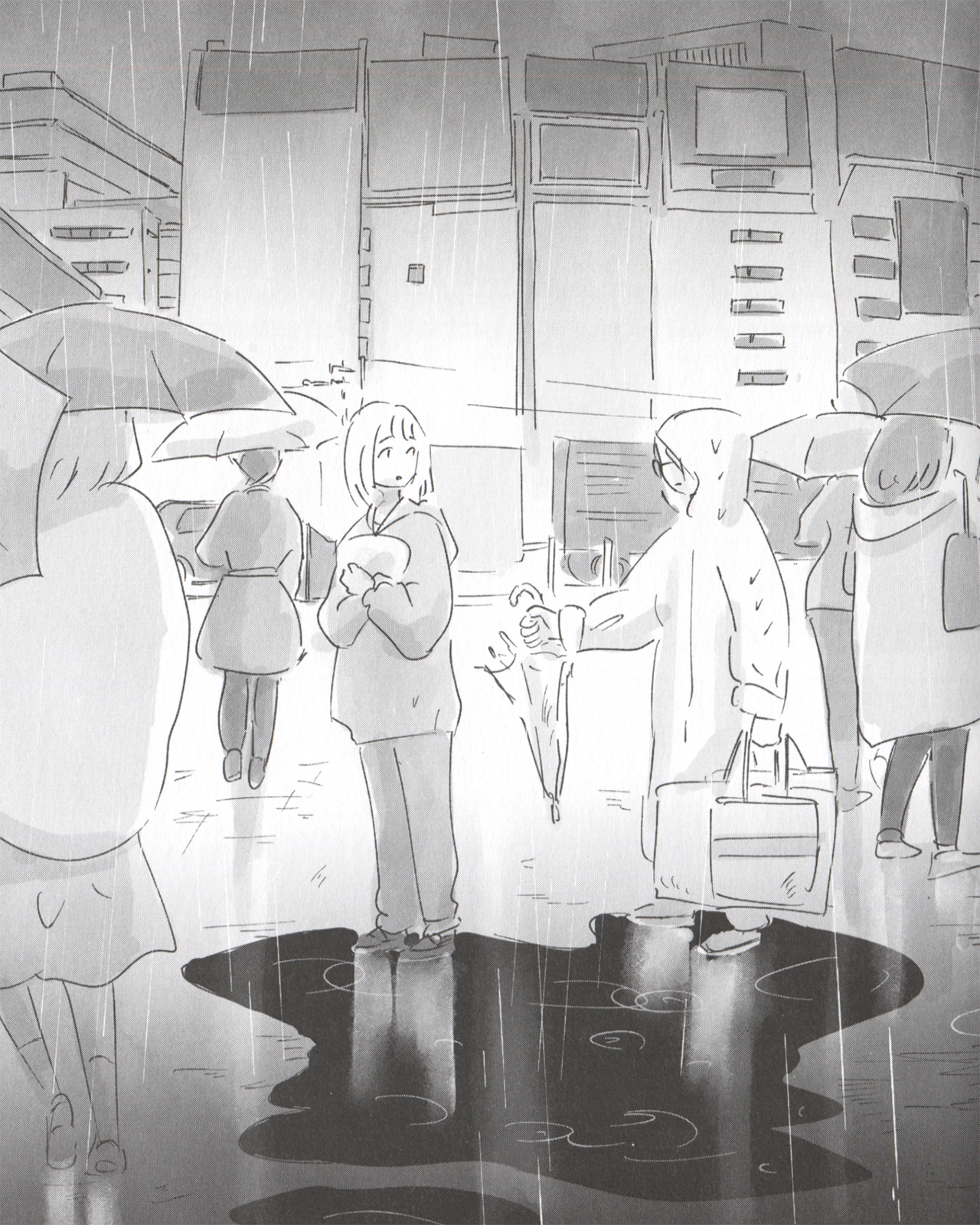
In Chapter Three, for example, Uka flees into the night after an attempted sexual assault at a roomshare apartment. After her escape, she wanders through the rain with nothing but the clothes on her back. Out of context, the rainy cityscape may seem bleak, but the large panels filled are a visual relief after the oppressively small and claustrophobic panels that depict the apartment.

One of the anonymous figures passing in the rain, whom the reader later learns is Yō, stops beside Uka to give her an umbrella. Page 71 opens with a close-up of Yō’s extended hand before spreading into an open panel in which Uka and Yō stand at the center of a composition framed by misty buildings and puddles on the concrete. The two small figures reaching out to one another are enclosed in a soft curtain of rain, and the sense of relief at being a part of a larger world is palpable.  

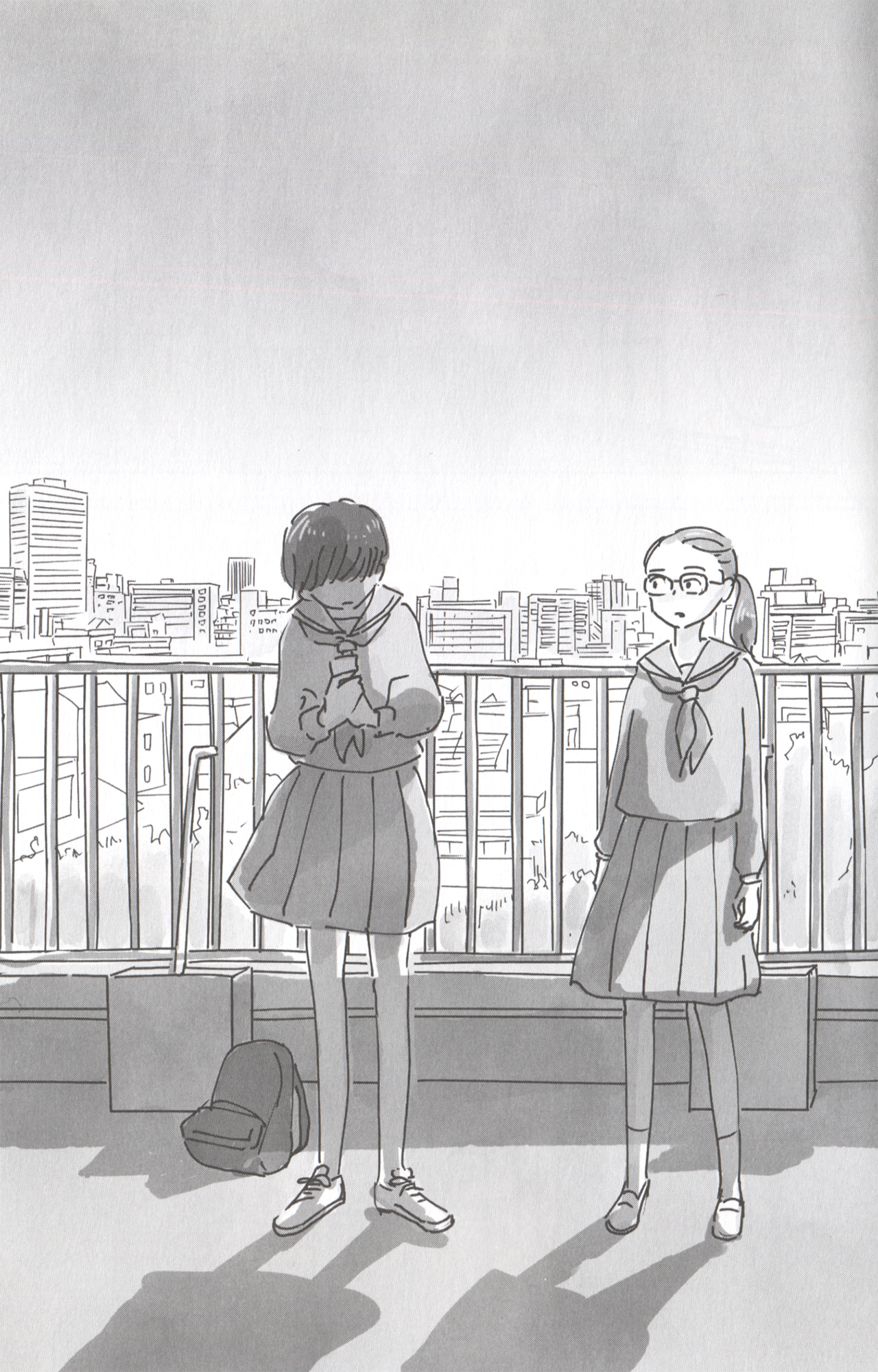
Chapter Seven contains a similar scene in which the open sky and background cityscape suggest freedom from the violence that occurs behind closed doors. Nagisa, who’d encountered Uka in a roomshare arrangement, takes Uka’s discarded uniform and attends school in her place. One of Uka’s former classmates approaches Nagisa, offers to share her lunch, and asks that Nagisa talk with her on the roof. Nagisa initially tries to be normal, showing the girl photos of her mother and stepfather’s new infant daughter.

During this scene, the panels become progressively smaller until Nagisa finally admits the truth about having left her family. The shift to a full-page panel depicting the city’s jumble of buildings spreading under the open sky signals Nagisa’s admission that something has to change. This moment also serves as the catalyst for Uka’s classmate to begin searching for her missing friend, a decision that ultimately results in Uka’s rescue from the Kami No Ie shelter.

The openness of Tokyo cityscapes in these scenes suggests that the sort of hidden abuse endured by these young women needs to be brought into the open and exposed to the light of public scrutiny. Along those lines, I can’t help but feel that Kyō’s depictions of outdoor spaces in Kamimachi also reflect the artist’s emotional response to the Covid pandemic. For people in precarious situations, being physically stuck inside often exacerbated the experience of feeling trapped within oppressive social systems.

As an artist who documented the pandemic years through evocative illustrations posted to Instagram, Kyō’s project is not simply to depict the beauty of architecture and greenery within the city, but also to comment on the importance of open outdoor “third places” for young people suffering from social pressure and economic strain. Kamimachi doesn’t provide easy solutions, but it’s cathartic to see the issue of youth precarity brought out into the open air. 

Machiko Kyō is a prolific and award-winning artist whose illustration collections have been celebrated by The Comics Journal (here). If you’re interested in reading more about the artist’s work, I published a short essay on her 2013 graphic novel Cocoon – whose animated adaptation is scheduled to premiere on NHK in Summer 2025 – on Women Write About Comics (here). Here’s hoping that English-language readers will be able to experience Kyō’s compelling and thought-provoking work in the near future.

とんこつ Q&A

とんこつ Q&A collects four stories by Natsuko Imamura, the author of The Woman in the Purple Skirt. Each of these stories is built on a cute and wholesome premise that develops in a dark and strange direction.

The title story is about a woman with social anxiety who creates a written script to help her navigate her job as a server at a small diner called Tonkotsu. Her efforts are aided by the recently widowed owner and his young son, who teaches the narrator to speak in Osaka dialect like his late mother.

The narrator’s script gradually expands beyond professional dialogue into everyday pleasantries, and she ultimately becomes a ghostwriter for the diner owner’s new wife. This scenario seems like a perfect set-up for a sweet and gentle romantic comedy, but it gradually becomes more disturbing as the narrator cheerfully crafts the diner owner’s new wife into a living doll.  

The three other stories in the collection are about middle school bullies whose punishment is far worse than their crime, an aggressively clueless wife who gets away with murder, and a very sketchy coworker. Imamura’s prose is smooth but cuts like a knife, and the situations she crafts are never what they seem. I wouldn’t say that these stories have twist endings, necessarily, but the way their wholesome coziness slowly sinks into social horror is fascinating to watch.

Japanese Suspense Novels by Female Authors

The Memory Police by Yoko Ogawa
Normal people quietly go about their lives on a sleepy island where memories collectively vanish a bit at a time. But what happens to the people who can’t forget?

Masks by Fumiko Enchi
Two cultured and handsome men compete for the affections of a beautiful young widow while her devious mother-in-law manipulates their relationships from the shadows.

The Woman in the Purple Skirt by Natsuko Imamura
The Woman in the Yellow Cardigan is intrigued by the Woman in the Purple Skirt – so intrigued that she follows her every move and investigates every detail of her private life.

All She Was Worth by Miyuki Miyabe
Pursued by debt collectors, loan sharks, and yakuza henchmen, a woman vanishes, leaving behind a trail of false identities and broken lives.

The Eighth Day by Mitsuyo Kakuta
A desperate woman, spurned by her married lover, kidnaps his child and goes on the run. Now an adult, the kidnapped child has no memory of this and must piece together what happened from interviews and newspaper clippings.

Penance by Kanae Minato
A young girl is assaulted and killed in a small rural town, and the murderer is never caught. Years later, a series of letters from the girl’s mother forces her former friends to reflect on what they knew and what they could never tell anyone.

The Graveyard Apartment by Mariko Koike
A family moves into an inexpensive apartment next to a graveyard, but their hopes for a new life are shattered as strange and inexplicable things begin to happen in their building.

There’s No Such Thing As An Easy Job by Kikuko Tsumura
A woman suffering from burnout leaves her white-collar position and goes to a temp agency, requesting that she be placed in an “easy” job. There’s no such thing as an easy job, however, and it stands to reason that companies who are desperate for temp workers have shady ulterior motives.

Convenience Store Woman by Sayaka Murata
An unmarried woman finds joy and meaning in the comfortable routine of working at a convenience store. When pressured by her family and friends to quit her job and find a partner, how far will she go to prove that she’s “normal”?

Real World by Natsuo Kirino
A teenage boy from an affluent Tokyo suburb kills his mother in a fit of explosive rage. The friends of the girl next door decide to help him escape and gradually succumb to the darkness at the core of their seemingly perfect lives at a prestigious private high school.

. . . . . . . . . . . . . . .

The illustration above is by James of ShelfWornDrawn, whose work can be found on Instagram (here) and on Tumblr (here). You can commission a portrait of your own library via his Etsy page (here).


Earthlings

Japanese Title: 地球星人 (Chikyūseijin)
Author: Sayaka Murata (村田 沙耶香)
Translator: Ginny Tapley Takemori
Publication Year: 2018 (Japan); 2020 (United States)
Press: Grove Press
Pages: 247

Content Warning: This review contains a frank discussion of child abuse and incest.

If you’ve made it past the content warning, you should also be aware that Earthlings contains extended and explicit descriptions of parental child abuse, incestuous child sexuality, adolescent sexual abuse, severe dissociation, suicidal ideation, mental illness, murder, starvation, and cannibalism. This material is central to the story, which has a truly disturbing ending.

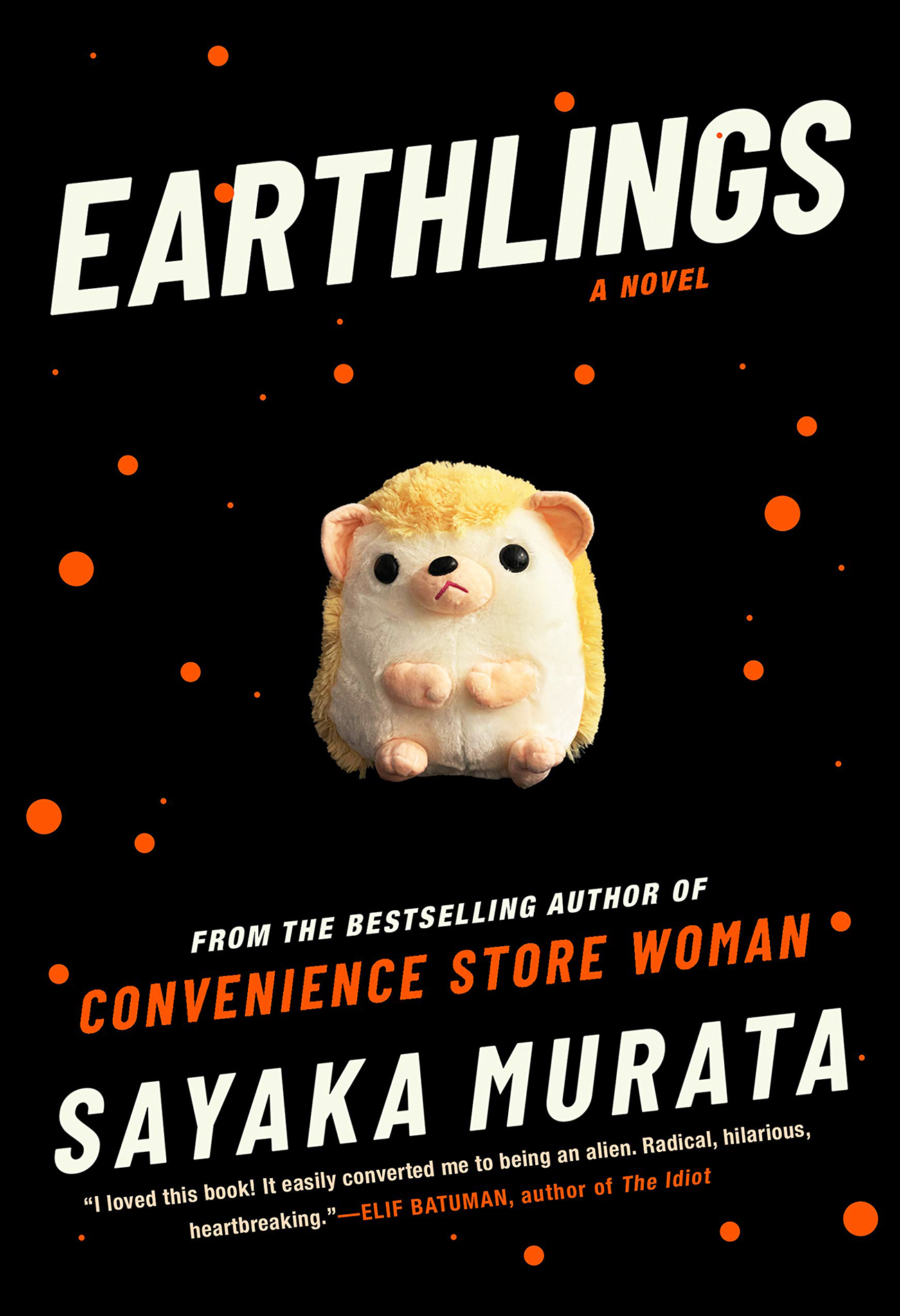
While I would happily recommend Sayaka Murata’s novel Convenience Store Woman to anyone, Earthlings is definitely not for everyone. Elif Batuman calls this novel “hilarious” in the blurb on the front cover of the American edition, and I’m not sure where that’s coming from. Earthlings is deeply sad and upsetting. It’s not the least bit funny, joyous, offbeat, or quirky. The author’s tone may be deceptively light, but the themes of her story are as dark as they come.

Earthlings is a novel about the deteriorating mental state and unfortunate life decisions of a relatively normal girl named Natsuki who is made to feel that she isn’t human because of the sustained abuse she receives at the hands of her parents and teachers. The point of the story isn’t to argue that we need to free ourselves from the normative expectations of an oppressive society. Rather, Earthlings demonstrates just how deeply painful and unhealthy social alienation can be to the people who are arbitrarily designated as outcasts and scapegoats.  

The novel begins with the eleven-year-old Natsuki’s confession that she is a special child who was chosen by an alien named Piyyut, who came from Planet Popinpobopia to help her fight evil witches as a magical girl. Although Piyyut looks like a stuffed animal to ordinary people, he’s actually an emissary sent by the Magic Police. This is a secret to everyone except Natsuki’s cousin Yuu, who tells Natsuki that he understands Piyyut’s situation because he’s an alien too.

From the very first page, it’s clear that Natsuki has created a fantasy version of herself in order to escape the neglect of her parents. Neither of Natsuki’s parents attempt to hide their preference for her older sister Kise, who has a codependent Münchhausen-by-proxy relationship with their mother. While Kise can do no wrong and requires special care and attention, Natsuki becomes the scapegoat of her mother, who constantly criticizes her appearance and personality. Instead of defending Natsuki, everyone in her family defers to her mother – everyone except her kind and friendly cousin Yuu, whom Natsuki decides is her boyfriend and future marriage partner.

Because of the strength of her magical girl fantasy, Natsuki is able to survive the abuse she suffers at home. Unfortunately, precisely because this abuse makes her vulnerable, she becomes the sexual target of a young and popular teacher at her after-school tutoring program. The author gets the abusive teacher’s mentality exactly right. He starts with small acts that have plausible deniability, such as using “posture correction” as an excuse to grope Natsuki. When he escalates his behavior in an attempt to test the boundaries of what he can get away with, he does so in a way that Natsuki will be ashamed to talk about, such as fishing her used sanitary napkin out of the trash after she uses the bathroom.

Natsuki knows there’s something wrong with the teacher’s behavior and tells her mother, but her mother takes the teacher’s side and scolds Natsuki for overreacting. She then punishes Natsuki for “making up stories” by forcing her to spend more time with the teacher. Natsuki ends up going to the teacher’s house for a private lesson, which leads to exactly the scenario you’re afraid it will. The sexual assault scene is long, explicit, and extremely difficult to read. Once again, the author depicts the mentality of child abuse with perfect accuracy, in that the teacher forces Natsuki into a situation in which she feels compelled to “consent” to her assault, thus making it seem like her own fault.

Severely traumatized and knowing from experience that no one will believe she’s been raped, the now twelve-year-old Natsuki resolves to commit suicide in the mountain forest surrounding her grandparents’ house during the annual family get-together for the summer Obon festival. Before she dies, Natsuki wants to experience genuine physical affection, so she convinces her cousin Yuu to go out in the woods with her to have penetrative sex, after which she swallows an entire bottle of her aunt’s sleeping pills.

As Elif Batuman says in the blurb on the front cover of Earthlings, the abuse, rape, and attempted suicide of a twelve-year-old girl is “hilarious.”

Except it’s not. Natsuki’s fantasy of being a magical girl is a psychological coping mechanism, and her lack of affect is the result of severe trauma. Not only are the events Murata describes terrible to read, it’s also terrible to hear them recounted in the voice of a twelve-year-old narrator who doesn’t yet possess the emotional maturity to process what’s happening to her. This narrative style isn’t “quirky.” It’s horrifying.  

After Earthlings firmly establishes itself as a horror story told by an unreliable narrator, it jumps forward in time to 34-year-old Natsuki, who is currently in her third year of marriage to a man named Tomoya. After her suicide attempt, Natsuki was essentially treated as a prisoner by her family for two decades, and marriage seemed to be the only way for her to escape. Natsuki met Tomoya on a website for people in situations similar to her own, namely, people who need to get married in order to appease their families. The site caters mostly to the LGBTQ+ community; and, while Tomoya’s sexuality is never specified, he seems to be aro-ace, meaning that he does not experience romantic attraction and is disgusted by physical sexual contact.

Tomoya and Natsuki are essentially roommates who sleep in separate bedrooms while sharing an apartment. This arrangement works well for both of them, at least until their families begin to exert pressure about having children. The stress of this pressure weakens the deep fault lines of their respective childhood traumas, and they decide to escape society by fleeing to Natsuki’s grandparents’ house in the mountains. The house is currently occupied by Yuu, who has been acting as a caretaker for the property after having been laid off from a prestigious office job in Tokyo. As you can imagine, what happens to these three characters in an isolated cabin in the woods isn’t great, and the novel’s ending is shocking.

Earthlings is about three broken people whose connection to reality gradually deteriorates as they feed one another’s delusions while in total social isolation. The plot summary I’ve provided is the background necessary for the reader to understand the core of this story, as well as its tone.

In Convenience Store Woman, Sayaka Murata argues for the quiet dignity of menial service jobs and the validity of neurodivergent perspectives. The narrator of Convenience Store Woman enjoys her job as a clerk at a convenience store because she finds the routine comforting and appreciates being able to interact with other people according to a preset script. Toward the end of the novel, she finds herself in a difficult situation because she succumbs to her family’s pressure to find a partner and chooses the first person to make himself available despite his unsuitability. Many readers of this internationally bestselling novel identified with the narrator’s perspective and sympathized with the author’s description of the small pleasures of part-time service industry jobs that are often looked down on by older generations.

Earthlings explores similar material and themes but takes a radically different approach. In this novel, Murata emphasizes her narrator’s social alienation to an extreme degree. The narrator’s unwilling separation from “Earthlings” is not a good thing, nor is it depicted as being relatable. Instead, Murata uses these characters to ask serious questions about what it means for neurodiversity and queerness to be forcibly removed from mainstream society. For instance, why are child molesters protected by their communities while the children they abuse are treated as unbalanced and unclean? Why is traveling overseas to undergo expensive and invasive surgery in order to have children seen as normal, while choosing to remain childless is viewed as antisocial and neurotic?

If you can handle the dark tone and gruesome subject matter of Earthlings, it’s an extremely compelling story. At the risk of calling child abuse “hilarious,” I have to admit that I was entertained, especially once Natsuki starts living in her grandparents’ abandoned house in the woods. For what it’s worth, the ultimate fate of the pedo teacher and the garbage parents who enabled him is unpleasant yet satisfying.   

As a fan of social horror, I love Earthlings, but I would caution potential readers to take the content warnings seriously. Sayaka Murata is a brilliant writer who tells strange and complicated stories, and I look forward to seeing more of her sizeable body of work in translation. I just hope that, in the future, she’s treated like the complex and nuanced literary figure she is instead of marketed as an easily digestible product of pop culture.

The Woman in the Purple Skirt

Japanese Title: むらさきのスカートの女 (Murasaki no sukāto no onna)
Author: Natsuko Imamura (今村 夏子)
Translator: Lucy North
Publication Year: 2019 (Japan); 2021 (United States)
Publisher: Penguin Books
Pages: 216

The Woman in the Purple Skirt begins as a charming set of observations about a woman who lives in a quiet neighborhood. It soon becomes clear, however, that there is something creepy about the narrator, who calls herself The Woman in the Yellow Cardigan.

The specificity of the narration raises many questions. Why is the narrator so obsessed with the Woman in the Purple Skirt? How is she able to observe her so closely? Is she stalking this woman? Or is she perhaps talking about herself in third person? Is she making up a fantasy version of herself, or is she projecting her personality onto a real woman? If so, why? Who is the Woman in the Purple Skirt? Who is the Woman in the Yellow Cardigan?

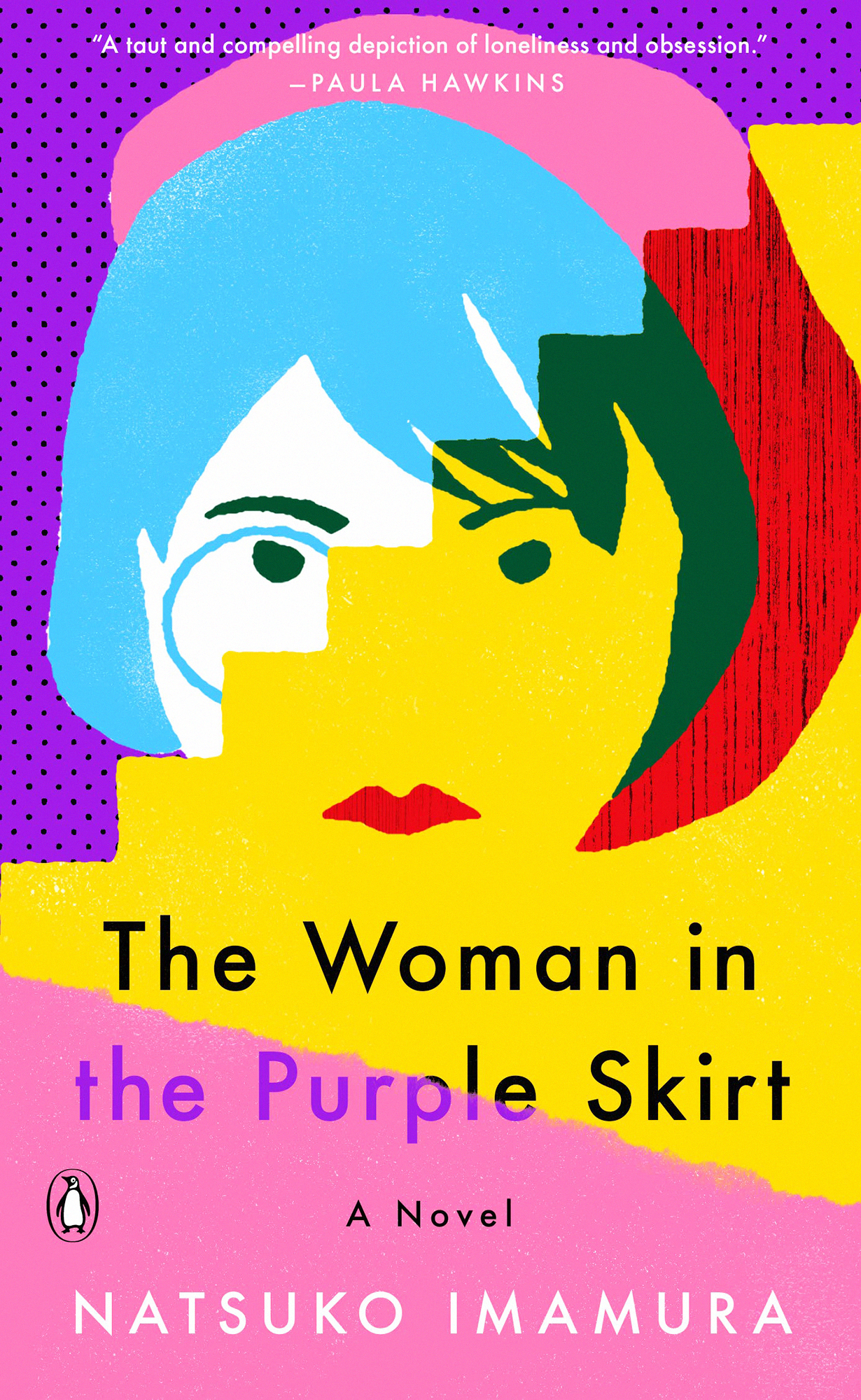
The Woman in the Purple Skirt isn’t suspense, necessarily, and it’s certainly not the “thriller” that the publisher seems to be trying to market it as, but the experience of reading this story is unsettling. The novella won the prestigious Akutagawa Prize, which is awarded to work from emerging writers that pushes boundaries and has a certain air of being “literary.” Despite the stylish chick lit cover of the American edition, the plot of The Woman in the Purple Skirt is almost depressingly mundane.

After a series of temp jobs that she quits after only a few days, the Woman in the Purple Skirt finds employment as member of the cleaning staff at an upscale hotel. She seems to be having an affair with one of her supervisors, and rumors spread that her salary is disproportionately high. At the same time, certain imbalances in inventory cause her coworkers to suspect that she is stealing. As the atmosphere at work becomes more hostile, the woman’s relationship with her supervisor also deteriorates. Meanwhile, the narrator, who is also a supervisor on the hotel’s cleaning staff, continues to glide through the life of the Woman in the Purple Skirt like a shadow.

This story is banal, but the subtle uncanniness of the narration forces the reader to view these normal events in normal lives with a sense of unease. The prose is sparse, the language is simplistic, and the affect is almost completely flat. Lucy North’s translation is reminiscent of Raymond Carver, especially in terms of dialog. Like Carver’s short fiction, the themes that emerge from beneath the placid surface of the narration are distressing: economic precarity, alienation, and the dangers of aging without a social network or financial safety net.

Despite its engagement with contemporary social issues, there’s nothing about The Woman in the Purple Skirt that requires specialist cultural knowledge, as the experience of struggling with loneliness while making minimum wage is equally shitty everywhere. I’d recommend this novella to anyone who enjoyed (or was at least moved by) Convenience Store Woman, as well as anyone concerned with urban anomie who entertains doubts about the ethics of low-wage work.

Because of the intriguing questions it raises and the unfortunate relatability of the discussion it’s likely to inspire, I would also recommend The Woman in the Purple Skirt as a text in a class on contemporary Japanese fiction. In addition, I think the novella might work well as a text for upper-level Japanese language classes, as its polished yet accessible prose evades the deliberate opacity of most Akutagawa Prize-winning work. Imamura has a field day with the narrative ambiguities made possible by the Japanese language, so it might be interesting to read the original side-by-side with North’s translation, which makes a number of tough decisions that nevertheless read as smooth and effortless.

Acclaimed author Natsuko Imamura’s first work to appear in English translation is short enough to be read in the span of an hour, but it’s worth spending time with. It’s difficult to say that a book as genuinely creepy as The Woman in the Purple Skirt is an enjoyable read, but the novella is a darkly shining jewel of literary fiction that invites and rewards analysis and introspection.

The Cat in the Coffin

Japanese Title: 柩の中の猫 (Hitsugi no naka no neko)
Author: Mariko Koike (小池 真理子)
Translator: Deborah Boliver Boehm
Publication Year: 1990 (Japan); 2009 (United States)
Publisher: Vertical
Pages: 190

According to the back cover copy, The Cat in the Coffin is “a gem of a modern update on the governess genre immortalized by Jane Eyre and ‘The Turn of the Screw’ [and a] hypnotic thriller that lures the reader into the darkness of the human heart,” which is as good of a description as any. The Cat in the Coffin is a story about family, desire, love, malice, and a cat at the center of a chilling murder.

Masayo, an aspiring artist from Hokkaido who has just turned twenty, moves to Tokyo to be a live-in housekeeper and caretaker for Momoko, the eight-year-old daughter of a semi-famous artist and college professor named Goro Kawakubo. The year is 1955, and Goro has embraced a modern American lifestyle of cocktails and garden parties after the tragic death of his wife. Masayo cares little for fashion or the glamor of high society, but she is enchanted by Momoko, who speaks to no one except her white cat Lala. Masayo bonds with Momoko through their shared love of Lala, and they become fast friends.

Everything goes well until a startlingly beautiful woman named Chinatsu shows up at one of Goro’s parties. Chinatsu worked as a translator and lived with her husband in America before becoming a widow and returning to Japan. Despite her air of cosmopolitan sophistication, Chinatsu is thoughtful and kind. Goro is clearly in love with her, but both Masayo and Momoko are ambivalent. After all, if Goro marries Chinatsu, there will be no need for Masayo to remain in the house as Momoko’s caretaker.

All of the characters in The Cat in the Coffin are good people, but they’re imperfect in small but significant ways. Goro takes his relationship with Chinatsu slowly so that his daughter will be comfortable with the woman who will replace her mother, but he is perhaps a little too willing to leave his daughter entirely to Masayo’s care. Momoko understandably misses her mother and craves her father’s affection, but her grief has caused her to become isolated and antisocial. Masayo tries her hardest to do what’s best for Momoko, but her crush on Goro causes her to give Chinatsu a cold shoulder.

The comparisons to Jane Eyre and “The Turn of the Screw” are apt, as Masayo’s idealized longing for Goro and Momoko’s aggressive strangeness create a difficult situation for Chinatsu, whose only flaw is that she isn’t able to conceal her dislike of Lala. Chinatsu gradually succumbs to a delusion that everything will work out if she no longer has to compete for Momoko’s affection with a cat, and she ends up taking drastic action in secret. Masayo witnesses her terrible act, which creates a terrible psychological burden she is unable to bear. The suspense of The Cat in the Coffin thus lies in witnessing a modestly happy household’s slow dissolution in a boiling pot of misdirected passion and ice-cold rage.

The Cat in the Coffin can also be read as a sustained exploration of Masayo’s fear of growing up as she longs for independence but still clings to childhood, sinking herself into a codependent relationship with Momoko and Lala instead of building a working friendship with Chinatsu, who represents her anxiety of adult sexuality. Meanwhile, although Chinatsu is only a secondary character from Masayo’s perspective, her life history is fascinating, and its eventual revelation is quite dramatic. Chinatsu’s story is reminiscent of The Great Gatsby in her ambition and failed pursuit of the American dream, and it’s precisely because of her progressive American approach to Momoko that their relationship is so disastrous.  

The Cat in the Coffin begins at a somewhat leisurely pace, but the suspense is slowly amplified throughout the novel, which is neatly structured and short enough to be read in one or two sittings. The ending is highly satisfying, as is the frame narrative, in which Masayo, now a famous artist, relates the story of Momoko, Chinatsu, and Lala to her own housekeeper. The well-edited and well-executed translation keeps the action moving at a brisk pace, making The Cat in the Coffin an enjoyable book to binge. This psychological thriller is lean and sharp and almost painfully insightful, and I especially recommend it to fans of Japanese cat novels who are interested in something domestic that still has its claws.