Exit 8 is a 2025 prose adaptation of a video game of the same name that was released in November 2023 and achieved viral success after being streamed by popular YouTubers like Markiplier and The Game Grumps.
The game version of Exit 8 (on Steam here) is a liminal space walking sim in which you loop through a (very) short passage in the Tokyo subway system endlessly. The only choice you can make is to keep moving forward or to go back the way you came, and you must do this according to a set of rules: (1) If something in the current loop is different, go back; and (2) if nothing is different, keep going forward. The “anomalies” occur randomly, so being observant is key.
If the player gets it right eight times, they can escape to the end credits, which play over Tokyo urban sounds that are like heaven after the underground corridor. If there’s any sort of mistake, though, the loop count resets to zero. (This) no-commentary video playthrough is about ten minutes long, and it’s worth watching for a minute or two if you’re curious.
Genki Kawamura’s novel adaptation maintains the same scenario and rules as the video game but creates a story centered around an original protagonist, an unnamed man in his mid-twenties who works as a freelancer in an unspecified field. Though he moved from his hometown to Tokyo with his girlfriend, the Lost Man has recently ended the relationship after he and his girlfriend grew distant.
As he exits a subway train several weeks after the breakup, the Lost Man’s ex-girlfriend calls to tell him that she’s pregnant. Before he can respond, the call drops. He rushes to get outside and call her back, and this is when he finds himself stuck in the endless loop.
Along with the Lost Man, Kawamura also gives a backstory to a figure referred to as the Salaryman, a featureless middle-aged office worker who travels through the loop in the opposite direction without ever changing his behavior or acknowledging his surroundings. In addition, the novel introduces an original character called the Boy, a shy child who cooperates with the Lost Man to escape the loop.
Exit 8 is one of the many horror-themed loop games to emerge in the wake of P.T., a “playable teaser” designed by Hideo Kojima and set in a single looping hallway. As the player walks through endless versions of this hallway, the game semi-randomly triggers instances of disturbing imagery that hints at a story of a man who murdered his pregnant wife.
In writing the backstory for the Exit 8 game, I get the feeling that Kawamura is likewise borrowing from its predecessor P.T., as well as the Silent Hill horror series that the demo was intended to showcase. While the Silent Hill games excel at exposing the psychology of an unreliable narrator protagonist, however, Kawamura’s adaptation of Exit 8 is remarkably shallow. Kawamura never provides the details of his protagonist’s backstory or attempts to explain his behavior. There is no complexity to this character’s motivations, nor is there any sort of nuance regarding his situation with his ex-girlfriend.
For some readers – including myself, if I’m being honest – this lack of psychological depth may detract from the story. If we don’t know anything about the protagonist or understand the conflict he’s facing, why should we root for him to escape the loop?
In fact, if we imagine the Lost Man giving up his easygoing lifestyle to join the corporate workforce in order to spend his adult life trapped in a relationship with a high-school girlfriend whom he no longer loves and a child he never wanted, is life outside the loop really going to be better for him? This isn’t the sort of question Exit 8 thinks to ask, nor does the novel attempt to interrogate the cultural symbolism of its setting and scenario.
At the same time, I think it’s worth pointing out that the novel version of Exit 8 reflects the stylizations of a genre of internet-based weird fiction called creepypasta (netto kaidan, or “internet ghost story,” in Japanese), which itself mirrors the “this could happen to anyone” anonymity of urban legends. Though creepypasta is presented as fiction instead of a recounting of a real event, one of the conventions of the genre is not to provide too many details about the characters, who are often framed as people posting anonymously to online message boards.
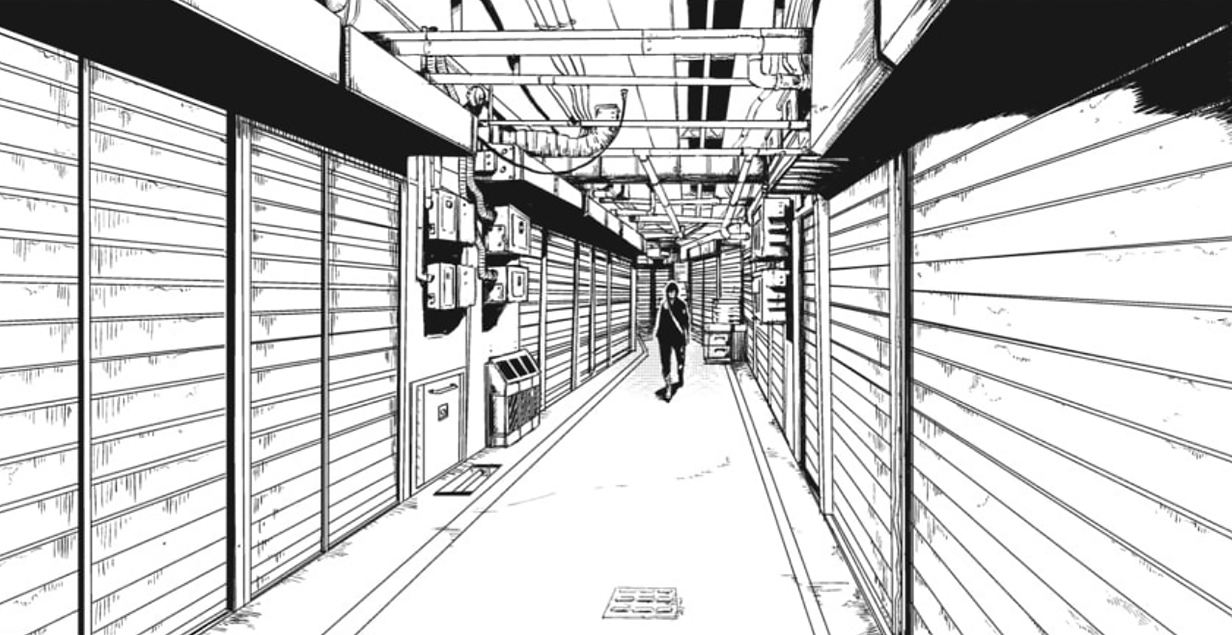
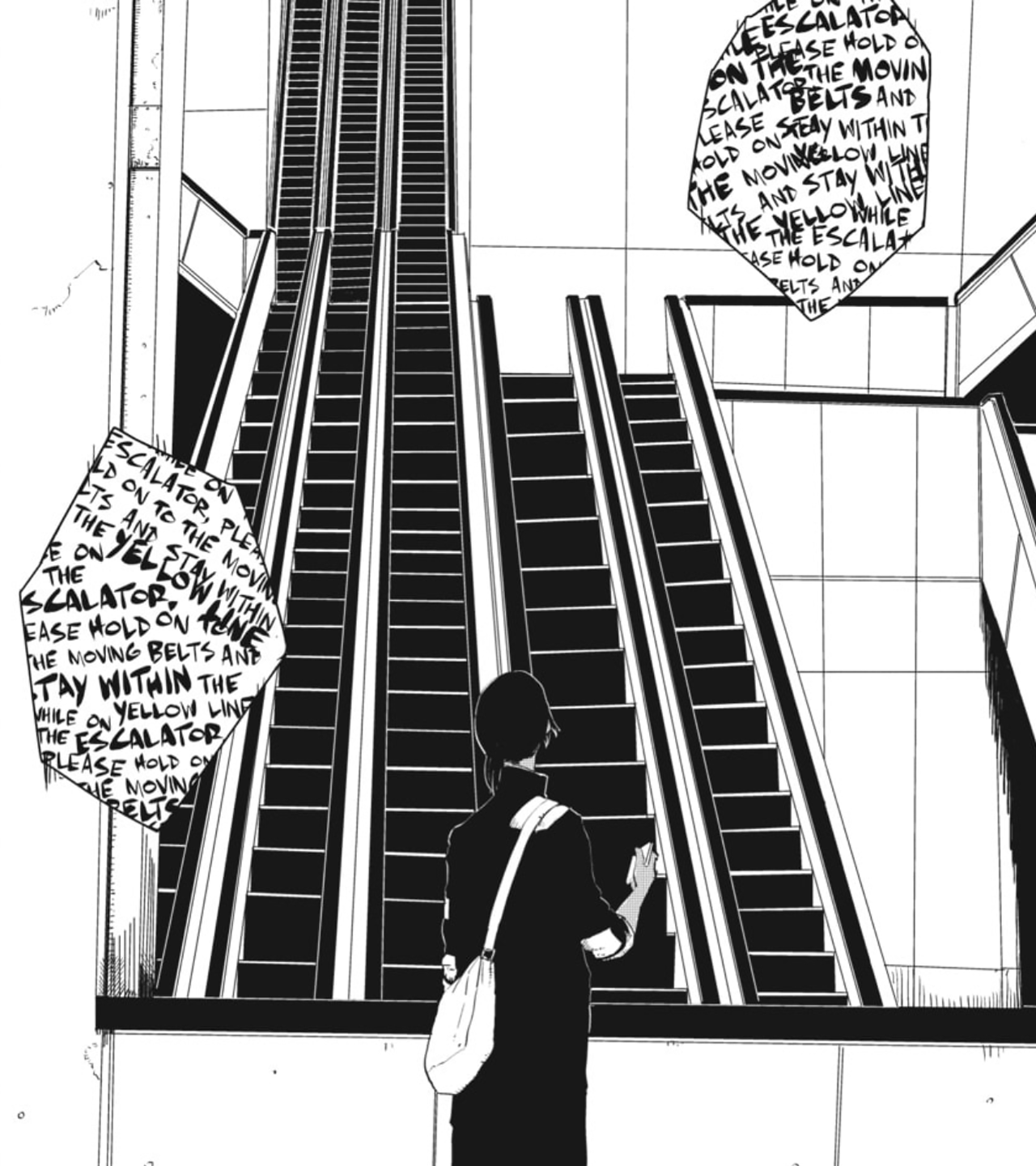
I also appreciate that, by refusing to give the reader any sort of emotional anchor in the Lost Man’s character or backstory, Kawamura emphasizes the sense of being disoriented while allowing the liminality of the setting to shine. Though none of the POV characters are inclined to wax poetic about the Tokyo Metro’s underground corridors, the book is filled with screen stills from Kawamura’s own movie adaptation of the book (here’s the trailer), allowing the reader to see for themselves just how uncanny it is. As in many images of liminal spaces that circulate online, a major element of this uncanniness is, as Freud aptly pointed out, the familiarity of the setting. You’ve never been to this place; but, then again, you totally have. Somewhere in your mind, you’re still there.
At 109 pages, Exit 8 moves quickly and ends before the reader can develop a sense of complacency. This short book is a special treat for fans of internet creepypasta like The Backrooms mythos, as well as fans of contemporary urban horror more broadly. Also, if you enjoyed Strange Houses or another of Uketsu’s books currently in translation, Exit 8 is for you.
Though I have to admit that the novelization of Exit 8 didn’t leave as strong an impression as my original experience of playing the game itself, I’d love to see more professionally published Japanese creepypasta in translation, and I’m always happy to see authors adapt the ludic aspects of video games into experimental prose.