The Word Book

Title: The Word Book
Japanese Title: 単語集 (Tango-shū)
Author: Kanai Mieko (金井美恵子)
Translator: Paul McCarthy
Publication Year: 1979 (Japan); 2009 (America)
Publisher: Dalkey Archive Press
Pages: 148

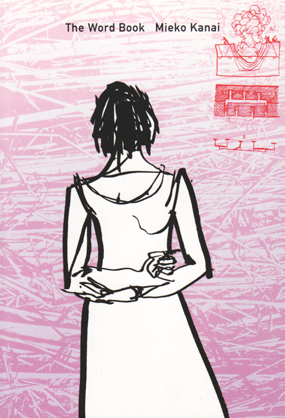
The pink cover of this small paperback might lead one to think that it’s a short collection of chick lit. While it’s true that Kanai Mieko is female, and while it’s true that she has often been classified as a “women writer,” The Word Book is just about as far away from chick lit as you can get. The twelve short stories in this collection are perhaps not so much “stories” as they are prose poems, or perhaps even essays written in the form of short stories. Kanai’s language is gorgeous, and the way she presents her ideas is fascinating. The stories themselves are very loosely structured and don’t follow established narrative patterns.

Kanai’s preoccupation in The Word Book is the writing self, or the self who is speaking, or telling a story. Many of the narrators in this collection are writers, and many of them are trying to explain something that happened in the past. Kanai almost fetishizes her narrators as they write about writing and constantly question their ability to tell a story. Perhaps it happened like this, perhaps it happened differently. Who is writing? Who is telling the story? Is the narrator of the story the same person as the protagonist of the story? Many of these stories have multiple narrators within the span of less than ten pages. A reader is faced with two choices – to either puzzle out who the narrators are and what their relationship to one another might be, or to let the narrative flow wash over him or her and simply accept that the narrator of a story is never a stable or unquestionable entity.

In that each of Kanai’s stories resembles something of an intellectual puzzle, I am reminded of Borges’s Labyrinths. In that Kanai’s stories are filled with a multitude of unreliable narrators who may or may not actually be the same person, I am reminded of Faulkner, especially As I Lay Dying. However, since Kanai is still able to infuse her stories with a sense of place and beauty, I am reminded of Furui Yoshikichi (Ravine and Other Stories, translated by Meredith McKinney), another Japanese writer of mysterious short fiction.

An interesting aspect of Kanai’s prose that I think is undeniably characteristic of her and no one else, however, is her play on gender. Kanai is a woman, but all of her narrators are men. To be more precise, Paul McCarthy has translated all of her narrators as men. I have only read a handful of Kanai’s stories in the original Japanese, but it is my impression that the writer takes full advantage of the ability of the Japanese language to not differentiate gender. Why does Kanai write with exclusively male narrators? Or are her narrators all men? Is she intentionally writing within a masculine narrative realm? If this book did not have a pink front cover and an “about the author” blurb on the back cover, would the reader even know that the author of this collection is a woman? Does it matter?

Meta-textual issues aside, I really enjoyed reading The Word Book because of its narrative sophistication, dreamlike atmosphere, and poetic touch. To illustrate what I like so much about this book, I would like to end with a passage from a story entitled “Fiction:”

But after awhile, I changed my mind: my guest’s words were as vague as they were clear, spoken by one who expresses by looks or by his whole weak body the scintillating talent of a born poet. Realizing this, I trembled with envy. Bitter as it was to admit, I was envious of those empty words, not understood even by the man who uttered them, those empty words that shone with a soft, rose-colored radiance. Words such as these, shining words bathed in a soft, rose-colored radiance, precisely because of their emptiness lusted after a shameless ecstasy of the sort one can only experience in dreams. And I thought, feeling a kind of despair, “Long ago my words, too, trembled violently in this shining, soft, rose-colored radiance.”

The Budding Tree

Title: The Budding Tree: Six Stories of Love in Edo
Japanese Title: 恋忘れ草 (Koiwasuregusa)
Author: Kitahara Aiko (北原亞以子)
Translator: Ian MacDonald
Publication Year: 1993 (Japan); 2008 (America)
Publisher: Dalkey Archive Press
Pages: 170

This past fall, I took a seminar on ukiyo-e, or Japanese woodblock prints depicting the “floating world” of the Edo period (1600-1868) urban pleasure districts. As we studied the courtesan prints of artists like Kitagawa Utamaro, we kept running up against the same issue: prostitution. Namely, what were the lives of the women painted by Utamaro really like? Were these women as glamorous as they seem in ukiyo-e, or were they sex slaves who lived miserable lives and died at an early age of starvation and disease? Or did they perhaps fall somewhere in between the two extremes, victims of their fates but still holding on to a measure of personal agency and control over their lives? As our class debated this issue, I couldn’t help but think about The Budding Tree.

Kitahara’s short story collection The Budding Tree is not about courtesans, but it is about Edo-period women who have close connections to the floating world. Each of the six stories in this collection has a different female protagonist: a Confucian tutor, a calligrapher who pens text that will be printed as gesaku popular novels, a singer of jōruri popular stage ballads, a hairpin designer who manages her own store, a rising print artist who works with Utagawa Kuniyoshi’s publisher, and the manager of an exclusive restaurant. Although the women don’t know each other directly, their stories are connected in small ways, and a unity of theme ties these stories together into a cohesive whole. Each of these women is struggling to make it in a man’s world, and each therefore leads a somewhat complicated love life.

I’m not an expert on the Edo period, so I’m not sure how realistic Kitahara’s depiction of her setting (Edo at the turn of the nineteenth century) actually is. From what I know of the lives of Hokusai’s daughters (especially Katsushika Ōi), however, her depiction of urban working women at the time isn’t too far off. As historical fiction, the stories in The Budding Tree are interesting and satisfying, especially since the swashbuckling samurai that one usually encounters in Japanese historical fiction are kept offstage. It is my (perhaps futile) hope that Ian MacDonald’s excellent translation will find a wide audience, so that other Japanese female-centric historical fiction, such as the Edo-period female detective stories of Miyabe Miyuki, will find their way into American bookstores.

I therefore recommend The Budding Tree to anyone with an interest in the Edo period, historical fiction, women’s literature, or just plain good romantic stories. The one caveat I might offer concerns the translation’s complete absence of footnotes. There are more than a few non-translated and non-glossed terms (such as jōruri, i.e., the songs of the puppet theater) that appear with frequency throughout the text, as well the names of actual historical figures and geographical landmarks with which a casual reader might not be familiar. Hopefully, however, the stories themselves will whet the reader’s appetite to learn more about the world of early nineteenth century Edo.

Palm-of-the-Hand Stories

Palm-of-the-Hand Stories

Title: Palm-of-the-Hand Stories
Japanese Title: 掌の小説
Author: Yasunari Kawabata (川端康成; Kawabata Yasunari)
Translators: Lane Dunlop and J. Martin Holman
Publication Year: 1988 (America)
Pages: 259

This book gathers Nobel Prize winning author Kawabata’s famous short shorts, or “palm of the hand (tenohira) stories.” These stories average about two and a half pages each, although some are a little longer, and some are much shorter. Most of these stories deal with the intricacies of male-female relationships, dreams, and fragmented memories of childhood. Even though some of the stories have a bittersweet sentimentality, Kawabata’s style is mainly realistic, especially in his portrayal of relationships crippled by words left unsaid and small, but meaningful, actions.

Some of Kawabata’s short stories are lyrical in their depictions of time, place, and nature, but many strike the reader as small mysteries to be pondered and unlocked. Who said what to whom? What significance did that have? Why would this person do that? What exactly is the relationship between these characters? The extreme brevity of these stories boils down life stories into a few irreversible moments and leaves the reader to read between the lines. This aspects of the works is rewarding but can be occasionally frustrating.

These stories were written over a period spanning between 1923 and 1972. Read individually, they can be unsatisfying; but, if the reader reads one story after another in a smooth, unbroken stream, the major themes and concerns of Kawabata’s career begin to gain a greater clarity, and the stories meld seamlessly into a greater whole.

I have read several of these stories in Japanese, as they are quite famous, and I have found that the translations are not only accurate but successfully convey the tone of the originals. The stories translated by Lane Dunlop (Shiga Naoya’s The Paper Door and Other Stories) tend to be a bit dry, but they are balanced nicely by Holman’s more experimental style.

The Diving Pool

The Diving Pool

Title: The Diving Pool
Japanese Title: ダイヴィング・プール
Author: Yoko Ogawa (小川洋子; Ogawa Yōko)
Translator: Stephen Snyder
Publication Year: 2008 (America); 1991 (Japan)
Pages: 176

This is the first collection of Ogawa’s fiction to be translated into English, and veteran translator Stephen Snyder (Murakami Ryū’s Coin Locker Babies, Kirino Natsuo’s Out) does Ogawa’s sparse and poetic style justice with his smooth and intelligent translation. This volume includes three short stories: “The Diving Pool,” “Pregnancy Diary,” and “Dormitory.” Although each of these stories is firmly grounded in reality, I don’t think it would be too far-fetched to call them ghost stories. These eerie stories, although aesthetically beautiful and highly reminiscent of their setting in modern, urban Japan, derive their main appeal from an insightful portrayal of the small cruelties that people inflict on each other. The fact that all of Ogawa’s characters are eminently sympathetic, combined with the lovely details of their daily lives, gives the subtle yet bizarre twist at the end of each story all the more impact.

I really cannot recommend this book enough, not just to people interested in Japanese literature, but to anyone who loves to read. It gives me great pleasure to start off this blog with this wonderful book!