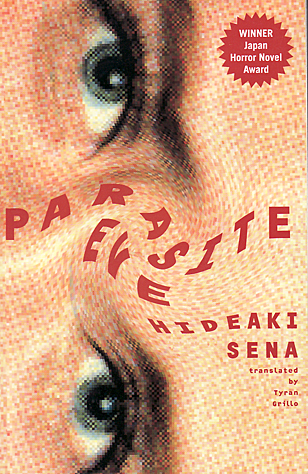
Parasite Eve

Title: Parasite Eve
Japanese Title: パラサイト・イヴ (Parasaito Ivu)
Author: Sena Hideaki (瀬名秀明)
Translator: Tyran Grillo
Publication Year: 1995 (Japan); 2005 (America)
Publisher: Vertical
Pages: 314

Sometimes I know that I should not write a particular review. Sometimes I have nothing nice to say. Sometimes, however, it’s way too much fun to resist writing about a hilariously bad book. This has happened before with Outlet and xxxHOLiC: ANOTHERHOLiC, and now it’s happening again with Sena Hideaki’s horror novel Parasite Eve, which is so bad that it’s almost good.

If nothing else, the premise of Parasite Eve is certainly original. A woman named Kiyomi has a problem with her mitochondria, which have collectively mutated into an intelligent being. These mitochondria gradually take over Kiyomi’s body, killing her and forcing her husband Toshiaki, a pharmaceutical researcher, to cultivate her liver cells. Since Kiyomi was an organ donor, one of her livers has found its way into a fourteen-year-old girl named Mariko, who begins to suffer from nightmares. As Toshiaki’s cell culture, which he has named “Eve 1,” grows, it (she) gains the ability to move around and make herself look like Toshiaki’s dead wife. Since Eve 1 cannot live for long on her own, she wants to create a half-human, half-mitochondria offspring, a project for which she needs Toshiaki’s sperm and Mariko’s womb. Although Eve 1 has a time limit for how long she can survive outside of a cell incubator, she can reshape herself at will and shoot fire. It goes without saying that Toshiaki must find a way stop her.

The narrative shifts between Toshiaki, Toshiaki’s research assistant, Mariko’s father, Mariko’s doctor, and Kiyomi. Eve 1 occasionally gets a few italicized paragraphs, too. Each of these characters is interesting in his or her own right; but, even though none of them are wooden or stereotypical, their characterization felt a bit half-hearted to me. The real focus of the first two-thirds of the book seems to be less on the characters and more on the surgery and scientific experiments they are involved in. Toshiaki’s research and Mariko’s organ transplant are described in loving detail, with all sorts of technical terms accompanied by explanations for the general reader. Even with all the non-fiction exegesis of science and medicine, the narrative progresses normally (if a bit slowly) for 175 pages. Even though there was a bit of Eve 1 shooting orgasms at people (I am not making this up) previously, this is the point at which things get ridiculous.

The next paragraph is filled with spoilers and sex. Consider yourself warned.

In the last third of the book, Eve 1 steps into the spotlight. I was especially struck by how Sena chose to portray her as intensely sexual. When Eve 1 first gains the ability to manipulate her shape while still in the cell culture incubator, she immediately gives herself a vagina and a finger and puts the two together. She then mouth-rapes Toshiaki’s student in order to gain control of her body for a few days before breaking free, at which point she turns herself into a giant vagina and rapes Toshiaki so as to procure his sperm. I kept thinking to myself, I bet Eve 1 is going to grow a penis and rape the fourteen-year-old next. So, when Eve 1 grew a penis and raped Mariko (after a short jaunt through the sewer), I actually laughed so hard that I cried a little bit. At the very end of the book, it turns out that Eve 1’s offspring cannot live (something about the male mitochondria in her body fighting the female mitochondria; don’t ask me). Instead of using her mitochondrial superpowers to generate a small-scale nuclear reaction and blow everything sky high (as I would have done in her situation), Eve 1’s daughter decides to fuse into the body of her father Toshiaki, and all of their cells have sex before they both die. Brilliant.

Body horror seems to be one of the major selling points of Parasite Eve, but body horror needs to be subtle in order to be truly effective. I believe that the body horror in this novel is unsubtle to an extreme, however, and the book has very few genuinely creepy moments. Also, by the end of the story, I really wanted Eve 1 to succeed in her mission of evolving an all-female race of mitochondria mutants, so I was a bit (okay, extremely) disappointed when both her and her daughter were defeated by the patriarchal power structures that pervade the narrative. Also, the idea that a female character needs to be either an innocent victim, a primordial mother, or a hyper-sexualized aggressor is getting a little stale. Seriously, is the dawn of a female race of X-Men with tentacles really too much to ask for?

To summarize, Parasite Eve is somewhat slow and boring for 175 pages, becomes progressively more gross and strange for the next 100 pages, and then ends in a 15 page orgy of fire and violence and slime. In other words, the pacing is a bit uneven, as is the distribution of action and explanation. Overall, reading Parasite Eve felt uncannily like reading a Michael Crichton novel, including the way that the science became increasingly more outlandish as the story progressed. If you’re a fan of Michael Crichton novels (or Dean Koontz novels), then you’ll probably be able to gloss over the flaws in the writing and enjoy Parasite Eve. Sena is working with very interesting material, after all, and his style is neither dry nor unliterary. The translation flows smoothly, and everything from dialog to the description of surgery has been rendered into natural, idiomatic English. If nothing else, it is worth reading through the first two thirds of the book in order to get to the ending. Especially if you’re into the sort of thing that happens during the ending – and, admit it, who isn’t?
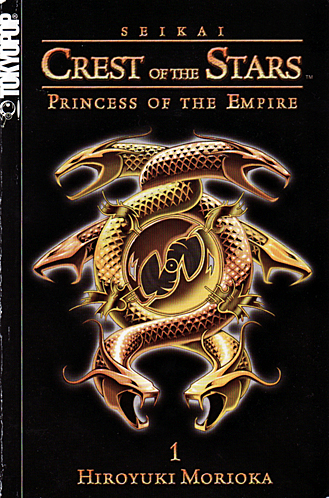
Crest of the Stars

Title: Crest of the Stars: Princess of the Empire
Japanese Title: 星界の紋章:帝国の王女 (Seikai no monshō: Teikoku no ōjo)
Author: Morioka Hiroyuki (森岡浩之)
Translator: Sue Shambaugh
Publication Year: 1996 (Japan); 2006 (America)
Publisher: Tokyopop
Pages: 212

I am a great lover of books, and I spend a great deal of my time reading. I genuinely enjoy almost everything I read, no matter what the genre, and rarely do I dismiss something as absolutely not worth reading. It is very easy for me to explain why I like a particular book, or what is valuable about a particular work, but I think that sometimes it’s important to also discuss what is mediocre, and what can be done better.

Morioka Hiroyuki’s Crest of the Stars series was recently held up to me as a paragon of Japanese science fiction. I wasn’t impressed with the translation of the first book in the series, Princess of the Empire, when it was released in the fall of 2006, but I decided to try it again. The series is massively popular in Japan, and it has quite a dedicated fan base in America as well. I have heard it described as a masterpiece of Tolkienesque proportions in several reviews; and, in my mind, there is no higher praise. Perhaps I had misjudged it four years ago.

Unfortunately, upon re-reading the book, that turned out not to be the case. Princess of the Empire starts off with a wonderful prologue, which briefly introduces the main character of the series in an interesting and beautifully described setting before launching into a short but fascinating account of the space journeys that led to the present moment. This history is then interrupted by action! intrigue! betrayal! and emotion! Unfortunately, this prologue is only sixteen pages long. What follows is 161 pages of utter garbage.

The teenage hero of the series, Jinto, arrives at a spaceport, where he is met by a beautiful blue-haired space elf named Lafiel. Lafiel takes Jinto to a space elf ship which will transport him to the space elf academy (Jinto, although genetically human, is politically an honorary space elf). The ship is attacked by a human group that seeks to oppose the space elf empire, and only Jinto and Lafiel escape. The ship is destroyed, and the unlikely pair (well, actually, very likely, considering that there are no other characters) is stranded on a small backwards planet. The end. Oh, and if you guessed that Lafiel is the princess of the space elf empire, you win a cookie.

You might be thinking, well, if Morioka spins 161 pages out of relatively nothing, then he must be a fairly talented writer with an eye for detail and a talent for dialog. Wrong. The Crest of the Stars series is known for its world building, and what Morioka has given us is 161 pages of almost unmitigated world building. The space elves are called Abh, they have a space empire, they have strange breeding practices, and they are genetically engineered to be beautiful, blue-haired, and psychic. That’s right, they are psychic space elves – which would perhaps be forgivable if there were more to them. Unfortunately, Morioka’s world building reads like a world history textbook written for fourth graders. Even when delivered in speech, the tone of this information is uniformly dry, essentialist, and uninteresting. Population statistics and general government details are provided, but nothing is said about culture, religion, art, lifestyles, political factions, diversity, philosophy, attitudes towards technology – or anything that the reader might actually care about. The clunky constructed language that annoyingly pervades the text is substituted for any real imagination. The almost complete lack of any visual imagery makes the book seem almost sterile, which I don’t think is a deliberate choice on the part of the author, whose writing is incessantly puerile:

Sure, Jinto had experience interacting with girls – he’d made a point on Delktou, in his own way. However, older women were still a complete mystery to him – especially gorgeous older women who were commanders of interstellar battleships. He couldn’t get his heart to stop racing.

In other words, instead of building a fictional world gradually while pulling his readers deeper into said world through plot thickening and character development, making them increasingly curious about the universe in which the characters live as they become increasingly attached to the characters themselves, Morioka completely forgoes plot and character development in order to construct his setting, which quite frankly feels like a cliché mix of Star Wars empire-and-princess driven space opera and Star Trek alien-culture-of-the-week episodic exploration adventure. The fact that the Abh are long-lived, pointy-eared, and dismissive of humans does not make Crest of the Stars Tolkienesque, unfortunately. In his postscript, Morioka states that he hopes “to make shameless sci-fi fans groan.” I’m pretty sure “groan” is the operative word here, since even Troy Denning’s novels set in the Star Wars universe are better written. Alas.

Princess of the Empire is everything I hate about the genre of young adult fiction, which tends to presume that its readers can’t handle complex plots, three-dimensional characters, figurative language, or middle school vocabulary. It could be argued that Japanese light novels are an entirely separate medium than young adult fiction; but still, there are infinitely better light novels out there. One of my personal favorites is Ono Fuyumi’s The Twelve Kingdoms series. A translation of the fourth installment, Skies of Dawn, was recently released a week or two ago, and I am happy to report that the series is only getting better with each successive book.

If it’s Japanese science fiction you’re looking for, then popular mainstream writers from Abe Kōbō to Ōe Kenzaburō to Miyabe Miyuki have successfully tried their hands at hard science fiction at one point or another. If you’re looking for the epic adventure and unparallel world building of Frank Herbert (or China Miéville), then check out Murakami Haruki’s Hard-Boiled Wonderland and the End of the World, which benefits from one of the most artistic and creative translations I have ever read. If you’re more in the mood for the intellectual short fiction of someone like Ray Bradbury (or Tim Pratt), then check out Tsutsui Yasutaka’s collection The Salmonella Beings from Planet Porno. If you’re in the market for lighter fare, I have been especially impressed by several of the translations I have read from an upcoming press called Haikasoru, which is an arm of Viz Media, an established publisher of manga intended for a slightly more mature audience than that targeted by Tokyopop.

In any case, to return to Princess of the Empire, it’s a morass of weak writing and tired stereotypes. Perhaps the Crest of the Stars series deepens in the second and third books, which are also available from Tokyopop, but I would rather spend my time reading all the cool new stuff that seems to be coming out almost every month. For those who want to know what all the fuss is about but don’t have the stomach to brave the light novels, there is always the Crest of the Stars manga trilogy (also published by Tokyopop). The manga are just as mediocre as the books – but at least the female characters provide the service of bending over to reveal themselves every few pages. Which, I suppose, is always a welcome distraction from heavy-handed world building and the overuse of a constructed language.