Speculative Japan

Title: Speculative Japan: Outstanding Tales of Japanese Science Fiction and Fantasy
Editors: Gene van Troyer and Grania Davis
Publication Year: 2007
Publisher: Kurodahan Press
Pages: 290

As a short story collection, Speculative Japan is a strange book. 200 of its 290 pages are comprised of short stories, and the other 90 pages are mainly short non-fiction essays about the book itself. These essays involve topics such as how the stories appearing in Speculative Japan came to be selected, edited, and translated. 20 of these 90 pages are author and translator biographies, and another 20 pages are filled by a translated essay by Shibano Takumi, the editor of the Japanese sci-fi magazine Uchūjin. For a reader who starts the book at the front cover and progresses in a linear fashion, Speculative Japan gets off to a somewhat rocky start with pages and pages of metatextual material.

Gene Von Troyer’s introduction jumps from topic to topic before finally summarizing Yamano Kōichi’s “three phases of Japanese science fiction” and settling into speculation concerning what makes Japanese science fiction “Japanese”:

We can’t say definitively, but can only point to trends and tendencies. Viewed through one facet of the jewel, we can say, as Tatsumi [Takayuki] does, that “what with the imperative of American democratization and the effect of indigenous adaptability, the postwar Japanese had simultaneously to transform and naturalize themselves as a new tribe of cyborgs” as reflected in the images from manga and anime. Japanese SF leans (or has leaned) more on robots and cyborgs than on stars and planets.

This generalization is certainly interesting, but I wonder if it’s really true. For example, the advertisements in the back of the book for Mayumura Taku’s Administrator (a collection of four short novels about “Terran colonies far from Earth”) and Night Voices, Night Journeys (the first of a series of collections of “Tales in the Cthulu Mythos from Japan”) seem oriented more towards “stars and planets” stories, and I can’t help but think of the “spaceships and galaxies” imagery of popular 1970s series such as Takemiya Keiko’s To Terra and Matsumoto Leiji’s Space Battleship Yamato, but perhaps it might simply be better to read Troyer’s introduction as an initial attempt to sketch a map of a huge and understudied body of literature.

In any case, the stories contained in Speculative Japan have less to do with either cyborgs or space than they do with hypothetical concepts. Toyota Artisune’s “Another Prince of Wales” concerns the question, “What if, in the future, war were a popular sport played on an international stage?” Yamano Kōichi’s “Where do the Birds Fly Now?” is an expansion of the question, “What if birds could fly between dimensions and take people with them?” Very few of these stories have serious, in-depth plots; but, then again, very few of these stories are more than twenty pages long. A reader familiar with the type of tightly plotted sci-fi stories published in Fantasy & Science Fiction Magazine is in for a surprise with Speculative Japan, which – as its title suggests – is more about “speculative fiction” than “science fiction.”

Five of the stories in the collection are recycled from the out-of-print The Best Japanese Science Fiction Stories. Of these five, Tsutsui Yasutaka’s Orwellian fable “Standing Woman” and Yano Tetsu’s “The Legend of the Paper Spaceship,” a lyric tale of a woman deep in the Japanese mountains who may or may not be an alien, are excellent and definitely worthy of republication. Making an appearance from the out-of-print Monkey Brain Sushi anthology is Ōhara Mariko’s “Girl,” a sex-saturated story of love and body modification in a decaying city on the eve of an apocalypse.

Three stories that have appeared for the first time in book form in Speculative Japan that really jumped out at me were Kajio Shinji’s “Reiko’s Universe Box,” Kawakami Hiromi’s “Mogera Wogura,” and Yoshimasu Gōzō’s “Adrenalin.” In “Reiko’s Universe Box,” a young woman copes with her negligent husband and failing marriage by becoming absorbed in a box containing an entire galaxy in miniature form. Like many of the stories in this collection, “Reiko’s Universe Box” is driven by strong elements of allegory, but its concept is delivered with cleverness, darkness, vivid description, and humor. When compared to the other stories in the collection, Kawakami’s “Mogera Wogura,” a description of a day in the life of a mole-like creature who lives among humans in contemporary Japan, is in a class of its own in terms of its gentle magical realism, its playfulness, and its removal from the themes and narrative style of more traditional science fiction and fantasy. “Adrenalin” is not a story but rather an abstract poem filled with evocative imagery conveyed through variations of a handful of short and catchy refrains, such as “To you, children of spirits, I send an immediate telegram / To drink milk / To memorize the names of flowers / Some day, I will return / That day, I will start fire.” I’m usually not a fan of Japanese poetry in translation, but I found myself captured and moved by Marilyn Mei-Ling Chin’s translation of Yoshimasu Gōzō’s verse. Each of these three selections stands on its own not simply as an illustration of a speculative concept but as a piece of writing that is fun to read, thought-provoking, and capable of multiple interpretations.

Of the collection’s fifteen stories, four were written in the sixties, eight were written in the seventies, and another was written in 1981. These thirteen stories, written during the period between 1962 and 1981, are all by men. The two more recent stories (published in 1985 and 2002) were written by female authors, but one can still say that this collection is mostly representative of science fiction written by men in the sixties and seventies. In the author biography section at the end of the book, the editors attempt to canonize many of the male authors (“without a doubt a Grand Master of Japanese science fiction and fantasy,” “one of the three pillars of Japanese SF,” “often referred to as ‘The King of Japanese SF,'” and so on), but I wonder if perhaps there wasn’t a hint of personal politics at play in the selection of authors. This suspicion seems to be corroborated by the collection’s metatextual essays, which detail the personal relationships between the authors and their translators.

Speculative Japan sometimes reads like a sci-fi literary fanzine in which the editors and regular contributors are just as concerned about themselves and their relationships with each other as they are with the fiction itself, and the essays in Speculative Japan demonstrate a certain geeky fixation on metatextual marginalia. If you happen to be outside of the small circle of authors, translators, and editors who all know each other and worked together on this collection, you might find these essays confusing and off-putting. If you’re already used to the style of the front (and back) material included in SF-themed literary magazines and fanzines, though, you’ll more than likely be able to see past (or even appreciate) the many pages of essays included in Speculative Japan.

The actual stories in the collection are interesting and well worth reading, and a few of them are truly excellent. Still, I want more work that doesn’t belong to a set clique of authors, more contemporary work, and more work by women. To be honest, I found Speculative Japan somewhat disappointing as a compilation. That being said, I am intrigued enough by the stories themselves to consider giving Speculative Japan 2 a shot in the near future.

Loups-Garous

Title: Loups-Garous
Japanese Title: ルー=ガルー (Rū=Garū)
Author: Kyōgoku Natsuhiko (京極 夏彦)
Translator: Anne Ishii
Year Published: 2010 (America); 2001 (Japan)
Publisher: Haikasoru
Pages: 450

Spoiler: There are no actual werewolves in this book.

The real shape-shifter is Loups-Garous itself, which wears multiple skins. The novel is a murder mystery and a sci-fi suspense thriller. It is a police procedural, a cyberpunk dystopia, and a high school drama. It can also be read as a series of philosophical musings on technology, authority, and human nature.

Loups-Garous is set in the not-too-distant future (the 2030s are referred to as if they were the 1990s) of Japan, in which many of the laws and social conventions concerning food, housing, education, communication, and privacy are no longer what they once were. For example, although minors are assigned guardians who may or may not be their parents, they are apparently not required to cohabitate with these adults. Furthermore, children learn from computer modules instead of from teachers, and their only physical contact with other people is through periodically scheduled meetings with selected peer groups and guidance counselors. The younger generation has gradually come to interact with the world almost exclusively through computerized devices called “moniters,” which range in size from wristband models to screens the size of bedroom walls. Cities are divided into carefully controlled zones, all food is artificial, and the movements and consumption patterns of every individual are recorded through omnipresent video cameras maintained in both public and private spaces by the corporation that controls the country.

Despite the fact that this micro-management of individual lives is supposed to keep people safe, a series of connected murders has broken out in an otherwise peaceful residential district. A possibly related set of school absences draws three high school girls, Hazuki, Mio, and Ayumi, to meet together in person. Meanwhile, the girls’ guidance counselor, Shizue, is pulled into a police investigation of several students who may be either suspects or victims. As Hazuki and Shizue are pulled deeper into the circumstances surrounding the murders, the grimy foundations of their seemingly utopian society are revealed, as is a major government conspiracy.

The cyberpunk gothic noir setup of Loups-Garous attracted me to the novel and kept me reading, but I will admit that I ultimately did not enjoy the experience. None of the plot devices are particularly original, the themes are spread too thin, and the pacing is uneven. Long passages of exposition and dialog are broken by fights and chase scenes in a way that seems random and frenetic, and the last fifty pages of the novel read like the two minutes of downhill careen that follow a very long and very slow slog up the first hill of a roller coaster ride. Furthermore, the big surprises at the end, such as the identity of the killer, have almost no foreshadowing. To give an example, there’s a giant mecha at the end of the novel. It comes out of nowhere. The lack of suspenseful buildup leading to its appearance is so total that mentioning it doesn’t even feel like a spoiler.

I also found the main characters infuriating. I understand that these characters, who have grown up in a world in which there is very little interpersonal interaction, are supposed to be socially maladjusted, but that doesn’t make their antisocial awkwardness any easier to read. To bring up a topical analogy, Sherlock Holmes is interesting (and bearable) as a character because he is juxtaposed against foils such as John Watson and Inspector Lestrade. These foils don’t just help to demonstrate what is so unique and fascinating about Holmes; they also serve to drive the story forward by providing a means to address the more commonplace concerns that exist for a reader who lives in a world governed more by social and accidental systems of cause and effect than by pure logic. A story with two Sherlocks and no Watson wouldn’t be nearly as readable. Loups-Garous has five Sherlocks and no Watson, and it’s painful to watch these characters bicker with each other endlessly. Besides being socially maladjusted, each of them is idiosyncratic in her own way (“I’m a genius, so I don’t have a sense of aesthetics.”), and the weird gaps in their knowledge of the world mean that each of them will often say things that can come off as inane to the reader (“You think you can actually eat animals? That’s stupid.”).

Speaking of the characters’ knowledge of their world, the author’s construction of the novel’s setting felt uneven to me. Specifically, the story is supposed to be set in a time in which people who were adults in the twentieth century still hold active positions of power, yet the main characters act completely ignorant of the history, economic systems, and technologies that existed before their own lifetimes (even though the reader is left to assume that such information is freely and easily available, such as in the form of entertainment media). For example, when the self-proclaimed genius Mio explains the concept of a “telephone” to Hazuki, Hazuki is completely flabbergasted over the fact that such a thing could ever exist, and Mio herself admits that she doesn’t know what language the word “telephone” comes from. There is thus a deep contradiction in the novel’s construction of its setting (which is either super-futuristic or not really futuristic at all) that prevents the reader from really understanding the novel’s worldview or becoming absorbed in its atmosphere.

Finally, perhaps partially as a result of the awkwardness of the characters and setting, the long philosophical passages that fill the novel are written in a style that is somewhat confusing. For example, a chain of logic might be set up like this:

“It goes without saying that scissors are good for cutting paper. Similarly, the best accounting software can’t make music. Computers are nothing more than calculators. It’s a system built to do the math necessary to accomplish a task. If humans were able to do several calculations at once there’d be no need for computers. No matter how grand the calculation, nothing but cutlery can cut paper.”

Or a theme of the novel might be expressed in a meaningless repetition of chichés and platitudes:

“The adults don’t know anything.” Don’t they? It wasn’t just the adults. Kids wouldn’t know anything about other people either. No one wanted to know and no one wanted to be known. So no one knew anything about anyone else. They weren’t bothered by not knowing. They weren’t bothered by not being known. Moreover… They actually hated being known.

Unfortunately, Loups-Garous is filled with many such pseudo-philosophical soliloquies, which detract from what little plot, character development, and world building the novel is able to offer.

In the end, I feel that Loups-Garous is a waste of a good premise that could have been vastly improved with either more judicious editing of the original text or more creative license on the part of the translator. I hate to bash anything published by Haikasoru, a press that has almost consistently put out quality material, but Loups-Garous weighs in towards the lower end of the publisher’s catalog (along with Mardock Scramble, another title that, like Loups-Garous, has an animated adaptation).

If you’re interested in the dystopian sci-fi premise of the novel, you might be better off watching either Fractale (streaming on Hulu) or No.6 (streaming on Crunchyroll), two anime that share similar themes but are much more intelligent and stylish in their execution of these themes. Also, while I was reading Loups-Garous, I kept wishing that I was reading Margaret Atwood’s Oryx and Crake instead. The story and premise of Oryx and Crake are similar to those of Loups-Garous, but the readability and literary flair of Atwood’s novel are much higher. Even though I didn’t like this novel, Kyōgoku Natsuhiko is a very interesting writer, and I definitely recommend his Summer of the Ubume. With so much other excellent reading and viewing material, why would you want to waste time on Loups-Garous? The novel wears many skins, but it doesn’t wear any one of them particularly well.

The Girl Who Leapt Through Time

Title: The Girl Who Leapt Through Time
Japanese Title: 時をかける少女 (Toki o kakeru shōjo)
Author: Tsutsui Yasutaka (筒井 康隆)
Translator: David Karashima
Publication Year: 2011 (Britain); 1967 (Japan)
Publisher: Alma Books
Pages: 170

Three things are generally true of Tsutsui Yasutaka’s writing: it’s easy to read, it’s creative and fun, and it’s usually more about the concept than the characters. The Girl Who Leapt Through Time is no exception. The story is short, it’s entertaining, and the idea of time travel is more fleshed out than the characters.

Junior high school student Kazuko hears a crash in her school’s science lab while helping her friends Goro and Kazuo clean up after class. When she enters the room to investigate, she smells lavender and passes out. The next morning, she and Goro are run down by a bus while rushing to school. Right before the bus strikes them, however, Kazuko opens her eyes and finds herself back in bed. She discovers that she has somehow jumped back in time to the morning of the previous day. Kazuko tells Kazuo and Goro about her strange experience, and they suggest that she talk to their science teacher, Mr. Fukushima, after school. Surprisingly enough, Mr. Fukushima listens sympathetically before explaining that Kazuko needs to jump back in time to the incident in the science lab in order to figure out what happened. She does so and meets Kazuo, who explains everything to her before erasing her memory and returning to where he originally came from.

And that is the story. Nothing else really happens. Kazuo’s debriefing is interesting, but there is no on-screen adventuring or experimentation on the part of Kazuko. There is no narrative tension, just a bit of simple mystery solving. None of the characters really stand out. Kazuko is frightened and dependent on the help of others, Goro is childish and petty, and Kazuo drifts along without contributing anything until the last three or four chapters. The two other named characters, Mr. Fukushima and Kazuko’s friend Mariko, barely have any lines at all. Director Hosoda Mamoru’s 2006 animated adaptation is much richer in terms of storytelling and character development. Still, The Girl Who Leapt Through Time is a quick and easy read that should appeal to a younger audience.

A bit more interesting than the main novella is the shorter work “The Stuff Nightmares Are Made Of,” which is also included in the book. In this story, junior high school student Masako tries to get to the bottom of her fear of heights, which is somehow connected to the discomfort she feels around Prajna masks. Masako’s close friend Bunichi passes along what his therapist uncle tells him about the psychology of fear, and Masako uses this information to help not only herself but also her five-year-old brother Yoshio, who suffers from night terrors. The relationship between Masako and Yoshio is charming and sweet, as is the budding romance between Masako and Bunichi.

If I had to guess, I would say that the two stories in The Girl Who Leapt Through Time are meant for kids who are a bit younger than their protagonists, despite the adult woman adorning the book’s cover. They’re both entertaining, simple stories for the age seven to twelve crowd. If you’re an adult reader in North America who can’t seem to find a copy of this British publication, though, you’re not missing much. The movie is definitely better.

The Best Japanese Science Fiction Stories

Title: The Best Japanese Science Fiction Stories
Editors: John L. Apostolou and Martin H. Greenburg
Publication Year: 1997
Publisher: Barricade Books
Pages: 176

In the introduction of The Best Japanese Science Fiction Stories, editor John Apostolou informs the reader that, prior to the publication of this collection, it was very difficult to find Japanese science fiction in English translation. Translations of a few Abe Kōbō novels (such as The Ark Sakura and Inter Ice Age 4) had been published by Knopf, but the majority of translations of science fiction stories (such Arai Motoko’s A Ship to the Stars and Takachiho Haruka’s The Adventures of Dirty Pair) were only available from the Kodansha English Library, which was (and still is) virtually impossible to find outside of Japan. The purpose of The Best Japanese Science Fiction Stories, then, was to collect translations of short stories by major Japanese sci-fi authors such as Hoshi Shinichi, Hanmura Ryō, and Komatsu Sakyō.

Most of the thirteen stories in this collection are less than ten pages long. Some (like Abe Kōbō’s “The Flood” and Komatsu Sakyō’s “The Savage Mouth”) read like modern parables of the nastier aspects of human nature, while some (like Hanmura Ryō’s “Tansu” and Kōno Tensei’s “Triceratops”) are more dark fantasy than science fiction. Others, however, are examples of speculative fiction at its best. One of my favorite stories in the collection is Tsutsui Yasutaka’s “Standing Woman,” which is a window into a dystopian future in which anyone caught grumbling about the wrong thing – whether it’s high prices at the supermarket or too much overtime at work – is punished by being “vegetized” and planted next to a sidewalk or park bench. The story that closes the collection, Yano Tetsu’s “The Legend of the Paper Spaceship,” comes as close as a twenty-page short story can get to being a masterpiece of science fiction. It features a mysterious woman, a psychic son, an isolated village in the country, and strange legends that all come together to suggest secrets and cosmic mythologies that are illuminated just enough to capture the reader’s imagination.

Although the translation is a bit wonky in places (particularly in Kita Morio’s “The Empty Field”), I really enjoyed reading all of the stories in The Best Japanese Science Fiction Stories, and the foreword and introduction provided interesting glimpses into the process of how these stories were translated. If I am allowed one complaint, however, it would be that there are no female writers represented by this collection. I would recommend that anyone looking for an overview of the many female sci-fi writers in Japan should check out Kotani Mari’s essay “Alien Spaces and Alien Bodies in Japanese Women’s Science Fiction” in the essay collection Robot Ghosts and Wired Dreams. (If you can read Japanese, Kotani’s monograph Technogynesis is also fun and informative.) In any case, The Best Japanese Science Fiction Stories served its purpose by making me want to read more Japanese science fiction short stories, and from here I’m planning on moving on to Speculative Japan and Speculative Japan 2.

The Stories of Ibis

Title: The Stories of Ibis
Japanese Title: アイの物語 (Ai no monogatari)
Author: Yamamoto Hiroshi (山本 弘)
Translator: Takami Nieda
Publication Year: 2010 (America); 2006 (Japan)
Publisher: Haikasoru
Pages: 423

After reading Melinda Beasi’s essay Twilight and the Plight of the Female Fan, I reached a strange epiphany. It’s okay if I don’t like Twilight! It’s okay if I don’t like Black Bird! It’s okay that I am never, ever going to enjoy reading manga like DearS and My-HiME! I am simply not the intended audience – and that’s okay. The point of Beasi’s essay is that fans should not judge other fans for being fans, even if they don’t personally enjoy the work that has inspired fannish behavior. Beasi has made this argument elsewhere, concerning shōjo manga and again concerning the Twilight fandom, and I agree with her. My own personal problem, however, is exactly the opposite. I do not get upset when people denigrate my interests; what upsets me is when I’m derided for not liking something that someone else feels I should.

One of my weak points in this regard is young adult fiction. I used to love it, but I’m almost ten years past sixteen and am beginning to find myself growing impatient with the tropes of both American and Japanese novels written for teenagers. Certainly, not every book written for a younger audience can be The Golden Compass or Harry Potter and the Chamber of Secrets, but I still hold everything else to the same standard. This applies to Japanese light novels as well. Books like Nishizaki Megumi’s adaptation of Hot Gimmick and Coda Gakuto’s Missing series make me grind my teeth in frustration. Thankfully, there are young adult novels in Japan that are every bit as good as anything found in the West, and The Stories of Ibis is one of them.

The Stories of Ibis is pure science fiction directed at a presumably teenage audience, and it can boast everything that is fun about young adult fiction. The prose is clear and concise while still being creative. The narrative is very forward-driven without neglecting character development. Stereotypes are clearly referenced but then played with and expanded upon. Finally, the overall mood of the book is refreshingly positive. As science fiction goes, The Stories of Ibis is overwhelmingly utopian, but there are still lots of quests and uncertainties to keep the reader engaged.

As the title suggests, The Stories of Ibis is a collection of six short stories and two longer stories connected both by theme and by a frame narrative. The theme is the reality of virtual reality and, by extension, the power of fiction. Ibis, a humanoid robot blessed with artificial intelligence, tells these stories to the narrator of the frame story, one of the last human beings on earth. In the narrator’s world, humans fear and distrust robots, and the narrator travels from outpost to outpost, spreading tales of humanity’s glory before the rise of artificial intelligence. The narrator is wounded in an encounter with Ibis, who had been searching for him, so she reads him fiction as he recovers. In between stories (in short segments marked as “Intermission”), Ibis and the narrator discuss the stories, and their relationship gradually changes and deepens.

The first six stories are short, with each barely thirty pages in length. Only one of them is hard science fiction, and only one is strongly anime-flavored. The other four are set in more or less the present day and the present reality. All six deal with artificial intelligence or the reality of a virtual, fantasy world in some way. They’re all enjoyable; but, in my mind, the standout is the first story, in which people who only know each other through a Star Trek themed role playing site try to save one of their online friends from committing suicide in real life. The seventh and eighth stories are considerably longer than the first six, spanning one hundred pages each. I read a short review in Neo magazine that claimed that the two final stories made the book feel unbalanced, but I have to disagree. The final two stories are like a main course after an appetizer, and they are both excellent. Yamamoto reels his readers in with the first six stories and then lands us with the final two.

“The Day Shion Came” is about a nursing robot that whose programming has been implanted with a kernel of artificial intelligence. The robot is given over to a young human nurse to train as the two go through their rounds at a senior care facility. Certain A.I. clichés apply to this story, but they are not the ones you would suspect, and they are challenged and reworked in surprising ways. If there is a literary genre of magical realism, then “The Day Shion Came” might be termed science fictional realism, as everything about it is simultaneously fantastic and mundane. The final story is the story of Ibis herself, who draws together all of the “Intermission” segments by explaining the history of the frame narrator’s world. A remarkable feature of this story is the language that the A.I. entities use to communicate with each other. It’s both interesting and intelligent, but never overused or explicated at length. I won’t attempt to describe it here, but let it suffice to say that I have no idea how the translator was able to handle it so successfully. I tip my hat in admiration of her efforts.

In the final evaluation, The Stories of Ibis is a wonderful book for both young adult readers and adult readers who enjoy good young adult fiction. It’s neither too sci-fi nor too “Japanese” to put off people who aren’t fans of either “genre,” but I think it will still appeal to fans who are familiar with the tropes presented. In other words, like any good young adult novel, The Stories of Ibis attains the perfect balance of intelligence, accessibility, and creativity – and you don’t even have to feel embarrassed for enjoying it.

Hard-Boiled Wonderland and the End of the World

Title: Hard-Boiled Wonderland and the End of the World
Japanese Title: 世界の終りとハードボイルド・ワンダーランド
Author: Murakami Haruki (村上春樹)
Translator: Alfred Birnbaum
Publication Year: 1993 (America); 1985 (Japan)
Publisher: Vintage
Pages: 400

Upon re-reading my reviews of Lala Pipo and Audition, I realized that sexism in narratives penned by male authors has been one of my major preoccupations during the past few months. I suppose I have been reacting, in part, to a school of thought that seems to hold that anything written by a man is inherently sexist, whereas anything written by a woman must be feminist. This way of thinking is flawed for several reasons (one of the most obvious being that if gender is performative, then the act of writing gender is exponentially so), and I object to it because it unthinking dismisses the work of several of my favorite authors as unworthy of attention. Are powerful female characters in books like Gerald’s Game, Rose Madder, and Dolores Claiborne to be automatically labeled as sexist creations simply because Stephen King is male?

Another writer that I feel often comes under unfair criticism is Murakami Haruki, who is ridiculed by one faction of thinkers (like Miyoshi Masao and Ōe Kenzaburō) for being too accessible and not literary enough while at the same time attacked by another faction (of mainly French and American scholars) for being a stereotypical representative of the male-dominated literary establishment. In either case, I am confounded by the intensely negative evaluation of his work as politically disengaged, sexist, or, most damningly, just not very well-written or enjoyable in general.

Hard-Boiled Wonderland and the End of the World is one of my favorite novels, ever, not simply because it’s very, very fun to read, but also because it’s intensely engaged with several social and philosophical issues that have become increasingly relevant since it was first published in 1985. What is an individual’s relation to a global government and economy that he cannot even begin to understand or affect in any way? What is a individual’s relation to the endless cycle of consumption imposed by these superstructures? What is an individual’s relation to a reality that is increasingly virtual; and, within that reality, what sort of responsibility does he owe to society? What sort of responsibility does he owe to himself? Surrounding these issues is an extended meditation on the nature and power of fantasy, both in its utopian and dystopian dimensions, that is woven into the very structure of the text.

The narrative of Hard-Boiled Wonderland and the End of the World is divided into two parts, the Hard-Boiled Wonderland and the End of the World, with each providing the setting for every other chapter. The Hard-Boiled Wonderland is very much like present-day Tokyo, although it has been enhanced by futuristic technology and conspiracies surrounding the development and use of that technology. The protagonist of this part of the story is not a traditional hard-boiled detective but rather a skilled and deadpan Calcutec who encodes information using a special ability artificially implanted into his brain. His life runs smoothly and predictably until he is given a job that plunges him into a secret conflict between the government and an organization of information pirates called the Factory. On the other hand, the End of the World is a quiet, pastoral fantasyscape centered around a small town and surrounded by an enormous, insurmountable wall. The protagonist of this half of the story has recently come to the area and settles in as the new Dreamreader in the town library while exploring the surrounding countryside.

Both the Hard-Boiled Wonderland and the End of the World are equally engaging as the reader becomes immersed in them and as curiosity builds concerning to how each world operates. Mysteries abound in either world, and the key to solving them lies at their intersection, which the reader suspects early on but whose full implications don’t become clear until much later in the story. Both protagonists are in mortal peril, from which they can escape only by solving the riddle of the two worlds. The hero of the Hard-Boiled Wonderland does this by dashing through sewers and abandoned subway lines, and the hero of the End of the World does this by strolling through the hills and woods, but both quests become increasingly urgent as their stakes become increasingly clear. One thing I appreciate about Murakami’s narrative style, however, is that his action is never non-stop. He gives his characters plenty of downtime to go about their daily lives, enjoy the worlds they live in, and interact with other characters on a casual basis. Hard-Boiled Wonderland and the End of the World in particular is a perfect blend of modern realist novel and postmodern fantasy; and, even though it occasionally acknowledges genre conventions, it is never formulaic.

Another thing I appreciate about Murakami is his writing. He has an incredible ability to make mundane things interesting. For example, the protagonist of the Hard-Boiled Wonderland is in an elevator:

Every last thing about this elevator was worlds apart from the cheap die-cut job in my apartment building, scarcely one notch up the evolutionary scale from a well bucket. You’d never believe the two pieces of machinery had the same name and the same purpose. The two were pushing the outer limits conceivable as elevators.

He also makes mysterious and fantastical things mysterious and fantastical. For example, the protagonist of the End of the World introduces the existence of a herd of imaginary animals:

With the approach of autumn, a layer of long golden fur grows over their bodies. Golden in the purest sense of the word, with not the least interruption of another hue. Theirs is a gold that comes into this world as gold and exists in this world as gold. Poised between all heaven and earth, they stand steeped in gold.

Certainly, his stories are told from a male point of view…

Around young, beautiful, fat women, I am generally thrown into confusion. I don’t know why. Maybe it’s because an image of their dietary habits naturally congeals in my mind. When I see a goodly sized woman, I have visions of her mopping up that last drop of cream sauce with bread, wolfing down that final sprig of watercress garnish from her plate. And once that happens, it’s like acid corroding metal: scenes of her eating spread through my head and I lose control.

…but both of the protagonists of this novel are male, so that’s only natural. Whether a male writer having his male characters speak from a male point of view is inherently sexist is open to debate, but I don’t think that’s particularly the case in this novel.

The idea that feminist writing is writing that resists the patriarchy and champions the cause of the weak, regardless of the anatomy of the body that performs that resistance, is a well-established argument that has its roots in the work of French feminists like Julia Kristeva and its branches in the tracts written by contemporary Japanese feminists like Ueno Chizuko. My own personal stance on the matter is that, in this light, Murakami can definitely be seen as a writer with a “feminist” agenda, as both protagonists of Hard-Boiled Wonderland are marginal and relatively powerless figures struggling against a much larger organization that directly references certain overtly patriarchal power structures in contemporary Japan. The ending of the novel severely complicates this resistance, but figuring out what the ending means in terms of politics and philosophy, as well what it personally means to you, gives it a great deal of impact.

To say that Hard-Boiled Wonderland is beautifully written and compelling from its very first pages to its very last is an understatement. It is simply a great novel, easily on par with masterpieces like Neil Gaiman’s Neverwhere and China Miéville’s Perdido Street Station. I should also mention that Alfred Birnbaum has turned the book into one of the finest translations that I have ever had the pleasure to read. He captures the tone of Murakami’s style perfectly and renders it into English that is never bland and literal but always colorful and exciting. His translations of specific fantasy words, like “semiotics” (for kigōshi) and INKlings (for kurayami) are brilliantly creative.

In conclusion, I suppose that haters are going to hate and that critics are going to judge, but I personally agree with the overwhelmingly popular opinion that Murakami is one of the most interesting and important living international writers – and he’s also one of the most enjoyable to read. If you’ve never read him before and aren’t quite ready to commit to a six hundred page monster like The Wind-Up Bird Chronicles or Kafka on the Shore, I think Hard-Boiled Wonderland is the perfect place to start.

Slum Online

Title: Slum Online
Japanese Title: スラムオンライン
Author: Sakurazawa Hiroshi (桜沢洋)
Translator: Joseph Reeder
Publication Year: 2010 (America); 2005 (Japan)
Publisher: Haikasoru
Pages: 210

Slum Online is a short novel about MMORPG gaming. I was skeptical of this concept at first, as I wondered how level grinding, ammunition collection, and/or interpersonal dialog along the lines of “omg n00b pwned” could be any less tedious in fiction than in real life (so to speak). Thankfully, the fictional game in question is a fighting game, and its setup and mechanics are both simple enough to be understood by a non-gamer and complex enough to not lose their freshness after two hundred pages.

I was also worried that, since the novel’s cover (which is a mirror of the original Japanese cover) sports a manga-style illustration, Slum Online would be nothing more than a light novelized plot worthy of an anime (whose plots and dialog tend to not work so well without the animation). Again, my worries were unfounded, since the story more or less eschews anime tropes and works fairly well as fiction that can be read by someone not familiar with the quirkiness of characters like Suzumiya Haruhi and Lina Inverse.

Slum Online follows an older teenager named Etsuro through his real and virtual life. In real life, he is a college student pursued by a classmate named Fumiko who is pursuing a blue cat through the streets of Shinjuku. In his virtual life, he is a karate fighter named Tetsuo who is pursuing a mysterious player known as Ganker Jack while being pursued by a ninja character named Hashimoto. The novel’s chapters alternate between Tetsuo’s real life and his virtual life, but there is little disconnect between the two; and, in the end, they come together quite nicely. It’s equally amusing for the reader to follow Etsuro through the backstreets and arcades of Shinjuku as it is to follow Tetsuo and Hashimoto through the alleyways and watering holes of the gaming world. Moreover, the cast of characters in either world is equally interesting, especially as they interact with each other across both worlds.

I wouldn’t call Slum Online science fiction, necessarily, and it doesn’t quite belong in the realm of cyberpunk, either. I found it quite realistic in its depiction of gaming technologies, their applications, and the cultures that surround them. Nobody is downloading anything directly into their brains or raving about the awesome theoretical potential of cyberspace. The characters go to school and go to work like anyone else, and the only men in black suits are the salary men on the commuter trains. Everyone knows what Google and Wikipedia and Playstation are. I personally found it refreshing to read a story about real kids playing video games. No one is a hacker, and there aren’t any cyber police; it’s just a kid and his game console and his online network.

There’s no nonsense in the book about not being able to tell the difference between the real world and the cyber world either, although Etsuro’s language occasionally betrays how his awareness of the real world is influenced by gaming. He describes hearing things in terms of “sound FX” and perceiving people’s faces in terms of polygons or anime-inspired designs. As he walks around Shinjuku, he remarks how convenient it is to not have to worry about running into invisible walls, and how in real life one can’t just approach someone and start a conversation as if he or she were an NPC. Despite (or more likely because of) his mild geekiness, Etsuro is an amusing and sympathetic narrator.

Slum Online should be a fun read for gamers, and I think it should even be a fun read for non-gamers, who won’t be alienated by any specialist vocabulary. The translation is smooth and readable, the narrative flows quickly and seamlessly, and the layout is professional and engaging. The only bad thing I might have to say about this book is that it tends to come off as male-dominated, but whatever – I enjoyed it anyway.

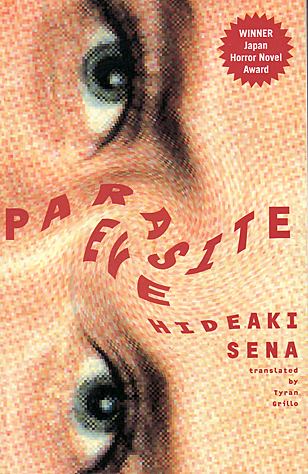
Parasite Eve

Title: Parasite Eve
Japanese Title: パラサイト・イヴ (Parasaito Ivu)
Author: Sena Hideaki (瀬名秀明)
Translator: Tyran Grillo
Publication Year: 1995 (Japan); 2005 (America)
Publisher: Vertical
Pages: 314

Sometimes I know that I should not write a particular review. Sometimes I have nothing nice to say. Sometimes, however, it’s way too much fun to resist writing about a hilariously bad book. This has happened before with Outlet and xxxHOLiC: ANOTHERHOLiC, and now it’s happening again with Sena Hideaki’s horror novel Parasite Eve, which is so bad that it’s almost good.

If nothing else, the premise of Parasite Eve is certainly original. A woman named Kiyomi has a problem with her mitochondria, which have collectively mutated into an intelligent being. These mitochondria gradually take over Kiyomi’s body, killing her and forcing her husband Toshiaki, a pharmaceutical researcher, to cultivate her liver cells. Since Kiyomi was an organ donor, one of her livers has found its way into a fourteen-year-old girl named Mariko, who begins to suffer from nightmares. As Toshiaki’s cell culture, which he has named “Eve 1,” grows, it (she) gains the ability to move around and make herself look like Toshiaki’s dead wife. Since Eve 1 cannot live for long on her own, she wants to create a half-human, half-mitochondria offspring, a project for which she needs Toshiaki’s sperm and Mariko’s womb. Although Eve 1 has a time limit for how long she can survive outside of a cell incubator, she can reshape herself at will and shoot fire. It goes without saying that Toshiaki must find a way stop her.

The narrative shifts between Toshiaki, Toshiaki’s research assistant, Mariko’s father, Mariko’s doctor, and Kiyomi. Eve 1 occasionally gets a few italicized paragraphs, too. Each of these characters is interesting in his or her own right; but, even though none of them are wooden or stereotypical, their characterization felt a bit half-hearted to me. The real focus of the first two-thirds of the book seems to be less on the characters and more on the surgery and scientific experiments they are involved in. Toshiaki’s research and Mariko’s organ transplant are described in loving detail, with all sorts of technical terms accompanied by explanations for the general reader. Even with all the non-fiction exegesis of science and medicine, the narrative progresses normally (if a bit slowly) for 175 pages. Even though there was a bit of Eve 1 shooting orgasms at people (I am not making this up) previously, this is the point at which things get ridiculous.

The next paragraph is filled with spoilers and sex. Consider yourself warned.

In the last third of the book, Eve 1 steps into the spotlight. I was especially struck by how Sena chose to portray her as intensely sexual. When Eve 1 first gains the ability to manipulate her shape while still in the cell culture incubator, she immediately gives herself a vagina and a finger and puts the two together. She then mouth-rapes Toshiaki’s student in order to gain control of her body for a few days before breaking free, at which point she turns herself into a giant vagina and rapes Toshiaki so as to procure his sperm. I kept thinking to myself, I bet Eve 1 is going to grow a penis and rape the fourteen-year-old next. So, when Eve 1 grew a penis and raped Mariko (after a short jaunt through the sewer), I actually laughed so hard that I cried a little bit. At the very end of the book, it turns out that Eve 1’s offspring cannot live (something about the male mitochondria in her body fighting the female mitochondria; don’t ask me). Instead of using her mitochondrial superpowers to generate a small-scale nuclear reaction and blow everything sky high (as I would have done in her situation), Eve 1’s daughter decides to fuse into the body of her father Toshiaki, and all of their cells have sex before they both die. Brilliant.

Body horror seems to be one of the major selling points of Parasite Eve, but body horror needs to be subtle in order to be truly effective. I believe that the body horror in this novel is unsubtle to an extreme, however, and the book has very few genuinely creepy moments. Also, by the end of the story, I really wanted Eve 1 to succeed in her mission of evolving an all-female race of mitochondria mutants, so I was a bit (okay, extremely) disappointed when both her and her daughter were defeated by the patriarchal power structures that pervade the narrative. Also, the idea that a female character needs to be either an innocent victim, a primordial mother, or a hyper-sexualized aggressor is getting a little stale. Seriously, is the dawn of a female race of X-Men with tentacles really too much to ask for?

To summarize, Parasite Eve is somewhat slow and boring for 175 pages, becomes progressively more gross and strange for the next 100 pages, and then ends in a 15 page orgy of fire and violence and slime. In other words, the pacing is a bit uneven, as is the distribution of action and explanation. Overall, reading Parasite Eve felt uncannily like reading a Michael Crichton novel, including the way that the science became increasingly more outlandish as the story progressed. If you’re a fan of Michael Crichton novels (or Dean Koontz novels), then you’ll probably be able to gloss over the flaws in the writing and enjoy Parasite Eve. Sena is working with very interesting material, after all, and his style is neither dry nor unliterary. The translation flows smoothly, and everything from dialog to the description of surgery has been rendered into natural, idiomatic English. If nothing else, it is worth reading through the first two thirds of the book in order to get to the ending. Especially if you’re into the sort of thing that happens during the ending – and, admit it, who isn’t?

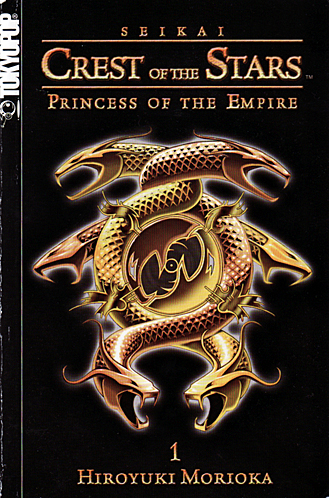
Crest of the Stars

Title: Crest of the Stars: Princess of the Empire
Japanese Title: 星界の紋章:帝国の王女 (Seikai no monshō: Teikoku no ōjo)
Author: Morioka Hiroyuki (森岡浩之)
Translator: Sue Shambaugh
Publication Year: 1996 (Japan); 2006 (America)
Publisher: Tokyopop
Pages: 212

I am a great lover of books, and I spend a great deal of my time reading. I genuinely enjoy almost everything I read, no matter what the genre, and rarely do I dismiss something as absolutely not worth reading. It is very easy for me to explain why I like a particular book, or what is valuable about a particular work, but I think that sometimes it’s important to also discuss what is mediocre, and what can be done better.

Morioka Hiroyuki’s Crest of the Stars series was recently held up to me as a paragon of Japanese science fiction. I wasn’t impressed with the translation of the first book in the series, Princess of the Empire, when it was released in the fall of 2006, but I decided to try it again. The series is massively popular in Japan, and it has quite a dedicated fan base in America as well. I have heard it described as a masterpiece of Tolkienesque proportions in several reviews; and, in my mind, there is no higher praise. Perhaps I had misjudged it four years ago.

Unfortunately, upon re-reading the book, that turned out not to be the case. Princess of the Empire starts off with a wonderful prologue, which briefly introduces the main character of the series in an interesting and beautifully described setting before launching into a short but fascinating account of the space journeys that led to the present moment. This history is then interrupted by action! intrigue! betrayal! and emotion! Unfortunately, this prologue is only sixteen pages long. What follows is 161 pages of utter garbage.

The teenage hero of the series, Jinto, arrives at a spaceport, where he is met by a beautiful blue-haired space elf named Lafiel. Lafiel takes Jinto to a space elf ship which will transport him to the space elf academy (Jinto, although genetically human, is politically an honorary space elf). The ship is attacked by a human group that seeks to oppose the space elf empire, and only Jinto and Lafiel escape. The ship is destroyed, and the unlikely pair (well, actually, very likely, considering that there are no other characters) is stranded on a small backwards planet. The end. Oh, and if you guessed that Lafiel is the princess of the space elf empire, you win a cookie.

You might be thinking, well, if Morioka spins 161 pages out of relatively nothing, then he must be a fairly talented writer with an eye for detail and a talent for dialog. Wrong. The Crest of the Stars series is known for its world building, and what Morioka has given us is 161 pages of almost unmitigated world building. The space elves are called Abh, they have a space empire, they have strange breeding practices, and they are genetically engineered to be beautiful, blue-haired, and psychic. That’s right, they are psychic space elves – which would perhaps be forgivable if there were more to them. Unfortunately, Morioka’s world building reads like a world history textbook written for fourth graders. Even when delivered in speech, the tone of this information is uniformly dry, essentialist, and uninteresting. Population statistics and general government details are provided, but nothing is said about culture, religion, art, lifestyles, political factions, diversity, philosophy, attitudes towards technology – or anything that the reader might actually care about. The clunky constructed language that annoyingly pervades the text is substituted for any real imagination. The almost complete lack of any visual imagery makes the book seem almost sterile, which I don’t think is a deliberate choice on the part of the author, whose writing is incessantly puerile:

Sure, Jinto had experience interacting with girls – he’d made a point on Delktou, in his own way. However, older women were still a complete mystery to him – especially gorgeous older women who were commanders of interstellar battleships. He couldn’t get his heart to stop racing.

In other words, instead of building a fictional world gradually while pulling his readers deeper into said world through plot thickening and character development, making them increasingly curious about the universe in which the characters live as they become increasingly attached to the characters themselves, Morioka completely forgoes plot and character development in order to construct his setting, which quite frankly feels like a cliché mix of Star Wars empire-and-princess driven space opera and Star Trek alien-culture-of-the-week episodic exploration adventure. The fact that the Abh are long-lived, pointy-eared, and dismissive of humans does not make Crest of the Stars Tolkienesque, unfortunately. In his postscript, Morioka states that he hopes “to make shameless sci-fi fans groan.” I’m pretty sure “groan” is the operative word here, since even Troy Denning’s novels set in the Star Wars universe are better written. Alas.

Princess of the Empire is everything I hate about the genre of young adult fiction, which tends to presume that its readers can’t handle complex plots, three-dimensional characters, figurative language, or middle school vocabulary. It could be argued that Japanese light novels are an entirely separate medium than young adult fiction; but still, there are infinitely better light novels out there. One of my personal favorites is Ono Fuyumi’s The Twelve Kingdoms series. A translation of the fourth installment, Skies of Dawn, was recently released a week or two ago, and I am happy to report that the series is only getting better with each successive book.

If it’s Japanese science fiction you’re looking for, then popular mainstream writers from Abe Kōbō to Ōe Kenzaburō to Miyabe Miyuki have successfully tried their hands at hard science fiction at one point or another. If you’re looking for the epic adventure and unparallel world building of Frank Herbert (or China Miéville), then check out Murakami Haruki’s Hard-Boiled Wonderland and the End of the World, which benefits from one of the most artistic and creative translations I have ever read. If you’re more in the mood for the intellectual short fiction of someone like Ray Bradbury (or Tim Pratt), then check out Tsutsui Yasutaka’s collection The Salmonella Beings from Planet Porno. If you’re in the market for lighter fare, I have been especially impressed by several of the translations I have read from an upcoming press called Haikasoru, which is an arm of Viz Media, an established publisher of manga intended for a slightly more mature audience than that targeted by Tokyopop.

In any case, to return to Princess of the Empire, it’s a morass of weak writing and tired stereotypes. Perhaps the Crest of the Stars series deepens in the second and third books, which are also available from Tokyopop, but I would rather spend my time reading all the cool new stuff that seems to be coming out almost every month. For those who want to know what all the fuss is about but don’t have the stomach to brave the light novels, there is always the Crest of the Stars manga trilogy (also published by Tokyopop). The manga are just as mediocre as the books – but at least the female characters provide the service of bending over to reveal themselves every few pages. Which, I suppose, is always a welcome distraction from heavy-handed world building and the overuse of a constructed language.