Mushishi

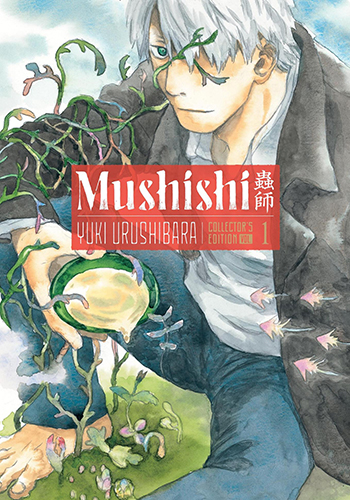
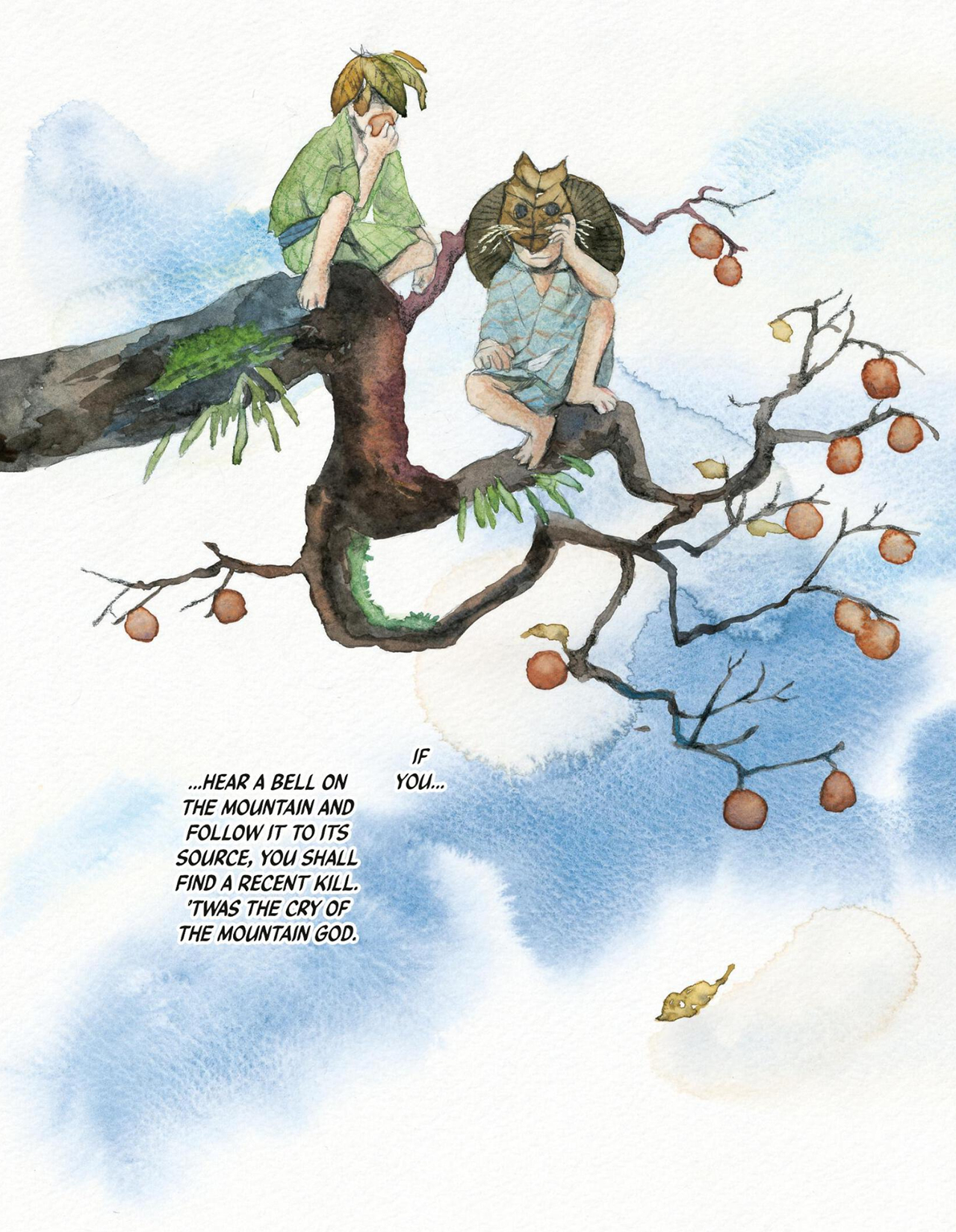
Yuki Urushibara’s ten-volume manga series Mushishi is a gentle but eerie collection of short stories about the uneasy relationship between humans and the natural world. Originally serialized between 1999 and 2008, Mushishi is now available in a series of hardcover Collector’s Editions from Kodansha, which has done a marvelous job with the release.

Mushishi is set in Japan during an unspecified time around the late nineteenth century. Some people wear Western clothing and smoke cigarettes, but traditional ways of life still persist in isolated rural areas, which seem untouched by time.

Ginko is a mushishi (“mushi scholar”) who travels to remote villages to study and document “mushi,” a collective term for a variety of lifeforms that exist partially in our world and partially in the realm of the supernatural. Like germs or bacteria, mushi are tiny and exist unseen by the vast majority of people. Problems arise when mushi form large colonies, especially within human bodies. Even as he studies and admires mushi, Ginko is often compelled to eliminate them in order to restore health to their human hosts.

As is the case with non-supernatural illnesses, people severely impacted by mushi often find themselves unable to return to normal life. In the manga’s second story, “The Tender Horns,” people living in a village deep in the mountains find that they go deaf in one ear when the snow falls. Ginko tells the village chief that this is the result of a mushi called “Un,” which lives in human ear canals and eats sound. This is a temporary inconvenience for most people, but one woman was so deeply impacted that she died. Now her son seems to bear the same affliction, which has manifested as a set of small horns on his forehead.

The tone of Mushishi occupies a liminal space somewhere between nostalgia and horror. Many of the stories have happy endings, but they’re nevertheless pervaded with the uneasiness of living at the edge of an unseen world that has little regard for human life. Mushi, which are something in between plants and animals and spirits, act in keeping with their nature, which is simply to grow and replicate. To most mushi, humans are little more than substrate.

Some species of mushi seem to possess something akin to sapience, however, and their relationship with humans is complicated. One of my favorite stories in the opening volume of Mushishi is “The Traveling Swamp,” in which a marshland appears and disappears seemingly at will. When Ginko studies the pattern of the manifestations on a map, he realizes that the colony of mushi is traveling through underground waterways. The young woman who appears and vanishes with the mysterious swamp has become saturated with the mushi, which have welcomed her as a companion on their journey to the sea.

What Ginko sees of mushi growth and behavior is akin to many written records of Japanese folklore, such as The Legends of Tono and Tales of Times Now Past, in which inexplicable things happen to people seemingly at random. In a time before modern science and infrastructure, the natural world was just as dangerous as it was awe-inspiring. As much as people in rural areas were dependent on nature for their livelihood, they were also at its mercy.

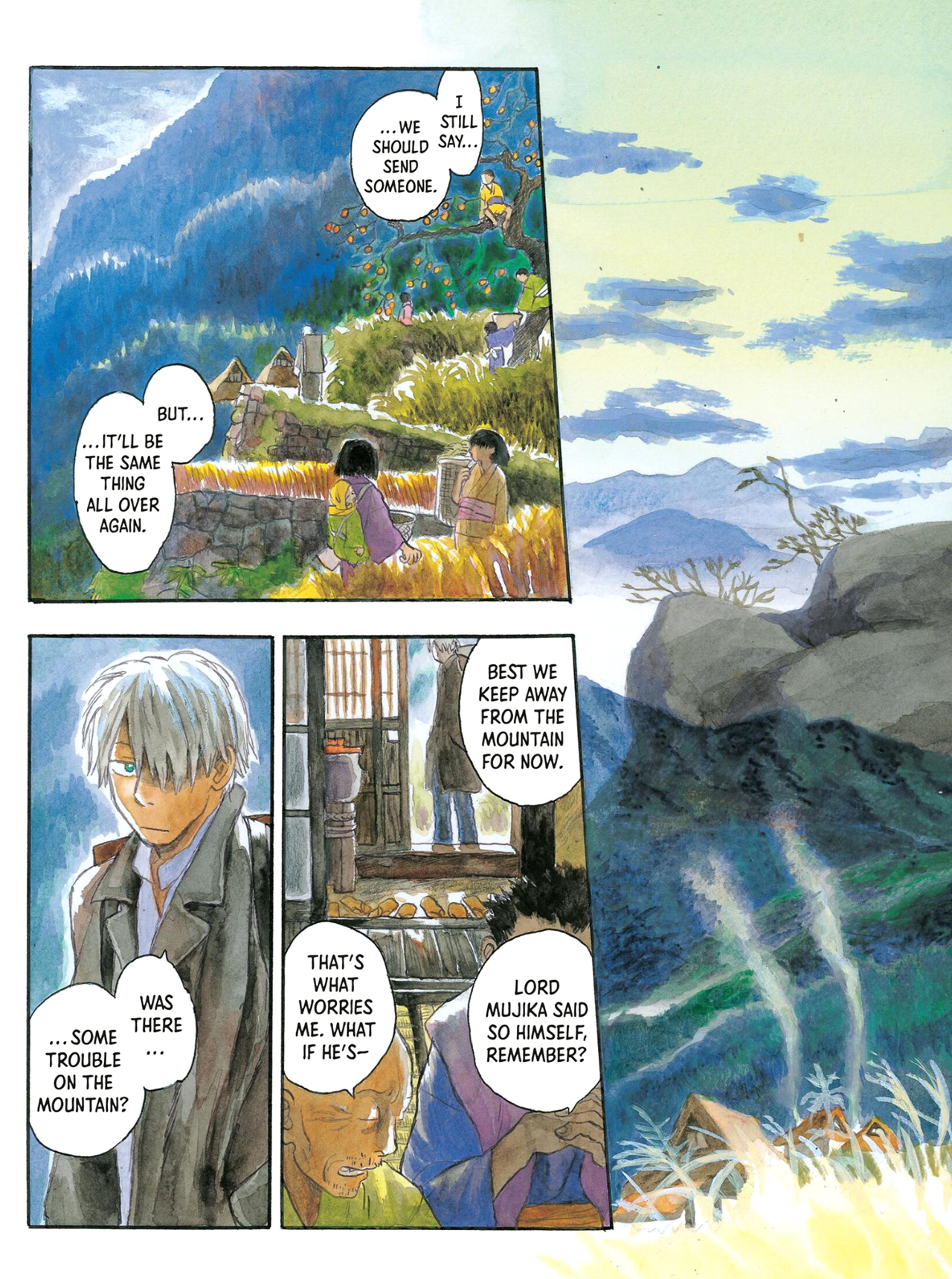
Yuki Urushibara’s artwork delights in wild spaces, from mountain roads to deep forests to ocean vistas to overgrown villages, and her depictions of premodern architecture and clothing are equally impressive. Urushibara is especially skilled with the use of etching and screentone to convey a sense of dim lighting while still using enough contrast to creatively highlight the focal points of each composition. The inkwork is truly impressive, as are the watercolor inserts, and Kodansha’s release of the manga allows Urushibara’s art to shine.

If you’d like to bask in the twilit atmosphere of a deep mountain forest, I might also recommend watching an episode or two of the Mushishi anime (available on Crunchyroll in the U.S.), which is extraordinarily well-produced. The anime is slow and quiet and isn’t for everyone, perhaps, but there’s really nothing else like it.  

Age of Shōjo

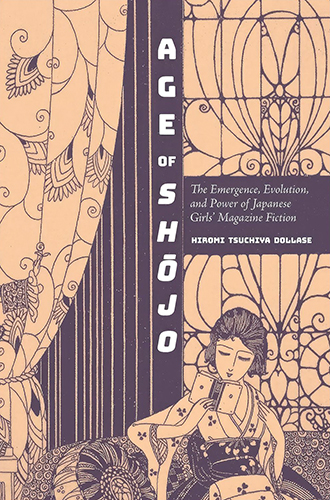
Numerous articles and book chapters have explored the origins of shōjo culture, and Hiromi Tsuchiya Dollase’s Age of Shōjo: The Emergence, Evolution, and Power of Japanese Girl’s Magazine Fiction contributes new insights while weaving these threads together into a tapestry depicting the history of how imagined communities of young women were shaped by the editors and contributors of popular mass-market magazines in Japan.

Age of Shōjo opens with a discussion of Louisa May Alcott’s novel Little Women, which was translated by Kitada Shūho in 1906 as Shōfujin. Through a close reading that compares the translation to the original, Dollase demonstrates how the novel “introduced a Japanese female audience to Western lifestyle and the image of a Western home” while still conforming to native Meiji-era constructions of femininity.

Chapters Two and Three introduce two key figures who helped shepherd amateur women’s fiction into professional venues. The first is Numata Rippō, who edited the seminal magazine Shōjo sekai (Girls’ World), and the second is Yoshiya Nobuko, who is famous for her contributions to this magazine, which were later published as the collection Hana monogatari (Flower Tales).

Chapters Four and Five trace the development of the portrayal of gender and sexuality in Yoshiya’s work in comparison with her contemporaries Morita Tama and Kawabata Yasunari, who also contributed short fiction to popular magazines such as Shōjo no tomo (Girls’ Friend) during the 1930s and early 1940s.

Chapter Six jumps forward to the immediate postwar era, when girls’ magazines such as Himawari (Sunflower) were filled with romanticized images of the United States, and Chapter Seven chronicles how magazine fiction for teenagers took a more mature turn during the 1980s. The stories published in the 1980s were still commissioned, selected, and edited to appeal to a readership of young women, but this fiction now addressed themes relating to women in the workforce, including frustrations concerning the choice between marriage and a career. 

As related by the anecdotes in the book’s Introduction and Afterword, girls’ fiction continues to be widely read and culturally influential in Japan. Dollase handles this material with respect and care by acknowledging its problematic aspects but preferring to contextualize instead of critique. This is especially the case with the heavily censored fiction of the 1940s, as well as the work of writers whose stories were progressive when they were first published but may seem socially conservative now.

In her informative study of these texts, Dollase demonstrates how, “through magazine stories and illustrations, readers came to acknowledge themselves as shōjo, a new cultural identity,” and how the fiction of these authors contains “messages of resistance against disagreeable cultural conditions cloaked in fantasy, sentimentalism, and humor.” Along with Dollase’s deft and accessible analysis, Age of Shōjo’s annotated reproductions of magazine covers and interior illustrations are a gift to readers interested in the literature and visual culture of girlhood in twentieth-century Japan.

Mothers

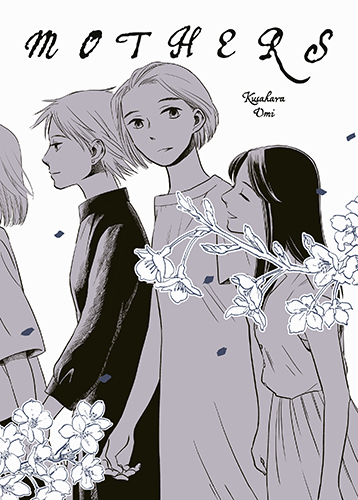
Mothers, released by Glacier Bay Books in April 2023 after a successful Kickstarter campaign, collects twelve one-shot manga stories about small but significant moments of kindness enacted in uncommon ways.

Umi Kusahara’s work is accented by touches of the fantastic but grounded in a reality that doesn’t pull its punches. These stories are particularly concerned with grieving and the emotional impact of loss, which is represented delicately but without sentimentality.

In the piece that lends its title to the collection, “Mothers,” two women visit the hospital beds of two teenagers who have only barely survived a horrible car crash. Each woman has a complicated relationship with the patient she visits, but they find sympathy and support in the connection they create with each other. As in the other stories in the collection, the catharsis lies in the moment of clarity when the characters can be finally honest with themselves about what they want and what will make their lives worth living.

Umi Kusahara originally self-published these short manga as dōjinshi, and it’s wonderful to see an American publisher uplifting noncommercial indie work that doesn’t fit into established genres. All of the titles in the Glacier Bay Books catalog are worth checking out, but I’m especially fond of Mothers, which I continually find myself returning to. Kusahara’s shōjo-inspired artwork is a lovely source of inspiration, and it’s a joy to bask in the sweetness of her worldview.

Glacier Bay Books is currently running a crowdfunding campaign for Fall 2025. The campaign will run until September 11, and this is a great way to check out and preorder their upcoming indie manga titles.

The Melancholy of Haruhi Suzumiya

The Melancholy of Haruhi Suzumiya, originally published in 2003, is a sci-fi romantic comedy about a quirky afterschool club. It’s also one of the most influential light novels from the heyday of otaku culture. Although I can’t say that all of its humor has aged well, it’s a quick and fun read, and there’s a good reason why it’s still in print.

Kyon is an average high school boy who’s assigned to the same homeroom as Haruhi Suzumiya, a beautiful girl who has a reputation for being weird. True to everyone’s expectations, she marches into the first day of class and introduces herself with the declaration that she’s not interested in speaking to anyone who isn’t an alien, an esper, or a time traveler. When Kyon tries to strike up a conversation with Haruhi, he gets roped into joining the SOS Brigade, an afterschool club that Haruhi has created to research supernatural phenomena.

The plot twist is that, with the exception of Kyon, every member of the SOS Brigade is indeed an alien, an esper, or a time traveler. They gradually reveal themselves to Kyon, insisting that they’re posing as high school students in order to observe Haruhi, who unknowingly has extraordinary powers capable of restructuring the universe. If Haruhi becomes bored with the current universe, it’s not beyond the realm of possibility that she might inadvertently destroy it. It’s therefore imperative that Haruhi remains entertained and blissfully unaware of her power.

As you might imagine, this scenario has a number of unsettling implications. Is everyone in the story merely a figment of Haruhi’s imagination? Does anyone in the universe she created have free will? If Haruhi created “this” universe, what happened to the universe where aliens, espers, and time travelers don’t exist?

The Melancholy of Haruhi Suzumiya goes right to the edge of these darker implications but ultimately backs off in favor of light comedy and mild teenage romance, a tonal balance that undoubtedly contributed to its popularity.

This light novel was adapted into an anime that aired in the Winter 2006/07 season. I admit that I’ve never watched it from start to finish, but the show was ubiquitous in Japanese pop culture fandom communities for years. The ending theme, “Hare Hare Yukai,” became a meme that spawned countless flash mobs of cosplayers recreating the iconic dance at anime conventions.

Due to its prominent place in mid-2000s otaku culture, I was considering including The Melancholy of Haruhi Suzumiya on the syllabus of a college class about Japanese science fiction and fantasy. I think it would be a good choice, but I’m still undecided. My hesitation is mainly due to the fact that one of the early chapters includes light elements of goofy sexual comedy that made sense in the cultural atmosphere at the time but might read a bit differently today.

To give an example, in order to blackmail the members of the computer club into giving her a PC, Haruhi takes someone’s hand and places it on the breast of one of the female SOS Brigade members before asking Kyon to take a photo. To me, this scene reads as the sort of stupid but harmless fantasy that might appeal to the book’s target readership of teenage boys, but I understand how it might be interpreted as sexual harassment (because, undeniably, it is).

Still, light novels are filled with this sort of thing, and I tend to think that The Melancholy of Haruhi Suzumiya is on the “unproblematic” end of the spectrum. To be fair, it’s not anything worse than what’s in most Haruki Murakami novels.

I don’t read many light novels these days, but I enjoyed The Melancholy of Haruhi Suzumiya. The pace is brisk, the writing is snappy, and the story offers a nice treatment of its speculative worldbuilding without getting too deeply into the weeds of hard science fiction. Looking back on this book from twenty years in the future, I found myself waning a bit nostalgic for an earlier (and, I think, more lighthearted) era of otaku culture. The Melancholy of Haruhi Suzumiya is an interesting cultural artifact, but it’s also a fun story that I’d recommend to anyone who hasn’t yet encountered its particular flavor of high school comedy.

Shimeji Simulation

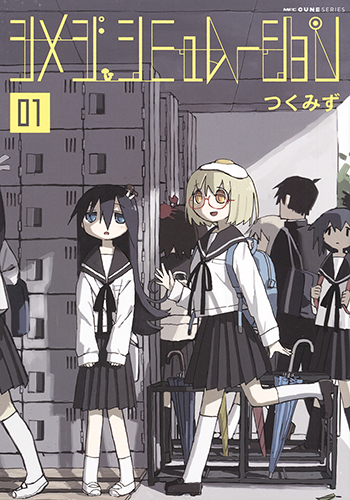
Shimeji Simulation (シメジ シミュレーション) is a gentle but deeply surreal slice-of-life manga about two teenage girls living through the end of the world – or perhaps not “the” world, necessarily; but rather, an artificial world that they happen to inhabit. The focus of the manga isn’t on the apocalypse, which passes mostly unremarked and unexplained. Instead, the core of the story is the friendship (and understated romance) between the two girls, Shijima and Majime. 

Shijima Tsukishima has spent the past two years of middle school quietly living inside a closet, and the manga opens when she decides to begin attending high school at the beginning of the school year. Why Shijima became a hikikomori is something of a mystery, but her primary personality trait is that she dislikes being bothered. She plans to spend her time in high school silently reading books at her desk.

This plan is interrupted by a classmate named Majime, who aggressively demands that Shijima become her friend. Since a pair of shimeji mushrooms sprouted from the side of Shijima’s head during her period of isolation, Majime immediately gives her the nickname “Shimeji,” an appellation that quickly becomes as pervasive and persistent as Majime herself.

Majime bluntly inserts herself into Shijima’s life and persuades her to join the school’s Hole Digging Club, which is managed by an art teacher named Mogawa. Majime assumes that the club is little more than an excuse to hang out after school, but Mogawa is oddly committed to the endeavor, especially when encouraged by the quiet presence of a second-year student named Sumida who only communicates through abstract drawings. Meanwhile, Shijima’s older sister has dropped out of college to devote herself to the ongoing construction of a bizarre machine with an inexplicable function.

For the most part, the girls engage in mundane slice-of-life adventures. They chat in the classroom, visit one another’s houses, and attempt a study session at a family restaurant. Mogawa teaches her art lessons. Majime catches a cold. A group of girls in their homeroom start a rock band. Shijima meets a super-senior named Yomigawa who’s decided to stay in high school just to hang out in the library and read philosophy books.

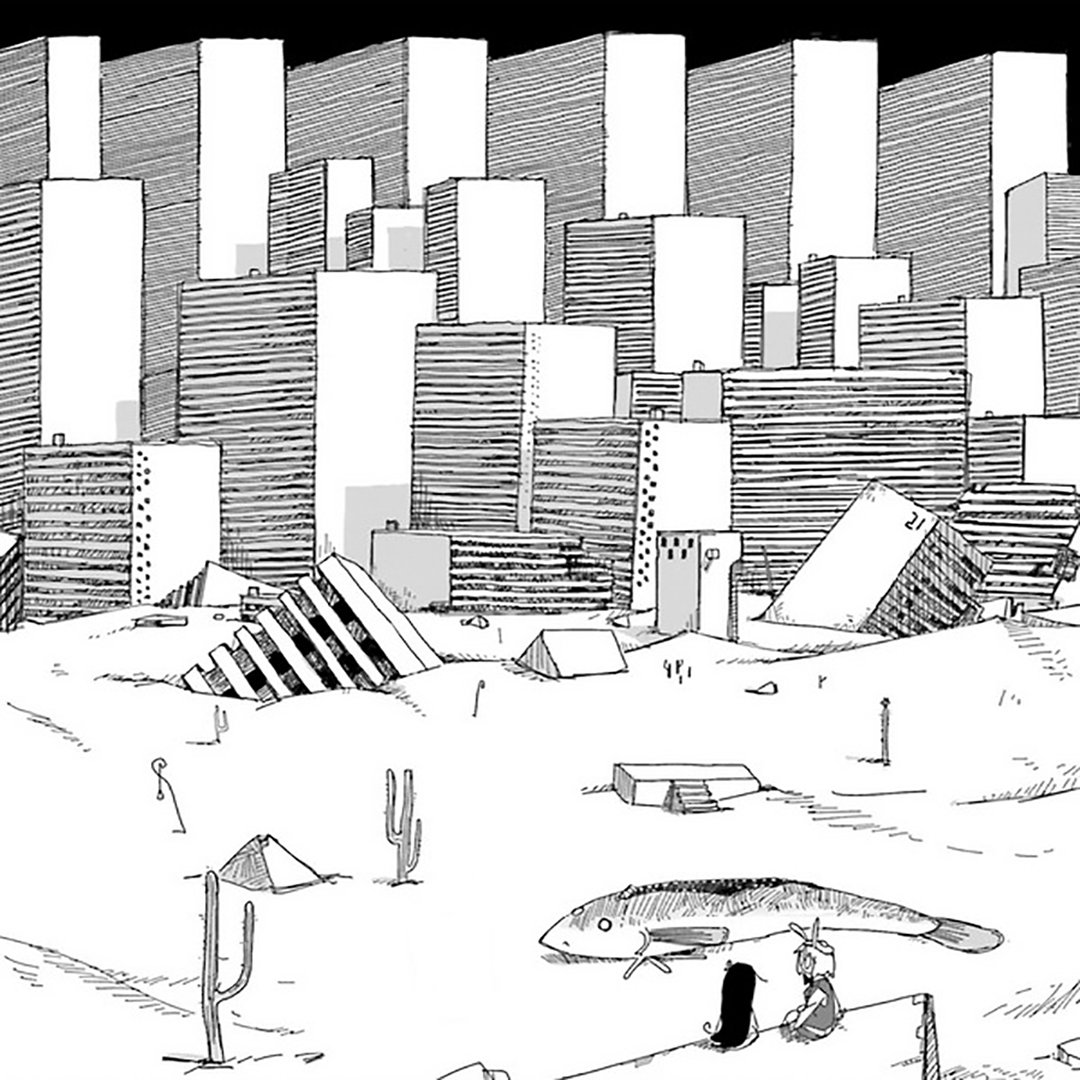
What makes this manga interesting are the strange glitches in the world surrounding the characters. The mushrooms sprouting from Shijima’s head are a good example, but there’s also the fact that Shijima and her sister occupy one of the only two tenanted apartments in a giant danchi housing building that’s falling apart yet still somehow livable. 

As the story progresses, more glitches begin to manifest. Everyone wakes up to a snowstorm in the middle of summer, for example. One day, the school building is flipped vertically and becomes a pocket dimension with a separate axis of gravity. Another day, water loses its mass and floats in the air. Suburban streets twist into optical illusions, and fish swim through the sky.

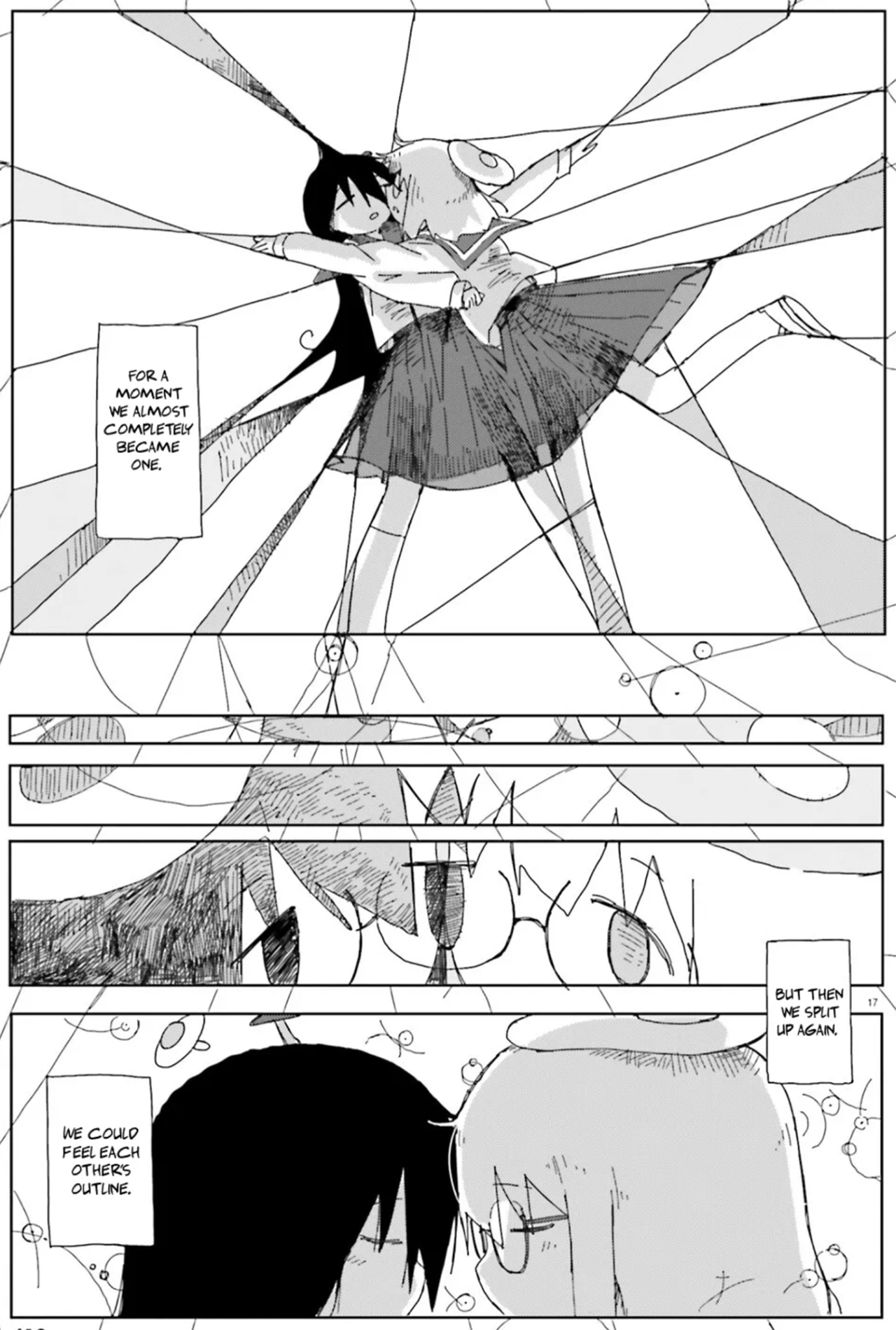
Although small glitches seem to be innate to the world, they’re exacerbated by Shijima’s sister, who’s been building and experimenting with various devices that alter the fabric of reality. Each of the first three volumes of the manga concludes with a longer narrative segment that shows the consequences of these experiments for Shijima and Majime, who are briefly thrown into the gaps between the cracks of reality.

The cumulative damage caused by Shijima’s sister is countered by a godlike entity who presents as a young girl and calls herself “the Gardener.” The Gardener’s role is to ensure that the reality experienced by the characters doesn’t mutate too wildly from one day to the next, but her power is curbed by the features of the universe’s code intended to keep its residents safe. She might be able to repair gaps in reality, but she has no means of forcing her will onto humans, even if it’s for their own good.  

Like Tsukumizu’s previously serialized manga, Girls’ Last Tour, it’s difficult to say that Shimeji Simulation is “about” anything. There’s no plot to speak of, and the only real conflict is between the characters and the entropy eating away at the edges of their slowly decaying world. In addition, it’s never explained how this constructed universe and the characters who inhabit it came to exist. Instead, I think it’s probably fair to say that the manga’s primary concern is existential ontology. In other words, what does it mean to be human, and why do we exist?

I recently read an interesting essay (here) whose author argues that Shimeji Simulation is about the barriers between people, why we need them, and what happens when they disappear. If everyone were able to get exactly what they want, what happens when the desires of separate individuals come into conflict? If there were a world perfectly tailored for one person alone, could anyone else live there? And, if you retreat into complete solipsism, what’s the point of being alive?

Toward the end of the manga, Shijima finds herself in a situation very much like her self-imposed hikikomori isolation in the beginning, when she lived entirely in the darkness of her closet. In the simulated world she comes to occupy through her sister’s rewriting of the universe’s code, Shijima doesn’t bother anyone, and she never has to deal with any external input that she doesn’t choose for herself. Still, can we really say that such pristine loneliness is preferable to the messiness of human relationships?

I read Shimeji Simulation as a story about the various ways that people communicate and connect with one another. Shijima never becomes a “normal” or friendly person, but she still manages to find joy and meaning in her interactions with other people, even if most of these interactions are nothing special. This is why, in the fifth and final volume of the manga, Shijima breaks the boundaries of her personal universe to find Majime, wherever her friend might exist in the fractured constellation of simulations.

“The meaning of life is to understand love” may seem cliché; but, given how strange and surreal her story becomes, Shijima’s realization feels significant and well-earned. Life is a constant shifting and melding of interpersonal boundaries, and communication and companionship are worth the pain and trouble of being human.

Shimeji Simulation is a remarkable work of science fiction. The manga may seem to have an unassuming beginning, but its narrative structure gradually builds, loops back in on itself, and continually starts over from a weirder and more nuanced position. Likewise, Tsukumizu’s art may initially feel sketchy, but this style is perfectly suited to express the uncanny glitches and fluid malleability of the setting. Shimeji Simulation is gentle and quiet, but also immensely intelligent and creative, and it’s a manga to contemplate and enjoy slowly while allowing yourself to be transformed alongside the characters and their strange but fascinating world.

Shimeji Simulation hasn’t received an officially licensed English translation, but a fan translation is currently available to read on Dynasty Scans (here). If you’re interested in a small taste of the manga’s tone, I’d also like to recommend the short fan anime adaptation of the opening chapter on YouTube (here).

うみべのストーブ

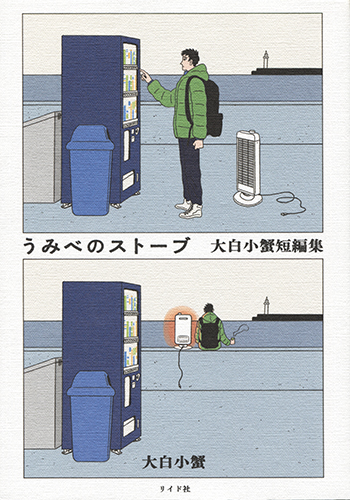
Umibe no Stove (うみべのストーブ), originally published in 2022, is a collection of seven short manga stories by Kogani Ōshiro. In a surprising but well-deserved turn of fate, the collection was listed as the #1 women’s title in the 2024 edition of the Kono Manga ga Sugoi! (“This Manga Is Awesome”) series of mass-market reference books. Ōshiro’s magical realist stories are difficult to categorize, but what they share is a gentle and bittersweet appreciation for the small challenges and victories of growing older and moving on. 

The title story is about a man named Sumio whose girlfriend breaks up with him on her birthday. Left alone in the apartment they once shared, Sumio huddles next to the space heater and cries. The space heater takes pity on him and reveals that it can talk. It suggests that they go to the beach together, a trip Sumio never made with his girlfriend. Sumio agrees and spends the night sitting on a concrete embankment overlooking the ocean as he talks with the space heater and finally accepts the fact that his girlfriend isn’t coming back. Even though it’s unplugged, the space heater keeps him warm by sharing its memories of happier times.

The second story, 雪子の夏 (Yukiko no natsu), is about a trucker who encounters a Yuki Onna while stuck in traffic on a snowy night. The childlike yōkai doesn’t particularly want to kill the trucker; and, after they talk for a bit, she reveals that it’s her dream to see summer fireworks. The trucker invites the Yuki Onna to share her apartment until summer, at which point she can use her refrigerated cargo space to take her guest to see a summer festival. While watching the fireworks explode in the night sky, the Yuki Onna is so overjoyed that snow begins to fall.

My favorite of the stories, 海の底から (Umi no soko kara), is about a young woman named Fukatani who always dreamed of being a professional novelist. Her two friends from college both managed to become published authors after they graduated, but Fukatani lost her motivation to write after starting an office job. During a late-night drinking session, Fukatani’s friends ask her if she’d really be happy never writing another story, but she doesn’t know what to say. She used to love writing, but she just hasn’t felt any inspiration recently.

Later, Fukatani’s boyfriend comforts her, saying that there’s no rush for her to begin writing again. After college, he explains, she found herself standing at the base of a pyramid on the bottom of the sea. She’s been working to climb each step – finding a job, paying off student loans, and so on – but when she gets to the top and rises above the surface of her ocean of worries, she’ll be able to feel the wind of creativity again. This sounds like a silly analogy, but the way Ōshiro illustrates the process of coming up for air is remarkably cool and refreshing.

Something I love about Umibe no Stove is the non-commercial quality of Ōshiro’s visual style. Admittedly, the art of some of the stories feels a bit amateurish, but I find this charming. Even when Ōshiro’s drawings are unpolished, her sense of sequential art is unflaggingly excellent. Her use of panels in Umi no soko kara, for instance, creates a lovely sense of space during the protagonist’s conversation with her boyfriend. Even if Ōshiro’s drawings aren’t always technically precise, her manga still has incredible emotional impact.

I want to recommend this book to manga fans interested in a more indie style of Japanese comics, perhaps along the lines of the graphic novels published by Western presses like Fantagraphics and Drawn & Quarterly. Umibe no Stove may seem unassuming on the surface, but this manga is something special.

As an aside: if you’re looking for something similar that’s been translated into English, I’d like to recommend Natsujikei Miyazaki’s short story collection And the Strange and Funky Happenings of One Day. It’s weird, it’s fun, and the indie manga publisher Glacier Bay Books has done an amazing job with the translation and editing.

She and Her Cat

She and Her Cat collects four interlinked short stories about women and their cats. Though these stories are bittersweet, their gentleness is a source of comfort and encouragement.

The stories in She and Her Cat were written by Naruki Nakagawa, who’s mainly known as a screenwriter for science fiction anime from the mid 2000s, and the concept is based on the 1999 short indie film (which you can watch on YouTube here) created by the international superstar anime director Makoto Shinkai. I think it’s fair to say that the original short film is a representative example of the iyashikei “comfort” genre of anime, which Patrick Lum describes as “designed to be as comfy and mellow as can be.” This book, which Nakagawa wrote in his late forties, similarly uses young female characters to create a sense of living in a world where a brighter future is always possible.

The first story is a direct adaptation of Shinkai’s original short animation. A young office worker named Miyu brings home a kitten who’s been left outside in the rain in a disintegrating cardboard box. Miyu is growing apart from both her boyfriend and her best friend, and she feels as though she’s no longer able to understand the nuances of other people’s feelings. Thankfully, her new cat Shiro loves her unconditionally, and he’ll always be there for her.

The second story is about an art student who can’t find the motivation to apply to a university-level Fine Arts program, and the third is about an aspiring manga artist who was unable to make her debut and became a hikikomori after the death of her writer, who also happened to be her childhood friend. Both women find the courage to pull themselves out of their depression and take the first few steps forward – with the help of their cats, of course.

In the last story, a childless middle-aged woman finds herself alone after caring for her husband’s parents only to be left by her husband himself. As she gets older, so too does the boss of the neighborhood stray cats, and she ends up adopting him. Around the same time, her nephew has a quiet breakdown at his first job out of college, and the woman ends up sheltering him too. In return, he eagerly learns the non-corporate life skills she shares, and he naturally begins to help her manage the household. While it’s always rewarding to nurture a mutually loving and beneficial relationship with a cat, this story reminds the reader that kindness can exist between humans as well.

The narrative viewpoint of these stories alternates between the cats and their human companions. When the cats aren’t expressing their undying love for the human ladies in their lives, they’re off on their own adventures in the neighborhood, doing as cats do. Even more than the human characters, the cats have strong personalities and know what they’re about.

Comforting Japanese books about cats are currently enjoying a small cultural moment, and She and Her Cat is among the best of them. As you might expect from a book written by a professional screenwriter, each “scene” is fairly short, which makes for a quick and engaging read. Nagakawa maintains the distinctive narrative voice associated with Makoto Shinkai’s films, and Ginny Tapley Takemori conveys this straightforward gentleness perfectly in translation. In the English edition, each story is prefaced by a gorgeous full-page illustration by Rohan Eason, which only adds to the book’s charm. Exactly like the creatures it celebrates, She and Her Cat is light, nimble, and filled with character. 

Belles Ruelles

Belles Ruelles is a gorgeous full-color anthology that collects the work of eleven manga artists and illustrators, each of whom has been tasked with telling a story set in the fictional European town of Eufemia.

Eufemia has preserved its medieval cityscape while maintaining a lively community of established shops, young entrepreneurs, and cultures from all over the world. It’s filled with narrow alleys, charming old buildings, ivy-adorned walls, and even a bit of magic.

One of my favorite stories is Keiko Shiki’s “Spice,” in which the young assistant at a store specializing in herbal teas and cooking spices learns just how much love and care the store owner puts into perfecting her craft.

I also love Hiromi Matsuo’s “Soie Rouge,” in which a college student tastes the luxury of trying on a kimono for the first time. Every panel of this manga is an artistic masterpiece, and the writing gently guides the reader through the sartorial experience.

I’m happy to see that this anthology is the first in a series, because I’m very much looking forward to visiting Eufemia again soon. If you’re a fan of the fantasy European setting of Studio Ghibli movies like Kiki’s Delivery Service, I’d encourage you to take a trip yourself.

Tree in the Middle of the World

世界の真ん中の木 (Tree in the Middle of the World) is a lushly illustrated picture book written and drawn by Makiko Futaki, a former animator at Studio Ghibli. Originally published in 1989, this book is now available in a beautiful hardcover edition that allows the full glory of the artwork to shine.

In the Afterword to the original softcover edition published by Animage, Futaki wrote that she was inspired to create this story after visiting the Yakushima natural heritage forest, where she conducted visual research for My Neighbor Totoro. Despite its young protagonists and verdant greenery, however, Tree in the Middle of the World is a complex ecofable that has more in common with Princess Mononoke

A preteen girl named Cici lives in the mountains with her grandmother. Their small cottage lies at the base of the gargantuan “tree in the middle of the world,” and their modest livelihood is supported by its ecosystem. One year, the tree’s cycle of seasons goes strangely awry, and the sapling Cici attempts to grow from one of the tree’s seeds withers. Hoping to learn more about the malady affecting the tree, Cici resolves to speak with the legendary golden bird that lives in its uppermost branches.

During her epic three-day climb, Cici realizes that the state of the tree’s health is far more dire than she suspected. To make matters worse, she seems to be followed by a young archer from the steppes named Dimo. Dimo is an inexperienced speaker of Cici’s language, but he manages to communicate that he intends to kill the very bird she seeks. Thankfully, Cici does not have to bear her worries alone. Early in her climb, she gains a travel companion in the form of a talking frog whose avuncular good nature serves as a welcome relief from the hardships of her journey.

When Cici finally finds the golden bird, she learns that it has gone insane in its old age, and the putrescence it sheds from its rotting feathers is the cause of the tree’s sickness. Just as he intended, Dimo appears in the nick of time to slay the bird, which answers Cici’s question with its dying breath – in order to save the tree, Cici must venture underground to scatter the tree’s seeds below its roots.

This is a fearsome undertaking, to be sure, but Dimo promises to lend his aid. The two children thus embark on a second journey that proves to be just as dangerous as the first. Just when all hope seems lost in the darkness, Cici and Dimo arrive on the shore of a golden sea that might just be the very stream of life itself. Having succeeded in the quest, the two children return to the surface, where the first winds of spring greet them with verdant laurels of fresh greenery.

Although I’ve outlined the contours of the story, Tree in the Middle of the World is a substantial book whose plot contains a number of twists, turns, and quiet spaces for rest and contemplation in between. The writing is simple but evocative, especially during the portion of the story that takes place underground. Miraculously, every page boasts gorgeous illustrations, each of which is more magical than the last.

Tree in the Middle of the World reminds me a great deal of Hayao Miyazaki’s Shuna’s Journey, albeit with two key differences. First, the visual layout of Tree in the Middle of the World makes its text much clearer and easier to read than the text in Shuna’s Journey; and second, Futaki is far more focused on guiding the reader along a journey through the space of a fixed setting. Like Shuna’s Journey, however, Tree in the Middle of the World contains moments of genuine fear and menace that might not be appropriate for younger children.

Tree in the Middle of the World doesn’t skirt around the shadows of its themes. Like everything in nature, the life of the giant tree exists in cycles, as does that of the giant bird that nests in its branches. Sometimes, like Cici, we find ourselves at the end of a cycle, and there’s not much we can do to prevent the death and destruction we see everywhere around us. Still, it’s our responsibility to preserve the seeds of what we hold dear and plant them carefully in the hope that they will grow strong and healthy in the future when the cycle turns once again.

Tree in the Middle of the World is an uplifting and optimistic story guided by a fantastic sense of adventure. Through her luminous artwork, Futaki conveys the joy of being surrounded by green and growing things, and the action is easy to follow even if your Japanese reading ability isn’t perfect – or if you don’t read Japanese at all. If nothing else, it’s impossible to read Tree in the Middle of the World and not feel inspired to go outside and interact with the world with a renewed sense of hope and purpose.

Dragon Goes House-Hunting

Earlier this year, Seven Seas released the tenth and final volume of Kawo Tanuki and Choco Aya’s fantasy series Dragon Goes House-Hunting. This manga follows the misadventures of a gentle but cowardly dragon named Letty and his real estate agent Dearia, a massively powerful and inhumanly beautiful dark wizard. Letty is searching for a comfortable house that will accommodate his size while also protecting him from the pesky adventurers trying to hunt him for crafting materials. While Letty pictures himself in a cozy cottage, Dearia encourages him to be more pragmatic and dungeon-minded.

What makes Dragon Goes House-Hunting stand out in the “slice-of-life fantasy” genre is the consistently high quality of its art, which references the detailed monster designs from video game manuals of the 1990s while still feeling fresh and contemporary. For video game fans especially, it’s quite entertaining to look at dungeon design from the perspective of the monsters, who are just trying to make it through the day without being harassed by heroes. The manga’s situational humor is gentle and sweet, but each volume still managed to surprise me with at least three or four devilishly sharp jokes.

Perhaps the easiest way to describe Dragon Goes House-Hunting is to say that it’s the high fantasy version of the wholesome yakuza comedy The Way of the Househusband. Like The Way of the Househusband, Dragon Goes House-Hunting is designed to be accessible to all ages, but it will resonate most strongly with readers old enough to have some experience with real estate (even if that experience is limited to looking for a student apartment). For a more action-oriented and kid-friendly take on the concept of “building homes for monsters,” I’d also like to recommend the ongoing shōnen series Soara and the House of Monsters, which is a gorgeously creative celebration of fantasy architecture.  

Screenshot