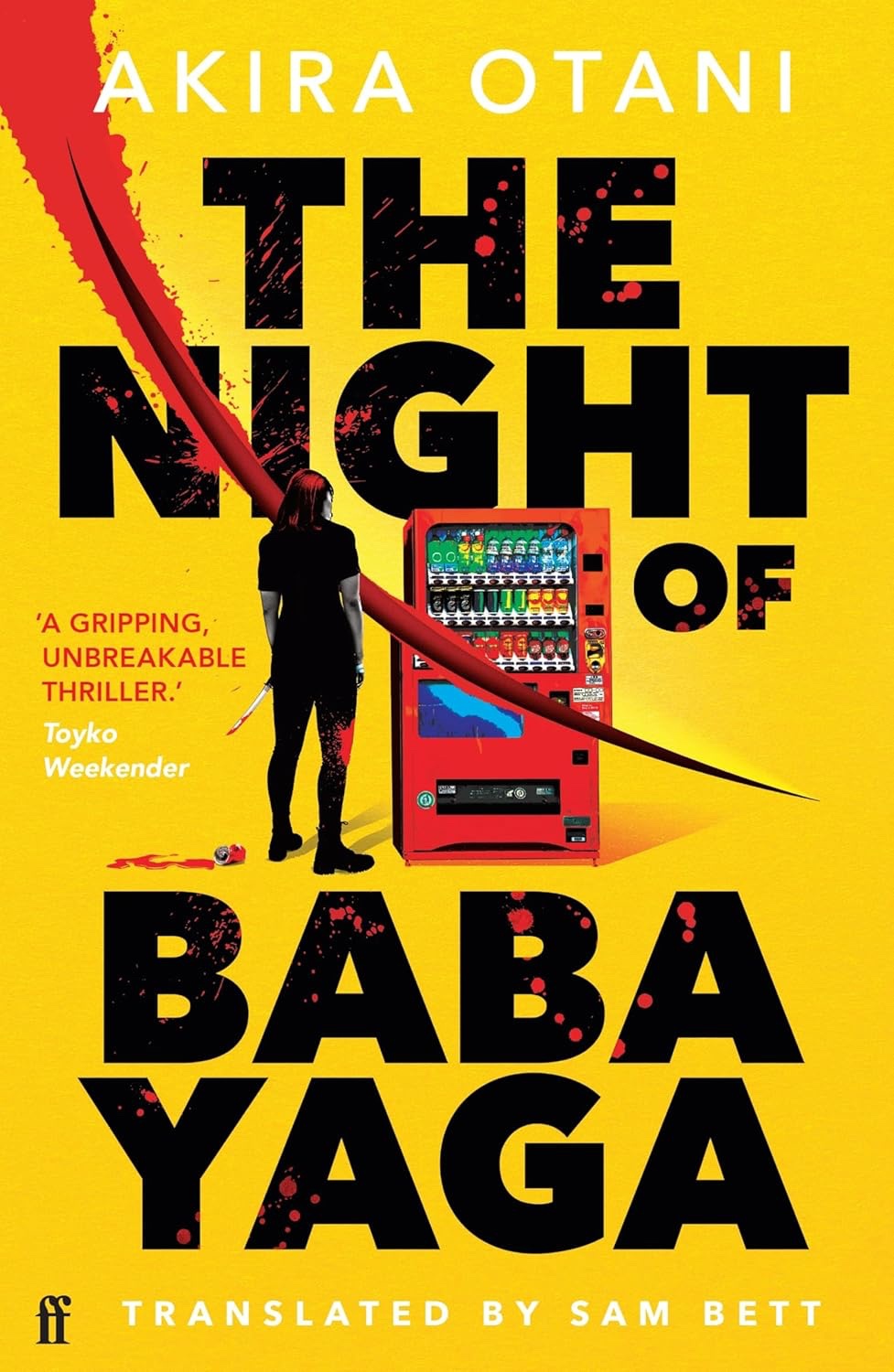
The Night of Baba Yaga

The Night of Baba Yaga is two hundred pages of violence, torture, and rape. All of the novel’s descriptions of violence, torture, and rape are graphically explicit; and again, there are two hundred pages of them. I enjoyed this book, but it’s not for everyone.   

The bulk of The Night of Baba Yaga is set in Tokyo in 1979. A 22yo street brawler named Yoriko Shindo is pressed into the service of a notorious yakuza crime syndicate whose boss has ordered her to become the chauffeur for his precious only daughter, a prim-and-proper college student named Shoko. The yakuza boss assumes that, because Shindo is female, she won’t attempt to romance Shoko, but of course the two women fall in love and help each other escape the family.

I’d like to say that The Night of Baba Yaga is a love story, but it’s more of a series of fight scenes occasionally broken by scenes of torture and rape. The novel begins and ends with Shindo getting the shit beaten out of her, and most of the gaps in the fighting are created by the aforementioned torture and rape. I’m not saying this is a bad thing. The Night of Baba Yaga is what it is, which is a lesbian BDSM hurt/comfort fantasy in which male characters enact hurt so that female characters can provide comfort. Aside from the brief comfort scenes, there’s not much romantic chemistry or character development.

The Night of Baba Yaga is empowering for the woman who wrote it, no doubt, and I get the sense that there will be queer readers (such as myself) who will be amused to see this sort of openly horny fantasy in print. The Night of Baba Yaga isn’t empowering for any of the characters, however. Short interstitial chapters jump ahead in time, but I hope it’s not a spoiler to say that nobody gets a happy ending. Not in this sort of story. The tragedy is so over-the-top it’s Shakespearean.

Personally, I thought the ultraviolence was a lot of fun. The action is so gory and exaggerated that it’s difficult to take seriously, and The Night of Baba Yaga feels silly and campy in the same way that Takashi Miike movies like Ichi the Killer do. If you (like me) are a fan of the horror movie mindset that inspires you to cheer with delight when somebody’s hand gets chopped off, The Night of Baba Yaga delivers.

The translator, Sam Bett, has done an amazing job. Fight scenes are notoriously difficult to write, yet the translation is snappy and remarkably fast-paced. The character voices aren’t “natural” by any means, but they’re pitch-perfect for the genre. When it comes to descriptions of rape and violence, Bett doesn’t pull any punches. It’s an incredible translation, and I am in awe.  

I’ve seen social media reviews hailing The Night of Baba Yaga as “an inspirational queer romance,” and it 100% most definitely is not that. Nobody does any learning or growing in this story, which has exactly zero social commentary. Rather, The Night of Baba Yaga is an adrenaline-laced lesbian power fantasy about being the most badass fighter you can be until you die. If you’re not the target audience, The Night of Baba Yaga probably isn’t for you. Like Wolverine, it’s the best at what it does, and what it does isn’t very nice. This short and compulsively readable novel gets in, gets messy, and gets what it came for.

The Deer King: Survivors

Nahoko Uehashi’s fantasy epic The Deer King is the story of two characters who find themselves caught in an ongoing conflict fought on two fronts – an imperial war for conquest, and the spread of a mysterious disease.

The Deer King works best when it focuses on its primary viewpoint character, a middle-aged warrior named Van who lost his homeland when he was captured in battle and sent to the imperial salt mines to work and die as a slave. After the mines are attacked by black wolves, Van passes out and wakes to find he is the sole survivor – with one exception, a small child named Yuna who was stuffed into an oven in the kitchens aboveground.

With Yuna in tow, Van escapes into the forest, where he encounters an injured traveler who has been abandoned by his pyuika, a cross between a deer and a reindeer that Van’s people have traditionally ridden like horses. When Van befriends the missing pyuika, the traveler invites him back to his village to teach everyone how to raise the animals properly. Van agrees, and he and Yuna find peace in the isolated village. Unfortunately, the ongoing war is not far behind them, and Van begins to manifest strange abilities that pull him in the direction of the black wolves.

Van’s portions of the story are wonderful. Van is a careful observer of the world around him, and his perspective allows the reader to appreciate the details of the natural environment while learning about the cultures of the people who live on the borders of the empire. Despite his background as a military leader, Van is primarily concerned with establishing peaceful human relationships. This facet of his character allows worldbuilding to occur organically through conversations about mundane matters. 

Unfortunately, The Deer King becomes borderline incomprehensible when it shifts to the secondary viewpoint character, a young and brilliant physician named Hohsalle who seeks to combat the deadly disease supposedly spread by the phantasmic black wolves that attacked Van. Hohsalle’s chapters are exposition dumps filled with fantasy names and places and ranks that feel uncomfortably decontextualized.

All of the characters operating within the empire have lords, and they also have servants, and their servants have servants, and their lords have family histories. To my dismay, all of these characters are presented as though the reader were already familiar with their relationships. What could have been an interesting medical drama is thus buried under a slurry of fantasy names and meaningless titles.

I had the same problem with Uehashi’s novel The Beast Player, a coming-of-age story that’s interesting and compelling right up until the point when the narrative suddenly shifts to the machinations of a dozen new characters active in the succession drama of a large and labyrinthine imperial court. The poor pacing and uneven structure of both novels render their stories unnecessarily difficult to follow, which is a shame. 

In addition, while I’m always hesitant to critique Japanese-to-English translation, I feel that veteran translator Cathy Hirano’s signature style of simple and lucid clarity might not be the best fit for a work of epic fantasy. When I read fantasy, I want the prose to be at least a little purple, with the beauty (or darkness) of the language reflecting what’s unique about the world imagined by the author. I also want the characters to have distinct voices, especially if they’re coming from vastly different cultures. I personally feel it’s something of a drawback for the translation of The Deer King to be so smooth, as I’d prefer the writing to have more texture.

The Deer King: Survivors is only the first half of the story, but I don’t think I’m going to read the second volume. Even though the novel contains numerous themes that interest me, such as the ecological impact of war and the moral compromises of marginal communities resisting oppression, the flawed execution of these themes failed to hold my attention.  

What I’d strongly recommend is for anyone interested in the premise of The Deer King to check out the animated cinematic adaptation, a breathtakingly beautiful film that deserves far more attention than it’s received. The movie version of The Deer King is on par with Princess Mononoke in terms of its depiction of a green world filled with mystery and populated by sympathetic characters who are doing their best to understand one another despite their competing goals.

Unlike the original novel, the pacing of the movie is excellent. Many of the side characters and their subplots have been cut or simplified, thereby allowing the physician Hohsalle to shine like the star he’s meant to be. The film version of The Deer King is the sort of animation for intelligent adults that harks back to an earlier generation of filmmakers like Satoshi Kon and Mamoru Oishii, and I can’t help but wish that the original novel had been able to meet the same standard.

ハンチバック

Saō Ichikawa’s ハンチバック (Hunchback), which won the prestigious Akutagawa Prize for emerging writers, is about a woman with a congenital spinal condition who lives in a group home and posts her secret desires and frustrations on Twitter. It’s an amazing story and a brilliant piece of writing.

The protagonist, Shaka Izawa, has been provided for by her wealthy parents. Although she doesn’t need the money, Shaka works as a freelance writer, mainly penning reviews for stores and restaurants she’ll never be able to visit in person. She also writes explicit erotica, a selection of which opens the novella.

Hunchback is written in a playful and accessible style, but it asks serious questions about disability. Why shouldn’t Shaka create erotica? Why shouldn’t she experience desire? Why shouldn’t she have sex? These questions become less abstract when one of Shaka’s caretakers discovers her secret writing account, and she presents him with a proposition – she’ll pay him to have sex with her.

I was so intrigued by Shaka’s story that I read Hunchback (which is ninety pages long) in one sitting. Ichikawa’s description of the daily life of someone with severe mobility impairments is honest yet compassionate, and her anger at Japanese society’s ingrained ableism is powerful and resonant.

The Forest Brims Over

Maru Ayase’s short magical realist novel The Forest Brims Over is about a young woman named Rui whose husband is a famous writer. Fed up with the words her husband puts in her mouth in his fiction, Rui swallows a handful of seeds that sprout from her body, gradually turning her into a forest.

Despite its fantastic premise, the story is firmly grounded in the psychological realism of the authors and editors who treat women as nothing more than literary symbols to be exploited for sales and awards. In the first four chapters, Rui’s transformation inspires significant shifts in the lives of the people in her husband’s literary circle. In the fifth and final chapter, we finally get to see Rui’s own perspective, and it’s brilliant.

I sympathize with Rui, whose every word is stolen from her by the literary professionals who conspire to confine her existence to a page of pulped paper. If Rui can’t speak in the language of the cultural elite, she’ll find another way of expressing herself, and the vast and mysterious array of life she produces is infinitely more vibrant than her husband’s formulaic literary fiction.

Rui’s husband may have the privilege of publishing award-winning books made of dead wood, but she is the roots and the leaves and the flowers and the wind. The Forest Brims Over is much more subtle and nuanced than perhaps I’m making it seem, but I personally found it joyful and liberating to be reminded that there’s much more room to grow outside the walls built by literary gatekeepers.

Mina’s Matchbox

Tomoko is only twelve years old when she loses her father to cancer. To learn to support herself, Tomoko’s mother attends a dressmaking school in Tokyo, where she lives in a student dorm. From 1972 to 1973, Tomoko is sent to live with her aunt in Ashiya, an upscale suburb between Osaka and Kobe. Her uncle is the president of an international soft drink company, and his house is extravagantly large and quite grand. Tomoko’s cousin Mina lives a charmed life marred only by her asthma, which is serious enough to necessitate frequent hospital visits.

Mina’s grandmother Rosa emigrated from Germany in 1916, and the family’s house is filled with beautiful things, from foreign furniture and luxurious cosmetics to exotic Christmas paraphernalia to a room covered in Islamic tiles and used for a holistic health treatment called “light bathing.” Perhaps the most intriguing thing about the house is Mina’s pet, an aging Liberian pygmy hippopotamus named Pochiko who carries Mina to school every morning. The household is managed by Yone-san, an elderly woman who is ostensibly Rosa’s maid but can more properly be called her companion and life partner.

Tomoko’s aunt is attractive, elegant, and kind. Her uncle is handsome, friendly, and good-natured. The family’s groundskeeper and driver, Kobayashi, is a sweet and patient man whom everyone loves. The entire family welcomes Tomoko with style and grace, and she quickly becomes fast friends with Mina. The opening chapters of Mina’s Matchbox unfold almost like a Studio Ghibli movie, and I couldn’t help envisioning the characters in the style of When Marnie Was There.

To add to the magical atmosphere, Mina is thoroughly charming. She reads well above the level of a sixth grader and asks Tomoko to check out books from the local library like Yasunari Kawabata’s House of the Sleeping Beauties and Katherine Mansfield’s The Garden Party. Mina conveys her comments on these books to Tomoko, who shares them with the gentle young librarian she fancies.

Meanwhile, Mina has a crush on a deliveryman for her father’s company who drops by the house every week. During each visit, he gives Mina interesting matchboxes that he picks up on his rounds. Inspired by the graphics printed on the boxes, she writes short stories on paper that she uses to adorn the inside of the small containers she uses to store her collection. These stories are often fables about animals or other small creatures, and Tomoko loves them.

Mina’s Matchbox is a Yoko Ogawa novel, so it goes without saying that all is not well. Quiet tensions flow underneath the family’s beautiful surface, which is marred by the infidelity of Tomoko’s handsome uncle. To give herself a sense of purpose, Tomoko’s aunt combs through magazines searching for typos so that she’ll have an excuse to send letters of complaint. Mina’s older brother writes to the family from Switzerland but never mentions his father. In her devotion to Rosa, Yoneda-san almost never leaves the house and is frightened by everything outside of her immediate sphere of influence.

Nothing bad happens, and this definitely isn’t the sort of novel where the sick child dies. I hope it’s not a spoiler to say that both Mina and Tomoko go on to live happy lives. Aside from subtle but meaningful character development, Mina’s Matchbox doesn’t have much in the way of plot.  

Regardless, this isn’t a slow novel. The pacing is excellent, and I finished the book quickly. In fact, I would have liked to spend more time with it. Every sentence is perfect, and each paragraph is a joy. Despite the child protagonists, Mina’s Matchbox has all the nuance of an adult perspective and steadfastly refuses to engage in melodrama. Reading this novel is like sitting outside and enjoying the sunshine on a warm spring day, and it’s a pleasure to follow the gradual progression of the small stories surrounding Mina and Tomoko as recounted in Ogawa’s impeccable prose.

Flowers of Grass

Takehiro Fukunaga’s 1954 novel Flowers of Grass is considered to be a classic of postwar Japanese fiction, and it’s the sort of book that I imagine many people envision when they think of “literature.” The main narrator is Shiomi, an intelligent but sad young man who’s deeply concerned with spiritual and philosophical matters. As the novel opens, Shiomi has opted to undergo a risky operation at a tuberculosis care facility. Knowing that he won’t survive, he leaves a handwritten account of his life before the war, when he loved and lost both a male classmate and that classmate’s sister.

If one reads Flowers of Grass “straight,” Shiomi is a passionate but pure-hearted young man who has a tendency to fall in love with the idealistic versions of people he creates in his head instead of the actual people themselves. If you’re me, however, it feels much more natural to read Shiomi as a closeted gay man who has an intense sexual crush on a fellow member of his high school archery club but feels obligated to transfer his affection to the boy’s sister once he enters college. Despite being a devout Christian, the sister loves the apostatic Shiomi and twice attempts to initiate a sexual relationship, but Shiomi finds himself unable to reciprocate her physical attraction.

Perhaps this is just my own personal bias, but I also picked up an element of homosexual attraction between Shiomi and the narrator of the novel’s frame story, a fellow patient at the tuberculosis sanitarium. In my reading of Flowers of Grass, the burgeoning romantic relationship between Shiomi and the frame narrator goes a long way toward answering the novel’s opening question: Why does Shiomi decide to undergo a dangerous operation that’s almost certain to be fatal? Essentially, Shiomi has decided to commit suicide, and the point of the testament he leaves behind is to explain why. The answer is complicated, but I get the feeling that Shiomi’s inability to come to terms with his queer sexuality is not inconsequential.  

Putting the matter of sexuality aside, the bulk of Flowers of Grass is set during the late 1930s and early 1940s, and the story is of historical interest for its clear and unapologetic stance against the aggression of the Japanese imperial state. Shiomi is eventually drafted, and I think the author intends him to serve as a representative symbol of a typical Japanese soldier in that he really, really wasn’t cut out for the army. No sane military organization would want someone like Shiomi to be a soldier, but the Japanese Imperial Army was not sane.

The two love stories at the core of Flowers of Grass are intriguing, as is the mystery posed in its opening section. Unfortunately, the beginning of the novel is somewhat dull and meandering, and it takes an inordinately long time for the story to find its feet. In particular, your mileage may vary regarding how many dozens of pages of teenagers discussing philosophy you’re willing to wade through. Flowers of Grass requires patience, but it rewards thought and reflection.

As an aside, this novel was translated by Royall Tyler, who is famous for his translation of The Tale of Genji. I was curious about what Royall Tyler is up to these days, and I was amazed and delighted to find that he’s retired from academia to manage a llama farm. I highly recommend checking out his website (here), which is the most charming and wholesome thing I’ve encountered on the internet in a long time.

Cannibals

Shinya Tanaka’s prizewinning novella Cannibals is a harrowing story of how poverty enables a cycle of abuse and assault. The writing and translation are beautiful, but the book is often difficult to read.

In the brutally hot summer of 1988, a 17-year-old boy named Toma is forced to confront the blood he’s inherited from his father, who beats his stepmother and sleeps with various women in their working-class neighborhood along the banks of a polluted river.

To his disgust, Toma realizes that he, too, receives gratification from physical violence, and he struggles to process what this means. Meanwhile, tensions at home threaten to reach a breaking point when Toma’s stepmother confides that she intends to leave his father.

The neighborhood river is never far from the story, and Tanaka’s virtuoso description of its eventual flood is incredible; the violence of the rushing waters is a necessary cleansing and catharsis.

The damage caused by the flood also serves to deny any complacency with violence that the reader may have developed through identification with the narrator. Still, I can’t help but feel that perhaps the author may have taken this violence too far for my own taste, especially as a reader who tends to be critical of how visceral depictions of assault often obfuscate thematic resonance through shock.

Cannibals is a prime example of what feminist scholar Chizuko Ueno has termed “men’s literature” (as opposed to the more commonly used expression “women’s literature”), which delves into specifically gendered issues that may not by sympathetic to a wider audience. The problem I once had with books like Cannibals is that there were so many of them in translation, especially in relation to the exclusion of similarly disturbing stories written by women. Now that there’s a greater diversity of Japanese fiction in English translation, it’s easier to read something like Cannibals on its own terms instead of seeing the explicit misogyny of the characters as a reflection of the implicit sexism of the publishing industry.

In the end, I think Cannibals might be better suited to a college-level literature class than pleasure reading, at least for most people. Without the context of the masculinity narrative of the 1980s that Tanaka is pushing back against in a frankly heroic style, there’s a danger of Cannibals coming off as almost voyeuristic of working-class poverty and sexual violence. Regardless, I appreciate this novella, and I’m grateful it’s been skillfully translated and lovingly published in a beautiful paperback edition with a striking cover design.

The God of Nishi-Yuigahama Station

Takeshi Murase’s linked short story collection The God of Nishi-Yuigahama Station is about four people who lost members of their family in a tragic train derailment. For a year after the accident, the ghost train still makes its fatal run at midnight, giving those who grieve its passengers an opportunity to speak to the loved ones they lost.

The God of Nishi-Yuigahama Station is meant to make the reader cry, and it does so primarily through its improbably melodramatic situations. This short book is relatively light reading, and the level of catharsis it allows you to experience will depend on your tolerance for sentimentality.

Still, as far as this type of fiction goes, I enjoyed The God of Nishi-Yuigahama Station much more than similar titles (such as Toshikazu Kawaguchi’s Before the Coffee Gets Cold). Murase’s stories are grounded in the social realities of contemporary Japan, and the characters are messy and complicated enough to be interesting.

My favorite story is “To My Father, I Say,” which is about a young man named Sakamoto who leaves his rural hometown to work at a large finance corporation after graduating from a prestigious university in Tokyo. Sakamoto is forced to attend mandatory drinking sessions after work, and he’s bullied by his supervisor. He’s tired all the time, and his relationship with his girlfriend has gone stale. Meanwhile, he’s ignoring the calls from his father, who comes from a humble background.

Sakamoto finally snaps and quits his job, but he can’t bring himself to tell his family as his living conditions grow more precarious. Thankfully, he gets a second chance to talk to his father on the ghost train, which is the exact opportunity he needs to reevaluate his life and goals.     

Like a lot of contemporary Japanese popular fiction aimed at young adults in their twenties, The God of Nishi-Yuigahama Station is brutally honest about the emotional damage caused by bullying, which can extend far beyond grade school. Like other authors, Murase doesn’t shy away from stating that the main problem lies with the people who tolerate this behavior, while the solution is for one brave person to step up and offer support to the target.

This is an important and wholesome message, of course, but it’s a little depressing to me that this support can only exist in the form of a magical ghost train. Then again, the purpose of The God of Nishi-Yuigahama Station is not to offer deep insights and critique, but rather to make the reader cry and feel gratitude for their own family and friends. And who knows? This might just be the support you need.

The Hunting Gun

Yasushi Inoue’s epistolary novella The Hunting Gun tells the story of a man’s extramarital affair through three letters: one from his daughter, one from his wife, and one from the woman he loved. The man himself is largely unimportant and provides little more than the frame story. Instead, the three female characters take center stage as they describe the complexities and compromises of their lives and emotions.

My favorite character is the man’s wife, a cultured intellectual who always knew her husband was having an affair. One of the primary reasons she stayed in the marriage was her affection for his mistress, who happens to be her beautiful and elegant older cousin Saiko. Once Saiko passes away after a long illness, the wife unapologetically ditches the husband to pursue her art (and, presumably, her younger lovers) in a villa in the mountains. Good for her.

The Hunting Gun was originally published in 1949, but it reads like the literature of the Victorian era. The eloquence of the three women’s letters is striking, as are the emotional contortions employed by the characters to avoid upsetting the status quo. The choices the three women make are almost comically irrational and counterproductive, but I couldn’t help sympathizing with them.

Michael Emmerich’s 2014 translation has an expansive sense of flow that stands in pleasing contrast to the style of earlier translations. Emmerich’s translation reminds me of nothing so much as the fluent but subtle monologues of Jane Austen (albeit with more than a hint of Brontë melodrama). There are other ways to read this classic of Japanese literature, but I’m grateful for the updated translation provided by Pushkin Press’s handsome stand-alone edition.

A Perfect Day to Be Alone

Nanae Aoyama’s novella A Perfect Day to Be Alone chronicles a year in the life of a young woman named Chizu who moves in with an elderly relative named Ginko after her mother accepts a teaching position in China.

Aoyama deftly captures the reality of a relationship between a flighty 20-year-old girl and a mature 71-year-old woman. There are no heart-to-heart talks or life lessons, just a lot of sitting around and chatting about nothing in particular.

Chizu breaks up with one boyfriend and starts a casual relationship with another, but this relationship goes nowhere. The same could be said of Chizu’s job at a kiosk at a suburban train station. Aside from a vague desire to save money, Chizu has no goals or ambitions.

Rather, the story is completely interstitial, a chapter between chapters of Chizu’s life. A Perfect Day to Be Alone brought me back into my own 20-year-old headspace with an immediacy that would be difficult to achieve through a story with more of a plot.

Nothing happens in A Perfect Day to Be Alone, but I enjoyed getting to know Chizu and Ginko, whose characters are sketched out and then defined with subtle touches. I appreciate the opportunity to spend time in their company, which is supremely chill and relaxing.