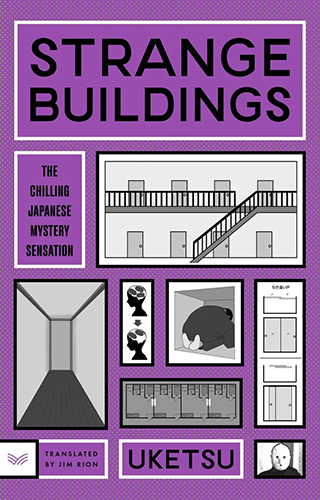
Strange Buildings, the 2023 follow-up to Uketsu’s smash hit Strange Houses, collects eleven illustrated stories about horror-themed architectural riddles followed by a lengthy exposition that reveals how these mysterious places are connected.
One of my favorite stories is “The Mousetrap House,” in which the wealthy heir to a large construction firm builds a luxurious mansion in order to kill a disabled elderly woman. If he puts a steep stairway next to the bathroom, he reasons, the woman will eventually lose her footing and tumble down the stairs.
When this eventuality fails to come to pass, he bullies his daughter into creating exactly the right set of conditions to make it happen. This horrible story is recounted decades later by the girl’s childhood friend, who was there on the night the old woman finally fell to her death.
I also enjoyed “The Watermill in the Woods,” which is presented as an old travelogue that recounts a curious building in the woods that’s nowhere near water. Its mechanical wheel instead powers the movement of an interior wall, but why would anyone need that?
This question is answered in the story “The House Where It Happened,” in which the frame narrator (who is styled as Uketsu himself) visits the old watermill in its current form as a remodeled modern house. When the village residents illuminate the shadows of the area’s history, the sinister purpose of the watermill becomes clear.
As in Uketsu’s other books, the overarching conspiracy is extremely silly. I don’t consider this a flaw, as there’s a certain sense of satisfaction in how delightfully outlandish the scenario is.
It should probably be said, however, that Uketsu is playing with acute cases of human misery as if they were Lego blocks. If one were to stage a gendered critique of this book, for instance, the ground is fertile. Still, I think it’s probably fair not to expect nuanced character portrayals from the weird architecture guy.
I enjoyed Strange Buildings, and I flew through this book as quickly as I could turn the pages. Jim Rion’s translation is compulsively readable, and I appreciate how Rion’s minor reconfigurations smooth over the “info dump” awkwardness of the original Japanese.
If you’ve never read Uketsu, Strange Buildings is a great introduction to the writer. If you’re already a fan, this is four hundred pages of the same, and it’s fantastic. Uketsu has found his niche, and it gives me joy to know that he’s out in the world being strange and living his best life.
Strange Houses is a four-part horror mystery novel about houses with strange and uncanny floor plans.
Each of the four chapters takes the form of a series of conversations between the narrator, their architect friend, and various people who have been involved with the houses. The first three chapters explore three different houses with extra rooms and inexplicable gaps in the walls. These explorations are liberally illustrated with diagrams in which certain sections of the floor plan are highlighted and annotated to clarify the text.
Each of these stories is like a locked room mystery. Over the course of the chapter, the narrator’s architect friend performs a close reading of a floor plan while gradually building a theory concerning what sort of upsetting behavior that type of strange space might enable.
In the final chapter, it’s revealed that these houses are connected to an old and wealthy family with a terrible secret. I have to admit that I found this situation highly improbable, so much so that it comes off as almost cartoonish. The author is great at architectural walkthroughs but skimps on the character development, which contributes to the conclusion of the book feeling somewhat hollow. Still, there’s a lot of fuel for the reader’s imagination, and fans of gothic horror will have a lot to play with here.
I flew through Strange Houses and loved every page. The speculative conversations between characters are easy to follow; and, thanks to the diagrams, the spaces are easy to visualize. I enjoyed the slow build of the overarching mystery, and the revelations about the bizarre family at the center of the strangeness were beyond anything I expected.
It’s worth noting that the first story in Strange Houses was originally written as a script for a twenty-minute video on YouTube, which you can find with English subtitles (here). There’s also a manga adaptation, which has been scanlated and is available to read (here). And finally, I’d like to share a more substantial review of the original Japanese book that was posted on one of my favorite blogs (here).
I tend to think that Uketsu’s earlier novel Strange Pictures (which I reviewed here) is somewhat more successful as a work of fiction with three-dimensional characters whose bad behavior stems from understandable motives. In comparison, Strange Houses feels more like a puzzle box than a novel. Strange Houses is less a character-driven story than it is an imaginative architectural mystery, but its eerie atmosphere and clever narrative structure make it a fascinating read for fans of speculative horror and uncanny design.
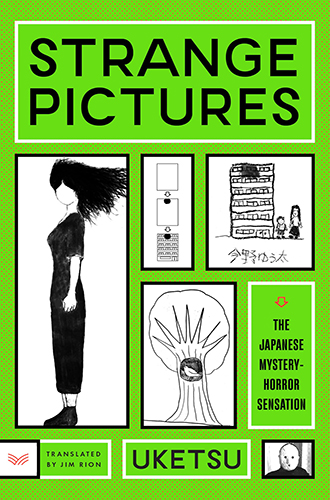
Strange Pictures is a compulsively readable horror mystery novel first published in 2022 by Uketsu, a mysterious masked YouTuber. This book is addictive, so much so that I accidentally spent an entire afternoon and evening reading it. So be warned – Strange Pictures is indeed strange, and it will hold you hostage.
In the five-page prelude that introduces the book’s premise, a psychology professor shows her class a photo of a picture drawn by a girl who killed her mother. The drawing is a childish self-portrait that shows the girl standing between her house and a tree. Although the picture seems completely normal at first, the professor zooms in on four small details that illuminate the girl’s inner state of mind. She makes the argument that, despite the abuse the girl suffered, she’s essentially a good person who never meant to hurt anyone. In retrospect, you can’t help but wonder how you didn’t notice these details of the drawing yourself.
This trick is an incredible sleight of hand. The same can be said of the following two chapters, both of which can be read as stand-alone short stories.
In the first chapter, “The Old Woman’s Prayer,” two college students in a small Paranormal Club discuss a curious blog they’ve found online. The blog is filled with cheerful observations of its writer’s everyday life. After a three-year hiatus, however, the blog closes with a mysterious post stating, “I can never forgive you.”
How did such a happy-go-lucky blog author arrive at such a mysterious statement? The five illustrations drawn by the author’s wife might just hold the key to the mystery. By themselves, they’re nothing special, but if you put them together in the right way…
The second chapter, “The Smudged Room,” features one of my favorite tropes, a creepy drawing made by a small child.
Five-year-old Yuta’s father recently passed away, and his preschool teacher is worried about the drawing he created for Mother’s Day. The picture shows a dark cloud hovering over the apartment building where Yuta lives with his mother, who is doing her best to care for Yuta with no family support. The matter comes to a crisis when Yuta suddenly disappears, and his teacher suspects that his mother may be keeping an unpleasant secret. What was Yuta trying to draw, exactly?
These two seemingly unrelated mysteries begin to coalesce in the third chapter, “The Art Teacher’s Final Drawing,” in which two sidelined newspaper employees become obsessed with the murder of a high school art teacher. The police dismissed the case due to a lack of evidence, but there is (of course) a drawing found in the teacher’s possession that was never fully analyzed. The younger reporter starts interviewing people who knew the teacher, thereby putting himself in grave danger.
Somewhere around the middle of this chapter, the story begins to strain credibility, but at this point I was fully invested and happy to be along for the ride. Uketsu has a gift for enabling the reader to suspend disbelief, and the Sherlock moment in the fourth and final chapter is incredible.
Strange Pictures is a bestselling cult hit in Japan and across Asia. I first heard about this book through word of mouth and read it in Japanese when it was first published. I was impressed by the clarity of Uketsu’s writing, which is simple and informative without being childish or condescending. Jim Rion has done an amazing job translating Uketsu’s distinctive style, with short declarative sentences pushing the reader forward at a brisk pace.
A large part of the mystery depends on the information that the narrative withholds from the reader, some of which is highly dependent on how Japanese works as a language. I’m impressed by how Rion manages to employ English to the same effect without the slightest trace of awkwardness. Reading Rion’s translation, I felt like I was encountering Uketsu’s story for the first time.
As long as you don’t mind losing a few hours to the addictive quality of the writing, I’d recommend Strange Pictures to anyone who enjoys puzzle box mysteries, creepy urban legends, and satisfying Sherlock Holmes style walkthroughs. I can’t overstate how much fun I had with this book, and I’m very much looking forward to Jim Rion’s upcoming translation of Uketsu’s debut novel, Strange Houses.
Rio Shimamoto’s 2018 novel First Love is a psychological mystery about a beautiful college student who has been arrested for the murder of her adoptive father. Although it tackles serious themes, this story is compulsively readable. All of the characters bring emotional baggage to the table, and Shimamoto teases out the reader’s sympathy as each of their histories is revealed.
Yuki Makabe is a clinical psychologist who specializes in parenting and childcare. She’s ambitious, and she’s on the verge of making a career transition to media appearances and popular audience articles. When Yuki’s brother-in-law, Kasho, is assigned to the high-profile case of Kanna Hijiriyama, a college student accused of killing her father, he asks Yuki to help him interview the young woman in order to ascertain her motive. Yuki’s prospective editor at a major publisher, a friendly young man named Tsuji, asks her to write about the case, so she agrees.
Yuki is happily married to an internationally famous photographer who supports her career by shouldering the majority of the responsibilities involved in the care of their son. Despite her loving relationship with her husband, Yuki has a troubled past with Kasho that neither of them is willing to discuss. While she and Tsuji work together on Kanna’s case, Yuki must navigate her strained relationship with Kasho, who is very charming but a bit of an asshole.
Kanna presents Yuki with another set of challenges. To begin with, Kanna can’t explain why she wanted to hurt her father, or even whether she intended to hurt him in the first place. But, if she never meant to attack him, what was she doing with a knife? To make matters more complicated, one of Kanna’s college boyfriends gives an interview to a tabloid magazine and says that Kanna went crazy after they broke up. Even Kanna’s own mother claims the young woman is crazy.
Yuki is convinced that Kanna is far from “crazy,” but the truth of the matter is elusive. Kanna is traumatized by the death of her father, and Yuki quickly realizes that the young woman’s trauma is much more extensive.
Based on the title of the novel and the relationship between Kanna and the person she may or may not have killed, a reader might suspect that there is underage incest involved. I hope I can be forgiven for spoiling the story by saying that, thankfully, this is not the case. Regardless, Kanna didn’t have a happy home life as a child.
I’m afraid that some readers may find Kanna frustrating, but her portrayal feels extremely realistic to me. I definitely knew people like this in high school and college. Generally speaking, these girls (and occasionally boys) were intelligent and competent, but they had a habit of saying whatever they needed to say to diffuse an awkward situation.
This behavior wasn’t “lying” or “being dishonest” so much as it was a manifestation of fawning, an alternative to the “fight or flight” response that’s common in young people who live in hostile home situations. Instead of fighting their parents or running away from home, “well-behaved” children and teenagers will contort their speech, emotions, and understanding of reality to ease tension. Issues often arise when this behavior carries over to romantic and professional relationships that would benefit from honesty.
Although this element of the story isn’t presented as a mystery to be solved, Yuki is confronted with the issue of whether Kanna truly consented to sex with two of the key romantic partners in her life. I can completely understand how the men involved might have understood Kanna’s words and behavior as expressing consent, but I also understand how Kanna could later admit that sex isn’t what she wanted, and that she was just going along with what was expected. As the author demonstrates, Kanna’s inability to understand her own boundaries is directly related to the emotional abuse she endured as a child.
Shimamoto doesn’t lean into an overtly feminist message, but there are multiple points in the story when Yuki comes into contact with the sort of ambient misogyny that might compel a vulnerable young person like Kanna to second-guess her own emotions and sense of self-worth. At the beginning of the novel, for example, Yuki reflects on a conversation between a male television producer and his younger female colleague that she overheard as she entered the studio.
As I was getting my makeup done, I examined my own features: not bad, but not particularly beautiful either. A face with no distinctive features. The only thing that stood out was my collarbone, protruding above my shirt.
I’d met that male producer several times previously, but he’d never once made eye contact with me. There were men like that everywhere in the television industry – men who wouldn’t engage in conversation with women they’d give less than an eight out of ten on looks. Men who thought nobody would notice this behavior. Or maybe they just thought it didn’t matter. These were men who had never suffered a single setback in their lives.
This is the sort of observation that, while eminently relatable to many people, would have Yuki called crazy if she spoke it out loud. It’s not “misogyny” or “sexism” if the male producer isn’t doing anything wrong, right? It’s not like he actually said anything offensive to Yuki, or to his younger colleague. This man’s behavior is rancid, but no one will ever call him out on it. Yuki has a supportive family and professional colleagues who aren’t human garbage, so she can cope. But what about Kanna, who hasn’t yet found a support network to replace her abusive family?
What Shimamoto criticizes in First Love are the gendered aspects of a social system that allows toxic men to flourish. First Love doesn’t offer easy solutions, but Shimamoto demonstrates that we can all be allies in pushing back.
Yuki’s husband is a prince from start to finish, and her editor Tsugi is able to see what happened to Kanna with clear eyes while re-evaluating his own perspective and never apologizing for the bad behavior of other men. Kanna’s defense lawyer Kasho has issues of his own due to childhood abuse at the hands of his mother, but he’s an adult who is capable of realizing his limitations – which is why he arranges for a series of meetings between Yuki and Kanna in the first place.
Without spoiling too much of the plot, First Love connects the stories of a number of characters who begin to question their past behavior in light of Kanna’s upcoming trial, and Shimamoto helps the reader to sympathize with these characters even when they behave badly. The point is not that men are evil or that women are innocent victims. Rather, it’s important to extend empathy instead of overlooking questionable behavior.
Putting the social relevance of the novel’s themes aside, First Love is a fun book to read. I got sucked into the story immediately. Like Yuki, I was instantly intrigued by the mystery presented by the death of Kanna’s father. Kasho’s defense argument during Kanna’s trial felt like a major revelation unfolding before my eyes, and I admire how carefully Shimamoto laid each brick in the wall. Louise Heal Kawai’s translation is featherlight and flawless and sets the tone perfectly.
I’d recommend First Love not just to fans of mystery and suspense, but to any reader interested in a compelling character drama that offers a number of different perspectives on family, mental health, and the darker aspects of everyday interactions that often go overlooked.
A young woman named Kiyose was recently promoted to the position of manager at an independent café. She devotes her love and attention to the business, but all is not well. One of her employees is a constant source of frustration, and she hasn’t spoken to her long-term boyfriend Matsuki since they had an argument about how Kiyose should handle the situation.
One day, Kiyose randomly gets a call from the hospital informing her that Matsuki is in a coma. The nurse in charge of his care informs her that she’s the closest thing he has to a next of kin, so she dutifully goes to confirm his identity. During her visit, Kiyose learns that Matsuki suffered a head injury sustained under mysterious circumstances, and his only other visitors are two unrelated people she’s never met.
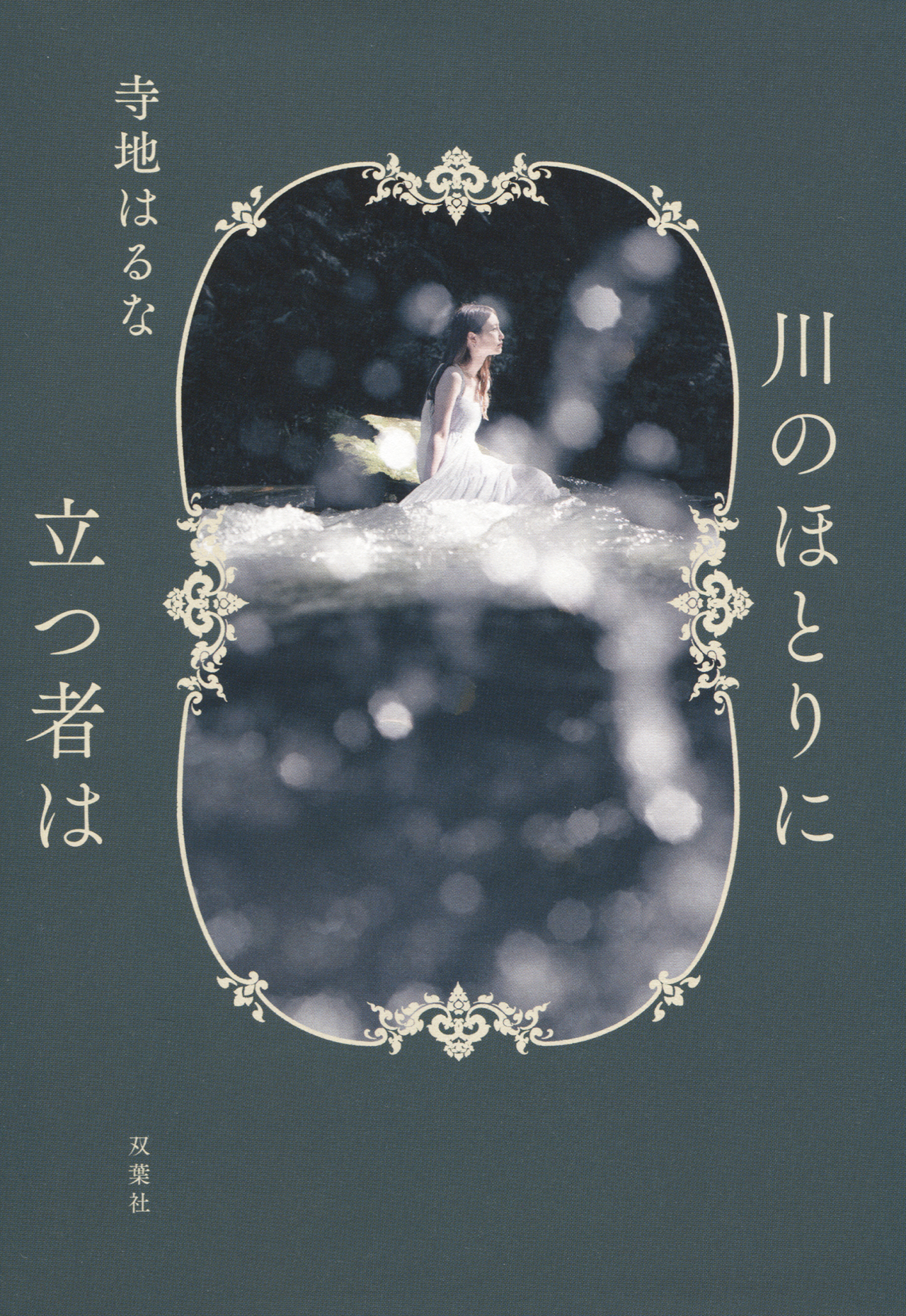
川のほとりに立つ者は initially seems as though it’s going to be a mystery about crime, but it’s actually a character drama about living with invisible disabilities, specifically ADHD and dyslexia. As Kiyose begins digging into Matsuki’s life, she learns that, despite being alienated from his uptight family of professional calligraphers, Matsuki was teaching an adult with dyslexia how to write so that he could pass letters to a woman trapped in an abusive housing situating.
The novel’s title is taken from the proverb 川のほとりに立つ者は水底に沈む石の数を知り得ない, “Those who stand on the river’s shore can never know the number of stones under the water.” After learning about the discrimination faced by Matsuki’s friend, however, Kiyose begins to understand how unfair it is to tell someone with a disability that they’re just being lazy and irresponsible. She realizes that she was being cruel to her employee, who had come out to her as having ADHD, and she resolves to make her café a more accessible and welcoming space while being kinder to the people in her life.
Although her work hasn’t yet been translated into English, Haruna Terachi is a prolific writer who has won a number of literary prizes since her debut in 2014. This is my first encounter with Terachi’s writing, and I enjoyed this short novel, especially the chapters that were narrated from Matsuki’s perspective. I also found it satisfying to watch the mysteries presented at the beginning of the story slowly unravel. That being said, I was unsatisfied with the novel’s conclusion that the solution to systemic discrimination falls on individuals, who simply need to “walk at the same pace” as people with disabilities.
Still, it’s always good to see sympathetic stories about disability – especially invisible disability – and I appreciate Terachi’s pushback against the toxic misconception that disabled people simply aren’t trying hard enough. Along with people interested in the experience of living with disability in contemporary Japan, I’d recommend this book to anyone looking for a fast-paced and wholesome character drama driven by hidden secrets brought to light.
Seichō Matsumoto’s Tokyo Express is a slim mystery novel from 1958 whose crime is largely dependent on train schedules. Although two apparent victims of suicide appear to have traveled together to a lonely seaside town, were they in fact being pursued…?
The officer assigned to the case, a young detective named Mihara, suspects the involvement of the president of an industrial manufacturer with close ties to the government. Mihara assumes that his prime suspect, an affable middle-aged gentleman named Yasuda, was attempting to cover up an illegal collusion.
As Mihara pursues various train schedules across the Japanese archipelago, he learns that Yasuda’s elaborate system of alibis checks out. But, if Yasuda didn’t murder the two victims, who could have been helping him?
For me, there were far too many timetables in Tokyo Express, and I found myself skimming to avoid getting bogged down in the numbers. No one in the story has much of a personality, and Mihara is mostly a cipher for the reader. Despite the plot’s emphasis on travel, the locations that Mihara visits don’t really have a sense of place or setting.
I’m given to understand that there are many mystery fans who appreciate this style of writing, namely, just the facts with little by way of atmospheric description. If you’re looking for a puzzle box in book form, Tokyo Express has a lot of fun moving parts to play with. If you read mysteries more for the story, however, it might be better to take a pass on this particular ride.
Strange Tale of Panorama Island
Japanese Title: パノラマ島奇談 (Panorama-tō kitan)
Author: Edogawa Ranpo (江戸川 乱歩)
Translator: Elaine Kazu Gerbert
Publication Year: 1927 (Japan); 2013 (United States)
Publisher: University of Hawai’i Press
Pages: 113
Strange Tale of Panorama Island is a short novel about murder, misdirected passion, and artistic delusion that climaxes with an explosive conclusion.
The story’s antihero, Hirosuke Hitomi, is a writer who is neither living his dream nor making a living. His life is horribly bleak until he receives news that a college friend named Genzaburō Komoda has passed away from a rare illness. Although Hirosuke was never close to Genzaburō, he knows that he was the sole heir of a wealthy family. He also knows that he resembled the recently deceased young man to such a strong degree that he could have been his doppelganger.
Hirosuke sees his chance, and he takes it. He fakes his death by leaping from a ship, an act interpreted as a suicide by the newspapers that report the event. He then disinters Genzaburō’s body, destroys it, and crawls to the Komoda family estate, claiming to have experienced a miraculous recovery. As Genzaburō, he blames his disorientation and seeming loss of memory on the trauma, knowing that the family’s doctors will be too embarrassed by their “mistake” to interrogate him.
Hirosuke is not content to live an easy life of luxury in the company of Genzaburō’s beautiful widow Chiyoko, however. Instead, he uses the vast wealth of the Komoda family to buy an island and fill it with aesthetic marvels, creating a sensualist utopia outfitted with near-future technology. The wonderland he names Panorama Island is both a museum of the fantastic and an amusement park for adults.
The short translator’s introduction explains the cultural context of the novel, specifically the public interest in panoramas during the 1920s in Japan, but none of this information is necessary to appreciate the marvelous imagery Edogawa dreams up to dazzle the reader as Hirosuke leads Genzaburō’s widow across the island. If Chiyoko knows Hirosuke’s secret, which she almost certainly does, what will become of her? Like Chiyoko, the reader can only be amazed by the island while disturbed by the troubled genius that created it.
Edogawa is interested, like his namesake Edgar Allan Poe, in the precise mechanics of how Hirosuke’s series of crimes might be possible. The novel contains a touch of the pulpy adventure story, as well as an earnest foray into the realm of medical science. Thankfully, the narrative never becomes mired in superfluous details, with most of the science remaining staunchly fiction. Hirosuke’s degeneration as a human being receives much more attention, as does his erotic and grotesque fascination with the confused and powerless widow of his former friend.
Although it’s published by a university press, Strange Tale of Panorama Island is a pleasure to read. The introduction and endnote sections are short, discrete, and quite interesting. If you’ve read and enjoyed any of the books in the Penguin Horror Classics series, including the handsome reprints of the work of Edgar Allan Poe and H.P. Lovecraft, you’ll more than likely have a lot of fun with Strange Tale of Panorama Island. The novel was originally written for a broad but intelligent audience, and it’s aged extremely well, partially thanks to the excellent translation.
I also want to recommend the manga adaptation drawn by Suehiro Maruo and published in English translation by Last Gasp Press. Maruo, a gekiga artist who has adapted numerous other works of dark mystery fiction, delights in the lurid imagery of the story, which he depicts with his signature detailed linework and bold panel compositions. Readers should be cautioned that, although this is a “classic” that’s taught in university classes, it is most definitely not safe for work.
The Aosawa Murders
Japanese Title: EUGENIA (ユージニア)
Author: Riku Onda (恩田 陸)
Translator: Alison Watts
Publication Year: 2005 (Japan); 2020 (United Kingdom)
Publisher: Bitter Lemon Press
Pages: 315
In 1973, in a small seaside town on the west coast of Japan, the prominent Aosawa family and their guests were poisoned with cyanide during a birthday party, an incident resulting in the death of seventeen people. Makiko Saiga, who was a child at the time, later interviewed people connected to the family for her senior thesis, which ended up becoming a true-crime bestseller titled The Forgotten Festival. Makiko never published another book and refused to give interviews, and the sole survivor of the Aosawa family, a young woman named Hisako, married and moved to the United States. When the man who delivered the poisoned alcohol to the party committed suicide, the police closed the case.
Thirty years after the incident, however, it becomes apparent that there may be more to the story. There are fourteen chapters in The Aosawa Murders, each narrated from the perspective of someone once connected to the Aosawa family or the publication of The Forgotten Festival. Makiko Saiga is polite yet evasive. Her research assistant knows that there are small departures from reality in her account but doesn’t know what to make of them. The detective who investigated the case is convinced that Hisako Aosawa is responsible for the murders but can’t quite prove it. Someone who knew the supposed culprit believes the young man was manipulated by a mysterious woman. A handful of other people, such as Makiko’s brother and the daughter of the Aosawa family’s housekeeper, offer additional intriguing anecdotes.
The Aosawa Murders is a slow burn. For the first two-thirds of the novel, the reader has no choice but to take each separate account as it comes while trying to pick out the connecting threads, which initially seem to be few and far between. The Aosawa Murders respects the intelligence of its reader by presenting information impartially and without cliffhangers, false leads, or red herrings. The circumstances surrounding the mystery are compelling enough to warrant sustained attention, but the carefully measured narrative pace allows the reader to take time with each account without being driven to rush forward.
When things begin to come together in the last hundred pages, the true brilliance of the story becomes apparent. The final two chapters focus on Hisako Aosawa (now Hisako Schmidt) and Makiko Saiga, and I couldn’t help but fall in love with both of them. After hearing so much about them from secondhand accounts, the down-to-earth reality of their actual personalities is refreshing. Regardless of what each of them may or may not have done, the author reminds us that both of these women are far more than archetypes in someone else’s story.
Although an astute reader will have formed several theories about what happened, the novel never presents a simple and neatly packaged explanation. The ending is fragmented and recounted in a jarring manner that serves as one of the strongest clues concerning the identity of the narrator who has presumably assembled the accounts that appear in the story. I can imagine that some people may find this sort of open-ended conclusion anticlimactic, but it was extremely satisfying to me.
I have to admit that I enjoy formulaic murder mysteries in which everything is neatly arranged and fits together perfectly at the end. The Aosawa Murders is not that type of story, however – not by a long shot. Instead, the novel is a sprawling puzzle that rewards the reader’s active attention and engagement. This is not a book that can be read in an afternoon. Thankfully, the strength of the writing and the quality of the translation encourage sustained reflection and speculation. I had an enormous amount of fun with The Aosawa Murders, and I would happily recommend it to anyone looking for an uncommon mystery written by a mature and confident storyteller.
To anyone concerned about such things, there is no overt violence, sexism, or misogyny in The Aosawa Murders. In addition, aside from a minor subplot involving a Buddhist priest, the story doesn’t contain any particularly “Japanese” elements, and it’s not necessary to be familiar with Japanese society or police procedure in order to fully appreciate the characters and plot. In fact, I think The Aosawa Murders would make an excellent addition to a reading list of contemporary international mystery fiction.
A review copy of this book was kindly provided by Bitter Lemon Press. The quality of the publication is excellent, and I’m thrilled and delighted that Riku Onda’s work has made such a stunning debut in English translation.
As his father is dying of pancreatic cancer, a young(ish) man named Ryosuke discovers a set of notebooks hidden in a box in his father’s study. The handwritten confession contained in the notebooks is shocking, and Ryosuke begins to suspect that the woman who raised him may not be his biological mother. Then again, a part of him has always known that something was strange ever since he was four years old, when his family moved from Tokyo to Nara while he was in the hospital. It may well be that Misako, the person he was told to call mother when he was brought home, replaced his real mother, especially if the woman who gave birth to him is the same person who has written something resembling a “murder diary” in the notebooks he’s found.
The woman who admits her darkest secrets in these notebooks knows that something is wrong with her. She has trouble empathizing with other people, and nothing in life brings her joy. When she discovers that witnessing a death makes her feel human, she can’t stop thinking about it, and she takes indirect action that results in the death of a young boy and one of her female classmates. Killing, she realizes, is her “Nan-Core,” something a doctor once told her parents that she was lacking and whose pronunciation she misremembered as a child. Her “Nan-Core” is what makes her feel alive, and she continues to search for opportunities to trigger it as she grows up, goes to college, and starts working at an office.
It’s not much of a spoiler to say that Misako, the woman who wrote the confessions in the notebooks, is indeed Ryosuke’s biological mother, and that the woman who called herself Misako as she raised him and his brother is a surrogate. Ryosuke wants to find out how and why this happened, and most readers will quickly come to the obvious conclusions, which are later confirmed by Ryosuke’s father. The most intriguing element of this family drama is what happened to the original Misako, whose fate remains a mystery until the very end of the novel.
As Ryosuke steals time during his father’s hospital visits to read Misako’s notebooks, a disturbing series of events plays out in his own life. Ryosuke runs a mountainside dog café called Shaggy Head, and he’s fallen in love with one of his employees, Chie. Chie was once a bar hostess, and she’s on the run from her abusive husband, who is in turn hounded by the yakuza. When Chie disappears into thin air, another of Ryosuke’s employees, Ms. Hosoya, takes it upon herself to find the missing woman, a decision that results in dangerous complications for everyone involved.
Despite all the murder and spousal abuse, Nan-Core tells a surprisingly gentle story. The novel’s focuses is mystery or violence, but rather the evolution of the relationships between the members of Ryosuke’s family as he and his brother learn more about their parents and begin to see them as people. Ryosuke also starts to develop a new sense of family as he develops stronger bonds with Chie and Ms. Hosoya. The secrets hidden within these relationships stem not from malice and neglect, but from attempts to do the right thing under difficult circumstances.
Even Misako is able to grow and change because of the kindness of the people who adopted her into their family. Her homicidal tendencies can be read as an attempt to form connections with other people despite extreme alienation, and some of her murders are even a bit gratifying. For example, why continue to deal with sexual harassment at work when you can just murder the creep who keeps bothering all the female employees? In the end, the gentle Ryosuke is able to borrow strength from his mother’s confessions; and, when his story finally intersects with hers, the result is extremely satisfying.
Nan-Core may at first seem to be a paper-thin mystery propelled by a cast of one-dimensional stereotypes, but the plot slowly thickens as layers are added to each character. The story can be melodramatic at times, and the lack of any real consequences resulting from the characters’ actions is a bit fanciful, but none of this detracts from the charm of the novel.
My only real complaint is that, given that Ryosuke manages a dog café, Nan-Core has an unfortunate lack of canine characters. Judging from its trailer (link), the 2017 cinematic adaptation of the book (link) doesn’t have any dogs either. This is a shame, because I think the story’s odd but intriguing blend of horror and romance could have been enhanced by more puppies. Honestly, probably everything could be enhanced by more puppies, but at least Nan-Core offers its readers a batch of warm and cuddly murderers.
My rating: 13/10, it would be an honor to be murdered be this family of cutie pies.
Title: Penance
Japanese Title: 贖罪 (Shokuzai)
Author: Kanae Minato (湊 かなえ)
Translator: Philip Gabriel
Publication Year: 2012 (Japan); 2017 (United States)
Publisher: Mulholland Books
Pages: 229
Fifteen years ago, in an unnamed rural town, a girl named Emily was raped and murdered. Although four of her friends saw the face of the man who tricked her into going off alone with him, he was never caught. Emily’s mother, driven half-crazy with grief, accused the four girls of being responsible for her daughter’s death, and they have all carried this burden with them into their adult lives. The statute of limitations on the murder is about to run out, yet its lingering effects have not yet faded. Is it possible that one of the surviving girls, now young women, holds a clue to solving the murder? If the murderer’s identity is revealed, will these women find peace, or is the cycle of violence impossible to halt?
The first four of Penance‘s five chapters are narrated from the perspectives of Emily’s friends, each of whom is haunted by the trauma of the incident.
The first narrator, Sae, is the girl who discovered Emily’s body, and the horror of what she saw has never been far from her mind. Of the four girls who survived, she’s been the most afraid that the killer will return, so she’s been determined to remain in the immature body of a child while keeping to herself and never dating. Not long after she’s hired by a firm in Tokyo, however, she’s presented with an offer of marriage she can’t refuse from a young man from her hometown. Although this man is too young to be the murderer, he possesses a significant and startling clue, and Sae comes to realize that he has a very good – and very creepy – reason for staying silent.
The second narrator, Maki, has become an elementary school teacher, and she’s recently found herself on national news after preventing a mentally ill young man from attacking her students. Far from being hailed as a hero, she is blamed for the young man’s death, and she does not deny that she took action to harm him. Addressing an assembly of parents, Maki explains what happened to her when she was a child, why she was able to act so quickly and decisively when threatened with violence, and why she bitterly regrets her behavior on the day that Emily died.
The third narrator, Akiko, is a precious human (I love her!) who sees herself as a “bear.” She has never moved out of her parents’ house, partially because of the trauma of Emily’s murder and partially because of outwardly imposed issues regarding her body image. “Boys have it easy,” she explains. “Even if they look like a bear they’re popular […] and being big isn’t a drawback the way it is for girls” (87). Akiko isn’t a shut-in, but she never went to high school and has since distanced herself from society. She now spends her days sleeping, helping her mother around the house, and working out. When her brother Koji gets married, she finds herself gradually being drawn out of her shell and becoming friends with her new sister-in-law’s child from a previous marriage, Wakaba. Wakaba’s mother Haruka has a dark past, however, and even the innocent and sweet-tempered Akiko senses that something isn’t quite right with the new family. She ends up becoming involved in their drama by accident, and disastrous consequences ensue.
The fourth narrator, Yuka, has lived her life in the shadow of her older sister, who was diagnosed with asthma at a young age. The older sister was doted on by their mother, while Yuka became the scapegoat for her mother’s frustrations. After Yuka indirectly witnessed Emily’s death, her mother began to alienate her even more, and Yuka has grown up feeling that she should have been the girl who died. Nevertheless, she has managed to achieve a modest amount of success in her life, but her resentment toward her sister has inspired her to enact a complicated plan of revenge. This brings her to the attention of the murderer, as well as Emily’s mother, who knows far more about why her daughter was killed than she has ever revealed to anyone.
The fifth narrator should perhaps remain a mystery for readers to discover for themselves. It seems as if this person will be able tie everything together… but then she doesn’t, not at all.
Penance had me enthralled from beginning to end. Although the story contains many mysteries, the identity of the murderer begins to feel irrelevant and inconsequential as the deeper tragedies of the narrators’ lives slowly unfold. The novel is are firmly grounded in contemporary Japanese society, but the characters’ anxieties are universally relatable. Penance has a lot to say about what it feels like to be an outsider, and what it feels like to live in fear of physical and social violence, and what it feels like to have difficulty communicating with the people who are close to you.
Penance is not a novel about vulnerability, however; it’s a story of resilience. It’s also a story about a group of women who learn where their breaking points lie and then purposefully put themselves into situations that trigger them to take action. By the end of the book, the narrators share more than one murder, and the loose conspiracy that arises between them is a beautiful development fashioned from intricate plot details. The strength of Kanae Minato’s writing is in her compassionate portrayal of her psychologically damaged yet intensely sympathetic characters, but that doesn’t get in her way of creating a compelling and suspenseful mystery in this brilliant literary thriller.




 Contemporary Japanese Literature