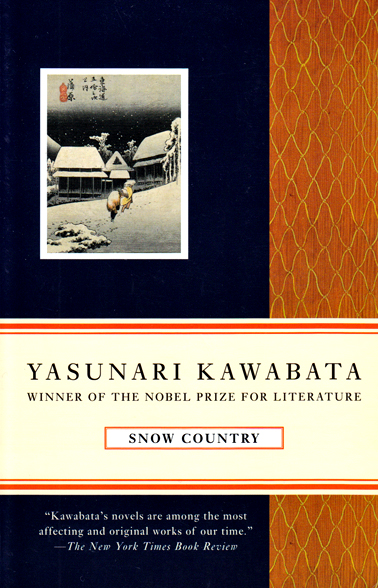
Snow Country

Title: Snow Country
Japanese Title: 雪国 (Yukiguni)
Author: Kawabata Yasunari (川端 康成)
Translator: Edward G. Seidensticker
Publication Year: 1956 (America); 1947 (Japan)
Publisher: Vintage International
Pages: 175

Snow Country won the Nobel Prize for Literature in 1968, a year which serves as a convenient temporal marker for the changing perception of Japan in the collective consciousness of the Western world. The postwar American occupation of Japan had ended fifteen years prior, and many of the American G.I. officers returned home from the country with the knowledge and motivation to create Japanese Studies departments in American universities like Columbia and Harvard. With their classes and translations came a new respect for the Japan of the twentieth century among academic circles. Meanwhile, Japan itself had risen from the ashes of wartime devastation and had begun to enter an era of double-digit GNP growth. The city of Tokyo had hosted the Summer Olympics in 1964; and, with the ultra-modern Tokyo Dome stadium and high speed bullet train between Tokyo and Kyoto, Japan was able to prove itself the technological and economic equal of any country in the world. The Nobel Committee thus awarded its literary prize to Kawabata for reasons that were partially political, as they would to many candidates over the following four decades. As with these other laureates, however, Kawabata did not win the world’s foremost award for literary distinction for political reasons alone.

According to academic lore, Kawabata’s candidacy was largely a result of Edward Seidensticker’s translation of Snow Country. Snow Country is an aesthetically magnificent book, and Seidensticker was able to do justice to Kawabata’s subtle and poetically resonant prose with his English translation. We are of course lucky that Seidensticker’s translation is so masterful; but, even if it had been merely adequate, the relatively early introduction of a translation into English would still have gained Kawabata a prominent position in the field of international literature. American and European prose writers and poets had cultivated a love affair with haiku and the Japanese aesthetic principals often associated with Zen Buddhism, and Snow Country delivered such “Japanese” sensibilities by the bucket load. In many contemporary reviews of the novel, Kawabata’s prose is repeatedly praised as being delicate and “haiku-like.”

As a prominent member of a literary group called the “New Sensationalist School” (新感覚派), Kawabata was interested in representing the various sensory stimuli of modern life in his writing. Earlier in his career, this interest lead to novels such as The Scarlet Gang of Asakusa, a loosely-structured work that pulls together various bits of urban ephemera, such as newspaper articles, playbills, advertising posters, and overheard conversations. In Snow Country, however, Kawabata turns his keen gaze on a small mountain village in the “snow country” of Niigata prefecture, a region on the west side of the Japan Alps that is referred to as such due to its heavy winter precipitation. Along with luxuriant snowfall, the words “snow country” conjure up images of ski vacations, deliciously warm hot springs, high-quality saké brewed with snowmelt runoff waters, and small, traditional inns catering to all of the fall and winter tourists. To men of a certain generation, the snow country is also associated with the geisha who service these tourists. Unlike the artistically skilled geisha of urban areas such as Kyoto, these “hot springs geisha” are known for using their minimal training in music and dance as a cover for more intimate performances.

Snow Country is about a man named Shimamura who travels to the snow country to meet a hot springs geisha named Komako. The novel begins during Shimamura’s second trip to Niigata as his train emerges from a mountain tunnel into the open air:

The train came out of the long tunnel into the snow country. The earth lay white under the night sky.

This is one of the most famous opening passages in Japanese literature. In the original language, when Shimamura’s train emerges from the long tunnel, he crosses a kokkyō (国境), or a border between countries, and, as he does so, “the bottom of the night becomes white” (yoru no soko ga shiroku natta). It is such terse and powerful descriptions that American critics have described as “haiku-like,” thus connecting Kawabata with premodern poets such as Bashō and Issa.

As I mentioned earlier, however, Kawabata’s New Sensationalist School was interested in describing the sensations of the modern era – thus the emphasis on “New.” Premodern poetry was no longer enough to describe the modern landscape, even in a place like the snow country. The New Sensationalists thus incorporated the methods of photography and cinematography into their writing. For example, while Shimamura is still on the train going deeper into the snow country, he watches the image of a woman reflected on the surface of his window.

In the depths of the mirror the evening landscape moved by, the mirror and the reflected figures like motion pictures superimposed one on the other. The figures and the background were unrelated, and yet the figures, transparent and intangible, and the background, dim in the gathering darkness, melted together into a sort of symbolic world not of this world. Particularly when a light out in the mountains shone in the center of the girl’s face, Shimamura felt his chest rise at the inexpressible beauty of it.

Not only is Kawabata referencing movies directly both in his description of the scene and in his play on light and mirrors and unreal images, but he’s also obliquely referencing the modern state of being overwhelmed with sensory input. On another level, by having Shimamura watch himself watching the reflection of a woman instead of directly addressing her, Kawabata hints at the fractured nature of the modern self, which, despite having finally developed a modern ego, is now mediated through various technologies. It would take some time to fully unpack this passage, but what I am trying to get at is that, instead of thinking of Kawabata as the successor to some mystical Zen poetic tradition, it’s useful to understand the author as looking through the modern lens of a camera, both in his still frames and in his tracking shots.

If a haiku is supposed to capture the “thusness” of a single moment, for instance, Kawabata instead uses his descriptive passages in the way that a movie director might use an establishing shot, namely, to suggest things about his characters that can’t otherwise be established in the absence of devices like narratorial exposition. In showing the reader an image of the house where the geisha Komako lives, Kawabata is essentially showing us Komako herself:

To the right was a small field, and to the left persimmon trees stood along the wall that marked off the neighboring plot. There seemed to be a flower garden in front of the house, and red carp were swimming in the little lotus pond. The ice had been broken away and lay piled along the bank. The house was old and decayed, like the pitted trunk of a persimmon. There were patches of snow on the roof, the rafters of which sagged to draw a wavy line at the eaves.

What the reader is supposed to understand from this description, especially as it is combined with Komako’s behavior and dialog, is that, although Komako tries to be bright and cheerful, there is something about her that is wasted and neglected as a hot springs geisha out in the rural snow country. Such a passage might indeed be “haiku-like” – but, then again, it is also intensely cinematic.

In Snow Country, Kawabata is writing about “traditional” Japan using “traditional” nature imagery, but he is also fully aware of the modern world and its literary devices, which include notions of dramatic structure, character psychology, and withholding information from the reader in order to force her to draw her own connections. It goes without saying that Kawabata was familiar with the canon of premodern Buddhist poetry, but he was equally familiar with the great novels of English, French, and Russian literature, as well as the cinematic auteurs of the early twentieth century.

It is also interesting to note that the majority of Snow Country was serialized between 1937 and 1941, a period of time in which writers, artists, and other intellectuals were indiscriminately jailed if they expressed even a hint of dissatisfaction with the fascist regime. By writing about geisha in the snow country, Kawabata could escape the attention of government censors. Yet, by not writing about the war – not a single mention of the Japanese state and its military action appears in the novel – Kawabata is, in a sense, resisting it by turning his back on it. Furthermore, when Japan does appear by association in the novel, it is not a healthy country. Shimamura, the modern dilettante who writes essays about Western ballet (which he has never actually seen), possess both wealth and power but refuses to do anything useful with it. Komako, an intelligent and essentially kind-hearted young woman with a glimmer of undeveloped talent, is pushed from male patron to male patron while rotting away in the heart of “traditional” Japan. Although Snow Country is unarguably an extraordinarily beautiful novel, its themes of waste and the contrast between hardship and indolence can be seen as a veiled commentary on the state of the nation during the opening years of the Pacific War, which director Toyoda Shirō subtly yet unmistakably drew out in his 1957 film version of the novel.

I think Snow Country is a fascinating novel. To dismiss it as a vaguely misogynistic, somehow Zen-like pastiche of auto-Orientalizing imagery is to do it a disservice. After all, Kawabata won the Nobel Prize for a reason. Snow Country is a pleasure to read, and it’s a pleasure to think about and discuss, which is probably the reason it’s assigned so often in “world literature” classes. As with all modern and contemporary Japanese literature, however, I have to insist that Snow Country be read as “literature” before it is read as “Japanese.”

Kusamakura

Title: Kusamakura
Japanese Title: 草枕 (Kusamakura)
Author: Natsume Sōseki (夏目漱石)
Translator: Meredith McKinney
Publication Year: 1906 (Japan); 2008 (America)
Publisher: Penguin Classics
Pages: 152

I don’t know whether it’s the tasteful covers, the velvety paper, the typeface, or the footnotes, but I love Penguin Classics. And I love it that they’re commissioning and publishing new translations of Japanese literature. Immediately before Kusamakura, I read the new Penguin translation of The Pillow Book of Sei Shōnagon, also translated by Meredith McKinney. This is probably not something someone who makes her business studying literature should say, but sometimes the publishing quality of a book makes all the difference for one’s enjoyment. A short but helpful and non-pretentious introduction, cogent yet unobtrusive footnotes, and a fluid and readable translation make texts like Kusamakura so much more worth reading in my eyes. I feel extraordinarily grateful to both Penguin and McKinney for the vast improvement they have made over the outdated Tuttle publications.

Aside from the cosmetic changes, what makes this new translation of Kusamakura worth reading? It is, quite simply, an intensely beautiful book. To put it in a different way, it is an aesthetically pleasing book about aesthetics. Many foreigners could be accused to coming to Japan while chasing a Japan fantasy; Kusamakura is Sōseki’s pursuit of this same Japan fantasy.

A nameless flâneur who styles himself as an artist escapes the harsh words (“fart counting”) of his critics in Tokyo by journeying to a small mountain hot springs village called Nakoi. There he observes the local culture and flora while casually interacting with the daughter of the owner of his inn, the abbot of the local temple, and a few other colorful characters. All the while, the narrator muses on art, poetry, and life. He references Chinese poets like Wang Wei and Tao Yuanming, Nō plays like Takasago and Hagoromo, and Japanese artists like Nagasawa Rosetsu and Maruyama Ōkyo while still sneaking in references to John Everett Millais’s painting Ophelia and Gotthold Lessing’s essay Laocoön. All this seems far removed from the military conflicts brewing with Russia and China on the mainland, and the modernity of crowded urban spaces, bustling public life, and anonymous train stations is kept at bay until the end of the novel, when the monk nephew of the inn’s owner is shipped away to war.

I did not read deeply into Kusamakura, but rather took it at face value as a testament to the nostalgia Sōseki must have felt for the old Japanese way of life, which was still preserved in isolated rural areas but vanishing quickly from the cultural landscape. Of course Sōseki does treat his narrator with a small degree of irony and invites his readers to laugh at him as well as sympathize with him, and of course traces of nationalist discourse can be found in this supposedly anti-modernist work, but I feel that the pleasure of this short novel lies in its descriptions of a beautiful mountain village and its vivid portraits of quaint rural characters.

To illustrate the allure of Sōseki’s Japan fantasy, I would like to offer a passage in which the narrator relaxes in the bath….

Chill autumn fog, a spring’s mist serenely trailing fingers, and the blue smoke that rises as the evening meal is cooked – all deliver up to the heavens the transient form of our ephemeral self. Each touches us in a different way. But only when I am wrapped, naked, by these soft spring clouds of evening steam, as now, do I feel I could well become someone from a past age. The steam envelops me but not so densely that the visible world is lost to view; neither is it a mere thin, silken swath that, were it to be whipped away, would reveal me as a normal naked mortal of this world. My face is hidden within voluminous layers of veiling steam that swirl all around me, burying me deep within its warm rainbows. I have heard the expression “drunk on wine” but never “drunk on vapors.” If such an expression existed, of course, it could not apply to mist and would be too heady to apply to haze. This phrase would seem fully applicable only to this fog of steam, with the necessary addition of the descriptive “spring evening.”

Kokoro

Kokoro

Title: Kokoro
Japanese Title: こゝろ
Author: Natsume Sōseki (夏目漱石)
Translator: Edwin McClellan
Publication Year: 1957 (America); 1914 (Japan)
Publisher: Regency Publishing
Pages: 248

When I first started studying Japanese literature in college, Natsume Sōseki’s Kokoro was one of the first modern novels I read. I remember being disappointed and a bit confused by it, however. Sōseki is one of the major figures in the Japanese literary canon, if not in fact the major figure. His early novel Botchan (坊っちゃん, 1905, recently translated by Joel Cohn) has been required reading for generations of Japanese schoolchildren, and his portrait used to grace the one thousand yen bill. A quick search on Google will turn up numerous syllabi for courses in Japanese literature that all begin with Kokoro. In short, this novel is kind of a big deal.

So why then, when I first read it, was I so disappointed? In short, I couldn’t help thinking, “Is this it?” Kokoro contains few lyrical passages, few descriptions of landscape, season, architecture, interior, or dress. Perhaps as a result, there is also no overt or sustained system of imagery. No light, no sound, no water, no heat. Of course I am exaggerating a bit (there are two memorable passages that occur in a tree nursery and by the seashore, respectively), but this novel boasts none of the opulent attention to detail that, in my mind at least, characterizes a great deal of Japanese literature.

There is also very little plot. The novel is divided into three sections. The first, “Sensei and I,” details the meeting and deepening friendship between an unnamed narrator (“Watakushi”) and an older man who he calls “Sensei.” In the second section, “My Parents and I,” the narrator has graduated from college in Tokyo and returns to his home in the countryside to be with his dying father. The third section, “Sensei and His Testament,” consists of a letter that Sensei has sent the protagonist explaining his past, his melancholy, and his decision to commit suicide after the death of the Meiji emperor. Kokoro ends with the conclusion of Sensei’s letter, and the reader is given no indication as to whether the narrator of the first two sections is able to make it to Tokyo in time to save Sensei or whether his father dies during his absence.

Although every single character in the novel is otherwise fully fleshed out as a believable human being, none of them seem to reflect archetypes familiar to a Western reader. In fact, Kokoro offers very little in terms of allusions and therefore might tend to come off as a bit shallow and one dimensional. Sure, there are some topical references to the death of the Meiji Emperor and the death of General Nogi, who committed suicide to “follow his master” out of an anachronistic sense of honor, but I wonder how deeply the reader is supposed to consider these references. The theme of the passing of an age is intriguing, but far from fully developed in the novel.

So why this novel one of the great classics of Japanese literature? Although I was frustrated the first time I read it, I think I am finally beginning to understand its appeal. Much of the literary writing in the Meiji period (1868-1912), such as Tayama Katai’s “The Quilt” (布団, 1907) and Shimazaki Tōson’s Broken Commandment (破壊, 1906), was concerned with the literary philosophy of Naturalism, which in Japan took the form of an attempt to realistically depict the psychology of a modern individual. The narrative style of such works was often stilted and noticeably stylized (despite their claims of realism). To me, Kokoro is an amazing work in that the narrative style actually feels quite “natural” in a Western way; at no point is the reader made aware of the fact that he or she is reading a novel. In other words, Sōseki was able to take the Japanese language and the concept of Japanese literature and do with them something that no one had done before.

What will appeal to the reader, then, are passages that a first time reader (such as myself in college) might not notice simply because they are so natural. When the narrator returns to his parents’ home, for example, he remarks that coming home from school is nice for the first week or two, but then the novelty wears off both for the student, who misses his friends, and for the parents, who begin to nag him. I couldn’t help smiling a bit when I read this. Moreover, the tragic past revealed by Sensei is his letter is believable but also, perhaps because it is so low-key, quite heart-wrenching. I feel that takes a master writer to avoid melodrama when working with such material, and Sōseki handles his subject matter beautifully.

All in all, Kokoro is worth reading not merely because it is a monument of Japanese literature but because of the sheer quality of the writing (and McClellan’s excellent translation). In any case, I found it very satisfying, and I’m glad I re-read it.

Palm-of-the-Hand Stories

Palm-of-the-Hand Stories

Title: Palm-of-the-Hand Stories
Japanese Title: 掌の小説
Author: Yasunari Kawabata (川端康成; Kawabata Yasunari)
Translators: Lane Dunlop and J. Martin Holman
Publication Year: 1988 (America)
Pages: 259

This book gathers Nobel Prize winning author Kawabata’s famous short shorts, or “palm of the hand (tenohira) stories.” These stories average about two and a half pages each, although some are a little longer, and some are much shorter. Most of these stories deal with the intricacies of male-female relationships, dreams, and fragmented memories of childhood. Even though some of the stories have a bittersweet sentimentality, Kawabata’s style is mainly realistic, especially in his portrayal of relationships crippled by words left unsaid and small, but meaningful, actions.

Some of Kawabata’s short stories are lyrical in their depictions of time, place, and nature, but many strike the reader as small mysteries to be pondered and unlocked. Who said what to whom? What significance did that have? Why would this person do that? What exactly is the relationship between these characters? The extreme brevity of these stories boils down life stories into a few irreversible moments and leaves the reader to read between the lines. This aspects of the works is rewarding but can be occasionally frustrating.

These stories were written over a period spanning between 1923 and 1972. Read individually, they can be unsatisfying; but, if the reader reads one story after another in a smooth, unbroken stream, the major themes and concerns of Kawabata’s career begin to gain a greater clarity, and the stories meld seamlessly into a greater whole.

I have read several of these stories in Japanese, as they are quite famous, and I have found that the translations are not only accurate but successfully convey the tone of the originals. The stories translated by Lane Dunlop (Shiga Naoya’s The Paper Door and Other Stories) tend to be a bit dry, but they are balanced nicely by Holman’s more experimental style.