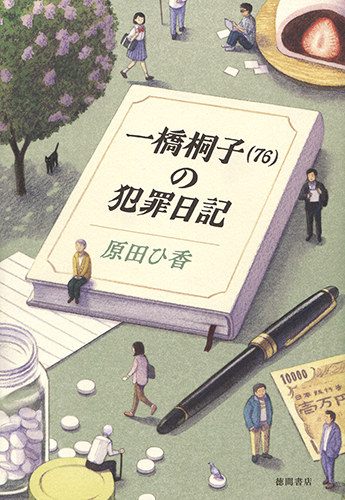
一橋桐子の犯罪日記

Hika Harada’s 2020 novel Hitotsubashi Kiriko (76) no hanzai nikki, which I’ll refer to as “Kiriko’s Crime Diary,” is the story of the eponymous Kiriko Hitotsubashi, who has found herself alone and in trouble at age 76. After her closest friend dies and her life savings are stolen, Kiriko decides that her best option is to spend her remaining years in prison. The only problem is that, before she goes to prison, Kiriko first needs to commit a crime.

Kiriko has been single all her life, but she jumps at the chance to share a house with her best friend Tomo, whose husband has died of a heart attack. Unfortunately, after two years of friendly companionship, Tomo dies of cancer, and Kiriko’s signature seal, bank passbook, and account holdings are stolen by a young man who asks to enter her house to pay respects to Tomo’s memorial. To add insult to injury, Tomo’s two sons treat Kiriko like garbage as they remove the furniture and cookware she shared with Tomo from her house.

Kiriko is left destitute, and she’s forced to use the last bit of money she has left to rent a subsidized apartment in a privately owned building for the elderly. She can barely afford groceries, and her new neighbors are difficult and unpleasant. Despite her age, Kiriko is as healthy as a horse, and she doesn’t seem to be in any danger of dying soon. She decides that being in prison would be preferable to becoming homeless, so she resolves to live a life of crime.

For the most part, Kiriko’s Crime Diary is a comedy that follows a sweet-natured and sensible woman as she does her best to get arrested. Kiriko has standards, and she doesn’t want to commit any sort of crime that might cause actual harm. She tries shoplifting from a chain grocery store, counterfeiting money with a convenience store photocopier, and scouting targets for a dubiously legal moneylender – all to no avail.

Over the course of her attempts to solicit advice regarding how to commit a crime, Kiriko ends up befriending all sorts of people, from the owner of the office building where she works as a janitor to a high school girl who volunteers to be kidnapped to punish her negligent parents. Between one thing and another, Kiriko ends up attracting the attention of a semi-retired yakuza boss, who uses intermediaries to contact Kiriko before finally meeting her in person.

One of the major subplots of the novel involves a man around Kiriko’s age who becomes entrapped in an elaborate “marriage scam” by a younger woman who drains his finances and then disappears. The man is crushed by disappointment, and the members of the poetry club Kiriko once attended with her friend Tomo have to band together to figure out how to help him. Along with Kiriko’s own troubles, this episode highlights the lack of a social safety net for many elderly people in Japan.

The theme of elder precarity becomes especially critical with the approach of Kiriko’s 77th birthday, which marks the start of her formal age of retirement. The janitorial company that employs Kiriko forces her to quit, depriving her of her only means of supporting herself. If Kiriko has no job and no one to serve as a guarantor for her rental contract, what is she supposed to do, exactly? Is her only recourse to start working with the yakuza?

Thankfully, Kiriko’s Crime Diary has a happy ending. All of Kiriko’s friends show up during a climactic scene to offer support and advocacy, and Tomo’s daughters-in-law apologize for the way she was treated by her late friend’s sons. All the loose ends are neatly tied, and Kiriko might even get to have a lovely winter romance with the handsome yakuza boss. I usually shy away from this sort of sentimentality, but why shouldn’t Kiriko have the best of all possible endings?

When I was working on one of my dissertation chapters about Natsuo Kirino’s gritty crime novel Grotesque, one of my readers asked me why Kirino’s characters all have to be so miserable. That was a fair question, and my answer was something along the lines that Kirino’s novels express the reality of the despair faced by many older adult women who find themselves completely devalued by society.

While I still believe that the tonal bleakness of Kirino’s style of critique is necessary and important, I also think that the happy ending of Kiriko’s Crime Diary is a welcome counterpoint. What Harada archives through this gentle comedy is to model one possible solution to elder precarity. Namely, if the neoliberal Japanese state is so utterly useless in providing social welfare, people must aggressively resist twentieth-century social conventions to form communities for mutual aid.

This support benefits not just elderly people, but also multigenerational networks. As much as Kiriko gains from her friendships with the owner of the building she cleans and the teenage girl she “kidnaps,” these characters also benefit from having Kiriko in their lives. It would be a shame, Harada suggests, not to have at least one friend like Kiriko.

Relearning how to make friends while relying on the kindness of strangers isn’t going to be a feasible solution for everyone, of course, but it’s a damn sight better than going to prison. And, if someone like Kiriko is considering prison, what are we even doing as a society? Even with a marvelously happy ending, Kiriko’s Crime Diary offers a social and political critique that’s difficult for even the most conservative reader not to agree with.

Hika Harada has enjoyed a productive career, and she’s won numerous awards for her fiction and screenplays. It’s no surprise that Kiriko’s Crime Diary was a bestseller that has found a place on all sorts of recommendation lists. This story will definitely appeal to readers outside of Japan, and it’s perfect for the same readership that enjoyed Killers of a Certain Age (which is fantastic, by the way).

Harada’s novel Dinner at the Night Library is going to be released in English translation in September 2025, and I’m looking forward to reading it. Kiriko’s Crime Diary is a genuinely fun and charming story, and I’d love to see it appear in translation too.

薬指の標本

Yōko Ogawa’s 1994 book Kusuriyubi no Hyōhon (薬指の標本) brings together two novellas that feel spiritually akin to The Memory Police, which was originally published in the same year. Like The Memory Police, the two novellas in Kusuruyubi no Hyōhon are set in a seemingly normal world haunted by a sense that something important has vanished. These stories are about ordinary people who come into contact with pockets of magic whose mundanity belies their deep strangeness.

The narrator of the first story, Kusuriyubi no Hyōhon, has moved to the suburbs after losing a portion of her ring finger in an industrial accident. While walking through the neighborhood, she encounters a handwritten “help wanted” sign taped to the front door of a “specimen museum” (標本室) operating in a building that once served as a dormitory during the postwar period. With no connections and no other job prospects, the young woman interviews for and accepts a position as a receptionist.

It’s not entirely clear what exactly the museum’s “specimens” are, and their method of manufacture is a mystery. Regardless, anyone is welcome to bring an object representing a traumatic experience to the museum, where it will be registered, cataloged, and preserved. Through each object’s transformation into a specimen, the pain of its associated memories disappears.

The narrator becomes the focus of the intense gaze and possessive interest of the artist who creates these specimens. Though she loves him, he forbids her to enter his underground workshop. Given the apparent disappearance of the people who requested that specimens be made from parts of their own bodies, the narrator can’t help but wonder what would happen if she entered the artist’s forbidden underground chamber and asked him to work his magic on what remains of her severed ring finger.

The narrator of the second story, Rokkakkei no Kobeya (六角形の小部屋), is a nurse at a large hospital where she recently ended a serious relationship with one of the doctors. She becomes fascinated by two middle-aged women she encounters in the locker room of a local sports club; and, with little else to occupy herself during the long winter evenings, she trails them to a semi-abandoned danchi housing complex.

One of these women, Midori, operates an odd service in the former apartment manager’s office. The “Katari Kobeya” (語り小部屋) is a small, self-contained room with six soundproof walls. Anyone who enters this room can speak to their heart’s content, thereby relieving themselves of the psychological burden of their secrets.

The narrator has no secrets to speak of, but she becomes friendly with Midori and her handsome son. In order for the magic of the Katari Kobeya to remain effective, however, it can’t remain in one place for long. If the narrator comes too close to this strange liminal space, she runs the risk of another heartbreak.

In her monograph The Pleasures of Metamorphosis, Lucy Fraser describes Ogawa’s stories as having a fairytale-like quality, and this is certainly true of the two novellas in this book. In Rokkakkei no Kobeya, the narrator follows two women through the trees of a snowy park at night and thereby finds herself in a warm and comforting sanctuary that can be found only by those in need. Meanwhile, Kusuriyubi no Hyōhon has echoes of Bluebeard, with an older man forbidding an inexperienced young woman from entering a special room in his gothic mansion.

In addition to the subtle inclusion of fairytale tropes, the ethereal quality of Ogawa’s writing is partially due to what Elena Giannoulis, in her article “The Encoding of Emotions in Ogawa Yōko’s Works,” calls the writer’s “mood tableaux.” Giannoulis argues that Ogawa generally doesn’t reveal much below the surface of her characters’ placid demeanors, nor do her characters go out of their way to offer psychologically perceptive commentary on the world around them. Instead, Ogawa creates a “mood” by describing what the narrator perceives with their senses. By thus crafting a vivid picture of a setting unimpeded by value judgments, Ogawa invites the reader to associate their own feelings with the cinematic tableaux they see in their mind’s eye.

Giannoulis’s argument makes perfect sense to me, especially in relation to Kusuriyubi no Hyōhon. I find the texture of Ogawa’s writing to be similar to the visual style of Hirokazu Kore’eda, who allows the camera to linger on the small details of his characters’ environment while the characters themselves remain silent. These settings tend to be mundane in the extreme, and Kore’eda luxuriates in the interiors of older structures that have become dirty and dilapidated. As in Kore’eda’s films, the combination of nostalgia and neglect lends a subtle touch of pathos to the quiet drama of Ogawa’s stories.

Kusuriyubi no Hyōhon is a meditation not on what has vanished, necessarily, but rather on what remains behind. In these two novellas, Ogawa speaks to the dignity of people, places, and objects that are in danger of being forgotten. No one would notice if anything in Ogawa’s stories disappeared – but she has noticed, and now the reader has noticed, too. Still, though there’s a certain tonal warmth and narrative coziness to Kusuriyubi no Hyōhon, Ogawa never allows the reader to relax. As in any fairytale, there’s always a sense of danger, as well as the intriguing strangeness of half-remembered liminal spaces.

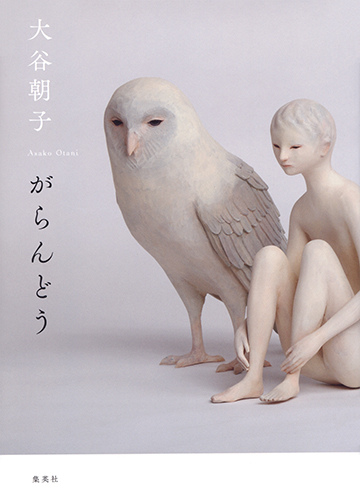
がらんどう

Asako Ōtani’s novella Garandō (がらんどう), which won the 46th Subaru Literary Prize in 2023, follows two 40yo women as they settle into a cozy life as adult flatmates.

Hirai recently moved in with her friend Suganuma, who suggested that they live together so they can afford a nicer apartment. The two women met as adults through their shared fandom of the boy band KI Dash, and they managed to remain friends during the pandemic despite drifting away from their other friends and family members.   

Hirai works in an office, while Suganuma is a self-employed artist who uses a 3D printer to create custom memorial figurines of her clients’ deceased pets. The two women share chores and meals, sometimes cooking for each other and sometimes going out to eat. Although they’re not romantically involved, they often fall asleep together in the living room while watching KI Dash performances on DVDs that they play on an old PlayStation 2.

When Suganuma’s star idol suddenly marries an adult video actress, Hirai takes her flatmate to the beach for a breakup vacation. Afterward, Suganuma begins dating a married man she met at the hotel bar. Hirai is jealous but understands that this is simply the way of the world.

In resignation, Hirai signs up for a dating app, but this goes poorly. Her lack of success is partially because she’s aggressively targeted by someone involved in a multi-level marketing scam, but it’s mostly because Hirai is about as asexual and aromantic as someone can be. She has a vague aspiration of having a child one day, but is that really what she wants?

For Hirai’s birthday, Suganuma ends her relationship with the sleazy married man and uses her 3D printer to manufacture a baby as a gift for her flatmate. The story closes in much the same place it began, with the two women happy and secure in one another’s company. The title of the novella, Garandō, means “empty,” and it most directly refers to the hollow centers of Suganuma’s 3D-printed figurines. This title might at first be taken to refer to the relationship between Hirai and Suganuma as well, but their friendship is anything but hollow.

Because really, what’s to stop two adult women from spending their lives happily together as flatmates? Why do two people need to be married or related in order for it to be “normal” for them to live together? Is your life really “empty” if you don’t get married and have children?

More than anything, Garandō reminds me of Banana Yoshimoto’s bestselling 1988 novel Kitchen, which presents alternate models of modern families while comforting the reader that, even if you’re not “normal,” life is still well worth living. Granted, Hirai and Suganuma are older than the characters in Kitchen, and they’re not living in the lap of Japan’s bubble-era luxury. In addition, Ōtani’s writing style is relatively sardonic and dry, especially when compared to the bubblegum pop of Kitchen. Still, Garandō is a positive story about two weirdos who manage to find happiness. Even if their lives don’t follow the standard model, they’re doing okay.

At a slim 112 pages, Garandō is a quick read. Ōtani has a wonderful sense of pacing, juxtaposing scenes of comfort inside the home with scenes of (highly relatable) social awkwardness in the outside world. I really enjoyed this book, which pulls off something I appreciate – the normalization of “difference” without resorting to sentimentality or melodrama.

What Ōtani demonstrates in this meticulously crafted novella is that people like Hirai and Suganuma are less uncommon than you might think, and that’s cool. And honestly, given that a house and a nuclear family have become distant dreams for many of us, why not join them? 

Okareta basho de abaretai

Emuko Asai began posting essays online in 2021. She never considered herself to be a writer, she says, but the enthusiastic support she received from thousands of readers inspired her to keep sharing her stories. Asai’s 2024 collection 置かれた場所であばれたい (Okareta basho de abaretai) is a clear demonstration of the appeal of her essays, which inject a healthy dose of good humor into the trials and tribulations of everyday life.

Okareta basho de abaretai follows a loose timeline from Asai’s girlhood to her current career as a professional in the field of early childhood education. Although I get the sense that the staunchly pseudonymous Asai grew up in an upper middle-class family, the path she followed to adulthood was anything but standard. To me, Asai reads as having mild learning impairments, and she frequently makes jokes about her terrible grades and how much she hated studying. Since she was never going to meet expectations, Asai always figured that she might as well enjoy herself and have a good time.

One of my favorite essays is Miko no arubaito (Part-time job as a shrine maiden) which is about the weekend Asai worked at a large Shinto shrine during the rush over the New Year holiday. Just like her normal part-time job at a bakery, her duties involved standing behind a counter and helping people pay for their purchases. Amusingly, Asai had a bit of trouble with code-switching between secular and religious settings, which resulted in several comedic exchanges with confused patrons.

( As an aside, Miko no arubaito would be an excellent reading assignment for a Japanese language class, especially since its humor is dependent on a knowledge of the taigū hyōgen set expressions used by service workers. )

Asai’s most popular essay on social media is Yasashii uragiri (A gentle betrayal), which is about a written test given by her high school Home Economics teacher. This story will probably be familiar to American Millennials, many of whom were exposed to a variation of this test at some point in secondary education. Over the course of the essay, we follow Asai’s progress through the exam, which presents a lengthy series of detailed instructions. The last item on the list is, of course, “Don’t write anything. This is a test of whether you read the directions before starting work.”

Although Asai presents this story as little more than an amusing anecdote, I get the feeling that this experience was probably crucial in her decision to become a teacher. Many of Asai’s experiences with education seem confrontational at best (and downright depressing at worst), so it would make sense that she had a positive response to a teaching strategy that fostered independent thought and prioritized practical application.

In later essays, Asai describes her own goals as a teacher while challenging herself to accommodate different learning styles. Perhaps the best example is Sensei-tte, dare no koto (Who are you calling Teacher?), in which Asai attempts to help a 4yo child overcome his refusal to sit down and draw with crayons. It turns out that what the boy really disliked was having his pictures compared to the drawings of his best friend, who displays a small measure of artistic talent. Asai readily admits that she herself can’t draw, but what she can do (using an age-appropriate version of the Two Cakes! meme) is to help this little kid realize that his work is just as valuable as his friend’s.

Lest you think Asai has grown soft, however, she follows this essay with one titled Unchi somurie (Poo Sommelier), which is about how she possesses the rare but useful ability to tell which of her young charges has shit themselves at school. 

Emuko Asai’s essays read a bit like David Sedaris, albeit without the cutting edge of Sedaris’s characteristic meanness. Her work isn’t wholesome, necessarily, nor is there an absence of irony. Rather, Asai expresses a type of radical good humor that occasionally borders on passive-aggressive sweetness but always mellows out into a chill attitude of c’est la vie – or YOLO, as the case may be. If nothing else, it’s always amusing to follow the unexpected progression of the author’s thoughts as she relates episodes of her life that probably would have been traumatic for someone without her incredible store of gentle good humor. 

You can follow Emuko Asai on Twitter (here), and you can read her essays online on Note (here). The most recent posts are only accessible to subscribers, but her older essays are free to read. My recommendation would be her story about her Home Economics test, Yasashii uragiri, which you can find under its original title (here).

Higashi Tokyo Machi Machi

Keita Katsushika’s manga Higashi Tōkyō Machi Machi (東東京区区) is a leisurely walking tour of East Tokyo. As suggested by their pen name, the artist lives in Tokyo’s Katsushika Ward, which is known for the retro ambiance of its Shibamata district and its green and pleasant riverside walking paths. Keita Katsushika is keen to show the reader the quiet charm of the area while exploring the depth of its history and the diversity of its communities.

Higashi Tōkyō Machi Machi follows the adventures of three focal characters. 21yo Sarah is a college student majoring in Urban Studies, and 8yo Selam is the daughter of an Ethiopian immigrant who runs a small restaurant near her university. While Sarah and Selam are out on a walk one afternoon, they meet 13yo Haruta, a homeschooled student pursuing his interest in Tokyo’s history. The friendship between these three characters is sweet and uncomplicated, and their personalities facilitate different approaches to urban exploration.

The trio’s first walk together takes them to the Tokyo Skytree, where they’re able to look out over the neighborhood while studying a reproduction of an Edo-period artwork that depicts the region as it appeared in the past. Another adventure takes them to the former site of the Venice Market, a postwar black market that was created by laying boards over a drainage canal. Since then, a normal street was built over the water, and the area hosts a number of stores and restaurants catering to Tokyo’s immigrant populations. If you’re interested in the history of the Venice Market, you can check out a two-page preview of this section of the manga (here).

All three characters were born and raised in Japan, and no one ever treats them with anything less than kindness and respect. As Sarah writes in the opening to her senior thesis, the formerly depopulated areas of Northeast Tokyo have gradually become home to many immigrant communities, who have revitalized the neighborhoods where they settle. Instead of resenting the growth of their communities, many older residents are happy to share their knowledge and memories with curious young people.

For what it’s worth, this portrayal of gregarious retirees is true to my own experiences walking around Tokyo with friends. Whether you’re a visitor or a long-term resident, it doesn’t matter what your face looks like or how you dress. As long as you’re willing to listen, there will always be people willing to share their stories. The manga’s scenes of immigrant community gatherings are equally warm and friendly. It’s lovely to see the diversity of people and life experiences in Tokyo shown as what it really is – not as a social issue to be discussed when something bad happens, but rather as a normal and pleasant aspect of everyday life. 

In many ways, Higashi Tōkyō Machi Machi reminds me of Kiyohiko Azuma’s manga Yotsuba&!, which follows the wholesome everyday adventures of a translator, his friends, and the young girl he adopted abroad. Just as in Yotsuba&!, the art of Higashi Tōkyō Machi Machi places simple and stylized characters into meticulously detailed backgrounds, thus helping the reader feel immersed in the cityscape of Tokyo and its suburbs.

The main difference is that Keita Katsushika’s manga is dense with text and reads more like a collection of illustrated essays than a story. Thankfully, the writing follows the standard shōnen manga convention of glossing the kanji with their hiragana pronunciations. As you might imagine, this is especially helpful with place names.

I’d recommend Higashi Tōkyō Machi Machi to anyone who’s interested in the history and culture of Tokyo. If you’ve read Jorge Almazán’s study Emergent Tokyo and are curious about how the urban design principles Almazán charted in West Tokyo neighborhoods have been adapted to the older neighborhoods in the east of the city, this manga was published for you specifically. Higashi Tōkyō Machi Machi is a treasure, and it’s a joy to explore Tokyo alongside its characters.

Mimi ni sumu mono

Yoko Ogawa’s 2024 short story collection Mimi ni sumu mono (耳に棲むもの) is about quiet endings and the unremarked deaths of small things. The tone of these five stories ranges from gentle and elegiac to genuinely shocking.

I’d like to begin with the latter, as Kyō wa kotori no hi (今日は小鳥の日) is one of the most subtle yet surprising horror stories I’ve read in some time. The nameless narrator of this story addresses the reader directly as she welcomes us to the annual gathering of the Small Bird Brooch Society. Small bird brooches can be made in a variety of ways, she explains, but she crafts hers using the real beaks and talons of dead birds. There’s something truly sublime about watching their tiny bodies decay, she muses.

The narrator then explains how her predecessor, the first president of the Society, met his untimely end. His death involves the still-living bodies of small birds, but I dearly wish it did not. After recounting one of the more gruesome scenes I’ve encountered in literary fiction, the narrator cheerfully invites the reader to sit down and enjoy the banquet. She then points out a few notable members of the Society, each of whom has their own method of constructing small bird brooches. Perhaps you, dear reader, will feel right at home in their company.

The collection’s final story, Senkōsho to rappa (選鉱場とラッパ), is about a young boy who lives with his mother in the company housing of a rural ore processing plant. His mother works both the day shift and the night shift at the plant’s cafeteria, leaving him to his own devices. During the summer festival at a local shrine, the boy becomes enamored with a toy bugle offered as a prize at a carnival game. Without any money to play, he’s reduced to lurking at the corner of the tent and praying that, if he can’t win the bugle, then no one else does either.

The next day, the boy takes out his frustration on a stray dog begging for scraps near the back entrance of the cafeteria where his mother works. He kicks the poor animal so hard that he ruptures its stomach, and it dies. Later he returns to the festival, where he witnesses the sudden death of the old woman running the carnival game. He steals the bugle in the confusion and returns home only to realize that the toy is nothing more than cheap plastic that has been spraypainted gold. In his shame, the boy buries the bugle in a closet, just as he buried the dog he killed between the roots of an old tree.

Still, as he sits on the apartment balcony while waiting for his mother to come home, the boy fashions constellations from the lights of the processing plant and imagines the songs he would play in their honor if his bugle were real.

Mimi ni sumu mono reminds me of Ogawa’s first work to appear in English translation, The Diving Pool (2008). Although it’s difficult to classify these stories as “horror,” they’re all subtly but effectively unsettling. When we’re exposed to the small cruelties that hide in the hearts of normal people, we begin to see reflections of their inner darkness in the details of the world that surrounds them. Ogawa’s characters are people who have lost their sense of belonging. The world has moved on without them, leaving a quiet air of desperation and neglect in its wake.

Mimi ni sumu mono is twenty-first century gothic fiction at its finest, but it’s not all bleak. Like the boy in Senkōsho to rappa and the president of the Small Bird Brooch Society, Ogawa remains fascinated by the beauty that gleams through the horrors. At 132 pages, Mimi ni sumu mono is relatively slim, but I believe this collection’s brevity is to its credit. The book is like an art gallery that encourages the reader to take their time with each piece, lingering as long as they like without any pressure to rush forward.

Mimi ni sumu mono was written in collaboration with Koji Yamamura, an Academy Award nominated animator. Yamamura created the companion piece My Inner Ear Quartet, which is described as “a literary VR animated film with an interactive storyline” on its page on Steam (here). This interactive animation was showcased at a number of international animation festivals and won several awards in Japan and abroad. As Yamamura’s animation requires a VR headset to view, I can’t offer any comments, but its trailer on YouTube (here) and the expanded excerpt (here) suggest that Yamamura was successful in capturing the eerie tone and uncanny beauty of Ogawa’s stories.

Kanda Gokurachō Shokunin Banashi

The first volume of Akihito Sakaue’s manga Kanda Gokurachō Shokunin Banashi, which won the Tezuka Osamu New Creator Prize in 2024, collects five stand-alone short stories about the everyday lives of artisans during the Edo Period. As might be expected from a manga about craftsmanship, Sakaue devotes meticulous care and attention to creating an accurate visual depiction of the tools and techniques used in these traditional arts. 

Shokunin Banashi opens with a twelve-page account of a day in the life of a carpenter who creates and repairs wooden buckets. Although the work may seem unglamorous, the skill involved is readily apparent. An additional layer of accuracy lies in the fact that this story’s star craftsperson is female, as were many of the artisans who kept Edo period society functioning.

The next two stories feature a blacksmith who specializes in swords and an indigo dyer who dreams of creating her own fabric pattern designs. My favorite of these opening stories is the fourth, which follows a young but talented seamster who sews and binds the edges of tatami mats. Along with the rest of his team, he’s been hired to replace the tatami in a high-end establishment in the Yoshiwara red light district. The courtesans are impressed by the craftsman’s skill with his hands, but he remains focused on his craft and maintains an appropriate professional distance. Once he’s finished the job, however, he allows himself to be a little flattered. This is a cute story that’s also very sympathetic to the craft of the women who work in Yoshiwara.

The three-chapter story in the second half of the volume is a workplace drama about a company of contractors who specialize in laying plaster walls. This is intense physical labor that requires a good eye, a steady hand, and careful group coordination. The leader of the team, Chōshichi, is an undisputed master of her craft, but a new recruit, Jinsaburō, soon learns that there’s trouble among the ranks of her subordinates. A master craftsman himself, Jinsaburō supports Chōshichi during the construction of a townhouse. For the reader, this is a marvelous opportunity to get an inside look at each stage of how these houses were built.

I’d recommend Shokunin Banashi to anyone who enjoyed Fumi Yoshinaga’s Ōoku series, especially for the high quality of its historical representation and the subtlety of its human drama. I might also recommend Shokunin Banashi to any illustrator who’s interested in studying hands depicted in a variety of positions while manipulating all sorts of specific tools. The art in Shokunin Banashi is something special, as is the physical book itself, which was designed to be a beautiful object.

Edited to add: This manga has been licensed by Yen Press as Neighborhood Craftsmen: Stories from Kanda’s Gokura-chou. Excellent!

Kamimachi

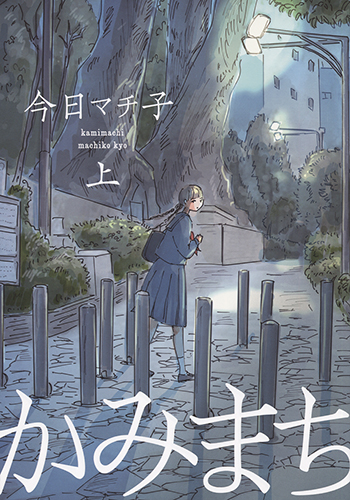
Machiko Kyō’s Kamimachi (かみまち) was serialized from June 2019 to December 2022 and published as a two-volume graphic novel in August 2023. The story follows four homeless teenage girls who find themselves at a privately run youth shelter called Kami No Ie (“Family of God”) in the Tokyo suburbs.

Although he initially seems kind and welcoming, the middle-aged man who runs this shelter is a sexual predator, and he has assaulted and murdered one of his young charges prior to the beginning of the story. The ghost of this young woman, in the form of a Christian angel, helps the girls find the courage to escape the Kami No Ie shelter.

Each of the four main characters in Kamimachi has become homeless after escaping a toxic home environment.

Uka is the only child of a single mother who projects her loneliness and frustrated ambitions onto her daughter. The story begins as Uka leaves home and seeks shelter by means of a roomshare app. After a number of awkward situations, Uka comes to the attention of a group of men who use the app to recruit sex workers. These men force Uka into a situation in which she’s expected to trade a night at a short-term rental space for sex. She breaks out of the apartment and wanders the streets of Tokyo before finding herself at the Kami No Ie shelter.

Uka’s closest friend at the shelter, Nagisa, has been sexually abused by her stepfather for years. She finally flees from home after her mother witnesses one of these assaults and turns away in disgust.

Arisa was raised as a television idol by a single mother. After her mother’s sudden death in an accident, Arisa is given to the care of a talent manager who steals her inheritance and financial assets, leaving her destitute.

Yō is one of five siblings. She’s so neglected by her family and bullied by her brothers that she finds it preferable to sleep in subway stations. Eventually she stops returning home altogether.  

For each of these young women, Tokyo becomes a wilderness whose anonymous open spaces serve as a refuge from the enclosed interiors where they’re coerced into enduring abuse. Kyō draws indoor scenes using small panels with blank backgrounds, and these scenes often feature close-ups of the characters’ faces in moments of distress. Meanwhile, Kyō depicts outdoor scenes with large panels that frame the characters with trees and buildings. The expansive outdoor settings often serve as the stage for small moments of kindness and emotional clarity.

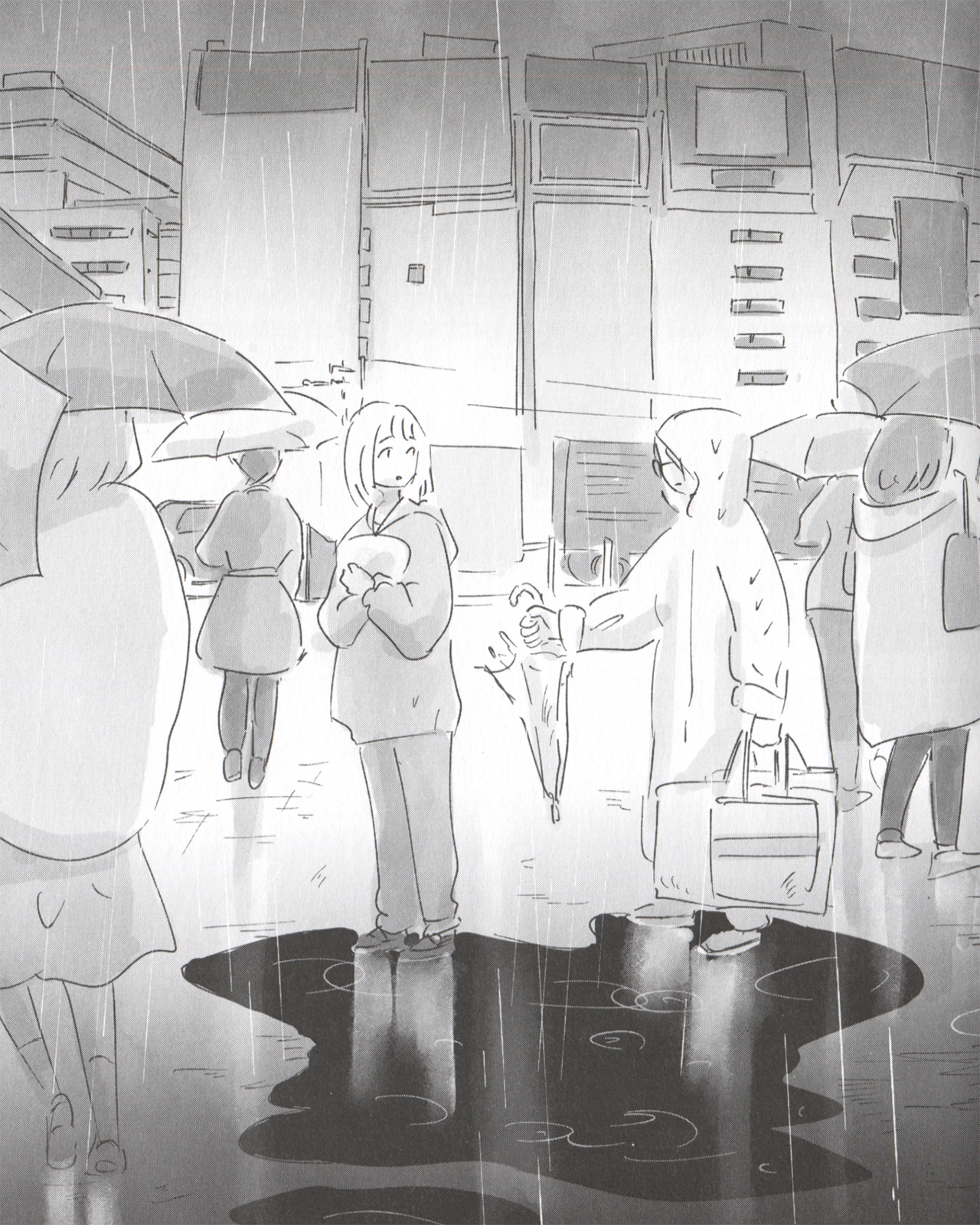
In Chapter Three, for example, Uka flees into the night after an attempted sexual assault at a roomshare apartment. After her escape, she wanders through the rain with nothing but the clothes on her back. Out of context, the rainy cityscape may seem bleak, but the large panels filled are a visual relief after the oppressively small and claustrophobic panels that depict the apartment.

One of the anonymous figures passing in the rain, whom the reader later learns is Yō, stops beside Uka to give her an umbrella. Page 71 opens with a close-up of Yō’s extended hand before spreading into an open panel in which Uka and Yō stand at the center of a composition framed by misty buildings and puddles on the concrete. The two small figures reaching out to one another are enclosed in a soft curtain of rain, and the sense of relief at being a part of a larger world is palpable.  

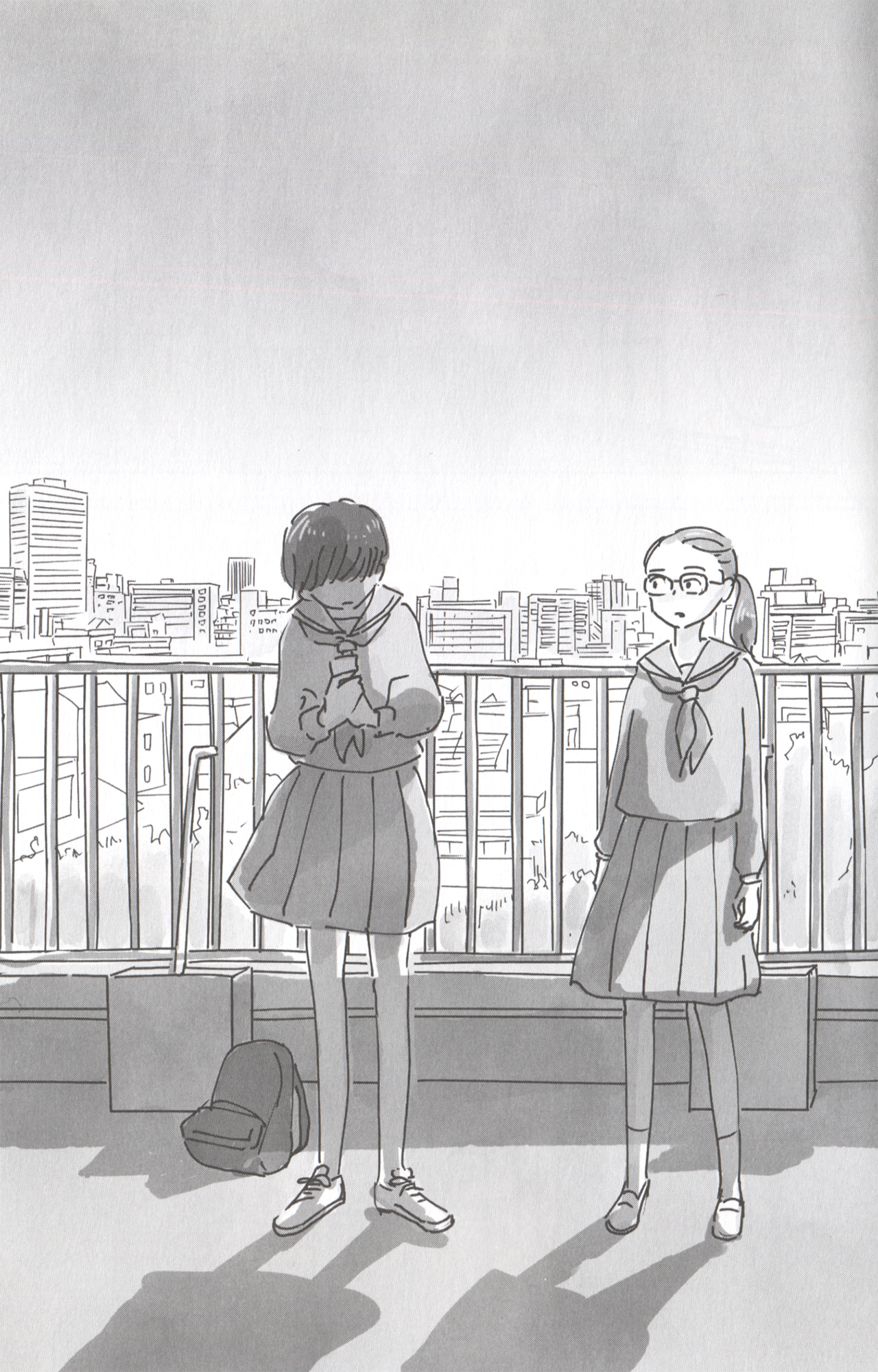
Chapter Seven contains a similar scene in which the open sky and background cityscape suggest freedom from the violence that occurs behind closed doors. Nagisa, who’d encountered Uka in a roomshare arrangement, takes Uka’s discarded uniform and attends school in her place. One of Uka’s former classmates approaches Nagisa, offers to share her lunch, and asks that Nagisa talk with her on the roof. Nagisa initially tries to be normal, showing the girl photos of her mother and stepfather’s new infant daughter.

During this scene, the panels become progressively smaller until Nagisa finally admits the truth about having left her family. The shift to a full-page panel depicting the city’s jumble of buildings spreading under the open sky signals Nagisa’s admission that something has to change. This moment also serves as the catalyst for Uka’s classmate to begin searching for her missing friend, a decision that ultimately results in Uka’s rescue from the Kami No Ie shelter.

The openness of Tokyo cityscapes in these scenes suggests that the sort of hidden abuse endured by these young women needs to be brought into the open and exposed to the light of public scrutiny. Along those lines, I can’t help but feel that Kyō’s depictions of outdoor spaces in Kamimachi also reflect the artist’s emotional response to the Covid pandemic. For people in precarious situations, being physically stuck inside often exacerbated the experience of feeling trapped within oppressive social systems.

As an artist who documented the pandemic years through evocative illustrations posted to Instagram, Kyō’s project is not simply to depict the beauty of architecture and greenery within the city, but also to comment on the importance of open outdoor “third places” for young people suffering from social pressure and economic strain. Kamimachi doesn’t provide easy solutions, but it’s cathartic to see the issue of youth precarity brought out into the open air. 

Machiko Kyō is a prolific and award-winning artist whose illustration collections have been celebrated by The Comics Journal (here). If you’re interested in reading more about the artist’s work, I published a short essay on her 2013 graphic novel Cocoon – whose animated adaptation is scheduled to premiere on NHK in Summer 2025 – on Women Write About Comics (here). Here’s hoping that English-language readers will be able to experience Kyō’s compelling and thought-provoking work in the near future.

Hoshikuzu Kazoku

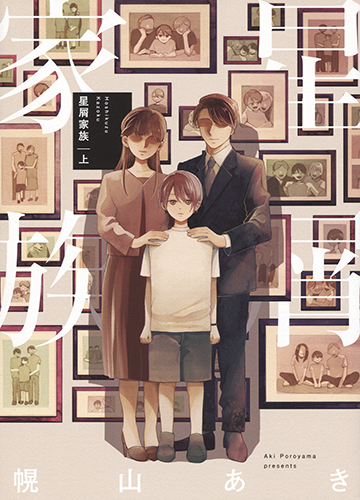
Hoshikuzu Kazoku (星屑家族) is a two-volume graphic novel set in an alternate universe where parents are required to obtain a license to raise children. To qualify for a license, a prospective family is asked to undergo an audition with a homestay student. This auditor, who is often an orphan raised in a government-run facility, evaluates the family’s fitness by deliberately behaving badly and provoking difficult situations. 

An auditor who goes by Hikari is assigned to Daiki and Chisa Hirokawa, a young couple who live on the grounds of a Shinto shrine. During their initial interview, Daiki surprises Hikari by openly requesting that their family be denied a childrearing license. Daiki claims to be happy living with his wife as a couple, and he shares his suspicions that Chisa doesn’t actually want children. With that out of the way, Daiki says, the three of them can enjoy the homestay visit without any pressure or expectations.             

Chisa and Daiki genuinely seem to be happy together, but Hikari soon notices that Chisa is the target of a longstanding prejudice held by people in the neighborhood. Chisa’s mother killed her father when she was a child, and she’s been ostracized ever since. Along with her foster father, who once managed the shrine, Daiki was the only person who was kind to her. Now that she and Daiki have married and set up a household at the shrine, Chisa feels trapped within a community she can’t escape. Why, then, does she want a child so badly? And is it Hikari’s place to get involved?

Hoshikuzu Kazoku is a high-stakes family drama that presents a moral conundrum with no easy solutions. If the government creates regulations to ensure a well-ordered society, what happens to the people whose lives are more complicated than the provisions allowed by the legal code? If there’s room for flexibility in the bureaucratic system that enforces the law, who should have the right to grant exceptions? And more specifically, in a country witnessing its birth rate decline in response to the disintegration of community support structures, what are the limits of government intervention?

Even putting such questions aside, Hoshikuzu Kazoku is compelling by virtue of its problematic yet still sympathetic characters. Hikari, Daiki, and Chisa each bring loads of emotional baggage to the table, but they do their best to communicate to the limited extent of their abilities. Despite their many flaws and the odds against them, I wanted these characters to be happy.

Aki Poroyama’s writing, dialogue, and pacing are all excellent, and the visual language of the manga serves to set the mood and create dramatic impact. I wasn’t familiar with the work of this artist, and I was amazed by the polish of this graphic novel. I’d recommend Hoshikuzu Kazoku to mature readers looking for socially conscious speculative fiction driven by complicated human stories. 

52ヘルツのクジラたち

52ヘルツのクジラたち is a bestselling novel by Sonoko Machida that won the 2021 Japan Booksellers’ Award Grand Prize. In March 2024, the story was adapted into a feature film directed by Izuru Narushima, who worked with LGBTQ consultants in order to portray a key transgender character with the same compassion and sensitivity expressed by Machida’s novel.

Kiko Mishima has left Tokyo to move to a seaside town near Oita on the eastern coast of Kyushu. She’s inherited a house from her grandmother, and she gets along well with the contractors she hired for renovations. It’s difficult to adjust to life in a small community, however, and Kiko begins to withdraw into her house.

During a trip to the grocery store, Kiko encounters a 13yo boy who can’t speak and seems to have nowhere to go. The nameless boy bears undeniable signs of abuse and neglect, so Kiko invites him home and begins caring for him.

As the novel progresses, the reader learns more about Kiko, who was emotionally abused by her mother and stepfather. Circumstances relating to her stepfather’s health prevent Kiko from escaping from her family after high school, and she’s driven to the verge of suicide by her experience of serving as her stepfather’s primary caregiver.

Kiko is rescued by her high school friend Miharu, who also grew up in an abusive family. Miharu introduces Kiko to her colleague Ango, who sympathizes with Kiko and takes responsibility for her emotional support as he helps her move into a sharehouse and begin a new life.

From the beginning of the novel, the reader is confronted by numerous questions. Given how important Ango was to Kiko, what happened to him? Why did Kiko suddenly move to Kyushu without telling anyone? Where is she getting the money to renovate her house? And, most importantly, what can she do to help the abused boy whom the entire town has decided to ignore?

52ヘルツのクジラたち takes its title from the story of 52 Blue, a whale of an unidentified species that has never been sighted but only heard via hydrophones. It sings at a frequency 52 hertz, which is much higher than the calls of other migrating whales. Because of the highly unusual sonic signature of its call, the whale migrates alone.

Kiko compares her isolation during her childhood to that of the 52-hertz whale, and she once listened to recordings of its singing to calm and ground herself after she left her family. She shares these recordings with the seemingly wordless boy she takes under her wing, promising that she’ll wait patiently until she can understand his own 52-hertz voice.   

We live in a society, however, and it’s not strictly legal to assume care of a minor without the permission of the child’s guardians. Thankfully, Miharu manages to track down Kiko and pays her a visit in Kyushu. She once again comes to the rescue, helping Kiko to reach out to the community for the support that she and the boy desperately need. 

Make no mistake, 52ヘルツのクジラたち is an intensely melodramatic novel. Its characters are either saints or devils. It’s never explained why anyone would be abusive toward a child, or why most people who witness child abuse choose to ignore it. In addition, the story’s victims of abuse come off as perfect angels who suffer with dignity and almost never display any of the problematic behavior associated with a history of sustained childhood trauma.

I find this lack of psychological depth frustrating, as it glosses over many of the issues underlying child abuse, which is often known and tacitly tolerated by the larger community. Instead of serving as a meaningful model for how such abuse can be prevented, this novel feels more like a character drama that uses serious social issues for the sole purpose of generating heightened emotions. In addition, although the treatment of the central transgender character is sympathetic, I couldn’t help but shake my head at some of the tired narrative tropes applied to their story.

Still, I can’t deny that 52ヘルツのクジラたち is a lot of fun to read. The pacing is excellent, and I was swept along by the story’s strong forward momentum. Although bittersweet, the ending is emotionally satisfying, as is the conclusion of Kiko’s character arc. I’d especially recommend this novel to fans of Banana Yoshimoto, as it feels like a progressive development of many of the themes explored in Kitchen, from a universal concern with love and loss to a more specific push for the legal rights of minors and transgender people. 

While the message of 52ヘルツのクジラたち might have benefitted from more psychological nuance, Sonoko Machida makes a strong and compelling case for mutual aid and community action in which everyone in a society benefits by actively protecting the marginalized.