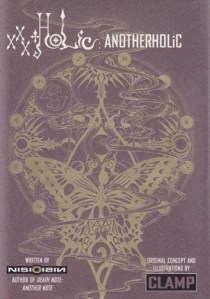
Title: xxxHOLiC: ANOTHERHOLiC: Landolt-Ring Aerosol
Japanese Title: xxxHOLiC アナザーホリック ランドルト環エアロゾル
Author: NISIOISIN (西尾維新)
Translator: Andrew Cunningham
Publication Year: 2008 (America); 2006 (Japan)
Publisher: Del Rey Books
Pages: 203
Given my fondness for the supernatural genre, it is no surprise that I love CLAMP’s manga xxxHOLiC. It took me awhile to pick up the first volume, however, because the concept seemed so cliché and gimmicky: an excitable high school boy who can see spirits works at the shop of a witch who promises to eventually cure him in a story featuring numerous plot crossovers from the simultaneously running epic manga (I believe there are currently twenty-seven volumes of it) Tsubasa: Reservoir Chronicles. I was tempted, however, by the Japanese tankobon, which Kodansha has published in beautiful editions, and ended up becoming addicted to the series. Not only is the artwork gorgeous in the style of early twentieth century Japanese lithographs (or Edward Gorey drawings), but the manga is dark and engaging in a deliciously creepy way. Besides, I am in love with Yūko, the hedonistic yet wise ‘Dimensional Witch’ who employs Watanuki, the hapless protagonist.
I had known about NISIOISIN’s novelization of xxxHOLiC for some time, but, unimpressed by his work in the two translated volumes of the short fiction anthology Faust, I never bothered to pick it up (ditto with his novelization of Death Note). Upon accidentally running across the book in a local bookstore, however, I was seduced by the beautiful gold-foil embossed cover and the chapter heading illustrations provided by CLAMP. Perhaps I should give it a chance, just like I did the original manga. Perhaps there is more to NISIOISIN than meets the eye.
Nope. Wrong. In short, this is a waste of a hardcover book. All of the subtle black humor and eeriness of the original manga turns to dust in the hands of the novelist. To back up a bit, it is perhaps a stretch to call ANOTHERHOLiC a novelization. The book is made up of three episodic short stories featuring the characters from xxxHOLiC. The first story, “Outerholic,” is a prose adaptation of an episode in the first volume of the manga and thus retains a modicum of the charm of the original. The second two stories are, as far as I can tell, NISIOISIN’s original creations. And they suffer for it.
Why do I hate NISIOISIN so much? Because I think he hates me, his reader. In all sincerity, what he has written is so full of bitterness that it left me feeling defensive. I’m not the sort of person who feels the need to evaluate whether NISIOISIN was true to the original characters, but I definitely got the feeling that he does not like them. Watanuki comes off as juvenile and whiny, Yūko is petty and self-important, and the writer even extends harsh editorial judgment towards his own original characters. If the writer’s unrelenting antagonistic attitude were not enough to turn me off to this book, I’m sure the sloppy writing would have pushed me over the edge. NISIOISIN’s prose is rife with sentence fragments and ellipses, which might have some sort of dramatic effect if they didn’t appear multiple times on every page. On a broader scale, NISIOISIN relies not on foreshadowing, atmosphere, or suggestion to create a sense of mystery but rather on withholding information from the reader in a taunting way that almost resembles bullying. The last story forgoes any plot at all in favor of a long and tediously sophomoric pseudo-philosophical conversation. Moreover, things like the frequent otaku references to anime like Azumanga Daioh, combined with Yūko’s debate with Watanuki over the meaning of moe, left my head spinning.
According to the author biography in the back of the book, NISIOISIN was born in 1981, which would make him 27 or 28 this year. Although his accomplishments are nothing to sneeze at, ANOTHERHOLiC made me feel like he really needs to get a life and grow up. When I first started reading this book, I was considering buying the translation of the first volume of the author’s Zaregoto: The Kubikiri Cycle, but now I’m not sure I want to read anything written by him ever again. In any case, despite Del Rey’s lovely publishing job, ANOTHERHOLiC is not worth the money, even for fans of CLAMP’s original manga.
I should mention, however, that I don’t think the failure of this book is the fault of the translator, Andrew Cunningham. Cunningham does a wonderful job of rendering NISIOISIN’s numerous idiotic puns into English, and in fact the most enjoyable part of the whole thing were the translator’s footnotes. I can only hope that Cunningham will apply his considerable talent to other authors in the future.

 Contemporary Japanese Literature