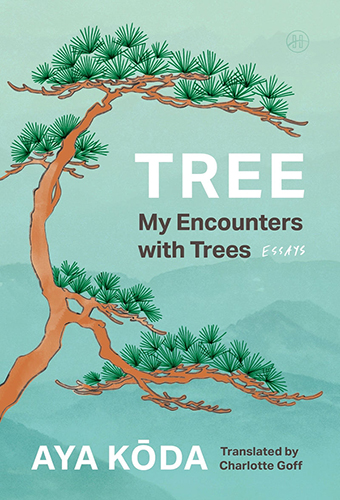
Tree: My Encounters with Trees

Aya Koda’s posthumous 1992 essay collection Tree, which has been translated with sensitivity and grace by Charlotte Goff, brings together fifteen short autobiographical essays about the author’s visits to famous trees and forests in Japan.

Koda, who was born in 1904, was primarily famous as a novelist and short story writer. She was most active in the late 1940s through the 1950s, when she documented the changing family dynamics of the postwar period through her fiction. Koda focused on shifting social mores through the lens of women’s work and material culture, especially clothing.  

Koda brings the same power of observation and gentle good humor to her accounts of her travels across Japan in order to satisfy a long-held curiosity about trees, forestry, and environmental science, as well as the professionals who work in these fields. As she explains her project in her own words…

It has only been a few years since I first started walking through the woods, hoping that as I encountered different trees I would be able to draw inspiration from them. I had been lucky enough to receive support and guidance from experts each time, and so in a few short years I had been afforded the chance to spend considerable time wandering the forest feeling moved by all sorts of wonderful trees.

In “Yakusugi,” Koda visits Yakushima, a World Heritage Site known for its luxuriant vegetation and the mountainous evergreen forest that inspired the Studio Ghibli film Princess Mononoke. Koda is specifically interested in visiting the Jomon Sugi, a cryptomeria cypress tree that’s at least two thousand years old (and may be much older). After braving the muddy mountain slopes, Koda is surprised to find that the tree is far from majestic, but what she calls its “squat ugliness” is impressive in its own way.

In “At Abe Pass,” Koda walks along the Abe Pass hiking trail, which is known for its views of Mount Fuji. Instead of visiting during the peak of the autumn foliage, Koda goes in May, when the leaves of the maple trees will hopefully be fresh and green. Unfortunately, the vicissitudes of nature can’t be predicted, and the maple trees are completely bare when she arrives. Koda still documents her trip with good humor, taking note of the smaller plants that are budding and flowering while also remarking on the river below, which has a tendency to complicate the postcard-perfect scenery by flooding and causing landslides.

For the reader, Koda’s essays can feel like secondhand forest bathing, but it’s also interesting to study the snapshots of cultural and natural history that she has preserved in her writing. For Koda, aesthetic appreciation is just as important as ecological understanding, and she describes her essays as an attempt to pass on a way of seeing nature that she developed as a child…

I grew up in a farm village on the outskirts of Tokyo, which is why there were always plants around. There were crops from the rice paddies, of course, scrubs of various small trees springing up alongside irrigation channels, areas of land cultivated by gardeners, and, as well as all this, just about every house had some form of greenery in or around it. Children could learn about trees and plants without even trying.

What separates Koda’s essays from a shallow appreciation of attractive landscapes is her willingness to address the more violent aspects of nature. The most powerful example is the essay “Volcanic Ash,” in which Koda visits Sakurajima, the location of a small town that has historically benefitted from the hot springs and fertile soil created by the island’s active volcano. After one of the major eruptions in the 1980s, Koda went to observe the effects of the falling ash on the plants. “It must be an extreme nuisance,” she says wryly; but, “as a natural phenomenon, you cannot simply ask it to stop.”

Though discussions of climate change had already begun in Japan in the 1980s, Koda doesn’t address this issue directly. Instead, in a very relaxed and apolitical way, she stresses the importance of learning to coexist with the environment, even when it’s inconvenient or destructive to human enterprise. By imbuing scientific curiosity with emotional warmth, Tree serves as a gentle and welcoming invitation to live attentively alongside the natural world. Aya Koda’s clear-eyed essays offer readers an entertaining and nostalgic tour of Japan’s forests, but they also provide a model for observing nature with respect and resilience.
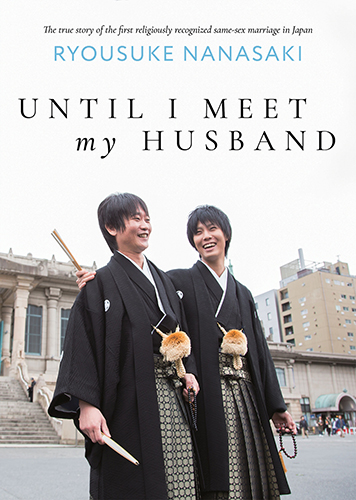
Until I Meet My Husband

Until I Meet My Husband is a collection of short autobiographical essays by Ryousuke Nanasaki, an activist who established LGBT Community Edogawa in 2015 and a wedding planning company called Juerias LGBT Wedding in 2016, both of which contributed to Tokyo’s Edogawa ward officially recognizing same-sex partnership by issuing marriage certificates.

Nanasaki lays out his motivations for becoming an activist toward the end of the book, but the majority of his essays are humorous stories about life and love. As Nanasaki explains in the final chapter, “In Place of an Afterword,” he wants readers to understand the “raw, uncut truth” of queer identity, which is that gay people experience happiness and make mistakes like everyone else.

As a result of Nanasaki’s honesty, the essays in Until I Meet My Husband are immensely entertaining and compulsively readable. Many of the stories will be familiar to queer Millennials, from receiving a stern lecture from a well-meaning teacher in elementary school to dating other closeted queer kids in high school to falling a little too hard for your first serious partner as an adult. Nanasaki leans hard into friendship drama, relationship drama, and family drama, but he’s so funny and good-natured that you can’t help but support him through his misadventures.

Molly Lee’s translation is pitch perfect, conveying the confidence and enthusiasm of Nanasaki’s voice in natural English that’s a pleasure to read. Along with the original essay collection, Seven Seas has also released the manga adaptation, which features dreamy artwork by BL manga author Yoshi Tsukizuki

Okareta basho de abaretai

Emuko Asai began posting essays online in 2021. She never considered herself to be a writer, she says, but the enthusiastic support she received from thousands of readers inspired her to keep sharing her stories. Asai’s 2024 collection 置かれた場所であばれたい (Okareta basho de abaretai) is a clear demonstration of the appeal of her essays, which inject a healthy dose of good humor into the trials and tribulations of everyday life.

Okareta basho de abaretai follows a loose timeline from Asai’s girlhood to her current career as a professional in the field of early childhood education. Although I get the sense that the staunchly pseudonymous Asai grew up in an upper middle-class family, the path she followed to adulthood was anything but standard. To me, Asai reads as having mild learning impairments, and she frequently makes jokes about her terrible grades and how much she hated studying. Since she was never going to meet expectations, Asai always figured that she might as well enjoy herself and have a good time.

One of my favorite essays is Miko no arubaito (Part-time job as a shrine maiden) which is about the weekend Asai worked at a large Shinto shrine during the rush over the New Year holiday. Just like her normal part-time job at a bakery, her duties involved standing behind a counter and helping people pay for their purchases. Amusingly, Asai had a bit of trouble with code-switching between secular and religious settings, which resulted in several comedic exchanges with confused patrons.

( As an aside, Miko no arubaito would be an excellent reading assignment for a Japanese language class, especially since its humor is dependent on a knowledge of the taigū hyōgen set expressions used by service workers. )

Asai’s most popular essay on social media is Yasashii uragiri (A gentle betrayal), which is about a written test given by her high school Home Economics teacher. This story will probably be familiar to American Millennials, many of whom were exposed to a variation of this test at some point in secondary education. Over the course of the essay, we follow Asai’s progress through the exam, which presents a lengthy series of detailed instructions. The last item on the list is, of course, “Don’t write anything. This is a test of whether you read the directions before starting work.”

Although Asai presents this story as little more than an amusing anecdote, I get the feeling that this experience was probably crucial in her decision to become a teacher. Many of Asai’s experiences with education seem confrontational at best (and downright depressing at worst), so it would make sense that she had a positive response to a teaching strategy that fostered independent thought and prioritized practical application.

In later essays, Asai describes her own goals as a teacher while challenging herself to accommodate different learning styles. Perhaps the best example is Sensei-tte, dare no koto (Who are you calling Teacher?), in which Asai attempts to help a 4yo child overcome his refusal to sit down and draw with crayons. It turns out that what the boy really disliked was having his pictures compared to the drawings of his best friend, who displays a small measure of artistic talent. Asai readily admits that she herself can’t draw, but what she can do (using an age-appropriate version of the Two Cakes! meme) is to help this little kid realize that his work is just as valuable as his friend’s.

Lest you think Asai has grown soft, however, she follows this essay with one titled Unchi somurie (Poo Sommelier), which is about how she possesses the rare but useful ability to tell which of her young charges has shit themselves at school. 

Emuko Asai’s essays read a bit like David Sedaris, albeit without the cutting edge of Sedaris’s characteristic meanness. Her work isn’t wholesome, necessarily, nor is there an absence of irony. Rather, Asai expresses a type of radical good humor that occasionally borders on passive-aggressive sweetness but always mellows out into a chill attitude of c’est la vie – or YOLO, as the case may be. If nothing else, it’s always amusing to follow the unexpected progression of the author’s thoughts as she relates episodes of her life that probably would have been traumatic for someone without her incredible store of gentle good humor. 

You can follow Emuko Asai on Twitter (here), and you can read her essays online on Note (here). The most recent posts are only accessible to subscribers, but her older essays are free to read. My recommendation would be her story about her Home Economics test, Yasashii uragiri, which you can find under its original title (here).