Shojo Manga! Girl Power!

Title: Shojo Manga! Girl Power!: Girls’ Comics from Japan
Editor: Masami Toku
Publication Year: 2005
Publisher: Flume Press
Pages: 80

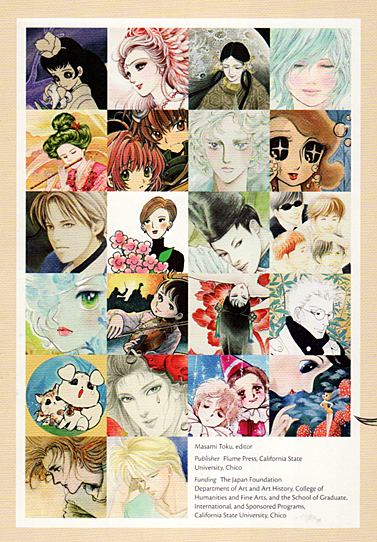
Judging from its front and back cover, you might expect this catalog to contain big, glossy reproductions of artwork gleaned from shōjo manga, like watercolor cover illustrations or the artistic two page spreads that are a defining characteristic of the genre. Aside from six color pages in the middle of the volume, however, there are relatively few images, and majority of the book is printed in black and white.

What this volume does contain are thirteen essays, each three pages long, on the phenomenon of shōjo manga, manga in general, and the impact of Japanese comics on America, followed by page-long profiles of twenty-three manga artists. The essays mainly repeat the same outdated information and stereotypes about manga (and gender) that you can find anywhere. Typical of these short essays is the misleading and essentially meaningless line, “The popularity of the genre [of boys’ love] is reflective of the fact that in Japan, male love, loyalty, and companionship are considered of the highest virtue (Toku).” A few of the essays are well worth reading, however. One of them is Yoko Nagakubo’s essay “Yaoi Novels and Shojo Manga,” which contains the most reasonable explanation concerning gender identification in boys’ love manga that I have ever come across. Another is Frederick Schodt’s “A Different View,” which seeks to correct some of the most widespread American misconceptions about the Japanese manga industry (and which seems surprisingly prescient in light of the current crisis facing the American manga industry).

The main selling point of the book are the artist profiles. These profiles list two or three major works of each creator and briefly cover his or her thematic preoccupations. Each profile is accompanied by one or two small, black-and-white (but still gorgeous) illustrations that demonstrate the artist’s style. Most of these artists are still relatively unknown in America, as only a small handful of them have been translated into English. (And, even if their works have been translated, as is the case with Ikeda Ryōko of Rose of Versailles fame, they are almost impossible to find.) They include Watanabe Masako, Maki Miyako, Mizuno Hideko, Satonaka Machiko, and on and on.

In other words, this exhibition catalog might not be the most beautiful or academically rigorous book ever published, but it serves as an extremely useful field guide to the history of shōjo manga through its creators. It’s also an excellent reading guide, highlighting a manageable number titles as well as the reasons why they are important and enjoyable. I’m definitely taking this book along with me the next time I visit Japan.

Most major university libraries own a copy of this 2005 exhibition catalog; but, since there have recently been several copies floating around the internet (on Amazon and eBay), I thought I’d snag one for myself before they disappear. If you’re interested, I would encourage you to do the same!
Drop Dead Cute

Title: Drop Dead Cute
Author: Ivan Vartanian
Publication Year: 2005
Publisher: Chronicle Books
Pages: 160

When I first picked up this book several years ago, I was quite disappointed. With a title like “Drop Dead Cute” and references to Murakami Takashi and Nara Yoshitomo in the blurb on the inside cover, I had expected the book to contain more of what I saw as “anime art” (or perhaps “manga art”). In fact, however, the deliciously pink cover image by Takano Aya is as close as this book gets to anime art. The rest of the book isn’t even cute. It’s disturbing, yes, and violent, yes, and all sorts of interesting and creative, but not cute.

Which leads me to wonder, upon closer examination, what exactly the title means by “cute.” To me, “cute” is something that elicits an emotional response along the lines of “Oh my gosh I want to love on it.” The pieces exhibited in Drop Dead Cute aren’t exactly that sort of cute (and, to that effect, I would wager that the emphasis in the title is actually on “drop dead”). The book is filled with animals, however, and plant life. Much of this flora and fauna is anthropomorphic. There are also plenty of young women (and almost no men) and a profusion of soft pastel colors.

Kudo Makiko opens the book with her oil paintings of young girls, perhaps sleeping, perhaps dreaming, who have found themselves in strange landscapes guided only by cats and dogs. Murata Yuko renders animals and landscapes in simple compositions consisting of wide, sweeping brushstrokes. Hosoya Yuiko is represented by pencil drawings of sullen young women that look like the work of a beginning art student, with finger smudges and blank backgrounds. Ban Chinatsu, famous for her collaboration with Murakami Takashi in the New York Japan Society’s “Little Boy” exhibition of 2005, paints huge acrylic canvases filled with baby elephants in pursuit of underpants. Murase Kyoko works in all sorts of media, from traditional oils to white out pen on yellow legal paper, but her naked drowning girls are equally unsettling no matter what her canvas. Tabaimo’s work is, as always, something straight out of a horror movie.

My two favorite artists in this collection are Aoshima Chiho and Takano Aya. Although Aoshima claims that she doesn’t read manga or watch anime, her works closely resemble the anime style, filled as they are with fantastic, wide-eyed girls sporting wild hair of various colors and very little clothing. In her work, these girls are bound, eaten, digested, rotting, free floating, and reborn in amazingly detailed, brightly colored graveyards and Edens. Since the majority of her work is digital, her photo manipulations, which juxtapose her cartoon-like demon girls against ordinary Japanese backdrops, blend seamlessly into the rest of her oeuvre. Takano, whose artwork was used for the cover of this book, does in fact draw manga, or at least sequential art resembling manga, and she is represented in this collection by a short, colorful, manga-esque piece titled “Subterraned,” which I think is by itself worth the price of the entire book. Her artist’s statement, which delves into themes of sci-fi and eroticism, is also quite interesting.

Each of the ten artists is given a three page introduction, with doodles at the top of the pages and text based on interviews at the bottom. Following each introduction are eleven pages showcasing the works of the artist, with one, or occasionally more, pieces per page. The titles of the pieces are given in English, but each artist has also handwritten the original title of the piece next to the English entry. The book begins with a twelve page, well-illustrated introductory essay by Ivan Vartanian and ends with short biographies of all the artists. Everything is full color, and the publication quality is just about as high as it can go.

The artists featured in this book are:

Kudo Makiko
Aoshima Chiho
Murata Yuko
Aoki Ryoko
Hosoya Yuiko
Takano Aya
Ban Chinatsu
Murase Kyoko
Kusama Yayoi
Tabaimo

From Impressionism to Anime

From Impressionism to Anime

Title: From Impressionism to Anime: Japan as Fantasy and Fan Cult in the Mind of the West
Author: Susan Napier
Publication Year: 2007
Publisher: Palgrave
Pages: 243

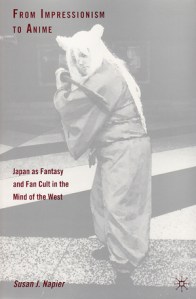
Let me start off by listing the obvious flaws of this book. First of all, the cover. It’s terrible. Whose idiot idea was it to take a crappy photo of crappy cosplay, run it through the “Impressionism” filter in Photoshop, and then put it on the cover of a book? According to the back cover, this monstrosity is the work of “Scribe Inc.” Shame on you, Scribe Inc., and shame on you, Palgrave, for letting them get away with it! Second of all, in a book primarily concerned with visual culture, there are surprisingly few illustrations. To be precise, there are ten, and only four of them are in color. This I am going to blame on the author, whose 2005 work Anime from Akira to Howl’s Moving Castle is also surprisingly under-illustrated (while other Palgrave scholarly publications have no shortage of well placed, high-quality greyscale images). Napier has no excuse for this, especially since the cosplay culture she details so lovingly is all about getting pictures of itself published. Third, Napier’s scope is very broad, but her treatment of her many topics is, perhaps unsurprisingly, shallow. I did not find this to be the case with Anime (despite many critical accusations to the contrary), but I’m disappointed with what I found to be the lack of sustained intellectual rigor in Impressionism.

Now that that’s out of the way, let me be something of a fangirl for a second and say that I love all of Napier’s work, Impressionism included. Napier always manages to choose the most fascinating things to write about, and she always does an excellent job of explaining why her chosen subject matter is interesting and important. Her analysis is apt, penetrating, and lucid, and her work does not suffer from any of the structural weakness found in a great deal of recent academic work – you always know what she’s trying to say, and her way of saying it is both logical and artistic. Although her theoretical background is rock solid (her bibliographies are a bit intimidating), she doesn’t blithely toss around big names and critical jargon. Also, you can tell that, even though she occasionally betrays a bit of light-hearted sarcasm, she has nothing but respect for the topics of her studies.

This attitude of respect is very important for a work like Impressionism, which deals with some strange and, depending on one’s perspective, almost contemptible subject matter. The book is divided into eight chapters (not including the Introduction and Conclusion). The first four chapters each take up a different aspect of the West’s fascination with Japan during the last two centuries. The first chapter covers turn-of-the-century Impressionists like Claude Monet and Vincent Van Gogh, who revolutionized the fine arts with a little inspiration from Japan, or at least the “Japan” of their imaginations. The second chapter goes into famous inter-war Japan enthusiasts such as Lafcadio Hearn, Arthur Waley, and Frank Lloyd Wright. The third chapter follows the antics of post-war American writers like Jack Kerouac, Gary Snyder, Michel Crichton, and William Gibson, and the fourth chapter is all about how Western men perceive and interact with Japanese women in works like Madame Butterfly and Memoirs of a Geisha. The last four chapters, which I consider to be the true raison d’être of this book, deal with American anime fandom and all its various manifestations, from anime conventions to cosplay to slash fan fiction. Through all of this, Napier attempts to uncover the source of the West’s long fascination with Japan, all the while making astute references to the global political and economic climates during which this fascination has become manifest.

The first four chapters, while interesting, are, as I said earlier, somewhat shallow. Each topic that Napier covers in these chapters has been written about extensively by other scholars, a fact which she openly acknowledges. Her originality here lies in the fact that she documents what she sees as a trend, although she is cautious about saying that the various moments in the history of what I am going to call “Japan fandom” are directly related. The main point of interest for readers is the work that Napier has done on post-1980 American anime fandom, which is the culmination of many years of interviews and surveys. Mainly speaking through the voices of the fans she has contacted, Napier attempts to explain the appeal of contemporary Japanese popular culture to Americans, often in contrast to American popular culture. Although she offers no strong conclusion, the variety of insights Napier offers are invaluable.

My one real criticism of this study is that, although Napier hints at exposing the power relations underlying fan culture, she never really follows through. In other words, she is mainly concerned with the relation of fans to the world outside fandom (what she calls “the Muggle world”) and doesn’t delve into the hierarchies of power within the in-group of fandom itself. For example, I would have found an analysis of the term “weeaboo” (an American who loves anime so much that he or she wants to become Japanese) to be a pertinent addition to her discussion. Instead, Napier makes American anime fandom seem like something of a utopia; although she mentions the darker side of fandom by quoting scholars who bring up the concept of “fan pathology,” she never directly acknowledges that such a thing might actually exist in her own object of study.

Otherwise, I found From Impressionism to Anime to be a very satisfying read. It’s an excellent cultural study and could double as a perfect introduction to modern and contemporary Japanese history for someone considering pursuing the subject as an undergraduate – or simply as an intelligent, interested individual. Don’t let the cover fool you. This is actually a book you want to read!

Yokai Attack!

yokai-attack

Title: Yokai Attack! The Japanese Monster Survival Guide
Authors: Hiroko Yoda and Matt Alt
Illustrations: Morino Tatsuya (森野達弥) 
Publication Year: 2008 (America)
Publisher: Kodansha International
Pages: 191

I was absolutely certain that I was not going to like Yokai Attack. I had fully expected it to be a boring and poorly organized mishmash of folklore, citations, and half-baked interpretation along the lines of Borges’s The Book of Imaginary Beings. But the illustrations for this book were commissioned from Morino Tatsuya, a famous apprentice of Mizuki Shigeru (a manga-ka known especially for his manga Hakaba no Kitarō, which was adapted into multiple versions of the anime franchise Ge Ge Ge no Kitarō), so I decided to give it a shot, despite the silly cover.

To my immense surprise, I fell in love with Yokai Attack right from the book’s dedication to Lafcadio Hearn and his wife, which I found apt and also quite touching. It is clear from the first few paragraphs of the preface that the authors have done their research and are extremely knowledgeable on the subject matter. In fact, the “Yokai Resources” section at the end of the book, with its extensive bibliography, is almost worth the price of the entire book itself for people interested in yōkai. Alt and Yoda draw on wide range of materials, from Nō plays to Edo-period collections of woodblock prints to Yoda’s memories of the ghost stories she heard as a child, to bring together about thirty-five detailed, four-page profiles of Japanese ghosts and goblins.

The joy of this book is not its wealth of information, however, but rather the lucid and witty style in which the information is presented. Alt and Toda obviously enjoy what they do, and they make sure their readers are just as amused as they are. I don’t mean to say that Yokai Attack is condescending or facetious; rather, the writing is exuberant and filled with small, good-natured jokes that make it a pleasure to read. The format and organization of the book are reader-friendly as well, and the captions, panels, and side notes are enjoyable and not distracting.

Yokai Attack seems to be targeted towards an audience of all ages, with perhaps a movie rating of “PG.” Although instances of people (or other strange and inappropriate things) getting eaten are directly referenced with much glee, all mention of grotesque violence and sexual activity has been struck from the text. This is something of a shame, as I’m sure the writers ran across enough upsetting and salacious material to fill another couple of books, but I suppose it’s for the best, as it will allow this gem of a book to reach a wider audience.

The one qualm I have with Yokai has nothing to do with the authors but rather with the publisher. Kodansha International, true to its Japanese origins, is known for going out of its way to publish beautiful books. It seems that it has shortchanged Alt, Yoda, and especially Morino by being only half full-color. Although the first two pages of each yōkai entry are full-color, the second two are not, and the publisher seemed to give up around page 145, when the full-color pages end. Since this book is beautifully formatted and filled with interesting images, I can’t even begin to imagine why Kodansha would cut corners like this. I am so disappointed in them! Such a fine book deserves better.

Another thing that bothers me is that I have not seen this book in bookstores anywhere – not even Kinokuniya in New York. Kodansha should get on the PR train and market Yokai Attack as a manga, so that it will be shelved with manga and reach its target audience. I kind of want to go to Kodansha and throw something at them for being so willfully ignorant.

But three cheers for Hiroko Yoda and Matt Alt! Yokai Attack is a wonderful book, and I highly recommend it to anyone interested in Japan in any capacity whatsoever.

Warriors of Art

Title: Warriors of Art
Author: Yamaguchi Yumi (山口裕美)
Translator: Arthur Tanaka
Publication Year: 2007 (America)
Pages: 175

Warriors of Art is, simply put, a beautiful, interesting, and exceptionally well-edited introduction to contemporary Japanese artists. The forty artists presented by the book represent a wide range of styles, media, and themes. A large percentage of the artists are internationally renowned and probably somewhat familiar to many Americans, who should be able to identify their styles if not necessarily their names. The book is illustrated with works instantly accessible to the casual reader, and the image quality could not be better. Every image has been reproduced in full color (where applicable) against a white background. At $35 (and deeply discounted on Amazon), Warriors of Art is also available at an affordable price.

The five page general introduction to the collection is promptly followed by a parade of artists appearing in alphabetical order. Each artist has been allotted four pages, the first of which contains a half-page, two column introduction. I have to say that, even though I generally don’t find much use for the text in art books, I genuinely enjoyed reading each of the artist introductions. These introductions put the work of the artist into perspective with biographical details and offer a few extremely apt interpretive comments, referring only to the pieces reproduced within the book. An average of five works follow each artist’s textual introduction, although the number tends of vary from artist to artist.

As for the actual content of the book, I found it extremely disturbing. Sometimes I was mesmerized by a piece, my reaction being something like “!!!!!!!!!.” Sometimes I found myself quickly turning the page because I found myself deeply upset by a particular work. As Yamaguchi says in her introduction to the book, “A glance at the work of the forty artists introduced in the book reveals recurring images of the cute, the grotesque, the erotic, the violent.” I think her description of “recurring images of” might more accurately read “a constant and overwhelming deluge of” images of cuteness and terror, eroticism and subtle (and not so subtle) aggression. In fact, one of the first plates in the book, an anime-style picture by Aida Makoto called The Giant Member Fuji versus King Gidora, depicts a female character from the anime Ultraman crying as she is both disemboweled and sexually violated by a golden hydra of Godzilla fame. Things carry on in much the same vein from there.

Even though Warriors of Art is not for the squeamish or the faint of heart (or the underage), the images are colorful, eye-popping, and deeply engaging. Questions of national identity, sexual identity, and personal identity are tackled again and again by these artists, whose experiments with style, composition, and color yield shocking results. Even a brief look at the works in this book calls the duality of high art and popular culture into question. Certainly, even though the entirety of Warriors of Art can be read less than two hours, I found myself captivated with it for days, returning to it for fresh surprises and new insights.