Age of Shōjo

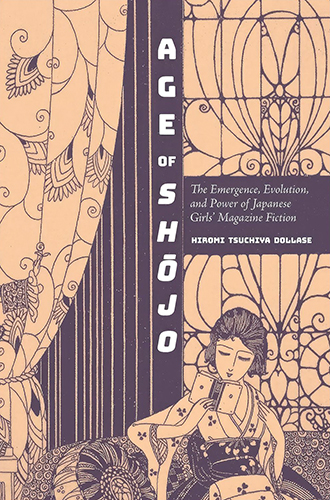
Numerous articles and book chapters have explored the origins of shōjo culture, and Hiromi Tsuchiya Dollase’s Age of Shōjo: The Emergence, Evolution, and Power of Japanese Girl’s Magazine Fiction contributes new insights while weaving these threads together into a tapestry depicting the history of how imagined communities of young women were shaped by the editors and contributors of popular mass-market magazines in Japan.

Age of Shōjo opens with a discussion of Louisa May Alcott’s novel Little Women, which was translated by Kitada Shūho in 1906 as Shōfujin. Through a close reading that compares the translation to the original, Dollase demonstrates how the novel “introduced a Japanese female audience to Western lifestyle and the image of a Western home” while still conforming to native Meiji-era constructions of femininity.

Chapters Two and Three introduce two key figures who helped shepherd amateur women’s fiction into professional venues. The first is Numata Rippō, who edited the seminal magazine Shōjo sekai (Girls’ World), and the second is Yoshiya Nobuko, who is famous for her contributions to this magazine, which were later published as the collection Hana monogatari (Flower Tales).

Chapters Four and Five trace the development of the portrayal of gender and sexuality in Yoshiya’s work in comparison with her contemporaries Morita Tama and Kawabata Yasunari, who also contributed short fiction to popular magazines such as Shōjo no tomo (Girls’ Friend) during the 1930s and early 1940s.

Chapter Six jumps forward to the immediate postwar era, when girls’ magazines such as Himawari (Sunflower) were filled with romanticized images of the United States, and Chapter Seven chronicles how magazine fiction for teenagers took a more mature turn during the 1980s. The stories published in the 1980s were still commissioned, selected, and edited to appeal to a readership of young women, but this fiction now addressed themes relating to women in the workforce, including frustrations concerning the choice between marriage and a career. 

As related by the anecdotes in the book’s Introduction and Afterword, girls’ fiction continues to be widely read and culturally influential in Japan. Dollase handles this material with respect and care by acknowledging its problematic aspects but preferring to contextualize instead of critique. This is especially the case with the heavily censored fiction of the 1940s, as well as the work of writers whose stories were progressive when they were first published but may seem socially conservative now.

In her informative study of these texts, Dollase demonstrates how, “through magazine stories and illustrations, readers came to acknowledge themselves as shōjo, a new cultural identity,” and how the fiction of these authors contains “messages of resistance against disagreeable cultural conditions cloaked in fantasy, sentimentalism, and humor.” Along with Dollase’s deft and accessible analysis, Age of Shōjo’s annotated reproductions of magazine covers and interior illustrations are a gift to readers interested in the literature and visual culture of girlhood in twentieth-century Japan.

Toward a Gameic World

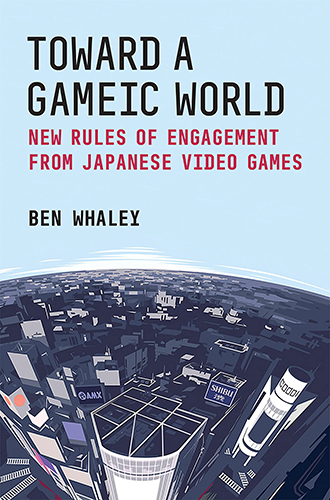
Ben Whaley’s 2023 monograph Toward a Gameic World: New Rules of Engagement from Japanese Video Games presents four case studies of how the virtual narratives of Japanese video games encourage engagement with social and political issues in the real world. Drawing on Katherine Isbister’s 2016 How Games Move Us: Emotion by Design, as well as a wealth of other recently published work in the burgeoning field of Game Studies, Whaley positions “engagement” as one of the primary means by which a video game conveys its message to the player.

“As I use it in this book,” Whaley explains in the Introduction, “‘engagement refers to a game’s capacity to evoke actual feelings of overcoming, guilt, complicity, or shared connection from a fictional experience of trauma.” The resulting study is not only a fascinating reading of key texts in the emerging canon of Japanese video games, but also a convincing argument for how Japanese games are able to engage transcultural audiences in political concerns ranging from youth precarity to environmental disasters.

The first chapter, “Limited Engagement,” asks interesting and culturally relevant questions about the politics of representing disaster in its discussion of the conversation surrounding the Disaster Report series of action-adventure games. Representations of apocalypse are often critiqued as being “disaster porn” meant to titillate viewers, but this chapter offers an alternate interpretation of the effects that experiencing such stories can have on individual players, as well as broader currents of historical memory.

“If mass-scale disasters conveyed in newspaper photos and YouTube videos represent collective narratives that run the risk of flattening the individual victims and individual narratives,” Whaley writes, “then video games like Disaster Report offer players the potential to rebuild some of this context by hearing lost voices, inhabiting lost bodies, and experiencing lost narratives, if only in virtual space.” In other words, the player engagement demanded by video games can serve as a means of presenting environmental disasters not as an abstract concept, but as a personally meaningful concern. The controversial Disaster Report series of games thus facilitates empathy for real-life survivors while also providing an education on disaster preparedness and survivor outreach.

The book’s fourth chapter, “Connective Engagement,” focuses on how social connections are modeled by the networked gameplay elements of The World Ends With You, a 2007 RPG set in an urban fantasy version of Shibuya. The game’s protagonist is a socially isolated teenager who suffers from depression and seems well on his way to becoming a hikikomori. While it’s easy enough to tell a story about a young person finding friendship, it’s much harder to break out of a toxic spiral of isolation in real life. The narrative of The World Ends With You acknowledges this challenge, and its gameplay cleverly models what this process actually entails.

Whaley demonstrates that, in addition to helping socially withdrawn players feel seen and recognized, the game’s networked features have the potential to encourage players to actively seek out other people in physical space, as wireless connections between Nintendo DS consoles are meaningfully rewarded within the world of the game. With its sensitive cultural study, this chapter is an antidote to sensationalistic accounts of mental health in Japan, as well as a welcome contribution to the ongoing scholarship concerning how online engagement in the communities surrounding networked games can positively affect the mental health of young people (and not-so-young people) who would otherwise feel alienated and alone.

Where the empathy of this book falls short is in the second chapter’s discussion of the 2011 visual novel / puzzle game Catherine. Catherine is a deeply misogynistic and openly transphobic video game, and critical responses to its story and characters have been mixed. While Catherine’s almost comically misogynistic treatment of its cisgender female characters is questionably open to argument and interpretation, the way the game handles a prominent transgender character is unequivocally hateful and extremely distressing. It’s therefore odd to see Catherine presented as a model of empathy.

My recommendation to readers would be to skip this chapter entirely. The author isn’t writing with malice; rather, it can often take many years to research, assemble, and publish an academic book, and scholarship that felt fresh a decade ago sometimes ages poorly. I will admit that I’ve occasionally found myself in a similar situation when I look back at my own work. This is simply the danger of writing about contemporary political issues, but it’s no reason not to create scholarship that’s relevant to the current moment.

Without sacrificing the quality of its research, Toward a Gameic World is accessible to general-audience video game fans interested in sustained critical analysis. (I didn’t mention the book’s third chapter in this review, but Metal Gear Solid fans are in for a special treat.) The book is also accessible to scholars who know little about video games but want to incorporate them into their classes. I think the first chapter on depictions of environmental disasters, “Limited Engagement,” would make an especially excellent reading for undergraduates. Whaley also offers many strong examples of how to integrate online conversations into academic literature reviews and textual analysis.

Toward a Gameic World takes the serious cultural topics addressed in a key selection of video games and, with sensitivity and grace, transforms their analysis into a surprisingly entertaining and enjoyable discussion. One might even say that it’s quite an engaging read.

Ryokan: Mobilizing Hospitality in Rural Japan

Chris McMorran’s Ryokan: Mobilizing Hospitality in Rural Japan is an academic monograph about gender and society that’s surprisingly entertaining and enjoyable to read. McMorran is an anthropologist at the National University of Singapore who spent more than a year working at an onsen hotel in the idyllic town of Kurokawa on Japan’s southern island of Kyūshū. His account of how such resorts operate is informed by his own experience, as well as a decade of talking to people with fascinating life stories.

McMorran is discrete and never exploitative, but he uses a fair amount of behind-the-scenes drama to illustrate the conflicting views at play in the construction and maintenance of Kurokawa’s fantasy of “traditional Japan.” Not every aspect of these traditions is worth preserving, especially the pressure placed on firstborn sons (and their wives) to inherit the family business, often at the expense of the ambitions of a family’s daughters.

Despite stubbornly persistent gendered expectations, one aspect of these onsen hotels that seems almost utopian is their willingness to employ women who might otherwise be in danger of falling through the cracks of society, such as divorcées and single mothers with small children. Even though McMorran tackles serious social issues, his approach is always sympathetic and accessible, and his writing is so crisp and clear that this study often feels remarkably akin to a literary memoir.

Ryokan: Mobilizing Hospitality in Rural Japan has the potential to be an entertaining read for fans of Japanese pop culture interested in indulging in a bit of armchair tourism while gaining a deeper understanding of contemporary Japanese society. To enhance the experience, I’d also recommend the gorgeous travel guide Onsen of Japan: Japan’s Best Hot Springs and Bath Houses, which perhaps might be enjoyed alongside a viewing of the beautiful slice-of-life anime movie Okko’s Inn.

Emergent Tokyo

Emergent Tokyo: Designing the Spontaneous City is a fascinating study of urban space augmented by a wealth of photographs and illustrations. Jorge Almazán convincingly argues that, instead of being designed from the top down, Tokyo’s distinctive cityscape emerged from history and opportunity.

Almazán focuses on five distinguishing characteristics of Tokyo, from the famous zakkyo “mixed-use” highrise buildings that line the main boulevards to the dense shopping areas that crowd the bays between support columns under elevated train tracks. Each feature of Tokyo’s cityscape is illuminated by three case studies that are meticulously documented and analyzed.

My favorite chapter is about the narrow and winding ankyo streets of West Tokyo, which were built on top of old canals and have gradually become pedestrian oases. The most famous is Harajuku’s Mozart-Brahms Lane, the chill and ambient twin to Takeshita Street. As in the case of Mozart-Brahms Lane, ankyo streets have often become communal backyards for neighborhoods with flashier public faces.    

I especially appreciate the Conclusion section, in which Almazán demonstrates that corporate-led urbanism has created unwelcoming and visually unappealing spaces that have none of the vibrancy of the more organic spaces fostered by collectives formed by homeowners and small business managers. While urban planning is still necessary, Almazán argues, emergent communities should not be stifled. 

Emergent Tokyo isn’t a book for tourists, but I imagine it will be of interest to anyone who’s curious about urban design. Also, although some of the more academic text might fly above the heads of small children, I think Emergent Tokyo would be a wonderful book to give a kid. The illustrations and diagrams are truly fantastic, and they’re so immersive that I found myself disappearing into the details as I imagined walking through the Tokyo gorgeously laid out across the pages.

Being Dead Otherwise

Being Dead Otherwise is an anthropological account of the shifting cultures of death and dying in contemporary Japan. Despite its seemingly grim topic, this is one of the most hopeful academic books I’ve read in recent years.

Anne Allison is primarily concerned with Japan’s aging population, who have begun to form communities surrounding their preparations for burial. Due to urbanization and an increase in nuclear family households, it’s no longer feasible to rely on one’s children or relatives for end-of-life arrangements. Still, older generations have been finding practical solutions.

I especially enjoyed the chapter about the social meetings of the future occupants of urban columbaria (repositories for burial urns), who call themselves “grave friends” and get together to make scrapbooks and other creative projects that will commemorate their lives for their children and grandchildren.

Allison argues that this type of self-care is often necessary to work around Japan’s outdated burial laws, in which only the formally registered Head of Household (who is almost always male) is allowed to make arrangements with a Buddhist temple. Thankfully, many temples are starting to ignore this law in order to serve the needs of older women who survive their husbands. 

Without a doubt, many problems still exist in an increasingly fragmented society, but Allison is optimistic and respectful as she interviews death workers ranging from priests to city officials to entrepreneurs. Being Dead Otherwise is an academic book that achieves the highest standards of scholarship, but it’s also a fascinating read that’s easily accessible to a wide audience.

A word of warning, however: Being Dead Otherwise contains photos of human remains that may be disturbing to those who aren’t used to such things. Sensitive readers may want to skip Chapter 6 entirely.

Books on Japanese Culture and Society

This past semester I taught a class on Japanese science fiction and fantasy, and I was surprised by how interested my students were in learning more about the social and cultural context of contemporary Japan. I therefore put together a list of recommendations for popular-audience books that are smart and specific yet still accessible to a casual reader. I decided to share this list here with the hope that it might prove useful outside the classroom.

If you’re interested in social issues facing contemporary Japan…

Dreux Richard’s Every Human Intention: Japan in the New Century (2021) tackles two of the most significant demographic concerns in Japan, immigration and rural depopulation, as well as a major environmental concern, Japan’s aging nuclear reactors. Richard approaches these topics by conversations with people who are directly involved, from Nigerian immigrants to census workers to nuclear regulatory officials. The writing is remarkably rich and features a large cast of characters with interlocking stories.

If you’re interested in learning more about the “Triple Disaster” of March 2011…

Richard Lloyd Parry’s Ghosts of the Tsunami: Death and Life in Japan’s Disaster Zone (2017) tells the stories of people who survived, as well as the stories of people who didn’t. There are elements of true crime in Parry’s journalism, which seeks to understand what happened, how it happened, and how it affected those involved. Parry is never needlessly dramatic or unkind, but he is justifiably critical of the decisions of elected officials at all levels of government.

If you’re interested in a deep dive into the “Lost Decade” of Japan in the 1990s…

John Nathan’s Japan Unbound: A Volatile Nation’s Quest for Pride and Purpose (2004) was written at a time when people were just beginning to understand the causes, repercussions, and long-term effects of Japan’s prolonged economic recession. Although it was published almost twenty years ago, this book remains relevant. Nathan is a professor and a literary translator, and reading each chapter is like listening to a fascinating class lecture.

If you’re interested in the dark side of Japan’s postwar economic miracle that emerged in the 1980s…

Norma Field’s In the Realm of a Dying Emperor: Japan at Century’s End (1991) is simultaneously an academic study and an intensely personal memoir. It’s also a genuine work of literature, and it won an American Book Award in 1992. Field’s prose is impeccably beautiful and a true pleasure to read, and her critique of the rise of neoliberal capitalism in Japan is penetratingly sharp. This book doesn’t feel the least bit dated, and it’s actually somewhat uncanny how all of Field’s predictions for Japan’s future came true.

If you’re interested in the history of how Japanese pop culture has been exported and received in the United States…

Matt Alt’s Pure Invention: How Japan’s Pop Culture Conquered the World (2020) is recounted from the perspective of an active working professional in the field of cultural exports from Japan. Alt begins in the immediate postwar period, and the scope of this book is impressively expansive. Alt regularly writes intriguing longread pieces for the New Yorker, and his 2018 essay “The United States of Japan” is a fascinating preview of an equally fascinating book.

If you’re interested in the American anime explosion during the early 2000s…

Roland Kelts’s Japanamerica: How Pop Culture Has Invaded the U.S. (2006) feels charmingly retro in its perspective on Japan’s anime industry, especially when it comes to Kelts’s optimistic enthusiasm. This book captures the excitement of the mid-2000s anime boom fueled by DVD sales and anime conventions, which were springing up like mushrooms in North America. Kelts hits all the high points of the conversation at the time as he discusses topics ranging from anime auteurs to otaku fandom subcultures.

I also want to mention Jonathan Clements’s Anime: A History, which was published in 2013 by the British Film Institute. This is a muscular book that might be a bit too powerful for a casual reader, but it’s exquisitely well-researched and absolute required reading for anyone’s who’s serious about studying anime in the context of the creative industry that produces it.

If you’re interested in how the gaming industry developed in America during the 1980s through the 2000s…

Jeff Ryan’s Super Mario: How Nintendo Conquered America (2012) is a lot of fun. Very few people knew how to write about video games back in the early 2010s, but Ryan has perfect pitch. Nintendo is an apt focus of Ryan’s exploration of how the gaming industry underwent numerous rapid shifts during a twenty-year period, but the book is still interesting and accessible even to people who don’t particularly care about Nintendo games.

If you’re interested in landmark speculative fiction and sci-fi anime from the 1980s and 1990s…

Robot Ghosts and Wired Dreams: Japanese Science Fiction from Origins to Anime (2007) is an academic essay collection, but most of the essays are fun, interesting, and easy to read. There’s a lot of intriguing analysis here, as well as a great deal of literary and media history that you can’t find in English anywhere else.

If you just really love Hayao Miyazaki…

Helen McCarthy’s Hayao Miyazaki: Master of Japanese Animation (1999) is a classic, with beautiful summaries, insights, formatting, and screenshots. Susan Napier’s essay collection Miyazakiworld: A Life in Art (2019) is published by an academic press but still accessible and enjoyable, and it has the added bonus of covering Miyazaki’s manga in addition to his films.

If you’d like to do some armchair tourism of otaku subcultures in Tokyo…

Gianni Simone’s Tokyo Geek’s Guide: The Ultimate Guide to Japan’s Otaku Culture (2017) is filled with incredible photos and a wealth of interesting recommendations. It also includes several illustrated essays on the history and cultural context of various subcultures, from comics to cosplay to pop idols to anime musicals.

If you want to learn about Japanese folklore while doing some armchair tourism of rural Japan…

Cécile Brun and Olivier Pichard’s Onibi: Diary of a Yokai Ghost Hunter (2016) is a collection of comic nonfiction essays about the artists’ travels to various points of interest in the Tōhoku region of north Japan. There is indeed ample discussion of ghosts and yōkai, but this book’s true charm is its depiction of small rural towns and the colorful human characters who live there.

If you want to learn about Japanese urban legends and the true stories that inspired them…

Tara A. Devlin’s Toshiden: Exploring Japanese Urban Legends (2018) is self-published on Amazon, but that doesn’t make it any less well-researched. This book covers many internationally well-known Japanese urban legends, as well as a few that are infamous in Japan but aren’t yet widespread on the English-language internet. It’s much longer and denser than you might expect, but every chapter is extremely entertaining.

. . . . . . . . . . . . . . . . . . . .

This post’s header illustration was created by Marty Tina G., who goes by @geezmarty on Twitter. You can check out their portfolio (here) and download their short fantasy and sci-fi comics (here). Marty is an expert at bold character designs and bright color palettes, and I trusted them to capture the energy and excitement of reading an interesting book that expands the world.

Writing Pregnancy in Low-Fertility Japan

Title: Writing Pregnancy in Low-Fertility Japan
Author: Amanda C. Seaman
Publisher: University of Hawai‘i Press
Publication Year: 2017
Pages: 230

This guest review is by Tyran Grillo (@tyrangrillo on Twitter).

Amanda C. Seaman’s Writing Pregnancy in Low-Fertility Japan is a masterfully written and timely monograph. It explores the role of pregnancy, if not the pregnancy of roles, concerning women as subjects within, and creators of, Japanese literature in a time of social restlessness around questions of procreation.

In her first chapter, “Write Your Mother,” Seaman seeks to define the practical and symbolic overtures of pregnancy as literary trope. Summarizing not only the large amount of literature on pregnancy and childbirth, but also the media blitz on Japan’s falling birthrate and rising aging population, she rightly asks: Does there continue to be a national obsession with all things baby? None have given this question proper attention, and Seaman’s work provides a compelling response. In addition to a widespread media blackout on this question, even less attention is paid to “cultural, artistic, and intellectual responses to and representations of pregnancy and childbearing in the ‘low fertility’ age” (1). This, Seaman claims, lenses a unique perspective on pregnancy as a metaphorical site for the actual bodies undergoing misunderstood changes.

Seaman is concerned with how women writers are using storytelling as response mechanism, and to make this point focuses on works of Takahashi Takako, Itō Hiromi, Ogawa Yōko, Tadano Miako, and Hasegawa Junko, among others. While politicians and other policy makers have taken it upon themselves to make pregnancy a matter of intense public interest, these writers make it matter of intense private interest, albeit in the decidedly public format of mass-market publishing.

Seaman’s book opens with an erudite summary of the scare regarding declining birth rates from the end of the Pacific War to the present century. Despite surface-level concern and efforts, Japan’s government has done little to promote childbearing in any way amenable to actual women. As the media continues to propagate a sugarcoated version of marriage and childbirth, the realities explored by Seaman’s writers of interest reflect an unabashed landscape of “danger, repression, destruction, or pain” (4). Their focus on bodies as continents shifting to the seismic activity of public opinion ensures that the self becomes not simply a beacon but a lightning rod to political provocation.

Explicit discussion on the printed page of women’s fertile bodies in such intimate terms is a relatively modern concession, and before its advent women’s bodies were relegated to a relatively impressionistic realm of unclean impulses and male-defined mystery. Yosano Akiko, notes Seaman, was instrumental in bringing an embodied approach to pregnancy and childbearing in the early 20th century, as well as for addressing the suffering involved in both. Her call was not taken up by many, although it did spark the “maternal turn” promulgated by such writers as Okamoto Kanoko. After the Pacific War, women’s maternal roles were more intimately associated with carbon-copied nuclear family archetypes. Only in the 1960s and 1970s did a “new wave” of women writers emerge. Among them, Tsushima Yūko reclaimed motherhood, in all its ups and downs, as something distinctly women’s own. Pregnancy manga soon followed in the early 1990s, and Seaman includes analyses of quintessential examples.

The title of Chapter Two – “Hey, You, Get Out of My Womb!” – references pregnancy as both a literal and metaphorical cipher of invasion. In this chapter, Takahashi Takako, Takekawa Sei, and Ogawa Yōko are shown to focus on the alien aspects of pregnancy. Seaman opens with an poem by Yosano Akiko that pays homage to folkloric themes newly applied to pregnancy. This sets a precedent for writers to come by exploring the ambivalences of the womb and using horror as a device of interruption. By capitalizing on the latter tropes, these writers challenge the characterization of pregnancy as uneventful. In Takekawa Sei’s “Tsuki no nai yoru ni” (On a moonless night), we encounter fantasy as manifestation of fear of sexuality in tandem with childhood trauma. And yet, Seaman concludes, “nothing can supersede the maternal instinct, not even the personal wishes or well-being of the maternal subject herself” (26). Takahashi Takako’s “Kodomo-sama” (Holy terror), on the other hand, takes fears of pregnancy into monstrous dimensions, while Ogawa Yōko’s “Ninshin Karenda” (Pregnancy diary) is alienation incarnate. Seaman characterizes the latter story as a modern fairy tale in its evocation of a collective unknown as it spirals into a pseudo-scientific and occult-like framing of family bonds and communication. She further notes an overarching ambiguity at play in all of these stories.

Chapter Three, “And Baby Makes One,” examines pregnancy and its connection to notions of escape and reformation of personal identity. Both Hasegawa Junko’s “Museiran” (The unfertilized egg) and Tsushima Yūko’s Chōji (Child of fortune) deal with women treating pregnancy as an escape and motherhood as a “type of personal salvation” (52). Seaman reveals motherhood as a leitmotif throughout Tsushima’s oeuvre in constant negotiations of opposites – both in the physical and emotional sense. The 36-year-old protagonist is on the cusp of losing her womanhood (at least from society’s point of view), and the narrator recalls the indifference with which she treated her present daughter, finding peace only when her maternity slips away from conscious reiteration. Hasegawa’s “Museiran” goes further in its depiction of a painful hermetism, but both authors make use of dreams and fantasies, using the power of pregnancy to go beyond the playing field of romance in the shadow of failure.

Pregnancy as a way to partnership is the subject of Chapter Four, “Manual Labor,” which discusses millennial writers Kakuta Mitsuyo and Tadano Miako. Seaman sees both as challenging what she calls “canonical pregnancy,” by which is meant the “ideals and practices promoted by pregnancy literature” (81). Such literature “trains” expecting mothers to become realizations of the ideal, as if such extraneous knowledge were only available in magazines, books, and guidelines and not in the hardwired mechanisms of the female anatomy, which are carefully monitored by doctors and, after a child is born, education systems. Everything the mother does during pregnancy is believed to have a direct outcome in the birth and subsequent development of the child, even as little is said in such literature about a mother’s relationships with others in her life.

Kakuta Mitsuyo’s Yoteibi wa Jimi Peiji (My due date is Jimmy Page’s birthday) and Tadano Miako’s Sannen migoromu (The three-year pregnancy) rework the canonical pregnancy as “an emphatically social enterprise” (85). In Kakuta’s novel, a seemingly textbook pregnancy churns the protagonist’s mind into a slow, diaristic unfolding of ennui over, and alienation from, her growing fetus. Paradoxically, the story underscores and unravels restrictive pregnancy norms as she settles into the reality with relative peace and acceptance. Tadano is less introspective and more humor-oriented, choosing instead to follow surreal sequence of events, thereby underscoring folkloric tendencies and problematizing the notion of self-made mothers.

Chapter Five, “Riding the Wave,” moves on to tropes of pregnancy manga, texts that allow Seaman to discover novel ways of depicting the pain of childbirth in their deft mélange of humor and critique. From Itō Hiromi’s illustrated 1984 manual Yoi oppai, warui oppai (Good breasts, bad breasts) to the manga collection of 12 short stories, Go-shussan! (Birth!), published by the editorial collective known as “Cream Puff” (Chou Crème), Seaman notes a metaphorical hyper-realism at work. Using symbolic imagery “in favor of an affective but rather static emphasis on motherhood” (129) in personal narratives that challenge medicalized notions of pregnancy in dealing with a matrix of pain for which they feel ill prepared, while their use of humor, as Seaman observes, “counteracts the impression that the pregnant body is grotesque or abnormal” (143).

These themes are deepened in the sixth and final chapter, “Em-bawdy-ing Pregnancy,” which offers a deep reading of Uchida Shungiku’s eclectic blend of critique and family values-focused conservatism. Her controversial book of autobiographical fiction, Fazaa Fakkaa (Father fucker), examines a life of abuse at the hands of an unnamed stepfather. Seaman looks beyond the obvious sexual perversions of the novel to its catalytic pregnancies. The manga series Watashitachi wa hanshoku shite iru (We are breeding) is an optimistic yet no-less-frank examination of pregnancy. Uchida’s experiential mixture of realism and exaggeration makes manga a suitable vehicle for self-expression, by which she delineates personal experience outside the trigger-happy realm of politics.

In her Afterword, Seaman concludes on an open-ended note: “It remains to be seen whether literature can offer a similarly [i.e., to manga] compelling, challenging, and idiosyncratic account of what it means to become a mother in millennial Japan” (182). The keyword in Seaman’s statement here is “account,” which underscores the importance of personal experience. The implicit question of this study, however rhetorical, inspires us to think beyond the script of pregnancy in search of individual connections and to view said connections not as objects of fetishizing scholarship but as the voices of living human beings.

* * * * *

Tyran Grillo is a Dorothy Borg Postdoctoral Scholar in East Asia and the Americas at Columbia University (link). Tyran received his doctorate in Japanese Literature in 2017 from Cornell University, where his research focused on (mis)representations of animals in Japanese popular culture, as well as intersections of Asian Studies and Posthumanism. He has been a professional translator for over a decade, translating twelve books of Japanese fiction into English to date, including Parasite Eve by Sena Hideaki (Vertical, 2005), Paradise by Suzuki Kōji (Vertical, 2006), and Mr. Turtle by Kitano Yūsaku (Kurodahan Press, 2016). Alongside his academic life, Grillo is an avid arts critic, having written over one million words of impressionistic reviews and essays on music, performance, and film on his website, Between Sound and Space.
The Pleasures of Metamorphosis

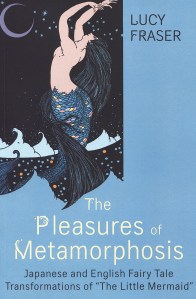
Title: The Pleasures of Metamorphosis: Japanese and English Fairy Tale Transformations of “The Little Mermaid”
Author: Lucy Fraser
Publication Year: 2017
Publisher: Wayne State University Press
Pages: 232

This guest review is by Annaleigh Marshall.

Lucy Fraser’s The Pleasures of Metamorphosis analyzes the idea of “pleasure” through the lens of mermaid stories, all of which branch from Hans Christian Anderson’s original “The Little Mermaid.” From a girl turning into sea foam to a man trying to have sex with a mermaid and then being eaten alive, Fraser uses the transformations present in the texts to show how different societies enjoy them and thus find pleasure in the tales. Through her feminist voice and academic knowledge of Japanese culture, Fraser reevaluates interpretations of both fairy tales and Japanese society.

The Pleasures of Metamorphosis is composed of six chapters, as well as an Introduction and Conclusion. Throughout her study, Fraser argues that the pleasure found in the idea of “The Little Mermaid” is achieved through the act of transformation. She discusses not only the legitimacy of being able to transform the fairy tale but also the ways in which this is done. Using concrete examples drawn from literature and film, Fraser shows how authors play with the ideas of Anderson’s original text.

Creators from both Western and Eastern backgrounds transform the figure of the mermaid, resisting the straightforward portrayal of an innocent girl becoming a male possession and transforming her into an adult woman on a journey to find herself within a society of gender norms and restrictive societal rules. The pleasure is in the journey of the characters, authors, and readers, and it exists within a conversation of laughter and societal critique that Fraser argues can only be created by a fairy tale. Fraser maintains a strong connection to the idea of transformation throughout the book, using evidence from multiples sources and disciplines.

Fraser makes it clear that she does not wish to compare the West to the East. Instead she wants to show the reader how fairy tales serve all of humanity as a safe way to critique our societies and experiment with concepts impossible to test in reality. The West and the East are in a cycle of constantly borrowing from one another, transforming and creating something new, sometimes to the extent that the original author does not recognize their own work’s influence. Fraser argues passionately for the idea of cross-cultural transformation, using “The Little Mermaid” as a case study and prime example. She also discusses other fairy tales, such as “The Snow Queen” and “Snow White,” but her primary focus is on the story of a youthful fish-girl going through a metamorphosis to enter the patriarchal world of adults.

Fraser’s writing style is detailed and specific, and she favors a system of presenting an idea and then illustrating this idea with lengthy examples. Often her detail-orientated perspective creates page-long discussions concerning minor details of a story. These extended explorations add strength to her argument that the pleasure of reading fairy tales lies in their transformations. Fraser shows how authors from Oscar Wilde to Japanese postfeminist writer Nonaka Hiiragi take Anderson’s original tale and use their own life experiences, national history, and personal beliefs to create unique retellings of “The Little Mermaid.” Sometimes these stories can act as methods to teach children proper social behavior, while sometimes they serve as a way to question our shared cultures and beliefs.

It should be noted the writing is not as accessible as it could be, as the author frequently uses academic jargon from Gender Studies, Folklore Studies, and Cultural Studies without sufficient explanation, expecting her reader to already understand her terms. The biggest problem lies in the author’s handling of Japanese-language expressions. Since she takes the time to explain these words, she seems not to take Japanese language proficiency for granted. Her explanations of these concepts can feel rushed, however, and she also refers to historical eras in Japanese history without providing a great deal of context, which can be alienating to readers unfamiliar with Japanese language or history.

Overall, I enjoyed reading Fraser’s informative study of the movement of fairy tales across national and cultural borders. By incorporating an interdisciplinary viewpoint, she is able to depict multiple perspectives on the transformative use of Anderson’s classic story as a means of understanding both society and individuals. As Fraser argues, we are all mermaids waiting for our metamorphosis, and the pleasure we find in mermaid stories exists in the potential for transformation.

* * * * *

Annaleigh Marshall is a rising senior double majoring in English and Modern Languages at George Mason University. She has previously published an essay on Hawai’ian Pidgin in the George Mason Review (link), and you can find her full professional profile on LinkedIn (link). Annaleigh is passionate about linguistics and translation, and she aims to enter the field of video game localization when she graduates.

The Book of Yōkai

the-book-of-yokai

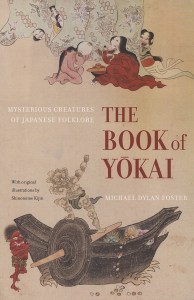
Title: The Book of Yōkai: Mysterious Creatures of Japanese Folklore
Author: Michael Dylan Foster
Illustrator: Shinonome Kijin (東雲 騎人)
Publication Year: 2015
Publisher: University of California Press
Pages: 309

This guest review is written by Katriel Paige (@kit_flowerstorm on Twitter).

Yōkai are part of an ongoing conversation surrounding global popular culture. Even in the United States we hear about yōkai through games like Pokémon and Yo-Kai Watch, and we happily watch films from Studio Ghibli that feature wondrous and strange creatures.

Although Michael Dylan Foster acknowledges that commercial cultures factor into the continued vibrancy of yōkai lore, The Book of Yōkai does not focus on the portrayals of yōkai in contemporary popular media and fan culture. Rather, the goal of this text is to provide an overview of the folkloristics of yōkai, from how thinkers and artists have interpreted yōkai to how the mysterious entities have been created, transmitted, and continually redefined. Foster is especially interested in how yōkai enthusiasts create their own networks of practice, with popular media cultures as one node in those networks. As he writes, “For many of my students in the United States, for example, the terms yōkai and Japanese folklore are practically synonymous; they have encountered kappa or kitsune or tengu in manga and anime, films and video games, usually in English translation. This exposure inspires them to delve further into folklore, to find the ‘origins’ of the yōkai of popular culture that they have come to love. And that is [a] purpose of this book, to provide some folkloric grounding for yōkai they might encounter” (6).

Foster succeeds in this endeavor, as The Book of Yōkai is an excellent overview, especially for those new to the study of folklore. In his first chapter, “Introducing Yōkai,” the author offers a short introduction to the shifting definition of the term “folklore,” reminding readers that, like yōkai themselves, “folklore” occupies a place-in-between, where it is both traditional and modern, rural and urban. Folklore, like yōkai, can be found both in the shadows of the forest and in the light cast by our computer screens. Just as there is no single definition of “folklore,” there is no single definition of “yōkai,” and Foster’s cogent explanations of liminality and communal creation serve as an excellent introduction to the study of cryptids and the legends surrounding them.

The Book of Yōkai is divided into two sections: “Yōkai Culture” and “Yōkai Codex.” The “Yōkai Culture” section is where the reader will find Foster’s discussions of the history of yōkai, beginning with the mysterious twilight entities of the classical Heian Period (c. 794-1185) and spanning to medieval picture scrolls illustrating yōkai night parades and early modern codices classifying both natural and supernatural phenomena. The majority of this section is centered around important texts, such as the mytho-historical Kojiki and hyakumonogatari compilations of ghost stories, and influential figures, such as the artist Toriyama Sekien and the scholar Inoue Enryō.

The “Yōkai Codex” describes yōkai according to their habitats, such as the countryside, the city, and the sea. This section is similar to the indexes seen in games that involve the collection of strange creatures, such Pokémon and Yo-Kai Watch. Foster’s “Yōkai Codex” also draws on and serves as a link to yōkai indexes past and present, most famously the illustrated yōkai compilations of the manga artist Mizuki Shigeru.

The writing is accessible to academics and non-academics alike, making The Book of Yōkai superb for independent scholars or a general reader with an interest in yōkai. Foster by and large avoids technical jargon, and he clarifies his treatment of Japanese words and names at the beginning of the book, which aids in cross-referencing with other sources. As a folklorist, Foster privileges the storytelling experience, using anecdotes to make the reader feel as if they are having a friendly chat with the author. Although the academic foundation of Foster’s text is solid, his colorful personal stories have the potential to resonate strongly with a non-academic audience.

The Book of Yōkai is a great resource for undergraduates, non-specialists, and other curious readers looking for a comprehensive English-language introduction to the historical complexities and artistic potential of yōkai. It is available in hardcover, paperback, and e-book editions from the University of California Press. Shinonome Kijin, who has provided thirty original illustrations for the text, can be found as @ushirodo on Twitter.

* * * * *

Katriel Paige is an independent scholar of yōkai as well as media cultures and folklore. They earned a MA in Intercultural Communication with International Business from the University of Surrey and a BA from the University of Delaware with a dual focus in East Asian Studies and English, and they currently work in the technology industry. They like cats, video games, and caffeine in both coffee and chocolate forms. You can find more of their work, including their essays on Japanese culture and video games, on their Patreon page.

the-book-of-yokai-page-73

The State of Play

The State of Play

Title: The State of Play
Editors: Daniel Goldberg and Linus Larsson
Publication Year: 2015
Publisher: Seven Stories Press
Pages: 256

This guest review is written by John D. Moore (@johndmoore5 on Twitter).

The State of Play is a collection of sixteen diverse essays on a variety of topics related to contemporary video game culture written by game creators, journalists, and academics. The collection comes from Seven Stories Press, a company that has demonstrated a dedication to publishing interesting and new kinds of books about video games in the last few years, including anna anthropy’s Rise of the Videogame Zinesters and The State of Play editors Daniel Goldberg and Linus Larsson’s own Minecraft. The essays consist of some previously published material as well as pieces original to or adapted for this volume. This is not a video game culture primer; while each essay does an adequate to great job of describing the particular corner of video game culture it explores, a basic familiarity with games and the popular discourse surrounding them is necessary to keep the reader from feeling disoriented.

The book is prefaced by a short introduction written by the editors that argues for its own necessity in the current climate of video game culture. The editors propose the term “post-escapism” for our present moment, pointing to a paradigm shift for independent game production and video game criticism symbolized by – if not initiated by – the miserable advent of Gamergate. As such, it explicitly announces its progressive stance against an oppositional conservative “side.” The majority of the essays have a definite progressive political slant, dealing primarily with race, gender, and sex. Not every piece is so politically conscious, such as level designer David Johnston’s rich account of his approach to designing CounterStrike maps and the tensions between level design and real-world architecture. Curiously, the introduction does not make reference to this or other pieces that fit this loose classification, and that lack of framing is disappointing. It does provide for their place obliquely by linking progressive politics to a progressive approach in writing about games as cultural objects that matter and are subject to the same scrutiny as other media.

There are as many approaches to writing as there are contributors in this volume. anna anthropy’s essay “Love, Twine, and the End of the World” is characteristically playful and borrows the format of a choose-your-own-adventure book, sometimes even inviting the reader-player to exit the book and take action elsewhere, advancing her cause for games as a powerful medium of self-expression. In “A Game I Had to Make,” Zoe Quinn writes of her experiences surrounding the development, release, and reception of her Depression Quest in an intimate and challenging second-person perspective, stylistically reminiscent of the text of her game. Cara Ellison and Brendon Keogh share a meandering correspondence about the meaning of violence and its dominance in contemporary video games, trying on frames like colonialism. History professor William Knoblauch offers a wide-reaching analysis of apocalyptic scenarios in games from the late Cold War to the present.

In one of the book’s finest pieces, Anita Sarkeesian and Katherine Cross describe their separate and varied stories of online harassment, putting them together to expose their common threads of misogyny that are, in turn, pervasive in mainstream video games and video game culture, dehumanizing and objectifying real women as non-player characters. Sarkeesian includes a harrowing sample of the threats she received. It is a vivid and accessible chapter that succeeds in succinctly delivering many of the main points of Sarkeesian’s Feminist Frequency project and I’d nominate it as required reading for anyone involved in video games.

With no thematic divisions, there is no clear structural logic to the book’s presentation, though some of the juxtapositions provide provocative or synergistic effects when read together. Evan Narcisse’s “The Natural: The Parameters of the Afro,” an exploration of black representation in games, pairs very neatly with Hussein Ibrahim’s “What It Feels Like to Play the Bad Guy,” about playing first-person shooters where the only in-game people who look like the author are presented as enemies and the representations of his culture are often ludicrously inaccurate. Together, these issues connect to the next essay by Quinn in a way that opens up broader questions about embodied experiences. Other essays, especially toward the end of the collection, seem arranged at random.

In these pages, it is unfortunately rare to see an acknowledgement of the specific regional discourse the writers are talking about, even as Japanese companies (which are admittedly multinational, with major global presences) are routinely referenced. An exception is in one of the standout pieces of the collection, in which merritt kopas examines the intersection of sex, games, consumerism, and culture, arguing that the intertwining of these themes in mainstream game productions is a reflection of our society’s misogynistic and problematic relationship to sex. While she acknowledges that her discussion might be applicable in some areas to other cultures, she emphasizes that her focus is on her own American context. This statement stands in contrast to the introduction, which identifies the mainstream game industry as historically preoccupied with the “young, white, Western male” from its genesis. That of course applies to what would generally be termed the Western video game market since the late 1980s, but it seems to dodge the problem of other major markets, or at the very least the Japanese market. Oli Wikander, a professor of Religious Studies, offers a strong exception, examining Western theology and Gnosticism in 1990s Japanese role-playing games. It’s an excellent piece, but its position at the back of the volume seems to speak to its outsider status.

The book would have benefited from more careful editing on both macro and micro scales. There are a few more instances of awkward grammar and spelling mistakes than I’m accustomed to seeing. In addition, only a handful of the pieces cite their sources, which is disappointing. Predictably, those who cite are among the small handful of academics in the collection.

On a related note, my biggest complaint about the book is its lack of contextualization. At least three essays were originally written for their authors’ blogs, and I think it would strengthen the book to contextualize these articles as such. Short introductions preface each piece, but they mainly serve to specify the topic of the essay. This book was published in 2015, so it is mildly confusing when Ian Bogost’s piece on the fantastic stupidity of Flappy Bird and video games at large, originally posted at The Atlantic, refers to “last summer” but means the summer of 2013. The nature of blogging tends to produce writing that is very reactive to its moment and the broader online ecosystem of blogging. These repurposed bog posts are all fine pieces by themselves, but their transition between media calls for some more compensation than the book provides. Another example would be Dan Golding’s fine specimen of rhetoric “The End of Gamers,” originally a 2014 Tumblr post, in which Golding opts to not delve into the events commonly credited for spearheading Gamergate, deeming it not worthy of consideration. Given the priorities of his post, this makes sense on Tumblr. The nature of a print anthology, however, would almost certainly benefits from a stronger historicization either in the text or in footnotes, especially if it aspires to continued relevance.

While the collection’s lack of an absolute unifying coherence is arguably a weakness, it is simultaneously a strength. The diversity of content allows for a wide range of examples of different ways people are approaching video games. The collection and availability of the pieces that were originally published online in a physical book has great value, preserving them from the vicissitudes of ephemeral news cycles. To give an example, in researching this review I discovered that Shanahan’s essay has disappeared from its original home on the Internet. While it remains available elsewhere online for the time being, it would be a shame if it were ever lost to the Internet’s ever-growing cemetery of failed servers and expired domains.

The book’s inclusion of essays on so many varied subjects from so many different angles inspires an excitement concerning the existence of new possibilities and fresh approaches that even this wide-reaching collection cannot accommodate. The collection’s title, The State of Play, suggests a sort of crystallization of all the current discourse surrounding games. I would love to see something like this turn into a series, chronicling these conversations as they continue to evolve in coming years.

The State of Play is strongly recommended for any reader with an interest in the current culture of video games and how we talk about them. Each individual essay could provide, at minimum, a jumping-off point for a spirited discussion on a major topic in contemporary video game culture. Indeed, I can imagine this volume providing the backbone for a unit in a college course. To that end, it’s worth noting that Seven Stories Press offers (free examination copies of its titles to professors.

* * * * *

John D. Moore is an M.A. student in the Department of East Asian Languages & Literatures at the University of Oregon researching Japanese anime in general and Mobile Suit Gundam in particular. He is also a filmmaker and hobbyist developer of several dozen freeware video games, including Caverns of Khron and ExpandoScape.