Audition

Title: Audition
Japanese Title: オーディション (Ōdishon)
Author: Murakami Ryū (村上龍)
Translator: Ralph McCarthy
Publication Year: 2010 (America); 1997 (Japan)
Publisher: Norton
Pages: 191

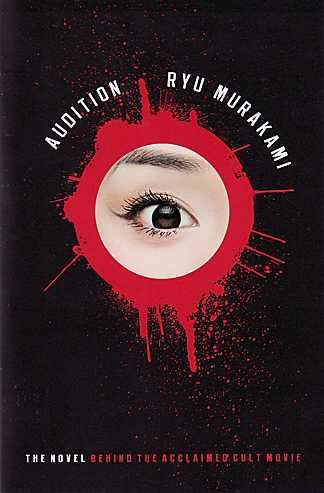
The first order of business in any review of Audition should be to spoil the plot. (If you don’t want to know what happens, don’t read this review. Don’t look at the front cover of the book, either.) My justification for giving everything away is that the ending of this book lends such a delicious flavor to the rest of the story that trying to keep it a secret is pointless, and probably fairly cruel as well.

With that in mind, the premise of Audition is as follows: a middle-aged producer named Aoyama is looking to re-marry after his son mentions that Aoyama’s wife, Ryoko, died seven years ago and that it’s time for him to move on. Since Ryoko was such a wonderful woman, and since Aoyama is more or less satisfied with his current life, however, his standards in women are high. Aoyama’s friend and fellow producer Yoshikawa suggests that Aoyama interview prospective brides as part of a film audition tailored to his specifications. Aoyama reluctantly agrees and ends up meeting Yamasaki Asami, a beautiful 24-year-old woman who seems perfect in every way. Yoshikawa is suspicious of Asami, but Aoyama has fallen head-over-heels in love with her and will have no one else. It turns out that Yoshikawa has every reason to be suspicious, since Asami has a bad habit of drugging and torturing her boyfriends who cannot love only her. Does this include the sincere and good-intentioned Aoyama? You bet it does. The final thirty pages of Audition are a torture-fest graphic enough to test even the most strong-stomached of readers, even as they delightfully revel in the violence and subtle sexuality of the scene.

I generally find comparisons between books and movies to be boring and pointless, but director Miike Takashi’s 1999 adaptation of Audition is such a cult classic that I feel it should be mentioned. Is the novel different from the movie? Of course it is. It goes without saying that certain plot elements are different, but perhaps the most interesting difference is that, while the film focuses on the back story of Asami, the novel pays much more attention to Aoyama. Thus, the horrifically grotesque images associated with Asami’s apartment are missing from the novel. Instead, the reader is party to Aoyama’s absolute fixation with Asami in a brilliant parody of the genre of romance. For example, Murakami describes Aoyama seeing Asami in person for the first time as an amazing, magical moment:

Silhouetted against the off-white walls, she walked to the chair, bowed with modest grace, and sat down. That was all, but Aoyama had a very distinct sensation that something extraordinary was happening all around him. It was like being the millionth visitor to an amusement park, suddenly bathed in spotlights and a rain of balloons and surrounded by microphones and flashing cameras. As if luck, normally dispersed in billions of tiny, free-floating, gemlike particles, had suddenly coalesced in a single beatific vision – a vision that changed everything, forever.

Oh, Aoyama, if only you knew! The dramatic irony of passages like this is superb, and there are a lot of them to enjoy, each one more imaginatively written than the next. Also, since the written word does not have quite the visual power of the silver screen, Asami’s sexuality and sex appeal are presented differently as well, again from the perspective of Aoyama. We never get to see her in knee-high boots and a black rubber apron, but her “hard, tender nipples” and “lust-crazed pussy” are mentioned more than a few times as the book approaches its climax, so to speak. In the end, though, the novel is infinitely less gut-wrenchingly visceral than the film. I think both the film and the novel are brilliant texts, but the novel is much more accessible to a broader audience.

(By the way, I am not kidding about how hideously upsetting the film is. If you have not seen Audition, don’t see Audition. I’m serious. It’s traumatizing. Read the book instead.)

Before I end this review, I’d like to briefly address the issue of the book’s sexism. Although the story may seem to reference the female revenge scenario, the fact that Asami is certifiably insane, as well as her presentation as utterly inhuman and her complete lack of interiority, cancel out any sort of argument for female agency or empowerment. The real case against patriarchal privilege is made through Aoyama. Although Aoyama seems like a decent guy in many ways, the underlying current of his thinking is undeniably sexist. Precisely because Aoyama comes off as such a nice guy, the critique of his sexism and the broad societal sexism that informs it is much more effective. In the book’s closing lines, Asami calls Aoyama a liar, and she is right, even if her words are unintelligible save when voiced by Aoyama’s son. Make no mistake, Audition is written from a completely male perspective, but the light it sheds on how sexism is tied to contemporary Japanese masculinity is interesting and invaluable.

The Walking Man

Title: The Walking Man
Japanese Title: 歩くひと (Aruku hito)
Artist: Taniguchi Jirō (谷口ジロー)
Publication Year: 2004 (England); 1992 (Japan)
Publisher: Fanfare / Ponent Mon
Pages: 155

Taniguchi Jirō is a popular manga artist that I’m always surprised more people don’t know about. His beautifully detailed, hyper-realistic artwork is simply amazing. The other day I stumbled across his one-volume manga The Walking Man in an independent bookstore, and the cover was so gorgeous that I went ahead and paid the import price for the book. It was worth it. As soon as I got home and finished reading it, I immediately read it again. That’s how wonderful and immersive the art is.

The Walking Man doesn’t tell a story, necessarily; it merely depicts a series of walks taken by its middle-aged protagonist. Each eight-page chapter has a broad theme, like taking the trash out at night or finding a shortcut through a narrow alley. The reader follows the protagonist on his walks, which are laid out in a beautiful use of paneling with a minimum of text and sound effects. The rich visual detail and minimalist storytelling make the reader almost feel as if he or she is actually walking along through the small-town Japanese cityscape inhabited by the protagonist. As a result, flipping through this manga is a thoroughly engaging experience.

For manga fans who might appreciate more conventional dramatic storytelling (and slightly less cartoonish character designs), Taniguchi’s later, two-volume A Distant Neighborhood (1999) is also a compelling read. Although the subject matter is quite different, readers who enjoy nostalgic slice-of-life manga featuring normal people moving through detailed visual depictions of Japanese cities might also consider checking out Kōno Fuyumi’s Town of Evening Calm, Country of Cherry Blossoms (2003), which follows several generations of Hiroshima survivors in a story that is touching but never overly political. Perhaps illustrations of everyday life such as those contained in the work of Taniguchi and Kōno don’t have the immediate, flashy appeal of more mainstream series, but there’s a lot to enjoy and appreciate in these manga, and I think every anyone who reads Japanese literature should at least give them a chance.

Slum Online

Title: Slum Online
Japanese Title: スラムオンライン
Author: Sakurazawa Hiroshi (桜沢洋)
Translator: Joseph Reeder
Publication Year: 2010 (America); 2005 (Japan)
Publisher: Haikasoru
Pages: 210

Slum Online is a short novel about MMORPG gaming. I was skeptical of this concept at first, as I wondered how level grinding, ammunition collection, and/or interpersonal dialog along the lines of “omg n00b pwned” could be any less tedious in fiction than in real life (so to speak). Thankfully, the fictional game in question is a fighting game, and its setup and mechanics are both simple enough to be understood by a non-gamer and complex enough to not lose their freshness after two hundred pages.

I was also worried that, since the novel’s cover (which is a mirror of the original Japanese cover) sports a manga-style illustration, Slum Online would be nothing more than a light novelized plot worthy of an anime (whose plots and dialog tend to not work so well without the animation). Again, my worries were unfounded, since the story more or less eschews anime tropes and works fairly well as fiction that can be read by someone not familiar with the quirkiness of characters like Suzumiya Haruhi and Lina Inverse.

Slum Online follows an older teenager named Etsuro through his real and virtual life. In real life, he is a college student pursued by a classmate named Fumiko who is pursuing a blue cat through the streets of Shinjuku. In his virtual life, he is a karate fighter named Tetsuo who is pursuing a mysterious player known as Ganker Jack while being pursued by a ninja character named Hashimoto. The novel’s chapters alternate between Tetsuo’s real life and his virtual life, but there is little disconnect between the two; and, in the end, they come together quite nicely. It’s equally amusing for the reader to follow Etsuro through the backstreets and arcades of Shinjuku as it is to follow Tetsuo and Hashimoto through the alleyways and watering holes of the gaming world. Moreover, the cast of characters in either world is equally interesting, especially as they interact with each other across both worlds.

I wouldn’t call Slum Online science fiction, necessarily, and it doesn’t quite belong in the realm of cyberpunk, either. I found it quite realistic in its depiction of gaming technologies, their applications, and the cultures that surround them. Nobody is downloading anything directly into their brains or raving about the awesome theoretical potential of cyberspace. The characters go to school and go to work like anyone else, and the only men in black suits are the salary men on the commuter trains. Everyone knows what Google and Wikipedia and Playstation are. I personally found it refreshing to read a story about real kids playing video games. No one is a hacker, and there aren’t any cyber police; it’s just a kid and his game console and his online network.

There’s no nonsense in the book about not being able to tell the difference between the real world and the cyber world either, although Etsuro’s language occasionally betrays how his awareness of the real world is influenced by gaming. He describes hearing things in terms of “sound FX” and perceiving people’s faces in terms of polygons or anime-inspired designs. As he walks around Shinjuku, he remarks how convenient it is to not have to worry about running into invisible walls, and how in real life one can’t just approach someone and start a conversation as if he or she were an NPC. Despite (or more likely because of) his mild geekiness, Etsuro is an amusing and sympathetic narrator.

Slum Online should be a fun read for gamers, and I think it should even be a fun read for non-gamers, who won’t be alienated by any specialist vocabulary. The translation is smooth and readable, the narrative flows quickly and seamlessly, and the layout is professional and engaging. The only bad thing I might have to say about this book is that it tends to come off as male-dominated, but whatever – I enjoyed it anyway.

Anime from Akira to Howl’s Moving Castle

Title: Anime from Akira to Howl’s Moving Castle: Experiencing Contemporary Japanese Animation
Author: Susan J. Napier
Publisher: Palgrave Macmillan
Publication Year: 2005
Pages: 355

Although I consider myself a literature person, it might be better to call what I do “media studies.” I write papers about books, but I also write more than a few papers about movies, and at least half of the Japanese movies I watch and write about these days are animated. This is something I wouldn’t have dreamed that I’d be doing when I first entered graduate school. For whatever reason, however, I read the 2005 updated edition of Susan Napier’s book on anime during my first winter break and was so inspired that I decided to start writing about popular media, too.

I had taken a lot from Napier’s two earlier books on literature (Escape from the Wasteland and The Fantastic in Modern Japanese Literature) as an undergraduate, so I’m not sure why it took me so long to sit down and starting reading Anime. If I had to guess, it probably had something to do with the bad reputation the book had (has?) among anime fans. I didn’t have a particularly strong impression from the chapters on magical girls from the original 2001 edition that I had read as a freshman in college (probably because I was eighteen years old), and several people had said that the book is poorly written, gets plot points wrong, and doesn’t respect anime as a medium.

My experience of reading the book was completely the opposite of the bad rumors I had heard. The first chapter of the book (appropriately titled “Why Anime?”) explains why Japanese animation is amazing and exciting and well worth academic attention, and I feel like it conveys a great deal of appreciation and respect for the medium. Also, I’ve seen my fair share of anime, and I’m a member of the generation that is old enough to have seen most of the works Napier discusses in Anime. Upon re-reading the book this past semester, nothing jumped out at me as overtly incorrect in terms of plot or character summary (but, then again, I have never finished and do not plan to ever finish watching Ranma 1/2, so I am willing to admit that I could be wrong). Finally, I think the writing is wonderful. Napier’s prose is clear, precise, and easily understandable by anyone who has neither a long history of watching anime nor a long history of studying Japan. Her writing is also enjoyable to read, as it is occasionally augmented by clever and poetic turns of phrase and various well-placed rhetorical devices that help her make her argument.

Anime is more or less written as a textbook for university-level students. It covers about two dozen films, television series, and OVA’s, usually focusing on two or three primary works over the course of each 20-25 page chapter. The book is broadly divided into three parts according to what Napier sees as the three essential modes of Japanese animation: the apocalyptic, the carnivalesque, and the elegiac. Woven throughout these modes are the three themes of technology, the body, and history. Chapters have titles like “Ghosts and Machines: The Technological Body,” “The Enchantment of Estrangement: The Shōjo in the World of Miyazaki Hayao,” and “Waiting for the End of the World: Apocalyptic Identity.” Although many of the works she discusses could belong in multiple chapters, I feel that Napier chooses her primary works for each chapter extraordinarily well and uses representative works to make strong arguments about various trends in contemporary Japanese animation.

Is there a danger of occasional overgeneralization? You bet. But so must there be in any entry-level textbook. A casual reader might run the risk of thinking, for example, that all Japanese animated pornography is fantastically grotesque after finishing the chapter “Controlling Bodies: The Body in Pornographic Anime” (which discusses such classics as Legend of the Overfiend and La Blue Girl), but Napier is always careful to qualify her argument and choice of texts not only within her main discussion but also in her footnotes, which document the sources from which Napier is drawing her conclusions, alternate texts for consideration, and interpretations that are at odds with her own.

Napier reads animation like a literature scholar would read a book, although her focus, understandably, seems to fall on visual imagery. Her readings of the texts follow two lines: psychoanalytic and socio-historic. Since Anime is targeted at undergraduates, neither line of interpretation is ever allowed to become too esoteric. A standard knowledge of Freudian psychology and basic sociology should suffice for the reader, who runs no danger of being confronted with Lacan’s objet petit a or the superstructures of Frederic Jameson. Nevertheless, Anime is far from mindless, and anime fans looking for extended plot summary followed by commentary, insights provided by interviews with directors, or viewing recommendations would probably best be served elsewhere.

I firmly believe that Anime works very well as an introductory textbook. It’s filled with interesting general ideas, and Napier’s clear language and precise structuring make these ideas easy to understand and debate. You don’t have to take my word for it, though, since there are plenty of other opinions floating around the internet. William Gardner (a scholar of science fiction) is happy that the book doesn’t seem like it’s written for otaku; Adam Arnold (a reviewer on Animefringe) is unhappy that the book doesn’t seem like it’s written for otaku. A reviewer for the Anime News Network claims that the book can be enjoyed as long as one is willing to accept the academic context; a reviewer for Hofstra Papers in Anthropology claims that the book can be enjoyed as long as one accepts that the academic context is not rigorous enough. Wherever you fall along this spectrum, Anime is a fun and inspiring book, and it contains a lovely ten-page bibliography that’s good to browse through for further reading on both the fun end and the serious end of writing on Japanese animation.

Little Boy

Title: Little Boy: The Arts of Japan’s Exploding Subcultures
Editor: Takashi Murakami
Publisher: Japan Society Gallery
Publication Year: 2005
Pages: 300

Little Boy is most definitely the contemporary Japanese art exhibition catalog to end all art exhibition catalogs. It quickly sold out when it was first released, and secondhand copies now sell for ridiculous amounts of money. The Japan Society of New York has finally released a softcover edition, which it sells in its headquarters in New York City. The new edition is just as gorgeous and well put together as the original hardcover version; so, if it’s at all possible for you to acquire one, go for it! Quickly! Do it now! Before you even start reading this review! Yes, it’s that good.

The first one hundred or so pages of this catalog feature full color plates of various artworks, photographs, and screen stills. Through these plates, pop artist extraordinaire Murakami Takashi attempts to demonstrate in images the thesis of his introductory essay “Earth in my Window.” Murakami’s main argument can be summarized in two points. First, the Pacific War, especially the two atomic bombs that ended it, left an indelible scar on the Japanese psyche. Second, the experience of having been defeated in war and thereafter occupied by America has turned multiple generations of Japanese people into perpetual children. The first point is illustrated by plates demonstrating recurring nuclear imagery in films and television serials such as Akira and Neon Genesis Evangelion and various tokusatsu (“special effects”) films released by Tōhō Studios, as well as in the artistic output of artists like Yanobe Kenji and Murakami himself. The second point is easily demonstrable by the overtly cartoonish and childlike work of artists such as Nara Yoshitomo, Ban Chinatsu, and Mr., as well as by the designs of popular and festishized kyara (“characters”) like Hello Kitty. Following these images and explanatory essay is a short manifesto penned by Murakami to support his superflat art movement, which is apparently based on the idea that contemporary Japan needs art that reflects its current cultural status of being awash in meaningless junk.

Next up is a transcription of a conversation between Okada Toshio and Morikawa Kaichirō (two self-proclaimed experts of “otakuology”) moderated by Murakami. Morikawa in particular states that otaku are characterized by an obsession with things that are dame (absolutely useless), whether it’s collecting antique model kits or falling in love with moe (young and innocent) characters. Okada seems to have a somewhat more optimistic view of otaku, who he thinks are simply resorting to childish things in order to escape a meaningless and unforgiving life. This conversation is superbly illustrated by images of the cultural paraphernalia the two men mention, and it also includes several dozen footnotes explaining their various obscure otaku references.

Following this conversation are two academic essays by Japanese scholars, Sawaragi Noi and Matsui Midori. Sawaragi discusses how the Pacific War has filtered through Japanese pop culture in movies like the Godzilla and Space Battleship Yamato series, and Matsui discusses the subculture of kawaii (“cute”) in postwar Japan, especially in terms of how it is connected to art depicting women and art by women artists like Takano Aya and Mizuno Junko. Following these two essays by Japanese authors are two essays by American authors, Alexandra Munroe and Tom Eccles. Munroe offers a history of otaku subculture from the perspective of a Western observer, and Eccles attempts to situate the superflat movement with the history of Western pop art. All of these essays (as well as everything else in the catalog) are presented in both English and Japanese, with a column of English text on the left and a column of Japanese text on the right. Finally, the “Further Readings” section at the end of the book is an invaluable six-page bibliography of related works in both English and Japanese.

In short, Little Boy is gorgeous, fun, and intelligent. The dual language presentation is unobtrusive for readers of one language but wonderful for readers of both. Murakami’s presentation of Japanese culture itself is both extremely interesting and highly controversial. This catalog is a work of art and an object of culture in and of itself. No matter what your field of interest is, I highly recommend picking up a copy before they’re all gone.

Shojo Manga! Girl Power!

Title: Shojo Manga! Girl Power!: Girls’ Comics from Japan
Editor: Masami Toku
Publication Year: 2005
Publisher: Flume Press
Pages: 80

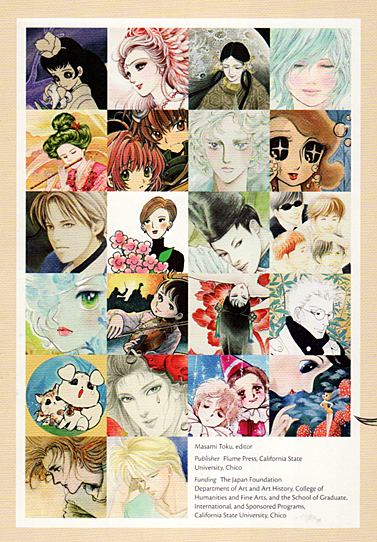
Judging from its front and back cover, you might expect this catalog to contain big, glossy reproductions of artwork gleaned from shōjo manga, like watercolor cover illustrations or the artistic two page spreads that are a defining characteristic of the genre. Aside from six color pages in the middle of the volume, however, there are relatively few images, and majority of the book is printed in black and white.

What this volume does contain are thirteen essays, each three pages long, on the phenomenon of shōjo manga, manga in general, and the impact of Japanese comics on America, followed by page-long profiles of twenty-three manga artists. The essays mainly repeat the same outdated information and stereotypes about manga (and gender) that you can find anywhere. Typical of these short essays is the misleading and essentially meaningless line, “The popularity of the genre [of boys’ love] is reflective of the fact that in Japan, male love, loyalty, and companionship are considered of the highest virtue (Toku).” A few of the essays are well worth reading, however. One of them is Yoko Nagakubo’s essay “Yaoi Novels and Shojo Manga,” which contains the most reasonable explanation concerning gender identification in boys’ love manga that I have ever come across. Another is Frederick Schodt’s “A Different View,” which seeks to correct some of the most widespread American misconceptions about the Japanese manga industry (and which seems surprisingly prescient in light of the current crisis facing the American manga industry).

The main selling point of the book are the artist profiles. These profiles list two or three major works of each creator and briefly cover his or her thematic preoccupations. Each profile is accompanied by one or two small, black-and-white (but still gorgeous) illustrations that demonstrate the artist’s style. Most of these artists are still relatively unknown in America, as only a small handful of them have been translated into English. (And, even if their works have been translated, as is the case with Ikeda Ryōko of Rose of Versailles fame, they are almost impossible to find.) They include Watanabe Masako, Maki Miyako, Mizuno Hideko, Satonaka Machiko, and on and on.

In other words, this exhibition catalog might not be the most beautiful or academically rigorous book ever published, but it serves as an extremely useful field guide to the history of shōjo manga through its creators. It’s also an excellent reading guide, highlighting a manageable number titles as well as the reasons why they are important and enjoyable. I’m definitely taking this book along with me the next time I visit Japan.

Most major university libraries own a copy of this 2005 exhibition catalog; but, since there have recently been several copies floating around the internet (on Amazon and eBay), I thought I’d snag one for myself before they disappear. If you’re interested, I would encourage you to do the same!

Magic as Metaphor in Anime

Title: Magic as Metaphor in Anime: A Critical Study
Author: Dani Cavallaro
Publication Year: 2010
Publisher: McFarland
Pages: 212

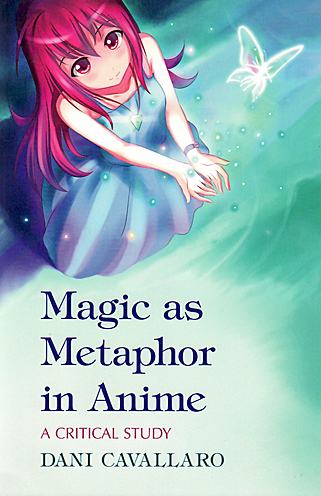
When Amazon recommended this book to me, I was really excited. What an interesting topic! I haven’t had good experiences with Dani Cavallaro’s work in the past, however. I felt that her books on the films of Oshii Mamoru (The Cinema of Oshii Mamoru: Fantasy, Technology and Politics, 2006) and Studio Gainax (The Art of Studio Gainax: Experimentation, Style and Innovation at the Leading Edge of Anime, 2009) were somewhat shallow and, to be frank, extraordinarily difficult to read. In these two books, Cavallaro has devoted five or six pages to films and television series to which other scholars have written thirty to forty page articles and chapters. Each of her essays reads like an outline – she skips from topic to topic with no development and little transition, using theoretical and philosophical terms without explaining what they mean in context and without giving examples. In this way, she can cover an exhaustive list of material, but it doesn’t seem like she has much to say. Since its table of contents would suggest that Magic as Metaphor focuses more on broader themes, though, I thought I would at least check it out from my university’s library and give it a shot.

Unfortunately, Magic as Metaphor is unreadable. I found so many things about this book frustrating that I don’t even know where to begin. I suppose I should start with the least damning of my criticisms: Cavallaro discusses an enormous number of titles. Her “Filmography” section at the back of the book lists forty-one primary titles (many of which are simply successive seasons of the same franchise). She’s got roughly seventy other ancillary titles listed, however, just in case the main forty weren’t enough. Even if we focus on the main titles, though, she still has less than 190 pages to talk about thirty or so anime franchises, which equals about six pages devoted to each of them. So yes, there is quite a bit of breadth, and I admire Cavallaro for being able to watch and keep track of so many titles (many of which came out quite recently); but again, it feels like she’s writing only marginally fleshed-out outlines, and the way she jumps from title to title and from concept to concept is disorienting. It’s also almost impossible to ascertain the main point of each chapter, and the way that various anime are included in the various chapters comes off as almost random.

In addition to her shallow discussions and poor structuring, I also feel like Cavallaro isn’t saying anything interesting. Certainly, she will quote key thinkers (like Tzvetan Todorov and Wikipedia) and then quickly move on without explaining what these quotes mean or how they relate to her argument, but most of her discussion is plot summary. Not explication through plot summary, but explanatory text that could be taken from an entertainment journalist’s review of a particular title. Her description of characters and themes often stems from the most simple and most obvious interpretation possible, as if it came off of the back of a DVD box. I am exaggerating, of course, but only a little bit. Certain sentences stand out as being insightful and useful and meaningful, but they are rare and isolated from one another.

The writing itself is terrible, ranging from overly flowery diction (“CLAMP’s passion for ocular impairment”) to purple prose (“whereas Lydia’s expression invariably exudes infinite kindness and compassion, Raven’s holds a malevolent light soaked with unspeakable sadness”) to condescension (“Earl and Fairy makes reference to so bountiful a range of magical entities as to occasionally come across as a concise guide to the spirit world for newbies”). Her paragraphs rarely have topic sentences, and there are no strong conclusions to be found anywhere. She quotes inane movie reviews as if they were scholarship and often uses these idiotic quotes (“Sousuke is ‘one of those adorable anime moppets with large round eyes’ amid ‘many a winsome tummy-poke and nose-wiggle’”) to close paragraphs. Things like this occur so frequently that I found myself growing increasingly frustrated as I read. In short, the writing in this book toes the line between journalism and scholarship but, unfortunately, contains none of the pleasures of either.

You may be asking yourself why I read the book if it was so bad. The answer is that I didn’t. I read one chapter (“Magic Bildungsromans”) and then threw the thing against the wall. It may be possible that I picked the worst chapter to read, and it may also be possible that the rest of the book is sheer brilliance, but I highly doubt it. Cavallaro has six other books about anime in print through McFarland, and all of them have been published in the last five years. These do not include the numerous other works she has published on cyberpunk through other publishers in the past five years. Simply put, Cavallaro is a writing machine, and her output indeed reads like it was written by a machine. I have found some of her work, especially Anime and Memory: Aesthetic, Cultural and Thematic Perspectives (2009) to be useful as a guide for viewing recommendations. Otherwise, it’s best to approach her books with caution, and with a library card instead of a credit card.

In all fairness, Cavallaro’s books are more than capable of carrying their weight as reference guides to Japanese animation (as opposed to “critical studies”), but I myself prefer the work of British anime scholar Helen McCarthy, whose books are less pretentious and infinitely more enjoyable to read. They also have more pictures, which is always a good thing where visual media is concerned.

The Summer of the Ubume

Title: The Summer of the Ubume
Japanese Title: 姑獲鳥の夏 (Ubume no natsu)
Author: Kyōgoku Natsuhiko (京極夏彦)
Translator: Alexander O. Smith and Elye J. Alexander
Publication Year: 1994 (Japan); 2009 (America)
Publisher: Vertical
Pages: 320

Reading The Summer of the Ubume was like being in a trance. Honestly, it feels weird to not be reading the book right now, but I imagine that I’m going to be reading it again soon. I haven’t been this engrossed in a book since I read Harry Potter and the Deathly Hallows…

Which is not to say that Summer of the Ubume is in any way like the Harry Potter series, aside from its sheer literary addiction quotient. On the surface, the book presents a simple “sealed room” murder mystery. Underneath, however, is mystery upon mystery upon mystery. Running through these mysteries is a current of Japanese folklore, especially folklore concerning spirit possession. The “ubume” of the title is the ghost of a woman who died in childbirth and carries out her grudge against still-living mothers by stealing their infant children. This trope is connected to the household of a family that is just about as gothic as they come, with frail maidens and hereditary curses and hidden murders set on the stage of an almost abandoned hospital, which was designed by an insane architect and almost destroyed during the wartime firebombing of Tokyo.

The Summer of the Ubume is set in 1952 in the Nakano area, which used to be a residential district on the northwest periphery of Tokyo, a stone’s throw away from the prisons, insane asylums, and black markets of Ikebukuro. Its narrator is a man in his early thirties named Sekiguchi, a freelance writer who specializes in essays on supernatural incidents. Sekiguchi is friends with the brilliant yet antisocial proprietor of the Kyōgokudō used bookstore (which is the name his friends use to refer to him). Sekiguchi is the Watson to Kyōgokudō’s Holmes, and a great deal of the book is devoted to their conversations concerning metaphysical matters, which end up having a great deal to do with the mystery at hand.

In the course of his work (which borders on yellow journalism), Sekiguchi has stumbled upon a rumor of a woman who, having been mysteriously deserted by her husband, has been pregnant for eighteen months. After asking several magazine editors about the source of the rumor, Sekiguchi becomes more intrigued. Due to a strange series of coincidences, the writer has the opportunity to meet the woman’s family, which is deeply dysfunctional in every possible way. As Sekiguchi learns more about these people, it turns out that his ties to them are deeper than he initially suspected.

The first chapter of the novel is a forty-page discussion of the supernatural between Kyōgokudō and Sekiguchi. Each page is dense with ideas and metaphysical language (not to mention text – the book’s margins are practically nonexistent), and neither Sekiguchi nor Kyōgokudō is presented in a particularly sympathetic light – Sekiguchi comes off as rather dense while Kyōgokudō is supremely abrasive. If the reader can weather this initial chapter, however, he or she will be rewarded with a deliciously convoluted mystery populated by a genuinely fascinating cast of characters. The action of the story reaches its climax 230 pages into the novel, which leaves 90 pages for the explanation of the mystery. Although this may seem like poor pacing, the explication is well-plotted, engrossing, and bizarre, reaching its own climax at the end of the novel.

The Summer of Ubume is Kyōgoku’s debut novel, and at times it does feel unpolished. The momentum of the story more than makes up for any flaws in the narrative’s structure, however. The occasional clichés implicit in the mystery (such as the uncertainty that is inevitably created when there are two almost identical sisters in a fictional family) are balanced by the writer’s unique take on the gothic genre. The novel’s setting in 1950’s Tokyo is fully taken advantage of by Kyōgoku, who skillfully renders the city as a sinister gothic landscape.

Although, as I mentioned, there is a greater emphasis on talking heads in this novel than is strictly necessary, the characters and setting are superbly handled, and the mystery is just about as addictive as they come. I can only hope that more of Kyōgoku’s work is translated into English as soon as possible.

The Devil’s Whisper

Title: The Devil’s Whisper
Japanese Title: 魔術はささやく (Majutsu wa sasayaku)
Author: Miyabe Miyuki (宮部みゆき)
Translator: Deborah Stuhr Iwabuchi
Publication Year: 1989 (Japan); 2007 (America)
Publisher: Kodansha International
Pages: 254

Some people say that Miyabe Miyuki is the Stephen King of Japan. I’m not sure exactly what that means, but I think it has something to do with the fact that she has published a hell of a lot of books (as well as scripts for radio dramas, manga, and video games). Her work is superlatively popular, and a great deal of it is dark or fantastic. She is perhaps best known in America for her murder mystery novels, which more often than not feature a killer who uses a magical or semi-magical power as his or her modus operandi.

The killer in The Devil’s Whisper is a hypnotist, as the book’s title implies. (I think I may have just given away what one of the blurbs on the back cover calls “a brilliant plot twist,” but I found it fairly obvious from the beginning of the novel.) He has hypnotized a young woman to run out in front of a taxi, thus making her death seem like a suicide. So far, so good. The driver of the taxi, however, is charged with vehicular manslaughter and imprisoned. His sixteen-year-old nephew, Mamoru, senses something fishy about the police reports and decides to investigate the matter himself. Mamoru is basically a decent kid, but he’s got some skeletons in his closet that come out to haunt him as the story progresses. The novel therefore presents two mysteries to the reader: what grudge does the hypnotist killer have against the women he murders, and why did Mamoru’s father abandon him and his mother when he was a young child? The way that these two plotlines come together at the end of the book is quite interesting and enjoyable.

Although The Devil’s Whisper does not suffer from an abundance of characterization, almost everyone comes off as sympathetic. Mamoru does indeed bear traces of several Stephen King characters like Danny from The Shining and Jack from The Talisman, who are bright and earnest boys placed in difficult situations. The killer comes off as a kind of Hannibal Lecter figure, as logical and urbane as he is insane. The real villains of the novel actually seem to be the young women who are being killed, although the reader is forced to wonder whether they really deserved to die.

In my eyes, the major weakness of Miyabe’s style is that she tells her reader what every character is thinking. This doesn’t necessarily have to be a flaw, but Miyabe will occasionally write entire sequences of paragraphs explaining the obvious. One of the first pieces of advice given to aspiring writers is to show, not tell. A relative clause depicting a character picking at her fingernail can say much more about her state of mind than an entire paragraph attempting to chart what is going on inside of her head. Since The Devil’s Whisper is only about 250 pages long, this type of inner explication is by necessity kept to a minimum, and a great deal of it is expressed in dialog, which partially reduces the level of tedium and keeps the action moving. Miyabe’s characters are interesting; but, unfortunately, none of them are so interesting that I want to know every thought that passes through their minds.

Overall, Miyabe’s mystery novels range from excellent (All She Was Worth) to decent (Shadow Family) to so horrible that they make me want to claw my eyes out (Crossfire). The Devil’s Whisper falls somewhere in the middle, and I would recommend it over many of Miyabe’s other titles available in translation.

Hotel Iris

Title: Hotel Iris
Japanese Title: ホテルアイリス
Author: Ogawa Yōko (小川洋子)
Translator: Stephen Snyder
Publication Year: 2010 (America); 1996 (Japan)
Publisher: Picador
Pages: 164

Hotel Iris is the third work by Ogawa Yōko to appear in print in America, following The Housekeeper and the Professor and The Diving Pool. Having read several of her works now, I think I am starting to get a feel for her style of writing, which is beautifully conveyed by translator Stephen Snyder. Ogawa takes the everyday and imbues it with a sense of strangeness. Nothing overtly fantastic happens in her stories, but everything is always a little unsettling. Something is always a little bit off. There is always a sinister current running underneath the mundane. In Ogawa’s novels, the petty cruelty of human beings is on full display, but it is up to the reader to uncover the mystery of a deeper cruelty. The questions that aren’t answered are more upsetting than the questions that are.

In Hotel Iris, a seventeen-year-old young woman named Mari has been forced to drop out of high school by her mother, who needs her to work at the family’s seaside hotel. Since Mari’s father has died, Mari’s mother has taken on a kleptomaniac housekeeper, who not-so-secretly steals from Mari. When, one night, a prostitute flees from one of the rooms in the hotel, Mari finds herself attracted to the older man from whom the woman flees. This older man, who lives by himself on an offshore island, is a translator of Russian. He falls in love with Mari, who craves the sexual masochism he displays when the two are alone. The specter of the man’s dead wife, whom he is rumored to have killed, haunts their relationship, which is further strained when the translator’s tongueless, college-age nephew stays over for a few days.

These relationships develop over the course of this short novel, which is narrated by Mari, who hints at her desires, frustrations, and rich inner world through anecdotes and observations instead of through direct statements. The novel unflinching depicts all manner of sexual acts, but its eroticism and sensory imagery are focused not on the meeting of bodies but rather on the depictions of small, everyday things, like a stain on a scarf, the music of an amateur, or the dripping of pizza grease. The narrative tension created by the almost constant yet varied reiteration of certain themes, like the fear of something hidden being uncovered or the uncertainty of how far violence can go, prevents the reader from ever settling into complacency concerning Mari’s life and her relationships.

In the end, I think, this is a novel about growing up, and all the psychological baggage that goes along with the process. Ogawa warps many psychological tropes (like the Oedipus complex) through her protagonist, however, and Mari’s loss of innocence is neither celebratory nor unproblematic. In many ways, Hotel Iris is something of an antidote to feel-good chick lit novels like Yoshimoto Banana’s Goodbye Tsugumi. It’s dark and it’s disturbing. Its themes and imagery are understated; and, although it has quite a great deal of forward momentum, it is never driven by its plot, much of which is left vague. In my opinion, this is a perfectly constructed and beautifully written novel. Please buy this. Please read it. Please tell all your friends about it. Ogawa has numerous novels translated into various European languages, and we really need more of her work translated into English.