Shojo Manga! Girl Power!

Title: Shojo Manga! Girl Power!: Girls’ Comics from Japan
Editor: Masami Toku
Publication Year: 2005
Publisher: Flume Press
Pages: 80

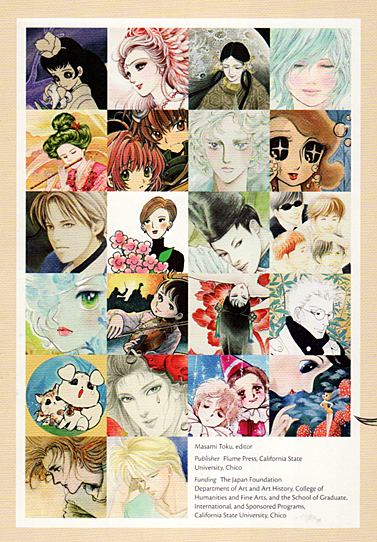
Judging from its front and back cover, you might expect this catalog to contain big, glossy reproductions of artwork gleaned from shōjo manga, like watercolor cover illustrations or the artistic two page spreads that are a defining characteristic of the genre. Aside from six color pages in the middle of the volume, however, there are relatively few images, and majority of the book is printed in black and white.

What this volume does contain are thirteen essays, each three pages long, on the phenomenon of shōjo manga, manga in general, and the impact of Japanese comics on America, followed by page-long profiles of twenty-three manga artists. The essays mainly repeat the same outdated information and stereotypes about manga (and gender) that you can find anywhere. Typical of these short essays is the misleading and essentially meaningless line, “The popularity of the genre [of boys’ love] is reflective of the fact that in Japan, male love, loyalty, and companionship are considered of the highest virtue (Toku).” A few of the essays are well worth reading, however. One of them is Yoko Nagakubo’s essay “Yaoi Novels and Shojo Manga,” which contains the most reasonable explanation concerning gender identification in boys’ love manga that I have ever come across. Another is Frederick Schodt’s “A Different View,” which seeks to correct some of the most widespread American misconceptions about the Japanese manga industry (and which seems surprisingly prescient in light of the current crisis facing the American manga industry).

The main selling point of the book are the artist profiles. These profiles list two or three major works of each creator and briefly cover his or her thematic preoccupations. Each profile is accompanied by one or two small, black-and-white (but still gorgeous) illustrations that demonstrate the artist’s style. Most of these artists are still relatively unknown in America, as only a small handful of them have been translated into English. (And, even if their works have been translated, as is the case with Ikeda Ryōko of Rose of Versailles fame, they are almost impossible to find.) They include Watanabe Masako, Maki Miyako, Mizuno Hideko, Satonaka Machiko, and on and on.

In other words, this exhibition catalog might not be the most beautiful or academically rigorous book ever published, but it serves as an extremely useful field guide to the history of shōjo manga through its creators. It’s also an excellent reading guide, highlighting a manageable number titles as well as the reasons why they are important and enjoyable. I’m definitely taking this book along with me the next time I visit Japan.

Most major university libraries own a copy of this 2005 exhibition catalog; but, since there have recently been several copies floating around the internet (on Amazon and eBay), I thought I’d snag one for myself before they disappear. If you’re interested, I would encourage you to do the same!

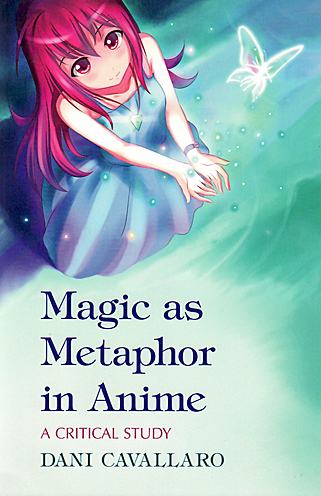
Magic as Metaphor in Anime

Title: Magic as Metaphor in Anime: A Critical Study
Author: Dani Cavallaro
Publication Year: 2010
Publisher: McFarland
Pages: 212

When Amazon recommended this book to me, I was really excited. What an interesting topic! I haven’t had good experiences with Dani Cavallaro’s work in the past, however. I felt that her books on the films of Oshii Mamoru (The Cinema of Oshii Mamoru: Fantasy, Technology and Politics, 2006) and Studio Gainax (The Art of Studio Gainax: Experimentation, Style and Innovation at the Leading Edge of Anime, 2009) were somewhat shallow and, to be frank, extraordinarily difficult to read. In these two books, Cavallaro has devoted five or six pages to films and television series to which other scholars have written thirty to forty page articles and chapters. Each of her essays reads like an outline – she skips from topic to topic with no development and little transition, using theoretical and philosophical terms without explaining what they mean in context and without giving examples. In this way, she can cover an exhaustive list of material, but it doesn’t seem like she has much to say. Since its table of contents would suggest that Magic as Metaphor focuses more on broader themes, though, I thought I would at least check it out from my university’s library and give it a shot.

Unfortunately, Magic as Metaphor is unreadable. I found so many things about this book frustrating that I don’t even know where to begin. I suppose I should start with the least damning of my criticisms: Cavallaro discusses an enormous number of titles. Her “Filmography” section at the back of the book lists forty-one primary titles (many of which are simply successive seasons of the same franchise). She’s got roughly seventy other ancillary titles listed, however, just in case the main forty weren’t enough. Even if we focus on the main titles, though, she still has less than 190 pages to talk about thirty or so anime franchises, which equals about six pages devoted to each of them. So yes, there is quite a bit of breadth, and I admire Cavallaro for being able to watch and keep track of so many titles (many of which came out quite recently); but again, it feels like she’s writing only marginally fleshed-out outlines, and the way she jumps from title to title and from concept to concept is disorienting. It’s also almost impossible to ascertain the main point of each chapter, and the way that various anime are included in the various chapters comes off as almost random.

In addition to her shallow discussions and poor structuring, I also feel like Cavallaro isn’t saying anything interesting. Certainly, she will quote key thinkers (like Tzvetan Todorov and Wikipedia) and then quickly move on without explaining what these quotes mean or how they relate to her argument, but most of her discussion is plot summary. Not explication through plot summary, but explanatory text that could be taken from an entertainment journalist’s review of a particular title. Her description of characters and themes often stems from the most simple and most obvious interpretation possible, as if it came off of the back of a DVD box. I am exaggerating, of course, but only a little bit. Certain sentences stand out as being insightful and useful and meaningful, but they are rare and isolated from one another.

The writing itself is terrible, ranging from overly flowery diction (“CLAMP’s passion for ocular impairment”) to purple prose (“whereas Lydia’s expression invariably exudes infinite kindness and compassion, Raven’s holds a malevolent light soaked with unspeakable sadness”) to condescension (“Earl and Fairy makes reference to so bountiful a range of magical entities as to occasionally come across as a concise guide to the spirit world for newbies”). Her paragraphs rarely have topic sentences, and there are no strong conclusions to be found anywhere. She quotes inane movie reviews as if they were scholarship and often uses these idiotic quotes (“Sousuke is ‘one of those adorable anime moppets with large round eyes’ amid ‘many a winsome tummy-poke and nose-wiggle’”) to close paragraphs. Things like this occur so frequently that I found myself growing increasingly frustrated as I read. In short, the writing in this book toes the line between journalism and scholarship but, unfortunately, contains none of the pleasures of either.

You may be asking yourself why I read the book if it was so bad. The answer is that I didn’t. I read one chapter (“Magic Bildungsromans”) and then threw the thing against the wall. It may be possible that I picked the worst chapter to read, and it may also be possible that the rest of the book is sheer brilliance, but I highly doubt it. Cavallaro has six other books about anime in print through McFarland, and all of them have been published in the last five years. These do not include the numerous other works she has published on cyberpunk through other publishers in the past five years. Simply put, Cavallaro is a writing machine, and her output indeed reads like it was written by a machine. I have found some of her work, especially Anime and Memory: Aesthetic, Cultural and Thematic Perspectives (2009) to be useful as a guide for viewing recommendations. Otherwise, it’s best to approach her books with caution, and with a library card instead of a credit card.

In all fairness, Cavallaro’s books are more than capable of carrying their weight as reference guides to Japanese animation (as opposed to “critical studies”), but I myself prefer the work of British anime scholar Helen McCarthy, whose books are less pretentious and infinitely more enjoyable to read. They also have more pictures, which is always a good thing where visual media is concerned.

The Summer of the Ubume

Title: The Summer of the Ubume
Japanese Title: 姑獲鳥の夏 (Ubume no natsu)
Author: Kyōgoku Natsuhiko (京極夏彦)
Translator: Alexander O. Smith and Elye J. Alexander
Publication Year: 1994 (Japan); 2009 (America)
Publisher: Vertical
Pages: 320

Reading The Summer of the Ubume was like being in a trance. Honestly, it feels weird to not be reading the book right now, but I imagine that I’m going to be reading it again soon. I haven’t been this engrossed in a book since I read Harry Potter and the Deathly Hallows

Which is not to say that Summer of the Ubume is in any way like the Harry Potter series, aside from its sheer literary addiction quotient. On the surface, the book presents a simple “sealed room” murder mystery. Underneath, however, is mystery upon mystery upon mystery. Running through these mysteries is a current of Japanese folklore, especially folklore concerning spirit possession. The “ubume” of the title is the ghost of a woman who died in childbirth and carries out her grudge against still-living mothers by stealing their infant children. This trope is connected to the household of a family that is just about as gothic as they come, with frail maidens and hereditary curses and hidden murders set on the stage of an almost abandoned hospital, which was designed by an insane architect and almost destroyed during the wartime firebombing of Tokyo.

The Summer of the Ubume is set in 1952 in the Nakano area, which used to be a residential district on the northwest periphery of Tokyo, a stone’s throw away from the prisons, insane asylums, and black markets of Ikebukuro. Its narrator is a man in his early thirties named Sekiguchi, a freelance writer who specializes in essays on supernatural incidents. Sekiguchi is friends with the brilliant yet antisocial proprietor of the Kyōgokudō used bookstore (which is the name his friends use to refer to him). Sekiguchi is the Watson to Kyōgokudō’s Holmes, and a great deal of the book is devoted to their conversations concerning metaphysical matters, which end up having a great deal to do with the mystery at hand.

In the course of his work (which borders on yellow journalism), Sekiguchi has stumbled upon a rumor of a woman who, having been mysteriously deserted by her husband, has been pregnant for eighteen months. After asking several magazine editors about the source of the rumor, Sekiguchi becomes more intrigued. Due to a strange series of coincidences, the writer has the opportunity to meet the woman’s family, which is deeply dysfunctional in every possible way. As Sekiguchi learns more about these people, it turns out that his ties to them are deeper than he initially suspected.

The first chapter of the novel is a forty-page discussion of the supernatural between Kyōgokudō and Sekiguchi. Each page is dense with ideas and metaphysical language (not to mention text – the book’s margins are practically nonexistent), and neither Sekiguchi nor Kyōgokudō is presented in a particularly sympathetic light – Sekiguchi comes off as rather dense while Kyōgokudō is supremely abrasive. If the reader can weather this initial chapter, however, he or she will be rewarded with a deliciously convoluted mystery populated by a genuinely fascinating cast of characters. The action of the story reaches its climax 230 pages into the novel, which leaves 90 pages for the explanation of the mystery. Although this may seem like poor pacing, the explication is well-plotted, engrossing, and bizarre, reaching its own climax at the end of the novel.

The Summer of Ubume is Kyōgoku’s debut novel, and at times it does feel unpolished. The momentum of the story more than makes up for any flaws in the narrative’s structure, however. The occasional clichés implicit in the mystery (such as the uncertainty that is inevitably created when there are two almost identical sisters in a fictional family) are balanced by the writer’s unique take on the gothic genre. The novel’s setting in 1950’s Tokyo is fully taken advantage of by Kyōgoku, who skillfully renders the city as a sinister gothic landscape.

Although, as I mentioned, there is a greater emphasis on talking heads in this novel than is strictly necessary, the characters and setting are superbly handled, and the mystery is just about as addictive as they come. I can only hope that more of Kyōgoku’s work is translated into English as soon as possible.

The Devil’s Whisper

Title: The Devil’s Whisper
Japanese Title: 魔術はささやく (Majutsu wa sasayaku)
Author: Miyabe Miyuki (宮部みゆき)
Translator: Deborah Stuhr Iwabuchi
Publication Year: 1989 (Japan); 2007 (America)
Publisher: Kodansha International
Pages: 254

Some people say that Miyabe Miyuki is the Stephen King of Japan. I’m not sure exactly what that means, but I think it has something to do with the fact that she has published a hell of a lot of books (as well as scripts for radio dramas, manga, and video games). Her work is superlatively popular, and a great deal of it is dark or fantastic. She is perhaps best known in America for her murder mystery novels, which more often than not feature a killer who uses a magical or semi-magical power as his or her modus operandi.

The killer in The Devil’s Whisper is a hypnotist, as the book’s title implies. (I think I may have just given away what one of the blurbs on the back cover calls “a brilliant plot twist,” but I found it fairly obvious from the beginning of the novel.) He has hypnotized a young woman to run out in front of a taxi, thus making her death seem like a suicide. So far, so good. The driver of the taxi, however, is charged with vehicular manslaughter and imprisoned. His sixteen-year-old nephew, Mamoru, senses something fishy about the police reports and decides to investigate the matter himself. Mamoru is basically a decent kid, but he’s got some skeletons in his closet that come out to haunt him as the story progresses. The novel therefore presents two mysteries to the reader: what grudge does the hypnotist killer have against the women he murders, and why did Mamoru’s father abandon him and his mother when he was a young child? The way that these two plotlines come together at the end of the book is quite interesting and enjoyable.

Although The Devil’s Whisper does not suffer from an abundance of characterization, almost everyone comes off as sympathetic. Mamoru does indeed bear traces of several Stephen King characters like Danny from The Shining and Jack from The Talisman, who are bright and earnest boys placed in difficult situations. The killer comes off as a kind of Hannibal Lecter figure, as logical and urbane as he is insane. The real villains of the novel actually seem to be the young women who are being killed, although the reader is forced to wonder whether they really deserved to die.

In my eyes, the major weakness of Miyabe’s style is that she tells her reader what every character is thinking. This doesn’t necessarily have to be a flaw, but Miyabe will occasionally write entire sequences of paragraphs explaining the obvious. One of the first pieces of advice given to aspiring writers is to show, not tell. A relative clause depicting a character picking at her fingernail can say much more about her state of mind than an entire paragraph attempting to chart what is going on inside of her head. Since The Devil’s Whisper is only about 250 pages long, this type of inner explication is by necessity kept to a minimum, and a great deal of it is expressed in dialog, which partially reduces the level of tedium and keeps the action moving. Miyabe’s characters are interesting; but, unfortunately, none of them are so interesting that I want to know every thought that passes through their minds.

Overall, Miyabe’s mystery novels range from excellent (All She Was Worth) to decent (Shadow Family) to so horrible that they make me want to claw my eyes out (Crossfire). The Devil’s Whisper falls somewhere in the middle, and I would recommend it over many of Miyabe’s other titles available in translation.

Hotel Iris

Title: Hotel Iris
Japanese Title: ホテルアイリス
Author: Ogawa Yōko (小川洋子)
Translator: Stephen Snyder
Publication Year: 2010 (America); 1996 (Japan)
Publisher: Picador
Pages: 164

Hotel Iris is the third work by Ogawa Yōko to appear in print in America, following The Housekeeper and the Professor and The Diving Pool. Having read several of her works now, I think I am starting to get a feel for her style of writing, which is beautifully conveyed by translator Stephen Snyder. Ogawa takes the everyday and imbues it with a sense of strangeness. Nothing overtly fantastic happens in her stories, but everything is always a little unsettling. Something is always a little bit off. There is always a sinister current running underneath the mundane. In Ogawa’s novels, the petty cruelty of human beings is on full display, but it is up to the reader to uncover the mystery of a deeper cruelty. The questions that aren’t answered are more upsetting than the questions that are.

In Hotel Iris, a seventeen-year-old young woman named Mari has been forced to drop out of high school by her mother, who needs her to work at the family’s seaside hotel. Since Mari’s father has died, Mari’s mother has taken on a kleptomaniac housekeeper, who not-so-secretly steals from Mari. When, one night, a prostitute flees from one of the rooms in the hotel, Mari finds herself attracted to the older man from whom the woman flees. This older man, who lives by himself on an offshore island, is a translator of Russian. He falls in love with Mari, who craves the sexual masochism he displays when the two are alone. The specter of the man’s dead wife, whom he is rumored to have killed, haunts their relationship, which is further strained when the translator’s tongueless, college-age nephew stays over for a few days.

These relationships develop over the course of this short novel, which is narrated by Mari, who hints at her desires, frustrations, and rich inner world through anecdotes and observations instead of through direct statements. The novel unflinching depicts all manner of sexual acts, but its eroticism and sensory imagery are focused not on the meeting of bodies but rather on the depictions of small, everyday things, like a stain on a scarf, the music of an amateur, or the dripping of pizza grease. The narrative tension created by the almost constant yet varied reiteration of certain themes, like the fear of something hidden being uncovered or the uncertainty of how far violence can go, prevents the reader from ever settling into complacency concerning Mari’s life and her relationships.

In the end, I think, this is a novel about growing up, and all the psychological baggage that goes along with the process. Ogawa warps many psychological tropes (like the Oedipus complex) through her protagonist, however, and Mari’s loss of innocence is neither celebratory nor unproblematic. In many ways, Hotel Iris is something of an antidote to feel-good chick lit novels like Yoshimoto Banana’s Goodbye Tsugumi. It’s dark and it’s disturbing. Its themes and imagery are understated; and, although it has quite a great deal of forward momentum, it is never driven by its plot, much of which is left vague. In my opinion, this is a perfectly constructed and beautifully written novel. Please buy this. Please read it. Please tell all your friends about it. Ogawa has numerous novels translated into various European languages, and we really need more of her work translated into English.

Parasite Eve

Title: Parasite Eve
Japanese Title: パラサイト・イヴ (Parasaito Ivu)
Author: Sena Hideaki (瀬名秀明)
Translator: Tyran Grillo
Publication Year: 1995 (Japan); 2005 (America)
Publisher: Vertical
Pages: 314

Sometimes I know that I should not write a particular review. Sometimes I have nothing nice to say. Sometimes, however, it’s way too much fun to resist writing about a hilariously bad book. This has happened before with Outlet and xxxHOLiC: ANOTHERHOLiC, and now it’s happening again with Sena Hideaki’s horror novel Parasite Eve, which is so bad that it’s almost good.

If nothing else, the premise of Parasite Eve is certainly original. A woman named Kiyomi has a problem with her mitochondria, which have collectively mutated into an intelligent being. These mitochondria gradually take over Kiyomi’s body, killing her and forcing her husband Toshiaki, a pharmaceutical researcher, to cultivate her liver cells. Since Kiyomi was an organ donor, one of her livers has found its way into a fourteen-year-old girl named Mariko, who begins to suffer from nightmares. As Toshiaki’s cell culture, which he has named “Eve 1,” grows, it (she) gains the ability to move around and make herself look like Toshiaki’s dead wife. Since Eve 1 cannot live for long on her own, she wants to create a half-human, half-mitochondria offspring, a project for which she needs Toshiaki’s sperm and Mariko’s womb. Although Eve 1 has a time limit for how long she can survive outside of a cell incubator, she can reshape herself at will and shoot fire. It goes without saying that Toshiaki must find a way stop her.

The narrative shifts between Toshiaki, Toshiaki’s research assistant, Mariko’s father, Mariko’s doctor, and Kiyomi. Eve 1 occasionally gets a few italicized paragraphs, too. Each of these characters is interesting in his or her own right; but, even though none of them are wooden or stereotypical, their characterization felt a bit half-hearted to me. The real focus of the first two-thirds of the book seems to be less on the characters and more on the surgery and scientific experiments they are involved in. Toshiaki’s research and Mariko’s organ transplant are described in loving detail, with all sorts of technical terms accompanied by explanations for the general reader. Even with all the non-fiction exegesis of science and medicine, the narrative progresses normally (if a bit slowly) for 175 pages. Even though there was a bit of Eve 1 shooting orgasms at people (I am not making this up) previously, this is the point at which things get ridiculous.

The next paragraph is filled with spoilers and sex. Consider yourself warned.

In the last third of the book, Eve 1 steps into the spotlight. I was especially struck by how Sena chose to portray her as intensely sexual. When Eve 1 first gains the ability to manipulate her shape while still in the cell culture incubator, she immediately gives herself a vagina and a finger and puts the two together. She then mouth-rapes Toshiaki’s student in order to gain control of her body for a few days before breaking free, at which point she turns herself into a giant vagina and rapes Toshiaki so as to procure his sperm. I kept thinking to myself, I bet Eve 1 is going to grow a penis and rape the fourteen-year-old next. So, when Eve 1 grew a penis and raped Mariko (after a short jaunt through the sewer), I actually laughed so hard that I cried a little bit. At the very end of the book, it turns out that Eve 1’s offspring cannot live (something about the male mitochondria in her body fighting the female mitochondria; don’t ask me). Instead of using her mitochondrial superpowers to generate a small-scale nuclear reaction and blow everything sky high (as I would have done in her situation), Eve 1’s daughter decides to fuse into the body of her father Toshiaki, and all of their cells have sex before they both die. Brilliant.

Body horror seems to be one of the major selling points of Parasite Eve, but body horror needs to be subtle in order to be truly effective. I believe that the body horror in this novel is unsubtle to an extreme, however, and the book has very few genuinely creepy moments. Also, by the end of the story, I really wanted Eve 1 to succeed in her mission of evolving an all-female race of mitochondria mutants, so I was a bit (okay, extremely) disappointed when both her and her daughter were defeated by the patriarchal power structures that pervade the narrative. Also, the idea that a female character needs to be either an innocent victim, a primordial mother, or a hyper-sexualized aggressor is getting a little stale. Seriously, is the dawn of a female race of X-Men with tentacles really too much to ask for?

To summarize, Parasite Eve is somewhat slow and boring for 175 pages, becomes progressively more gross and strange for the next 100 pages, and then ends in a 15 page orgy of fire and violence and slime. In other words, the pacing is a bit uneven, as is the distribution of action and explanation. Overall, reading Parasite Eve felt uncannily like reading a Michael Crichton novel, including the way that the science became increasingly more outlandish as the story progressed. If you’re a fan of Michael Crichton novels (or Dean Koontz novels), then you’ll probably be able to gloss over the flaws in the writing and enjoy Parasite Eve. Sena is working with very interesting material, after all, and his style is neither dry nor unliterary. The translation flows smoothly, and everything from dialog to the description of surgery has been rendered into natural, idiomatic English. If nothing else, it is worth reading through the first two thirds of the book in order to get to the ending. Especially if you’re into the sort of thing that happens during the ending – and, admit it, who isn’t?

Ōoku

Title: Ōoku: The Inner Chambers
Japanese Title: 大奥 (Ōoku)
Artist: Yoshinaga Fumi (よしながふみ)
Translator: Akemi Wegmüller
Publication Year: 2005-2009 (Japan); 2009 (America)
Publisher: Viz Media
Pages: 215 (per volume)

I have been a huge fan of Fumi Yoshinaga ever since her two-volume series Gerard & Jacques (ジェラールとジャック) was released in translation by the boy’s love manga publisher Blu in 2006. Gerard & Jacques distinguishes itself from the vast body of boys’ love stories by allowing the personalities of its characters to gradually develop and by acknowledging that openly homosexual relationships have not been tolerated in most societies. Mixing homosexuality with heterosexuality, masters with servants, and sex with philosophy, Yoshinaga delivers romance and intrigue on the eve of the French Revolution. Gerard & Jacques is undeniably porn, but it is porn for adults. Antique Bakery (西洋骨董洋菓子店), one of Yoshinaga’s more recent series released in America by Digital Manga Publishing in 2005, eschews both heteronormativity and pornography in favor of character development and an engrossing and surprisingly sophisticated narrative.

Ōoku is an ongoing series that Yoshinaga first stared publishing in 2005. So far, two of the series’ five volumes have been released in America, and Viz Media has put an extraordinary deal of effort into their publication of the title, making sure that the books themselves are as elegant as their subject matter. In Yoshinaga’s historical revision, a plague has struck early seventeenth century Japan, decimating the male population but leaving women untouched. The only members of the Tokugawa ruling family to survive are female, so the position of shōgun is filled by a woman. Her ōoku, or “inner chambers,” are therefore not staffed by women but instead entirely by men. The ostensible purpose of these men is to do household chores like cooking and sewing, but a select few form the shōgun’s harem, as the production of an heir is essential for the continuation of stable rule.

The first volume follows a young man named Yunoshin, who sells himself into the ōoku so that his financially ailing family can survive. His entrance into Edo Castle coincides with the commencement of the reign of the eighth Tokugawa shōgun, Yoshimune. The relationship between Yunoshin, who continues to nurse his love for a childhood friend, and Yoshimune, a mature woman who is more concerned with government than sexual diversion, is complicated, and their story (which is one of friendship rather than of love) comes to a conclusion at the end of the volume. The affair inspires curiosity in the shōgun, however, and she begins to search through historical records to uncover the truth of the strange gender roles at work in the palace. The second volume opens at the time when the plague first struck Edo and details the ascension of the first female shōgun as orchestrated by the shrewd former head of the female ōoku, Lady Kasuga.

A gender-swapping manga like this may seem to invite a fantastic and comical tone. A veteran reader of manga, upon reading such a plot synopsis, may feel like he or she has read numerous titles like this before. I have never read anything like Ōoku, though. Were it not for Fuminaga’s signature style (which, in this particular work, seems to be greatly enhanced by her assistants), I would consider Ōoku more of a graphic novel than a manga. Although well-placed humor occasionally lightens the story, its tone is serious, and its themes are fairly dark. Although there is a bit of sex (as appropriate to the subject matter and not explicitly portrayed), the focus of Ōoku is political and interpersonal intrigue. Human drama also features prominently, and I feel that the characters’ responses to their unfortunate situations are believable and never one-sided or overly dramatic.

The artwork of the manga is lovely, with everything from robes to hairstyles to furniture detailed to an extraordinary degree. One gets the feeling that Yoshinaga (or at least her assistants) put a lot of effort into researching the time period. The translation of the dialog is initially somewhat off-putting, however. It’s a pseudo-Shakespearean mismash of thee’s and thou’s that takes some getting used to, but I was able to settle into it after a few dozen pages. Overall, this is one of the most original and thought-provoking manga that I have read recently. All My Darling Daughters (愛すべき娘たち), a single-volume series of inter-related stories just published this January, is more mainstream in its gender politics but just as engrossing to an adult reader, and I highly recommend it as well.

Crest of the Stars

Title: Crest of the Stars: Princess of the Empire
Japanese Title: 星界の紋章:帝国の王女 (Seikai no monshō: Teikoku no ōjo)
Author: Morioka Hiroyuki (森岡浩之)
Translator: Sue Shambaugh
Publication Year: 1996 (Japan); 2006 (America)
Publisher: Tokyopop
Pages: 212

I am a great lover of books, and I spend a great deal of my time reading. I genuinely enjoy almost everything I read, no matter what the genre, and rarely do I dismiss something as absolutely not worth reading. It is very easy for me to explain why I like a particular book, or what is valuable about a particular work, but I think that sometimes it’s important to also discuss what is mediocre, and what can be done better.

Morioka Hiroyuki’s Crest of the Stars series was recently held up to me as a paragon of Japanese science fiction. I wasn’t impressed with the translation of the first book in the series, Princess of the Empire, when it was released in the fall of 2006, but I decided to try it again. The series is massively popular in Japan, and it has quite a dedicated fan base in America as well. I have heard it described as a masterpiece of Tolkienesque proportions in several reviews; and, in my mind, there is no higher praise. Perhaps I had misjudged it four years ago.

Unfortunately, upon re-reading the book, that turned out not to be the case. Princess of the Empire starts off with a wonderful prologue, which briefly introduces the main character of the series in an interesting and beautifully described setting before launching into a short but fascinating account of the space journeys that led to the present moment. This history is then interrupted by action! intrigue! betrayal! and emotion! Unfortunately, this prologue is only sixteen pages long. What follows is 161 pages of utter garbage.

The teenage hero of the series, Jinto, arrives at a spaceport, where he is met by a beautiful blue-haired space elf named Lafiel. Lafiel takes Jinto to a space elf ship which will transport him to the space elf academy (Jinto, although genetically human, is politically an honorary space elf). The ship is attacked by a human group that seeks to oppose the space elf empire, and only Jinto and Lafiel escape. The ship is destroyed, and the unlikely pair (well, actually, very likely, considering that there are no other characters) is stranded on a small backwards planet. The end. Oh, and if you guessed that Lafiel is the princess of the space elf empire, you win a cookie.

You might be thinking, well, if Morioka spins 161 pages out of relatively nothing, then he must be a fairly talented writer with an eye for detail and a talent for dialog. Wrong. The Crest of the Stars series is known for its world building, and what Morioka has given us is 161 pages of almost unmitigated world building. The space elves are called Abh, they have a space empire, they have strange breeding practices, and they are genetically engineered to be beautiful, blue-haired, and psychic. That’s right, they are psychic space elves – which would perhaps be forgivable if there were more to them. Unfortunately, Morioka’s world building reads like a world history textbook written for fourth graders. Even when delivered in speech, the tone of this information is uniformly dry, essentialist, and uninteresting. Population statistics and general government details are provided, but nothing is said about culture, religion, art, lifestyles, political factions, diversity, philosophy, attitudes towards technology – or anything that the reader might actually care about. The clunky constructed language that annoyingly pervades the text is substituted for any real imagination. The almost complete lack of any visual imagery makes the book seem almost sterile, which I don’t think is a deliberate choice on the part of the author, whose writing is incessantly puerile:

Sure, Jinto had experience interacting with girls – he’d made a point on Delktou, in his own way. However, older women were still a complete mystery to him – especially gorgeous older women who were commanders of interstellar battleships. He couldn’t get his heart to stop racing.

In other words, instead of building a fictional world gradually while pulling his readers deeper into said world through plot thickening and character development, making them increasingly curious about the universe in which the characters live as they become increasingly attached to the characters themselves, Morioka completely forgoes plot and character development in order to construct his setting, which quite frankly feels like a cliché mix of Star Wars empire-and-princess driven space opera and Star Trek alien-culture-of-the-week episodic exploration adventure. The fact that the Abh are long-lived, pointy-eared, and dismissive of humans does not make Crest of the Stars Tolkienesque, unfortunately. In his postscript, Morioka states that he hopes “to make shameless sci-fi fans groan.” I’m pretty sure “groan” is the operative word here, since even Troy Denning’s novels set in the Star Wars universe are better written. Alas.

Princess of the Empire is everything I hate about the genre of young adult fiction, which tends to presume that its readers can’t handle complex plots, three-dimensional characters, figurative language, or middle school vocabulary. It could be argued that Japanese light novels are an entirely separate medium than young adult fiction; but still, there are infinitely better light novels out there. One of my personal favorites is Ono Fuyumi’s The Twelve Kingdoms series. A translation of the fourth installment, Skies of Dawn, was recently released a week or two ago, and I am happy to report that the series is only getting better with each successive book.

If it’s Japanese science fiction you’re looking for, then popular mainstream writers from Abe Kōbō to Ōe Kenzaburō to Miyabe Miyuki have successfully tried their hands at hard science fiction at one point or another. If you’re looking for the epic adventure and unparallel world building of Frank Herbert (or China Miéville), then check out Murakami Haruki’s Hard-Boiled Wonderland and the End of the World, which benefits from one of the most artistic and creative translations I have ever read. If you’re more in the mood for the intellectual short fiction of someone like Ray Bradbury (or Tim Pratt), then check out Tsutsui Yasutaka’s collection The Salmonella Beings from Planet Porno. If you’re in the market for lighter fare, I have been especially impressed by several of the translations I have read from an upcoming press called Haikasoru, which is an arm of Viz Media, an established publisher of manga intended for a slightly more mature audience than that targeted by Tokyopop.

In any case, to return to Princess of the Empire, it’s a morass of weak writing and tired stereotypes. Perhaps the Crest of the Stars series deepens in the second and third books, which are also available from Tokyopop, but I would rather spend my time reading all the cool new stuff that seems to be coming out almost every month. For those who want to know what all the fuss is about but don’t have the stomach to brave the light novels, there is always the Crest of the Stars manga trilogy (also published by Tokyopop). The manga are just as mediocre as the books – but at least the female characters provide the service of bending over to reveal themselves every few pages. Which, I suppose, is always a welcome distraction from heavy-handed world building and the overuse of a constructed language.

Kusamakura

Title: Kusamakura
Japanese Title: 草枕 (Kusamakura)
Author: Natsume Sōseki (夏目漱石)
Translator: Meredith McKinney
Publication Year: 1906 (Japan); 2008 (America)
Publisher: Penguin Classics
Pages: 152

I don’t know whether it’s the tasteful covers, the velvety paper, the typeface, or the footnotes, but I love Penguin Classics. And I love it that they’re commissioning and publishing new translations of Japanese literature. Immediately before Kusamakura, I read the new Penguin translation of The Pillow Book of Sei Shōnagon, also translated by Meredith McKinney. This is probably not something someone who makes her business studying literature should say, but sometimes the publishing quality of a book makes all the difference for one’s enjoyment. A short but helpful and non-pretentious introduction, cogent yet unobtrusive footnotes, and a fluid and readable translation make texts like Kusamakura so much more worth reading in my eyes. I feel extraordinarily grateful to both Penguin and McKinney for the vast improvement they have made over the outdated Tuttle publications.

Aside from the cosmetic changes, what makes this new translation of Kusamakura worth reading? It is, quite simply, an intensely beautiful book. To put it in a different way, it is an aesthetically pleasing book about aesthetics. Many foreigners could be accused to coming to Japan while chasing a Japan fantasy; Kusamakura is Sōseki’s pursuit of this same Japan fantasy.

A nameless flâneur who styles himself as an artist escapes the harsh words (“fart counting”) of his critics in Tokyo by journeying to a small mountain hot springs village called Nakoi. There he observes the local culture and flora while casually interacting with the daughter of the owner of his inn, the abbot of the local temple, and a few other colorful characters. All the while, the narrator muses on art, poetry, and life. He references Chinese poets like Wang Wei and Tao Yuanming, Nō plays like Takasago and Hagoromo, and Japanese artists like Nagasawa Rosetsu and Maruyama Ōkyo while still sneaking in references to John Everett Millais’s painting Ophelia and Gotthold Lessing’s essay Laocoön. All this seems far removed from the military conflicts brewing with Russia and China on the mainland, and the modernity of crowded urban spaces, bustling public life, and anonymous train stations is kept at bay until the end of the novel, when the monk nephew of the inn’s owner is shipped away to war.

I did not read deeply into Kusamakura, but rather took it at face value as a testament to the nostalgia Sōseki must have felt for the old Japanese way of life, which was still preserved in isolated rural areas but vanishing quickly from the cultural landscape. Of course Sōseki does treat his narrator with a small degree of irony and invites his readers to laugh at him as well as sympathize with him, and of course traces of nationalist discourse can be found in this supposedly anti-modernist work, but I feel that the pleasure of this short novel lies in its descriptions of a beautiful mountain village and its vivid portraits of quaint rural characters.

To illustrate the allure of Sōseki’s Japan fantasy, I would like to offer a passage in which the narrator relaxes in the bath….

Chill autumn fog, a spring’s mist serenely trailing fingers, and the blue smoke that rises as the evening meal is cooked – all deliver up to the heavens the transient form of our ephemeral self. Each touches us in a different way. But only when I am wrapped, naked, by these soft spring clouds of evening steam, as now, do I feel I could well become someone from a past age. The steam envelops me but not so densely that the visible world is lost to view; neither is it a mere thin, silken swath that, were it to be whipped away, would reveal me as a normal naked mortal of this world. My face is hidden within voluminous layers of veiling steam that swirl all around me, burying me deep within its warm rainbows. I have heard the expression “drunk on wine” but never “drunk on vapors.” If such an expression existed, of course, it could not apply to mist and would be too heady to apply to haze. This phrase would seem fully applicable only to this fog of steam, with the necessary addition of the descriptive “spring evening.”

The Word Book

Title: The Word Book
Japanese Title: 単語集 (Tango-shū)
Author: Kanai Mieko (金井美恵子)
Translator: Paul McCarthy
Publication Year: 1979 (Japan); 2009 (America)
Publisher: Dalkey Archive Press
Pages: 148

The pink cover of this small paperback might lead one to think that it’s a short collection of chick lit. While it’s true that Kanai Mieko is female, and while it’s true that she has often been classified as a “women writer,” The Word Book is just about as far away from chick lit as you can get. The twelve short stories in this collection are perhaps not so much “stories” as they are prose poems, or perhaps even essays written in the form of short stories. Kanai’s language is gorgeous, and the way she presents her ideas is fascinating. The stories themselves are very loosely structured and don’t follow established narrative patterns.

Kanai’s preoccupation in The Word Book is the writing self, or the self who is speaking, or telling a story. Many of the narrators in this collection are writers, and many of them are trying to explain something that happened in the past. Kanai almost fetishizes her narrators as they write about writing and constantly question their ability to tell a story. Perhaps it happened like this, perhaps it happened differently. Who is writing? Who is telling the story? Is the narrator of the story the same person as the protagonist of the story? Many of these stories have multiple narrators within the span of less than ten pages. A reader is faced with two choices – to either puzzle out who the narrators are and what their relationship to one another might be, or to let the narrative flow wash over him or her and simply accept that the narrator of a story is never a stable or unquestionable entity.

In that each of Kanai’s stories resembles something of an intellectual puzzle, I am reminded of Borges’s Labyrinths. In that Kanai’s stories are filled with a multitude of unreliable narrators who may or may not actually be the same person, I am reminded of Faulkner, especially As I Lay Dying. However, since Kanai is still able to infuse her stories with a sense of place and beauty, I am reminded of Furui Yoshikichi (Ravine and Other Stories, translated by Meredith McKinney), another Japanese writer of mysterious short fiction.

An interesting aspect of Kanai’s prose that I think is undeniably characteristic of her and no one else, however, is her play on gender. Kanai is a woman, but all of her narrators are men. To be more precise, Paul McCarthy has translated all of her narrators as men. I have only read a handful of Kanai’s stories in the original Japanese, but it is my impression that the writer takes full advantage of the ability of the Japanese language to not differentiate gender. Why does Kanai write with exclusively male narrators? Or are her narrators all men? Is she intentionally writing within a masculine narrative realm? If this book did not have a pink front cover and an “about the author” blurb on the back cover, would the reader even know that the author of this collection is a woman? Does it matter?

Meta-textual issues aside, I really enjoyed reading The Word Book because of its narrative sophistication, dreamlike atmosphere, and poetic touch. To illustrate what I like so much about this book, I would like to end with a passage from a story entitled “Fiction:”

But after awhile, I changed my mind: my guest’s words were as vague as they were clear, spoken by one who expresses by looks or by his whole weak body the scintillating talent of a born poet. Realizing this, I trembled with envy. Bitter as it was to admit, I was envious of those empty words, not understood even by the man who uttered them, those empty words that shone with a soft, rose-colored radiance. Words such as these, shining words bathed in a soft, rose-colored radiance, precisely because of their emptiness lusted after a shameless ecstasy of the sort one can only experience in dreams. And I thought, feeling a kind of despair, “Long ago my words, too, trembled violently in this shining, soft, rose-colored radiance.”