Digital Geishas and Talking Frogs

Title: Digitial Geishas and Talking Frogs:
The Best 21st Century Short Stories from Japan
Editor: Helen Mitsios
Publication Year: 2011
Publisher: Cheng & Tsui
Pages: 240

Digitial Geishas starts off slow. Pico Iyer’s introduction to the collection is breezy (“When guidance comes in this anthology, it comes only from a six-foot tall frog; many characters in these tales are weirdly passive, just killing time until a tsunami, a pregnancy or two dangerously seductive girls appear on the horizon to shake them out of their stupor”) and even more disconnected and fragmented than the travel writer’s usual style. The opening piece, “The Floating Forest,” is boring, even though it’s written by Kirino Natsuo, a writer of psychological thrillers whose work is usually anything but boring. I suppose Kirino’s story about a daughter of a famous writer is meant to establish a theme of breaking away from the past and emerging into a new century, but it’s still rambling and tedious. The next story, Toshiyuki Horie’s “The Bonfire,” is like one last look back over our shoulders at “old Japan” and the remnants of its traditions of “pure” literature.

And then things start to get interesting.

“Ikebukuro West Gate Park” is a selection from Ishida Ira’s series of novels by the same name (which have been translated into French), and it’s awesome. The story is reminiscent of the anime series Durarara!! in its colorful urban setting, its cast of interesting and multifaceted characters, and its use of social networking and bizarre crime as plot devices. This story has everything – youth culture, counter-culture, underground culture, and literary culture – and its English translation is worth the price of the entire book just by itself.

The stories that follow it are equally fascinating. Murakami Haruki’s “Super-Frog Saves Tokyo” is a perfect example of the author’s trademark magical realism, Shimada Masahiko’s “The Diary of a Mummy” chronicles suicide through starvation from a first-person perspective, Ogawa Yōko’s “The Sea” is all sorts of strange and creepy and touching and brilliant, and Tsujihara Noboru’s “My Slightly Crooked Brooch,” in which a woman consents to her husband’s affair, is a lovely tale of obsession with the perfect twist ending.

Overall, I really enjoyed reading the stories in Digital Geishas, which showcases a fairly wide range of authors, who are all (with the possible exception of Kirino) flattered by the editor’s choice of their work. Although the subject matter of the stories contained within this volume is broad, the general tone of the anthology is far more literary than its title suggests. Finally, Helen Mitsios has done an excellent job not only with the selection of stories but also with the way they flow from one to another, and the individual translations have been edited to maintain a cohesive yet unobtrusive “house style” that still manages to show off the individual writing style of each author. In short, Digital Geishas contains a good batch of stories that have benefited from solid editing. This book is a wonderful follow-up to Mitsio’s earlier compilation, New Japanese Voices.

Review copy provided by Cheng & Tsui.

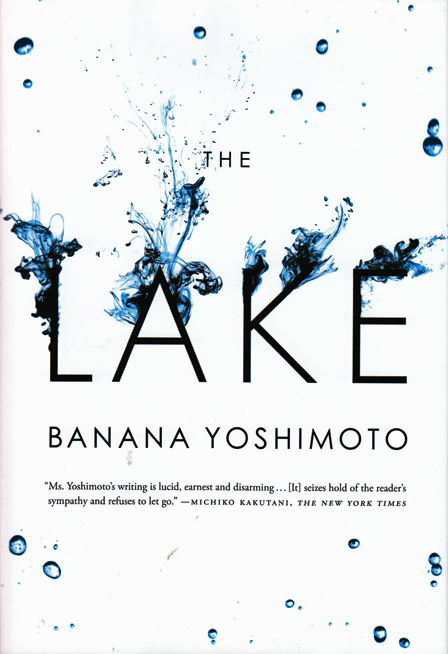
The Lake

Title: The Lake
Japanese Title: みずうみ (Mizuumi)
Author: Banana Yoshimoto (吉本 ばなな)
Translator: Michael Emmerich
Publication Year: 2011 (America); 2005 (Japan)
Publisher: Melville House
Pages:188

I have been waiting for this book to come out for months. When it finally did, I read it in one sitting. As with many of Yoshimoto’s novels, it was occasionally frustrating, but I liked it. I guess one could say that The Lake is typical Yoshimoto. Allow me to explain.

The novel’s protagonist and first-person narrator, Chihiro, comes from a non-traditional family, works in a non-traditional profession, never worries about material things like money or the future even though she’s almost thirty, and seems to float through life, although she has hidden depths:

It’s like when you decide to build a house: some people want to go and find the land first, then hire an architect to help them draw up plans, and then choose the materials for the walls and everything on their own. I’m not like that. I prefer to wander around until I stumble across something, then I do the best I can with it, scrutinizing this thing I’ve discovered, getting to know it for what it is.

The heroine meets her love interest in an offbeat and untraditional way – in this case, he lives across the street from her, and they wave to each other from their respective windows until he talks to her on the street and casually starts showing up in her apartment. This love interest, Nakajima, is a grad student (first warning sign) and a stereotypical herbivore male:

I got the sense that he wasn’t really into sex, and he was shockingly thin, and although there were days when he would consume an astonishing amount, ordinarily he ate almost nothing, so overall he didn’t seem very energetic.

Nakajima is a little weird. Besides not having any friends and never wanting to sleep with our protagonist, he also exhibits behavioral quirks, such as his insistence on keeping detailed tallies of the money he owes Chihiro for using water and electricity when he stays over at her place. But Chihiro is still in love with him:

Whenever Nakajima said my name, every single time, it sparkled like a treasure. I had no idea why. Wow – did you see how that flashed? Say it again for me, please!

Chihiro gradually comes to realize that there is something seriously wrong with Nakajima; but, since she’s become attached to him, she decides to take it slow. As she ever so articulately explains to a friend:

“Anyway, he’s not like other people at all, it’s like, I don’t know how to describe it, like he’s living in the clouds, maybe. Like when people talk about someone having transcended it all – he’s like that, I guess. So part of me thinks it’s just in his makeup, and he would have been this way even if nothing had happened. For the time being I’ll just keep watching, I won’t rush it.”

Finally, Nakajima asks Chihiro to go with him to visit two old acquaintances who live in a cottage by a lake. Chihiro has been worried that Nakajima will leave her, either physically (by suddenly disappearing from her apartment) or psychically (by entering a long-term catatonic trance). She’s also bothered by his plans to leave Japan and study in Paris, which don’t seem to include her at all. She thinks about her anxieties as she walks around the lake with a trembling and profusely sweating Nakajima, but she still supports him, because:

He was an adult, perhaps thirty-five or so, and yet he was extremely small, like a child. His face seemed kind of shrunken, giving him the look of a bulldog. His eyes were sparkling, though, and there was something noble in the way he carried himself.

Do you feel like you’re reading a shōjo manga yet?

The narrative is driven forward by a twinned pair of mysteries: who are the people who live on the lake, and what is Nakajima’s damage? Both mysteries are solved when Chihiro returns to the lake on her own around thirty pages before the book ends; and, to give the author credit, they are resolved quite nicely and sufficiently satisfied my morbid, look-at-the-car-wreck curiosity. Still, I wasn’t too terribly invested in figuring out what was going on (the blurb on the book jacket sort of spoils it with its overt mention of religious cults), and I didn’t really care about the relationship between Chihiro and Nakajima, which was more hurt/comfort than actual romance.

What was interesting to me were the descriptions of small-town politics. The majority of the story is set in Tokyo, but Chihiro comes from a small town where her father wasn’t allowed to marry her mother, who worked as the mama-san of a small bar. Chihiro’s assessment of her father’s family, the patrons of her mother’s bar, and the atmosphere of the town in general are acerbic and insightful. Also, Chihiro works as a muralist, and one of her friends commissions her to create a mural on one of the walls of a run-down community center in a small neighborhood in Tokyo in an effort to save the structure from being demolished. The interplay between Chihiro, the community center, the local government, and a potential sponsor of the project is dramatic in a quiet sort of way, and Chihiro’s explanations of her creative process as she interacts with the people who watch her work are also interesting.

If you like Banana Yoshimoto for her quirky characters, fragmented yet loving families, and universes almost like our own but one step closer to the supernatural, then you’ll like The Lake. If you dislike Banana Yoshimoto for the lack of adult judgment in her characters and her rambling, juvenile prose (which is tight like a handful of squirming hamsters), then you probably won’t like The Lake. For the record, I like the book, and I also think Michael Emmerich did an excellent job of translating it.

Gold Rush

Title: Gold Rush
Japanese Title: ゴールドラッシュ (Gōrudo Rasshu)
Author: Yū Miri (柳 美里)
Translator: Stephen Snyder
Publication Year: 2002 (America); 1998 (Japan)
Publisher: Welcome Rain Publishers
Pages: 286

I recently stumbled across an article titled Reading List: Books to Help You Understand Japan, which is a transcript of a conversation between NPR’s Neal Conan, the Brooklyn-based poet Kimiko Hahn, and Donald Keene, who recently retired from Columbia University in order to live in Japan. When Hahn and Keene were asked to list their top five works for understanding Japan in the wake of the recent disasters that have beset the country, they fired off titles like The Pillow Book of Sei Shōnagon and Essays in Idleness. This bothers me for three reasons.

The first reason is the blatant cultural essentialism, or the idea that one can understand everything about contemporary Japan by reading texts written in the Heian period, as if nothing has changed in the past thousand years. It’s like saying that one can understand everything about contemporary America by reading Jonathan Edwards’s 1741 sermon “Sinners in the Hands of an Angry God.” The Japanese people live (and have always lived) in harmony with nature and posses (and have always possessed) an innate understanding of the beauty of impermanence – and Americans are all God-fearing Puritans who stifle their artistic creativity and capitalistic interests in order to serve their small agricultural communities.

The second reason is the academic elitism. The Tale of Genji is indeed a great monument of Japanese literature. It is also more than a thousand pages long, written in a style that is frustratingly elliptical, and set in a time period and society that are fairly alien to anything a contemporary American (or Japanese) reader would be familiar with. Reading The Tale of Genji is hard, and reading it without guidance is even harder. To assume that even a highly educated and intelligent reader could just pick it up and understand the unadulterated beauty of every word is somewhat presumptuous. Hahn’s recommendation of two literary anthologies is even more baffling. It’s like saying, hey, if you can’t crack open a 421-page anthology of medieval literature and read it in one sitting, there must be something wrong with you.

The final reason is the utterly bizarre assumption that, in order to understand the contemporary Japanese imagination of disaster, one need not read anything either written or set later than 1945. This is doubly strange to me, as Donald Keene recently published an excellent translation of Oda Makoto’s 1998 novel The Breaking Jewel (Gyokusai), which depicts a Japanese soldier’s harrowing experiences during the last few weeks of the Pacific War. Moreover, even if tales of firebombings and severe food shortages and suicide attacks and two atomic bombs and total defeat and occupation by a foreign power wouldn’t give us any insight into postwar and post-earthquake Japanese society, perhaps something like Murakami Haruki’s After the Quake, written in the wake of the devastating Kobe earthquake of 1995, presumably would. To suggest that we can best understand Japanese anxieties regarding nuclear power by reading the poetic travel diaries of Bashō is, quite frankly, ridiculous.

I think Yū Miri’s novel Gold Rush is a perfect antidote to the sort of essentialist thinking demonstrated in the conversation on NPR. Gold Rush is set in Yokohama’s Kogane-chō neighborhood, a wrong-side-of-the-tracks sort of neighborhood filled with small bars, cheap restaurants, pachinko parlors, and love hotels. When most people think of Yokohama, they probably picture the swanky and high-tech Minato Mirai waterfront area or the upscale Motomachi shopping and residential district that serves as the setting of several Tanizaki and Mishima novels. Kogane-chō, however, is a grungy, run-down pleasure quarter that has seen better days, as is the neighboring Isezaki-chō. The streets are dirty, the Ōoka River is dirty, the karaoke bars are dirty, the train station is dirty, the cheap hotels under the railway bridge are dirty, and I imagine that even the many soaplands that dot the area are dirty. Gold Rush begins when four middle school boys pick up a high school girl in this neighborhood. They get her drunk, have her come with them to one of their houses, and then rape her. To be more precise, three of them rape her, and one of them watches.

The one who watches is the book’s fourteen-year-old protagonist, Kazuki, and abetting a rape is just the beginning for him. If trigger warnings were applied to mainstream fiction, Gold Rush would be slapped with all of the big ones. Rape, violence, child abuse, murder, more rape, more child abuse, substance abuse, abandonment, sexism, self-harming behavior, eating disorders, more child abuse, and then more rape. There is also a particularly nasty scene in which Kazuki kills a dog with a golf club. One might question the existence of a plot buried under all of these triggers, but the plot isn’t really the point of the novel. The reader is instead engrossed in following Kazuki’s slow psychological deterioration from the perspective of an omniscient third-person narrator. Kazuki is like Holden Caulfield on crack, and the reader can’t help but identify with his adolescent frustration at the realization that his life and his destiny are not entirely his own, even if he continually takes his rage one step too far. The people who surround Kazuki aren’t much better than he is in terms of acting like decent human beings, and the world they all live in is a bitter, nasty place. In a way, though, Gold Rush is also a twisted sort of love letter to Kogane-chō and the low city charm that permeates it.

Reading Gold Rush is like reading a full-length Ionesco play like Rhinocéros (or a Bret Easton Ellis novel like American Psycho) in that it’s trenchant and biting and brilliantly absurd, but difficult to actually read for the very same reasons. It doesn’t help that Gold Rush is two hundred and fifty pages of ultraviolence unmitigated by chapter breaks. If there’s a reason the novel won the Akutagawa Prize, however, it’s because the writing is excellent. Perhaps it’s also because the physical and psychological spaces written by Yū Miri are more than a little familiar to Japanese readers. So yes, classics like The Tale of Genji are very Japanese, but so is Gold Rush, which is written by a zainichi Korean telling a story about juvenile delinquency in a decaying neighborhood of a seedy commuter city. Yū is a good writer, she tells a good story, and Gold Rush is good Japanese literature. It might even give the reader some small insight into contemporary Japan as well.

Getting Wet

Title: Getting Wet: Adventures in the Japanese Bath
Author: Eric Talmadge
Publication Year: 2006
Publisher: Kodansha International
Pages: 255

For the past two weeks, the internet has been deluged with people talking about how Tokyopop is going out of business. Somehow, in all the confusion, it seems that it’s slipped everyone’s mind that Kodansha International is closing its doors as well. At least, it’s ceasing all operations at the end of April. Which was yesterday, I realized a few hours ago – to my considerable dismay.

In my startled panic, I thought about writing a brief retrospective highlighting the excellent work the publisher has done with regards to promoting Japanese literature in America. I thought about how the company has put out the early novels of Murakami Ryū (such as Coin Locker Babies and Almost Transparent Blue) and the murder mystery novels of Miyabe Miyuki (such as The Devil’s Whisper and Shadow Family). I thought about how the company has published offbeat classics like Natsume Sōseki’s Botchan and Kawabata Yasunari’s House of the Sleeping Beauties. I thought about how the company has taken financial risks to publish niche-interest period dramas such as Ariyoshi Sawako’s The River Ki and Fujisawa Shūhei’s The Bamboo Sword, and then I thought about how the company has taken on even greater financial burdens to collect contemporary avant-garde short fiction in anthologies like Monkey Brain Sushi and Inside.

But really, I think what I’m going to miss the most are Kodansha International’s intelligent and beautifully published books about Japanese culture, like Diane Durston’s Old Kyoto, Kiyoko Morita’s The Book of Incense, and Jay Rubin’s Making Sense of Japanese. And of course Eric Talmadge’s Getting Wet, which is probably my favorite “foreigner writing about Japan” book ever.

As its title suggests, Getting Wet is about baths in Japan. Private baths, public baths, bathing resorts, and bathing theme parks. And of course you can’t talk about baths in Japan without talking about onsen, or hot spring baths. Talmadge covers onsen in Hokkaido, onsen in Nagano, onsen right in Tokyo, and onsen in the Izu Islands south of Tokyo. There are onsen with mineral water, onsen with radioactive water, onsen with electrified water, onsen on the lips of volcano craters, onsen so acidic that your eyes hurt for days afterward, and onsen with snow monkeys.

There are plenty of books on Japanese baths floating around, but what I like about Getting Wet is that it’s not a traveler’s resource like A Guide to Japanese Hot Springs or a coffee table design book like The Japanese Bath. It is instead a collection of eleven journalistic essays unified by the theme of bathing. These essays aren’t travel literature, per se, but rather memoirs (if such a stodgy word is actually appropriate) of life in Japan cradling a core of interesting contextual information. For example, the fourth chapter, “Under the Bridge,” is about a trip to the Oedo Onsen Monogatari theme park in Odaiba. Talmadge begins by admitting his reluctance to don a yukata (he claims that they always flip open at the front at inopportune moments – which they do) and then walks his readers through the park before comfortably sliding into an essay about the Arima springs in Kobe, where emperors and the Heian nobility used to bathe. Talmadge then compares the Japanese history of bathing to that of the West, storied as it is with the opulence of the Greeks and Romans and Moors. Elsewhere, when Talmadge talks about mineral springs, for instance, he explains how our skin works and how our bodies retain water. When he talks about the onsen in the north of Japan, he writes about economic depression and the drive towards international and regional tourism (and why these initiatives never work). All of this writing, both travelogue and journalism, flows together smoothly, as if it were a feature in National Geographic.

Except Getting Wet is a lot more interesting than National Geographic. The way its author writes reminds me of the way my favorite grad student drinking buddy tells stories. His vocabulary is colorful but not ostentatious, he’s done his research and knows his facts, and he’s not afraid to laugh at something that’s ridiculous or unpleasant. Talmadge’s language is crisp and clean and for the most part professional, but every once in awhile he’ll let a colloquialism slip in (“The bath was – excuse me – fucking hot. It was really fucking hot.”), which adds both spice and warmth to his narrative. To put it simply, Getting Wet is a pleasure to read. Even if you don’t care about hot springs or bathing. Even if you don’t care about Japan. In terms of interesting and enjoyable essays, Eric Talmadge is right up there with John McPhee and Annie Dillard.

The book is a pleasure for other reasons as well. What I have always loved about Kodansha International is the attention and care they put into each publication, from the font to the page layout to the beautiful cover and binding. Most of these small touches are up to the reader to discover, but I should mention, in the case of Getting Wet, that the photographic illustrations are especially stunning. I don’t mean “stunning” in the sense of “created by a professional photographer with professional software,” but rather that the pictures are unusually sharp, printed in soft yet high-contrast greyscale, and perfectly positioned beside the text. In other words, the high quality of the images is something that you don’t find often even in art books published by specialty presses.

Kodansha International’s Japanese parent company has recently invested quite a great deal of money in Vertical, so I think that perhaps it’s not unreasonable to assume that their fiction licenses will change hands at some point. I’m not so sure what will happen to their non-fiction, though. Kodansha International put out beautiful books, and it will be a shame to see publications like Getting Wet disappear. I have loved Kodansha International and its books for many years, and I’m going to miss them now that they’re gone. Thankfully, the international arm of the company is resurrecting itself as a high-profile manga publisher, so this story may just have a happy ending after all.

The Best of Tokyopop

I suppose, at this point, it’s not news to anyone that Tokyopop has shut down its manga publishing operations. At first I couldn’t believe this was really happening, but the website was just taken offline a few days ago (although the Facebook page still remains, oddly). People have been writing touching elegies for the company (and perhaps an even greater number of people have been castigating its president); but, for me, it’s really all about the books Tokyopop published – and getting my hands on the good ones before it’s too late.

Because there are some titles you don’t want to miss. Ships like Ai Yazawa’s Paradise Kiss have already sailed, unfortunately, but there are still some excellent Tokyopop manga available on Amazon. For example:

Castlevania: Curse of Darkness (Kou Sasakura)
A vampire manga based on a video game? Why yes, yes it is. And it’s really good, too. Even for someone who’s never played the games. The story is perfectly paced, and the artwork is gorgeous.

Dramacon (Svetlana Chmakova)
This is a really fun manga for anyone who’s ever been to an anime convention – or for anyone who’s ever been a teenager with an impossible crush and an even more impossible dream.

Eensy Weensy Monster (Masami Tsuda)
This (ridiculously-titled) manga is the perfect light-hearted shōjo romance. The art is clean and pretty, the characters are adorable and develop nicely, and the story ends exactly where it needs to end.

Gerard & Jacques (Fumi Yoshinaga)
Yoshinaga has drawn some crappy boys love manga, but this is not one of them, not by a long shot. Think Ellen Kushner-esque snarky historical drama, except with fewer swords and more sexy funtimes.

Goth (Kendi Oiwa)
Based on an intensely disturbing light novel by Otsuichi, this manga captures the darkness of its source material with artistically sophisticated illustrations. The pictures amp up the shock value exponentially, and that’s saying a lot.

Legal Drug (CLAMP)
This short (and tragically abandoned) series has been eclipsed by CLAMP’s more high-profile titles, but that doesn’t mean it’s not fun, clever, creepily gothic, and full of handsome boys flirting with each other.

Suppli (Mari Okazaki)
Besides Ai Yazawa’s Nana, this is probably the best long-form josei manga in translation that I know of. It’s mature, it’s honest, and it has more drama than you can shake a designer handbag at.

Speaking of josei manga, if you can find anything by Erica Sakurazawa or Mitsukazu Mihara, get it! The short story collections of both artists are unique, quirky, and not likely to be seen again after the last copies vanish from Amazon.

Unfortunately, most of the Tokyopop light novels I’d like to recommend have long since been out of print. Thankfully, there are two happy exceptions, and they are the paperback editions of the second and third books of Fuyumi Ono’s The Twelve Kingdoms series of young adult fantasy novels (their titles are Sea of Wind and The Vast Spread of Seas, respectively). Both of these novels stand on their own as stories, and both are excellent reads with lucid translations and interesting illustrations that add a great deal to the text.

Most of the opinion pieces I have read concerning Tokyopop’s demise either lament the company’s slow slide into irrelevance or reminisce about long-gone gateway series such as Love Hina or Fruits Basket. I’m not a Tokyopop apologist by any means, but I think the publisher was still coming out with quality titles right until the end. Although it’s no longer a question of supporting the company, manga fans should still be able to get their hands on many of these titles at Amazon discounts (as opposed to eBay markups). If they act quickly, that is…

Bye Bye Kitty

Title: Bye Bye Kitty: Between Heaven and Hell in Contemporary Japanese Art
Editor: David Elliott
Additional Essay By: Tetsuya Ozaki (小崎 哲哉)
Publisher: Japan Society Gallery and Yale University Press
Publication Year: 2011
Pages: 125

I’m glad someone finally said it: Japan is not all cute, all the time. Japan produces many cute things (I’ll admit it, pokémon are pretty cute), and Japanese cuteness is fairly visible in America, where there are vast subcultures of people who idolize it. Part of the reason why Japanese cuteness has spread to North America, Europe, and other countries in Asia is because cuteness appeals to people outside Japan, after all. (And it’s not like mainstream American media doesn’t produce its fair share of appeals-to-men-in-their-thirties cuteness on its own.) I think there is still an oddly pervasive idea, however, that everything that comes out of Japan is either Hokusai or Hello Kitty. I therefore want to hug David Elliott, whomever he may be, for putting together the Japan Society’s Bye Bye Kitty exhibition and catalog. The artwork is spectacular, and the essay by Elliott that opens the catalog strikes a powerful blow against the assumption that all contemporary Japanese art features huge anime eyes.

Elliott begins with a five-paragraph introduction to postwar Japan, from Douglas MacArthur to double-digit GNP growth to post-bubble malaise. He then moves on to Murakami Takashi’s cultural theory of kawaii, namely, that the Japanese nation is some sort of puer aeternus stuck in a neverland of cuteness and consumption. And then Elliott laughs and states the obvious:

Many artists, however, … have produced work that indicates a more complicated, adult view of life, melding traditional viewpoints with perceptions of present and future in radical and sometimes unsettling combinations. This hybridity … has created a fertile seedbed in which the struggle between extremes of heaven and hell, fantasy and nightmare, ideal and real take place. There is no room for Kitty’s blankness here.

In other words, Japanese artists deal with the same concerns as Western artists, and they do so as adults, intelligently processing cultural and political history and anxieties through creative and technically sophisticated artworks. Elliott identifies three major themes in the work of the artists represented in this exhibition: critical memory (how we deal with the legacy of the immediate past), threatened nature (how we deal with our fears concerning the immediate future), and the unquiet dream (how we deal with our selves). As a whole, the essay is beautifully worded, beautifully illustrated, and well worth the price of the entire book.

Elliott’s essay is followed by a short piece by Tetsuya Ozaki, the former editor of ART iT, a gorgeous bilingual magazine devoted to the contemporary Japanese art scene (if you happen to be in Japan, you can easily find back issues on Amazon.co.jp or at major bookstores like Kinokuniya). In this essay, Ozaki makes the connection between “a system that doesn’t make people happy” and the current “floating generation” of suicides, hikikomori, and otaku. He demonstrates how young Japanese artists are resisting “the kawaii phenomenon” as a means of escape and argues for a broader understanding of Japanese artists as adults both reacting to and transcending their cultural environment. Accompanying this essay are timelines demonstrating, for example, the discursive space of Shōwa Japan and landmarks in postwar Japanese art.

And then there is the art itself. The catalog showcases the work of sixteen artists, all in their twenties through forties, and all showing large and colorful pieces in this exhibition. In my opinion, the primary keyword for these pieces is detail. Yamaguchi Akira, for example, has two pen and watercolor paintings on the theme of Narita Airport in which the roofs (even those of the planes) are lifted to reveal a minutely detailed Edo-esque fantasy of Meiji bureaucrats rubbing shoulders with women in kimono excusing themselves after bumping into Caucasian tourists fumbling with their cell phones. Another of Yamaguchi’s paintings, The Nine Aspects, is a picture scroll reading from right to left and illustrating the nine stages of decay of a horse after its top-knotted master discards its corpse by the wayside. Except the horse is also a motocycle, and the architecture is half Edo and half Shōwa nostalgia. Time is also compressed in the huge pen-and-ink illustrations of Ikeda Manabu, which depict hulking architectural monstrosities so finely detailed that a magnifying glass is necessary to catch all the small touches, like the bomber planes flying in formation below the golden-ceilinged temple caught up in the branches of an enormous dying cherry tree. Finally, there is Aida Makoto (of Harakiri School Girls fame) whose acrylic painting Ash Color Mountains confronts the viewer with towering piles of dead salarymen, each individually detailed, which somehow makes the spectacle even more disturbing.

My one complaint about the Bye Bye Kitty catalog is that, with dimensions of about a foot squared, it really can’t do justice to all of the amazing detail of the exhibition’s artwork, the majority of which is at least as tall as I am. Therefore, if you can possibly get to New York to see the show itself before it closes on June 12, you should go! It’s one thing to see something like Ash Color Mountains while flipping through the pages of a catalog; it’s another thing entirely to walk into a room with no expectations and suddenly find that there it is all around you. The work of Ikeda Manabu especially must be seen to be believed, and the more installation-focused work of artists such as Shioyasu Tomoko and Chiharu Shiota should really be experienced in person. There is not a single boring artist in the exhibition, so it’s definitely worth traveling to visit. The best work of so many unique and high-profile Japanese artists doesn’t come together like this very often, so catch it while you can – or at least consider ordering a copy of the catalog.

Feminism and Final Fantasy (Part Five)

If we can assume that the fantasy trope of mystical female other in bondage gear is popular among men, perhaps we can likewise assume that the fantasy trope often referred to as Draco in Leather Pants is popular among women. According to this trope, a man with a complicated past, equally complicated motivations, and a markedly antisocial streak has a heart of gold somewhere deep inside – especially if he’s handsome. The character Balthier from Final Fantasy XII meets all of these conditions; and, judging from the amount of fan fiction and fan art that has been created in his honor, female fans of the game love him.

It is therefore not unreasonable to argue that Balthier’s design and characterization both contain just as many fetish elements as Fran’s. After all, the male characters in the Final Fantasy series are subject to the same narrative tropes as the female characters. If Rydia is wedged into the role of spell caster by virtue of her gender, then Cecil is similarly cast into the role of the dark/white knight by virtue of his own gender. Moreover, if Rydia is sexually attractive to men, Cecil is perhaps even more attractive according to non-heteronormative female standards of male beauty (which include delicate features and long, willowy limbs). This is fantasy, and we want our characters to be attractive, and interesting, and suitably epic. There is no rule, after all, that says fantasy has to be any less subject to the confines of narrative tropes than, say, interwar French existentialist fiction.

If everyone in the Final Fantasy games is fetishized, and if everyone is subject to gendered tropes, however, can the series really be called “feminist”? Through my discussion of Rydia, Aeris, and Fran, I have attempted to prove that each successive game in the Final Fantasy series has become less sexist and phallocentric. I posited at the beginning of this essay that a “feminist” work contains “strong” (by which I mean “multi-dimensional” and “featured prominently”) female characters who are not villainized. By this standard of judgment, the games in the Final Fantasy series are indeed feminist works. Even though the player-protagonist is often male, this character is usually subordinate to the narrative importance of a central female character. Even though the story of this female character is seen through the eyes of a male character, it is her story that is being told, and the male player-protagonist is just along for the ride. While the player controls the gameplay, the actions of the female protagonist advance the plot and open more of the game’s world.

Although we could once safely assume that the gamer behind the player-protagonist was male, this is no longer the case; he is now just as likely to be controlled by a woman. The player-protagonist may have his own story, but he is also the eyes through which the player looks and the hands and feet by which the player explores and manipulates the world. Such a direct player identification thus makes his identity somewhat less than stable, along with his gender and sexual orientation. The player-protagonist is arguably little more than a cipher in many situations (such as Tidus in Final Fantasy X, who is never addressed or referred to by name, lest the player’s identification with him be impeded), and the true spotlight shines on the female protagonists of the series, such as Rinoa, Garnet, Yuna, and Ashe.

Perhaps, because these female characters were created by development teams consisting primarily of men, they can never be considered “pure” feminist role models, but there is another side to the equation – the female (and male!) fans of the series who have been inspired by these characters and have interpreted them in ways that may differ wildly from the original intentions of their creators. As I have argued elsewhere, a text does not end with the “Game Over” screen but rather spins into ever wider and deeper perversions in the personal fantasies of the player. These personal fantasies can then be reinforced and expanded upon when introduced into larger communities of gamers. Player reception is engaged in a feedback loop with Square-Enix, which has used the enormous revenue it has earned from the Final Fantasy franchise in order to develop games that will better appeal to its fans, both new and old. The strong female characters of the series have resulted in a large and vocal female following, which has in turn resulted in Final Fantasy XIII, a title that has been celebrated as a truly feminist video game. As gaming technology becomes more sophisticated, and as the narrative mechanisms of role playing games become more innovative and complex, I am looking forward to meeting the female characters in the future of Final Fantasy.

I cannot claim to have the final word on Final Fantasy, or on the topic of video games, role playing, and gender. Allow me to therefore cite my sources and inspirations, both online and in print.

The absolute best pieces of writing on Final Fantasy that I have ever had the pleasure of reading are collected under the title The Rise and Fall of Final Fantasy. Each of these essays is quite long, but each is beautifully written and provides all of the background information I have omitted, which is presented in a humorous and highly intelligent tone. The online video game “magazine” The Escapist recently posted a video essay called True Female Characters, which is a bit superficial in terms of analysis but makes some good points and provides several examples of female characters in video games who are prime examples of sexist stereotypes. A short, journalistic article called Getting the Girl offers an interesting counterpoint to this discussion in the light it sheds on female game developers and the market pressures they face when designing female characters. The website The Mary Sue has a number of interesting pieces on women and geek culture, including statistics relating to female gamers.

If you’re interested in other aspects of the Final Fantasy series as viewed from a “scholarly” analytical perspective, there is an essay in Mechademia 4: War/Time titled “Imagined History, Fading Memory: Mastering Narrative in Final Fantasy X.” This essay is somewhat crippled by the word count imposed by the journal, but it contains an interesting argument relating to how the narrative structure of the game may relate to Japan’s experience of modernity. There are also several interesting and tangentially related articles in an academic journal called Games and Culture, including an essay on ethics in Final Fantasy VI and Final Fantasy VII, as well as an interesting piece on fantasy races in MMO-RPGs.

On a broader level, Sharalyn Orbaugh’s “Busty Battlin’ Babes: The Evolution of the Shōjo in 1990s Visual Culture” (found in the collection Gender and Power in the Japanese Visual Field) is an excellent discussion of cross-gender character identification in a Japanese context. All four chapters of Tania Modleski’s short but brilliant Loving with a Vengeance discuss the romance tropes surrounding male characters and might be useful for a sustained inquiry into why a character like Balthier (or Sephiroth) is so popular with female fans. Finally, while I was writing this essay, I was addicted to Eleanor Byrne and Martin McQuillan’s Deconstructing Disney, which opens by making a strong case for why we should continue to analyze popular culture and then goes on to provide an fantastic model of how to do so.

All of the games and characters I have discussed, as well as (almost) all of the images I have borrowed, belong to Square-Enix. Square-Enix, I love you. Please don’t sue me.

Part One
Part Two
Part Three
Part Four

Feminism and Final Fantasy (Part Four)

When one looks at Fran from Final Fantasy XII, the first thing that jumps to mind is most likely bunny girl or perhaps fetish character. Fran is tall, beautiful, and wearing very little clothing. The clothing that she is wearing is black leather bondage gear. She is marked as exotic not only by her rabbit ears but also by her Icelandic accent and the coffee color of her skin. If there were ever a character who seems designed solely for heterosexual male viewing pleasure, Fran would appear to be that character. Putting issues of costuming aside, however, I don’t think Final Fantasy XII’s characterization of Fran is in any way sexist.

Before I explain why her characterization isn’t sexist, let me first address the issue of why I don’t think her characterization is racist. Although it’s very easy to jump to the facile conclusion that Fran is just another example of a hyper-sexualized black woman, I would argue that this is not in fact the case. The most significant counter-argument against this claim is that Fran is not black, at least not in the sense that being “black” in America carries with it a great deal of history and cultural significance. In Ivalice, the fantasy world that Fran inhabits, there are many races of people with whom the player has extensive contact, and none of these races is distinguished by racial stereotypes (as, for example, Vulcans and Klingons are in the Star Trek universe).

To give an example, the Bangaa are a type of bipedal lizard-like people with floppy puppy-dog ears. Some of them are bounty hunters, and some of them are merchants or traders, and some of them are mechanics. Some of them are vicious and cruel, and some of them are pleasant and kind. Some of them are intelligent, and some of them are stupid. Some of them have red skin, and some have green skin, and some have blue skin, and some have brownish-yellow skin. Because the player comes into contact wide such a wide variety of Bangaa, and because the game itself does not stereotype them in any way, it’s almost impossible to create an overgeneralizing racial profile.

Fran’s race, the Viera, are the same. Although they all have rabbit ears, different individuals have different color hair, eyes, skin, and ear-fur. While some dress in skimpy clothing, others do not. While some live in the forest like mystical rabbit-healer-elf-ninjas, others do not. While some are wise and bound to nature, others live in urban areas and engage in commerce and trifling romantic affairs. The fantasy world of Invalice is a pan-cultural diaspora in the truest sense of the word, and one of the primary themes of the game is that the twin concepts of “homeland” and “people” are nothing if not extremely problematic.

While Fran may be exotic, then, I don’t feel that the game’s depiction of her is particularly racist. Nor do I feel that it is particularly sexist. As I mentioned earlier, the Viera are a diverse race of people. Even though the race seems to have originated in a heavily wooded area of Ivalice and has developed ears to hear the semi-magical “voice of the forest,” many Viera do not live in the woods and consider their ears as nothing more than mere decoration. In the case of the Viera in general, this makes a sexist equation between woman and nature, or woman and mysticism, or woman and emotion, difficult. In the specific case of Fran, who is an engineer and pilot, such an equation is utterly non-applicable. Moreover, even though the player may fetishize Fran, Final Fantasy XII does not. Not only is Fran significantly older and more mature than any of the other playable characters, but she is the object of no one’s sexual attraction, and even her relationship with her male partner Balthier is characterized as friendly yet professional.

The game makes it hard to draw sexist conclusions based on any of its female characters either in terms of plot or gameplay. Ashe, the character around whom the game’s plot revolves, is a princess, but she is less concerned with love than she is with political strategy, international alliances, and the consequences of the use of weapons of mass destruction. Ashe comes pre-equipped with a sword; but, if the player decides to make her a spell-caster instead of a melee fighter, there are no consequences. Likewise, although Fran comes pre-equipped with a bow, the player can choose to make her a two-handed weapon-wielding tank of a melee fighter.

As in many earlier games in the Final Fantasy series (including Final Fantasy V, Final Fantasy VI, Final Fantasy VII, and Final Fantasy VIII), gender bears absolutely no relevance to fighting ability in Final Fantasy XII. The player builds each player’s abilities though a device called the “license grid,” which is the same for all playable characters, regardless of gender. Furthermore, a character’s base statistics (for values like attack power and physical defense) are dependent on his or her equipment, the selection of which is also non-specific to gender. Men can be healers dependent on magic, and women can wield battle axes larger than they are.

In other words, there is nothing about Fran’s character or fighting capacity that is innate to her race or gender, save her revealing costume. The clothing of the game’s other two female characters, Ashe and Penelo, is similarly racy, but so too is the clothing of the game’s three male characters. This point brings me to an important twist in my argument about the fetishization and sexism inherent in the female characters of Final Fantasy – are male characters not fetishized and subject to sexism in exactly the same way?

Part One
Part Two
Part Three
Part Five

Feminism and Final Fantasy (Part Three)

It can be argued that all of the characters in Final Fantasy VII are amalgamations of popular character tropes. One of the most important and popular characters from the game, Aeris, comes dangerously close to many of the various tropes identified with a Mary Sue. For example, the short paragraph of text in the game’s manual describes her as “mysteriously beautiful,” she has an exotic name, she has an usual and dramatic back story, she’s exceptionally talented in a wide variety of areas and possesses rare powers, she is the last of her race, all of game’s characters (even the markedly antisocial ones) adore her, she is brave, cheerful, and incorruptible, she is too pure for this earth and sacrifices herself to save everyone, and her only flaws, innocence and naivety, are far from damning. I am not trying to suggest that Aeris in fact is a Mary Sue character, or even that Mary Sue characters are necessarily a bad thing. What I am trying to suggest is that the character receives a very sympathetic portrayal and occasionally seems to good to be true.

No matter how close Aeris comes to a Mary Sue, she can never be a true Sue, as she is neither a writer nor a reader stand-in. That particular role belongs to Cloud, a confused and lonely young man who just happens to have a bigger sword than anyone else. It’s difficult not to sympathize with Cloud as he wins countless battles, runs up endless flights of stairs, snowboards, rides a huge motorcycle, cross-dresses, discovers his forgotten past, wins his revenge from the psychopath who torched his hometown, and is praised and admired by almost everyone in the game’s cast. At his core, though, Cloud is emotionally vulnerable and just needs someone to comfort and understand him.

That someone, for the first half of the game, is Aeris. Unless the player is armed with a cheat sheet of responses to in-game dialog, Final Fantasy VII sets Aeris up to be Cloud’s love interest. Aeris’s many attractive qualities serve to make her mid-game death more dramatically effective, of course, but they also serve to make her a more desirable partner for the player-protagonist. In this sense, then, she is what I might call a male-generated Mary Sue. She is not everything that the player wants to be, but everything that the player wants to be with. In other words, she is a perfect romantic partner, someone who is strong and kind and beautiful but still unconditionally attracted to the dorky male hero. Is the strength of such a female character truly empowering when it only serves to bolster the ego and libido of the player-protagonist?

Actually, quite a few female gamers have declared that yes, it is empowering. Over-rated though it may or may not be, Final Fantasy VII brought an extraordinary number of new players to the franchise with the richness and depth of its storytelling, world building, and gameplay. Many of these new players were female. As I mentioned earlier, although we can now say that it’s misleading to think of the majority of video game players as male, that stereotype wasn’t so far from the truth in 1997, the year that Final Fantasy VII was released during the early years of the Playstation gaming console. Female players were attracted to the game both by the burgeoning mainstream popularity of gaming and by the presence of female characters who were more than guns and boobs on a remote-controlled stick. Many female gamers in my generation grew up with Aeris and Tifa, and we saw these characters as much more than Cloud’s love interests – we saw them as real people, with real personalities. We also saw them as role models in a way that would have been difficult with the extremely limited dialog of earlier characters like Rydia.

Aeris may have been too good to be true, but she had thousands of lines of dialog that at least made her seem real to the player. Moreover, her dialog was not merely ego-reinforcement for the player-protagonist. Aeris kept secrets, and she had her own set of motivations that never became entirely clear until after her death. The character knew things that she did not share with the player-protagonist, and she expressed emotions that were not directly related to the player-protagonist or to the development of the game’s story. In other words, she had interiority.

Final Fantasy VII also passes the Bechdel Test in that Aeris is friends with Tifa, and the pair on multiple occasions talks about things other than Cloud. Tifa is herself an interesting character. Although her character design is all legs and chest, and although her fighting style seems tailor-made to show off her tight shirt and short shirt (witness her victory pose at the end of every successful battle), she has much more dialog than Aeris, and she is arguably a much darker character.

After the Shinra power company destroys her village and covers up the operation, she moves to the city of the company’s global headquarters, where she opens a bar that will serve as a base for a terrorist resistance movement. Throughout the game she is conscious of the human cost of terrorist activity, as well as the consequences of shutting down the world’s major source of electrical power. She must also navigate the guilt she feels at having bullied Cloud as a child, the confusion she feels regarding his amnesia surrounding their shared past, and the jealousy that she begins to feel toward Aeris. Yes, Tifa’s huge boobs are on constant display, and yes, the camera looks up her skirt when Cloud saves her from falling at the end of the game, but a new generation of female players were able to see past this and sympathize with Tifa as a complex character. Although there are countless fan works depicting the seduction and rape of both Tifa and Aeris, there are arguably many more that explore the aspirations and anxieties of the characters outside of sexual or romantic relationships.

Female players therefore brought with them a female gaze. This gaze not only transformed female characters from objects to subjects, but it also turned an objectifying lens on the male characters. These new female fans took advantage of the fledgling world wide web to form communities with other fans with whom they could discuss topics such as whether Cloud’s nemesis Sephiroth was even more attractive than Cloud. The international character of the internet also exposed Western fans to the work (and particularly the artwork) of Japanese fans, and soon Cloud was no longer in a romantic relationship with Aeris or Tifa but rather intimately involved with the evil military leader Sephiroth. For a generation of female fans too young for Star Trek, then, Final Fantasy VII was a gateway into alternative readings of popular texts. To give it due credit, the game has a story and cast of characters deep enough to actively encourage the female gaze that helped to make the game so popular. Although the vagaries of corporate marketing decisions are beyond me, I can only assume that Square quickly connected the unprecedented success of Final Fantasy VII to its popularity with gamers of both genders, since each successive game in the franchise has featured stronger and more developed female characters – as well as a colorful sprinkling of homoerotic tension between male characters.

Part One
Part Two
Part Four
Part Five

Feminism and Final Fantasy (Part Two)

Anyone who has played the first three Final Fantasy games, either on the NES or as reincarnated through their PSP and DS remakes, knows that there isn’t a great deal of character development involved. Male and female characters are more or less interchangeable; the gender of any given character is no more than window dressing for an essentially sexless data animal. Final Fantasy IV, the series’s first installment for the 16-bit Super Nintendo Entertainment System, is considered groundbreaking because it is the first of the games to feature a cast of characters with unique abilities, personalities, and backstories. The game follows the exploits of the dark knight Cecil, who has to (a) come to terms with the fact that he is working for an evil king, (b) overcome the darkness in his heart, (c) gain the holy sword necessary to fight evil, and (d) fly to the moon to defeat his evil brother and the dark force possessing him.

Cecil, who is your party’s fallback melee fighter, is supported by Rosa, one of those selfless white mage types who will do anything for Cecil but is all but useless in battle (at least until she learns the attack spell Holy). Despite all of the transformative and empowering fan work that has sprung up around her over the past twenty years, in the original game, Rosa was really nothing more than the love interest of Cecil and his rival Kain. Your party must repeatedly fight to save her from various conundrums, like fainting in the desert and being kidnapped. Much more interesting than Rosa, who is the proverbial sheath for the hero’s sword, is the summoner character Rydia.

Rydia is a young summoner whose village is unwittingly destroyed by Cecil. Since she has nowhere else to go after the entire race of summoners is killed, she accompanies your party until she is spirited away by a summon creature, Leviathan, to the city of summon creatures deep under the earth. When Cecil ends up traveling underground and finds himself in dire straights, he is rescued by Rydia, who has aged more than ten years while living in a different flow of time. Rydia is a valuable asset to your party, wielding whips that inflict paralysis and various other status ailments, as well as battle-ending summons and black magic so powerful that its use is depicted as killing other mages.

Since Rydia is so useful as a playable character, the player is given a strong incentive to go on several difficult side quests that serve no other purpose than to make her more powerful. The player therefore has something of a first-person investment in her, which is strengthened by her moving backstory. This backstory provides both a juxtaposition and an alternative to Cecil’s own. Both Cecil and Rydia are orphans who were raised to be masters of their respective powers, and both must make a choice regarding whom they will forgive and whom they will protect. Unlike Rosa, the adult Rydia does not need saving, and she is not interested in romantic love. It would seem that she is therefore not an object but rather a subject, a female hero who stands on equal footing with the male hero.

Unfortunately, there is the issue of her costuming. While the two primary male characters, Cecil and Kain, are allowed armor, Rydia is clothed in leggings, oversized arm warmers, a leotard, and high heels. Besides not being very practical for battle, this outfit is highly sexualized. As a result, fanworks from both Japan and America have cast the character as a porn star who is raped by not only Cecil and Kain but also by her summon monsters, a dubious honor that is not shared by Rosa.

This pornographic treatment is not merely a result of Rydia’s sexy costume (or of Rule 34), however. There is also an air of innocence and a whiff of child-in-a-woman’s-body about her that invite male protection and exploitation. While Cecil and Kain are depicted as undergoing emotional trails on the road to character development, Rydia has an almost complete lack of interiority. If the adult Rydia ever faces any doubt over her abilities or conflict over the fact that Cecil killed her entire family, for example, the player doesn’t hear about it. Rydia is magical and mystical and unknown; she is a blank slate in an appealing costume onto which the presumably male player can project his fantasies of exotic and mysterious femininity. Moreover, although Rydia’s magic is undeniably powerful, the game’s strict MP limitations ensure that she is never more than a support character in the vast majority of battles, an unfortunate caveat that also applies to Rosa.

In both the gameplay and narrative aspects of Final Fantasy IV, then, female characters are associated with magic, innate ability, dependence on men, and cheerful self-sacrifice, while male characters are associated with physical power, training and skill, and development toward emotional independence. The player is strongly encouraged to identify with the male characters and their personal struggles. The male is the subject, and the female is the object. The male is known and powerful, and the woman is unknown and mystical. These are popular fantasy tropes, and they are not unique to Final Fantasy IV, whose story is powerful and appealing partially because it makes effective use of these tropes.

Part One
Part Three
Part Four
Part Five