薬指の標本

Yōko Ogawa’s 1994 book Kusuriyubi no Hyōhon (薬指の標本) brings together two novellas that feel spiritually akin to The Memory Police, which was originally published in the same year. Like The Memory Police, the two novellas in Kusuruyubi no Hyōhon are set in a seemingly normal world haunted by a sense that something important has vanished. These stories are about ordinary people who come into contact with pockets of magic whose mundanity belies their deep strangeness.

The narrator of the first story, Kusuriyubi no Hyōhon, has moved to the suburbs after losing a portion of her ring finger in an industrial accident. While walking through the neighborhood, she encounters a handwritten “help wanted” sign taped to the front door of a “specimen museum” (標本室) operating in a building that once served as a dormitory during the postwar period. With no connections and no other job prospects, the young woman interviews for and accepts a position as a receptionist.

It’s not entirely clear what exactly the museum’s “specimens” are, and their method of manufacture is a mystery. Regardless, anyone is welcome to bring an object representing a traumatic experience to the museum, where it will be registered, cataloged, and preserved. Through each object’s transformation into a specimen, the pain of its associated memories disappears.

The narrator becomes the focus of the intense gaze and possessive interest of the artist who creates these specimens. Though she loves him, he forbids her to enter his underground workshop. Given the apparent disappearance of the people who requested that specimens be made from parts of their own bodies, the narrator can’t help but wonder what would happen if she entered the artist’s forbidden underground chamber and asked him to work his magic on what remains of her severed ring finger.

The narrator of the second story, Rokkakkei no Kobeya (六角形の小部屋), is a nurse at a large hospital where she recently ended a serious relationship with one of the doctors. She becomes fascinated by two middle-aged women she encounters in the locker room of a local sports club; and, with little else to occupy herself during the long winter evenings, she trails them to a semi-abandoned danchi housing complex.

One of these women, Midori, operates an odd service in the former apartment manager’s office. The “Katari Kobeya” (語り小部屋) is a small, self-contained room with six soundproof walls. Anyone who enters this room can speak to their heart’s content, thereby relieving themselves of the psychological burden of their secrets.

The narrator has no secrets to speak of, but she becomes friendly with Midori and her handsome son. In order for the magic of the Katari Kobeya to remain effective, however, it can’t remain in one place for long. If the narrator comes too close to this strange liminal space, she runs the risk of another heartbreak.

In her monograph The Pleasures of Metamorphosis, Lucy Fraser describes Ogawa’s stories as having a fairytale-like quality, and this is certainly true of the two novellas in this book. In Rokkakkei no Kobeya, the narrator follows two women through the trees of a snowy park at night and thereby finds herself in a warm and comforting sanctuary that can be found only by those in need. Meanwhile, Kusuriyubi no Hyōhon has echoes of Bluebeard, with an older man forbidding an inexperienced young woman from entering a special room in his gothic mansion.

In addition to the subtle inclusion of fairytale tropes, the ethereal quality of Ogawa’s writing is partially due to what Elena Giannoulis, in her article “The Encoding of Emotions in Ogawa Yōko’s Works,” calls the writer’s “mood tableaux.” Giannoulis argues that Ogawa generally doesn’t reveal much below the surface of her characters’ placid demeanors, nor do her characters go out of their way to offer psychologically perceptive commentary on the world around them. Instead, Ogawa creates a “mood” by describing what the narrator perceives with their senses. By thus crafting a vivid picture of a setting unimpeded by value judgments, Ogawa invites the reader to associate their own feelings with the cinematic tableaux they see in their mind’s eye.

Giannoulis’s argument makes perfect sense to me, especially in relation to Kusuriyubi no Hyōhon. I find the texture of Ogawa’s writing to be similar to the visual style of Hirokazu Kore’eda, who allows the camera to linger on the small details of his characters’ environment while the characters themselves remain silent. These settings tend to be mundane in the extreme, and Kore’eda luxuriates in the interiors of older structures that have become dirty and dilapidated. As in Kore’eda’s films, the combination of nostalgia and neglect lends a subtle touch of pathos to the quiet drama of Ogawa’s stories.

Kusuriyubi no Hyōhon is a meditation not on what has vanished, necessarily, but rather on what remains behind. In these two novellas, Ogawa speaks to the dignity of people, places, and objects that are in danger of being forgotten. No one would notice if anything in Ogawa’s stories disappeared – but she has noticed, and now the reader has noticed, too. Still, though there’s a certain tonal warmth and narrative coziness to Kusuriyubi no Hyōhon, Ogawa never allows the reader to relax. As in any fairytale, there’s always a sense of danger, as well as the intriguing strangeness of half-remembered liminal spaces.

The Melancholy of Haruhi Suzumiya

The Melancholy of Haruhi Suzumiya, originally published in 2003, is a sci-fi romantic comedy about a quirky afterschool club. It’s also one of the most influential light novels from the heyday of otaku culture. Although I can’t say that all of its humor has aged well, it’s a quick and fun read, and there’s a good reason why it’s still in print.

Kyon is an average high school boy who’s assigned to the same homeroom as Haruhi Suzumiya, a beautiful girl who has a reputation for being weird. True to everyone’s expectations, she marches into the first day of class and introduces herself with the declaration that she’s not interested in speaking to anyone who isn’t an alien, an esper, or a time traveler. When Kyon tries to strike up a conversation with Haruhi, he gets roped into joining the SOS Brigade, an afterschool club that Haruhi has created to research supernatural phenomena.

The plot twist is that, with the exception of Kyon, every member of the SOS Brigade is indeed an alien, an esper, or a time traveler. They gradually reveal themselves to Kyon, insisting that they’re posing as high school students in order to observe Haruhi, who unknowingly has extraordinary powers capable of restructuring the universe. If Haruhi becomes bored with the current universe, it’s not beyond the realm of possibility that she might inadvertently destroy it. It’s therefore imperative that Haruhi remains entertained and blissfully unaware of her power.

As you might imagine, this scenario has a number of unsettling implications. Is everyone in the story merely a figment of Haruhi’s imagination? Does anyone in the universe she created have free will? If Haruhi created “this” universe, what happened to the universe where aliens, espers, and time travelers don’t exist?

The Melancholy of Haruhi Suzumiya goes right to the edge of these darker implications but ultimately backs off in favor of light comedy and mild teenage romance, a tonal balance that undoubtedly contributed to its popularity.

This light novel was adapted into an anime that aired in the Winter 2006/07 season. I admit that I’ve never watched it from start to finish, but the show was ubiquitous in Japanese pop culture fandom communities for years. The ending theme, “Hare Hare Yukai,” became a meme that spawned countless flash mobs of cosplayers recreating the iconic dance at anime conventions.

Due to its prominent place in mid-2000s otaku culture, I was considering including The Melancholy of Haruhi Suzumiya on the syllabus of a college class about Japanese science fiction and fantasy. I think it would be a good choice, but I’m still undecided. My hesitation is mainly due to the fact that one of the early chapters includes light elements of goofy sexual comedy that made sense in the cultural atmosphere at the time but might read a bit differently today.

To give an example, in order to blackmail the members of the computer club into giving her a PC, Haruhi takes someone’s hand and places it on the breast of one of the female SOS Brigade members before asking Kyon to take a photo. To me, this scene reads as the sort of stupid but harmless fantasy that might appeal to the book’s target readership of teenage boys, but I understand how it might be interpreted as sexual harassment (because, undeniably, it is).

Still, light novels are filled with this sort of thing, and I tend to think that The Melancholy of Haruhi Suzumiya is on the “unproblematic” end of the spectrum. To be fair, it’s not anything worse than what’s in most Haruki Murakami novels.

I don’t read many light novels these days, but I enjoyed The Melancholy of Haruhi Suzumiya. The pace is brisk, the writing is snappy, and the story offers a nice treatment of its speculative worldbuilding without getting too deeply into the weeds of hard science fiction. Looking back on this book from twenty years in the future, I found myself waning a bit nostalgic for an earlier (and, I think, more lighthearted) era of otaku culture. The Melancholy of Haruhi Suzumiya is an interesting cultural artifact, but it’s also a fun story that I’d recommend to anyone who hasn’t yet encountered its particular flavor of high school comedy.

Shimeji Simulation

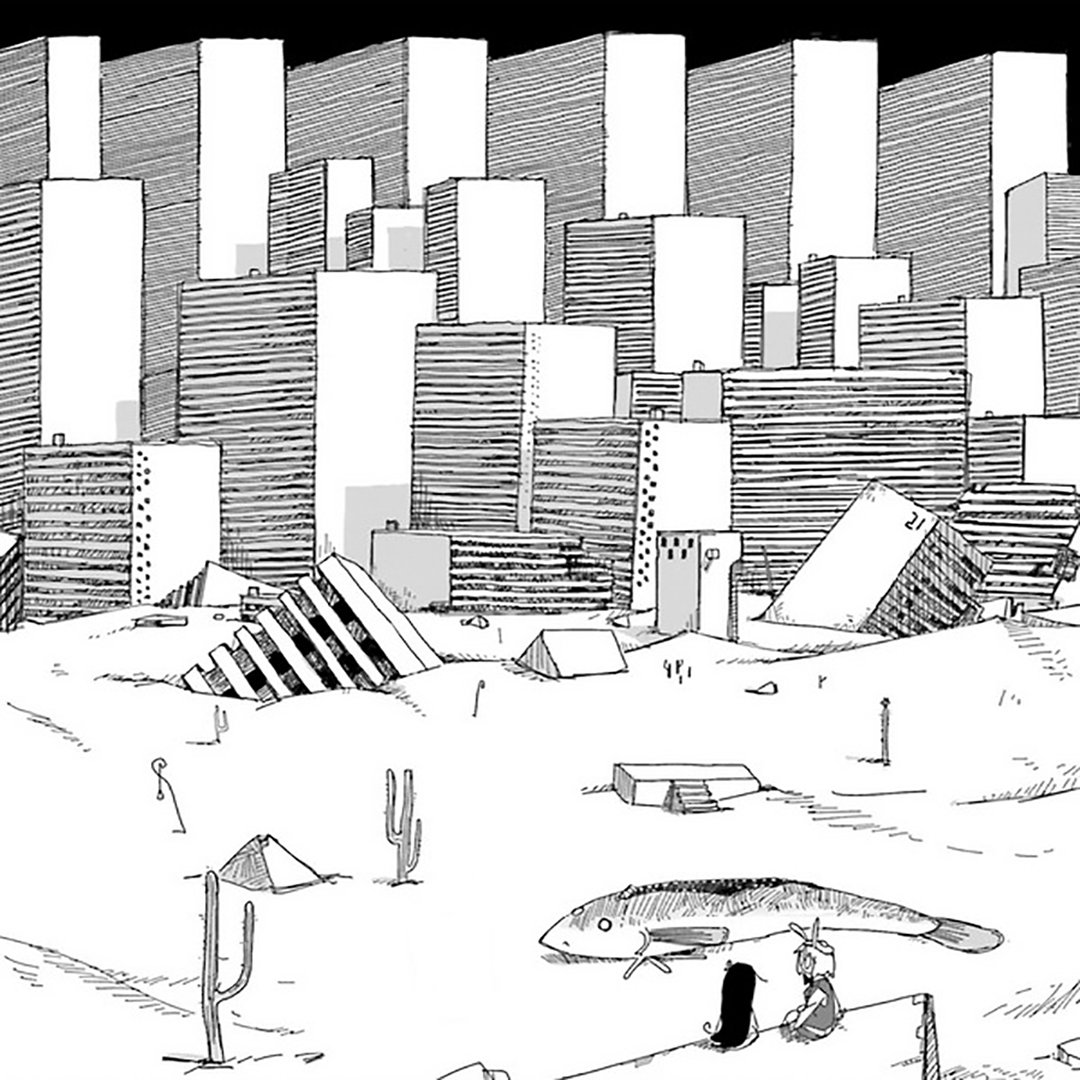
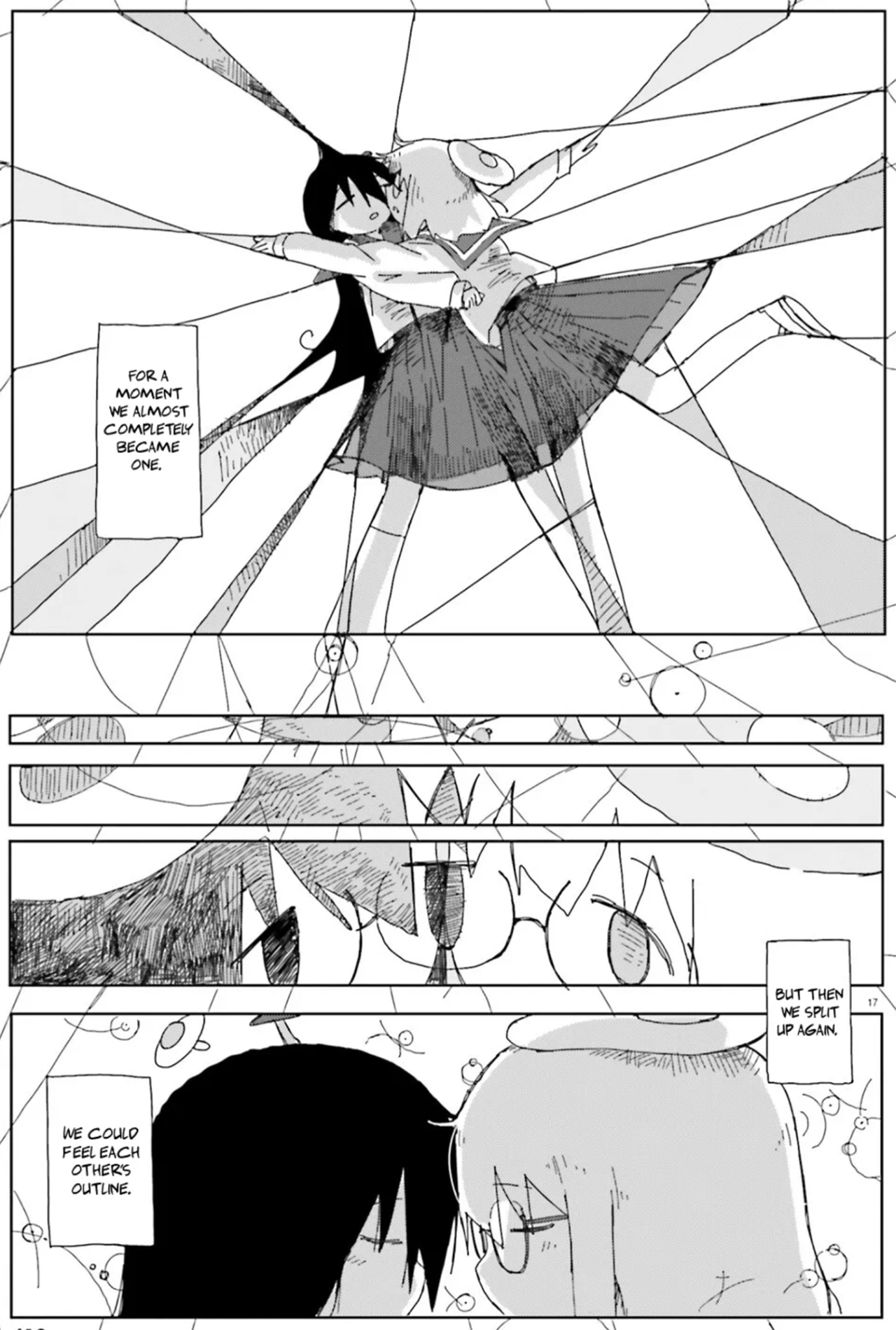
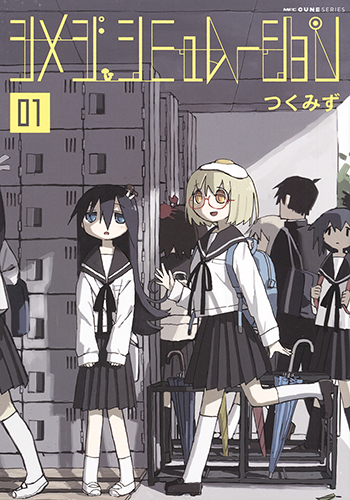
Shimeji Simulation (シメジ シミュレーション) is a gentle but deeply surreal slice-of-life manga about two teenage girls living through the end of the world – or perhaps not “the” world, necessarily; but rather, an artificial world that they happen to inhabit. The focus of the manga isn’t on the apocalypse, which passes mostly unremarked and unexplained. Instead, the core of the story is the friendship (and understated romance) between the two girls, Shijima and Majime. 

Shijima Tsukishima has spent the past two years of middle school quietly living inside a closet, and the manga opens when she decides to begin attending high school at the beginning of the school year. Why Shijima became a hikikomori is something of a mystery, but her primary personality trait is that she dislikes being bothered. She plans to spend her time in high school silently reading books at her desk.

This plan is interrupted by a classmate named Majime, who aggressively demands that Shijima become her friend. Since a pair of shimeji mushrooms sprouted from the side of Shijima’s head during her period of isolation, Majime immediately gives her the nickname “Shimeji,” an appellation that quickly becomes as pervasive and persistent as Majime herself.

Majime bluntly inserts herself into Shijima’s life and persuades her to join the school’s Hole Digging Club, which is managed by an art teacher named Mogawa. Majime assumes that the club is little more than an excuse to hang out after school, but Mogawa is oddly committed to the endeavor, especially when encouraged by the quiet presence of a second-year student named Sumida who only communicates through abstract drawings. Meanwhile, Shijima’s older sister has dropped out of college to devote herself to the ongoing construction of a bizarre machine with an inexplicable function.

For the most part, the girls engage in mundane slice-of-life adventures. They chat in the classroom, visit one another’s houses, and attempt a study session at a family restaurant. Mogawa teaches her art lessons. Majime catches a cold. A group of girls in their homeroom start a rock band. Shijima meets a super-senior named Yomigawa who’s decided to stay in high school just to hang out in the library and read philosophy books.

What makes this manga interesting are the strange glitches in the world surrounding the characters. The mushrooms sprouting from Shijima’s head are a good example, but there’s also the fact that Shijima and her sister occupy one of the only two tenanted apartments in a giant danchi housing building that’s falling apart yet still somehow livable. 

As the story progresses, more glitches begin to manifest. Everyone wakes up to a snowstorm in the middle of summer, for example. One day, the school building is flipped vertically and becomes a pocket dimension with a separate axis of gravity. Another day, water loses its mass and floats in the air. Suburban streets twist into optical illusions, and fish swim through the sky.

Although small glitches seem to be innate to the world, they’re exacerbated by Shijima’s sister, who’s been building and experimenting with various devices that alter the fabric of reality. Each of the first three volumes of the manga concludes with a longer narrative segment that shows the consequences of these experiments for Shijima and Majime, who are briefly thrown into the gaps between the cracks of reality.

The cumulative damage caused by Shijima’s sister is countered by a godlike entity who presents as a young girl and calls herself “the Gardener.” The Gardener’s role is to ensure that the reality experienced by the characters doesn’t mutate too wildly from one day to the next, but her power is curbed by the features of the universe’s code intended to keep its residents safe. She might be able to repair gaps in reality, but she has no means of forcing her will onto humans, even if it’s for their own good.  

Like Tsukumizu’s previously serialized manga, Girls’ Last Tour, it’s difficult to say that Shimeji Simulation is “about” anything. There’s no plot to speak of, and the only real conflict is between the characters and the entropy eating away at the edges of their slowly decaying world. In addition, it’s never explained how this constructed universe and the characters who inhabit it came to exist. Instead, I think it’s probably fair to say that the manga’s primary concern is existential ontology. In other words, what does it mean to be human, and why do we exist?

I recently read an interesting essay (here) whose author argues that Shimeji Simulation is about the barriers between people, why we need them, and what happens when they disappear. If everyone were able to get exactly what they want, what happens when the desires of separate individuals come into conflict? If there were a world perfectly tailored for one person alone, could anyone else live there? And, if you retreat into complete solipsism, what’s the point of being alive?

Toward the end of the manga, Shijima finds herself in a situation very much like her self-imposed hikikomori isolation in the beginning, when she lived entirely in the darkness of her closet. In the simulated world she comes to occupy through her sister’s rewriting of the universe’s code, Shijima doesn’t bother anyone, and she never has to deal with any external input that she doesn’t choose for herself. Still, can we really say that such pristine loneliness is preferable to the messiness of human relationships?

I read Shimeji Simulation as a story about the various ways that people communicate and connect with one another. Shijima never becomes a “normal” or friendly person, but she still manages to find joy and meaning in her interactions with other people, even if most of these interactions are nothing special. This is why, in the fifth and final volume of the manga, Shijima breaks the boundaries of her personal universe to find Majime, wherever her friend might exist in the fractured constellation of simulations.

“The meaning of life is to understand love” may seem cliché; but, given how strange and surreal her story becomes, Shijima’s realization feels significant and well-earned. Life is a constant shifting and melding of interpersonal boundaries, and communication and companionship are worth the pain and trouble of being human.

Shimeji Simulation is a remarkable work of science fiction. The manga may seem to have an unassuming beginning, but its narrative structure gradually builds, loops back in on itself, and continually starts over from a weirder and more nuanced position. Likewise, Tsukumizu’s art may initially feel sketchy, but this style is perfectly suited to express the uncanny glitches and fluid malleability of the setting. Shimeji Simulation is gentle and quiet, but also immensely intelligent and creative, and it’s a manga to contemplate and enjoy slowly while allowing yourself to be transformed alongside the characters and their strange but fascinating world.

Shimeji Simulation hasn’t received an officially licensed English translation, but a fan translation is currently available to read on Dynasty Scans (here). If you’re interested in a small taste of the manga’s tone, I’d also like to recommend the short fan anime adaptation of the opening chapter on YouTube (here).