Onibi: Diary of a Yokai Ghost Hunter

Onibi: Diary of a Yokai Ghost Hunter
Artists: Atelier Sentō (Cécile Brun and Olivier Pichard)
Translator: Marie Velde
Publication Year: 2016 (France); 2018 (United States)
Publisher: Tuttle
Pages: 128

This story was inspired by one of our trips to Niigata, during the fall of 2014. We dedicate it to the people we’ve met there. They welcomed us with overwhelming generosity and helped us discover the region and its secrets. Some of these people will appear in this book. We hope they will enjoy it.

This paragraph prefaces Onibi, a diary-style graphic novel written and drawn by Cécile Brun and Olivier Pichard, who work together as a creative team called Atelier Sentō. In the late summer and fall of 2014, Brun and Pichard were able to spend ten weeks living in the small village of Saruwada thanks to the efforts of Kosuke and Sumie Baba, who run a small restaurant and international guesthouse called Margutta 51. At the beginning of their stay, Brun and Pichard bought a toy Polaroid camera from a man who assured them that it could photograph spirits, so they went out ghosthunting. Onibi is the result of their travels and conversations.

Along with a short prologue and epilogue, Onibi has seven chapters, each of which chronicles a local legend related to the yōkai of Niigata prefecture in northern Japan. A few of Brun and Pichard’s excursions were facilitated by the proprietors of Margutta 51, who introduced them to people with stories to share. Some of their encounters happened completely by chance, however, and most don’t play out as expected. In the second chapter, for example, Brun and Pichard take the train to a small village to find a creature called “Buru Buru-kun,” but they find that the old forest where it’s said to live has been cut down to make room for rice fields. In the seventh chapter, Brun and Pichard visit Osorezan, a temple located in the caldera of an active volcano where the world of the living and the world of the dead are believed to meet. They misplace their ghost camera as they explore the strange landscape surrounding the temple, but the conversations they have with their fellow pilgrims make the journey worthwhile.

I especially enjoyed the fourth chapter, “Mountain’s Shadow,” which is about the pair’s chance encounter with a man who gives them a walking tour of Yahiko. The village is famous for its fall foliage, but it’s deserted during the week. After taking in the sights, Brun and Pichard step into a small udon restaurant, where they’re approached by a man who offers to tell them about the local yōkai. He takes them to a large tree in town and then up a hill to a mountainside temple, after which they embark on a hiking trail through the woods. Instead of taking the tram down the mountain once it gets dark, they decide to walk, and they hear strange noises in the trees as they descend. This episode is enhanced by its visual appeal as the color palette shifts from the brown of the restaurant interior to the gold of the afternoon sunlight in the village to the blue of the forest twilight.

The comic artwork in Onibi is gentle and warm, with a gorgeous color palette and a pleasing compositional balance on each page. The humans who appear in the book are distinctive without coming off as caricatures, and the landscapes, townscapes, and interiors are striking. Brun and Pichard devote special attention to natural and artificial lighting and weather conditions, making the reader feel almost as if they’re walking right alongside the artists as the summer shifts into fall. Tuttle has released a beautiful Kindle edition of the book, but I highly recommend the print version, which allows the reader to appreciate the details and textures of the artwork.

Although it hints at some fairly dark themes, Onibi is more atmospheric than spooky, and it should be suitable for people of all ages. If I were teaching a class about Japanese folklore (and Onibi makes me dearly want to teach such a class), I think the graphic novel might serve as an interesting companion to Marilyn Ivy’s Discourses of the Vanishing, especially its chapter on Osorezan. Even for people with no background knowledge of Japan, Onibi is a fascinating exploration of a beautiful part of the world, as well as a lovely introduction to the people who live there – and the supernatural creatures who might just coexist with them.

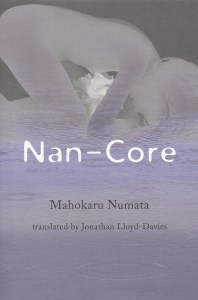
Nan-Core

Nan-Core
Japanese Title: ユリゴコロ (Yurigokoro)
Author: Mahokaru Numata (沼田まほかる)
Translator: Jonathan Lloyd-Davies
Publication Year: 2011 (Japan); 2015 (United States)
Publisher: Vertical
Pages: 253

As his father is dying of pancreatic cancer, a young(ish) man named Ryosuke discovers a set of notebooks hidden in a box in his father’s study. The handwritten confession contained in the notebooks is shocking, and Ryosuke begins to suspect that the woman who raised him may not be his biological mother. Then again, a part of him has always known that something was strange ever since he was four years old, when his family moved from Tokyo to Nara while he was in the hospital. It may well be that Misako, the person he was told to call mother when he was brought home, replaced his real mother, especially if the woman who gave birth to him is the same person who has written something resembling a “murder diary” in the notebooks he’s found.

The woman who admits her darkest secrets in these notebooks knows that something is wrong with her. She has trouble empathizing with other people, and nothing in life brings her joy. When she discovers that witnessing a death makes her feel human, she can’t stop thinking about it, and she takes indirect action that results in the death of a young boy and one of her female classmates. Killing, she realizes, is her “Nan-Core,” something a doctor once told her parents that she was lacking and whose pronunciation she misremembered as a child. Her “Nan-Core” is what makes her feel alive, and she continues to search for opportunities to trigger it as she grows up, goes to college, and starts working at an office.

It’s not much of a spoiler to say that Misako, the woman who wrote the confessions in the notebooks, is indeed Ryosuke’s biological mother, and that the woman who called herself Misako as she raised him and his brother is a surrogate. Ryosuke wants to find out how and why this happened, and most readers will quickly come to the obvious conclusions, which are later confirmed by Ryosuke’s father. The most intriguing element of this family drama is what happened to the original Misako, whose fate remains a mystery until the very end of the novel.

As Ryosuke steals time during his father’s hospital visits to read Misako’s notebooks, a disturbing series of events plays out in his own life. Ryosuke runs a mountainside dog café called Shaggy Head, and he’s fallen in love with one of his employees, Chie. Chie was once a bar hostess, and she’s on the run from her abusive husband, who is in turn hounded by the yakuza. When Chie disappears into thin air, another of Ryosuke’s employees, Ms. Hosoya, takes it upon herself to find the missing woman, a decision that results in dangerous complications for everyone involved.

Despite all the murder and spousal abuse, Nan-Core tells a surprisingly gentle story. The novel’s focuses is mystery or violence, but rather the evolution of the relationships between the members of Ryosuke’s family as he and his brother learn more about their parents and begin to see them as people. Ryosuke also starts to develop a new sense of family as he develops stronger bonds with Chie and Ms. Hosoya. The secrets hidden within these relationships stem not from malice and neglect, but from attempts to do the right thing under difficult circumstances.

Even Misako is able to grow and change because of the kindness of the people who adopted her into their family. Her homicidal tendencies can be read as an attempt to form connections with other people despite extreme alienation, and some of her murders are even a bit gratifying. For example, why continue to deal with sexual harassment at work when you can just murder the creep who keeps bothering all the female employees? In the end, the gentle Ryosuke is able to borrow strength from his mother’s confessions; and, when his story finally intersects with hers, the result is extremely satisfying.

Nan-Core may at first seem to be a paper-thin mystery propelled by a cast of one-dimensional stereotypes, but the plot slowly thickens as layers are added to each character. The story can be melodramatic at times, and the lack of any real consequences resulting from the characters’ actions is a bit fanciful, but none of this detracts from the charm of the novel.

My only real complaint is that, given that Ryosuke manages a dog café, Nan-Core has an unfortunate lack of canine characters. Judging from its trailer (link), the 2017 cinematic adaptation of the book (link) doesn’t have any dogs either. This is a shame, because I think the story’s odd but intriguing blend of horror and romance could have been enhanced by more puppies. Honestly, probably everything could be enhanced by more puppies, but at least Nan-Core offers its readers a batch of warm and cuddly murderers.

My rating: 13/10, it would be an honor to be murdered be this family of cutie pies.