Reading Japanese Literature in Japanese

I started taking Japanese language classes as a college freshman in 2002, and I will begrudgingly admit that, almost ten years later, I’m still not entirely fluent in the language. True linguistic fluency is almost infinitely multifaceted and difficult to attain in any foreign language, especially when that foreign language is not regularly spoken in one’s everyday environment. The best way to attain a high proficiency in Japanese is to move to Japan and live there for an extended period of time. Nothing that I can suggest here can serve as a substitute for actually going abroad and living one’s life in Japanese, so the best advice I can possibly give is – go! Figure out how your school or employer can help fund your sojourn, apply for a passport, and go!

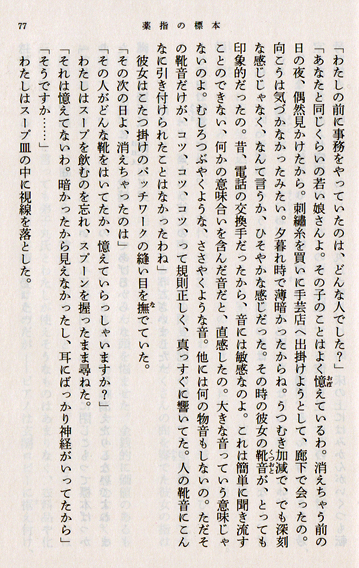
In the meantime, however, you don’t even need to leave your bedroom in order to start reading Japanese. Most Japanese language curricula focus on giving students the tools they need in order to read nonfiction texts such as newspapers, essays, and academic articles. Of course this type of instruction is useful, but a sentence like “the economy suffered a sudden downturn in the fourth quarter” requires a different set of linguistic skills than a sentence like “the stars shone brightly in the sky,” especially in Japanese. It’s therefore up to many language learners to figure out how to read Japanese fiction on their own.

What follows is a guide for students of the Japanese language who want to start reading literature – whatever their definition of “literature” may be – in Japanese. In this essay I will detail the necessary linguistic foundations before discussing useful tools and entry points for getting started. Beginning to read in Japanese may seem like a huge hurtle to clear for anyone who’s ever held an entire Japanese novel in her hands, and I’m not going to promise that it won’t be difficult, especially at first. It’s not impossible, however, and it can even be enjoyable.

Foundations

I think that, at an absolute minimum, one needs two full years of college-level Japanese before it makes sense to start reading Japanese language texts. There are two primary reasons for this. The first reason is that it takes about two years to become comfortable reading the Japanese scripts as they appear on a page. Basic reading skills, such as figuring out where words begin and end, figuring out who is speaking, and figuring out how to look up unknown words, will be unavailable to a student who doesn’t have two years’ worth of knowledge of kana usage, kanji, and grammar patterns. Without these skills, the characters printed on the page are just so much linguistic slurry. The second reason one needs two years of Japanese is that it takes about that long to develop a familiarity with the way the Japanese language works outside of an artificial environment (such as a classroom or a textbook). In Japanese, as in English, writers abbreviate words, leave out words, make up words, use words in strange ways, bend the rules of grammar, and do fun things with dialog and dialect. These are not the sorts of things one can look up in a dictionary, so one needs to know the rules well enough to identify which rule has been broken. Both reasons I have given are really the same reason – literature is high level writing, and one needs to accumulate experience with the language in order to understand it.

There are obvious benefits to enrolling in college level Japanese language classes, but I realize that not everyone has the necessary resources to do so. Thankfully, there are some excellent textbooks on the market that make self study easy. My absolute favorite is the Genki series, which comes with a matching set of workbooks. The main benefits of the Genki series are that it is ergonomically formatted, it teaches vocabulary and grammar in a well organized and easily digestible manner, and it contains reading passages and practice drills that help you use what you’re supposed to be learning in the most efficient way possible. I also think the Genki series tackles the challenge of learning to read written Japanese in a superlatively intelligent and user-friendly manner. The Genki series neither gives you too much information (like an expensive hardcover textbook such as Yokoso! does) or too little information (like a popular study guide such as Adventures in Japanese does), and it also integrates grammar and vocabulary seamlessly into speech patterns and the written language, unlike mass market texts such as those created by companies like Berlitz and Rosetta Stone. The two Genki books will teach you the rules of Japanese; and then, once you’ve mastered these rules, you can go on to the next book in the series, An Integrated Approach to Intermediate Japanese, which will teach you how to apply the rules to real conversations and reading material.

In whatever way you choose to study, it’s good to have those two years of Japanese language experience under your belt before you start trying to read real texts. Of course language learning ability differs from one person to the next; but, if you have less than two years of experience, attempting to read Japanese is more than likely going to be an exercise in frustration. I think the problem most people have, however, is not diving headfirst into real Japanese, but rather waiting too long to get their feet wet. I don’t think there’s any real need to wait until you’ve learned all the grammar points or all the kanji before you start reading – all you need is the right set of tools.

Useful Tools

As with many realms of study in the twenty-first century, the most useful tools available to you are digital, and the foremost of these digital tools is the internet. As wireless internet access is not available in all times and all places (especially in Japan), however, it’s always good to be in the possession of more concrete tools as well.

The single most useful tool available to someone moving past the initial stages of Japanese language study is a denshi jisho, or electronic dictionary. A denshi jisho will include a wide range of dictionaries, including the Genius series of English/Japanese and Japanese/English dictionaries. (Models with dictionaries for other languages, such as French and Chinese, are available as well.) Denshi jisho will also, without fail, include a Japanese dictionary, which is like a combination of a Japanese-language OED and an illustrated encyclopedia that may include sound (just in case you need to know the difference between the calls of two species of crickets, for example). Electronic Japanese dictionaries come equipped with a feature called gyaku-jibiki, which allows the user to search for a word by its last character instead of by its first, as well as many other search tools that accommodate the difficulties involved in figuring out how any given kanji is read.

If you don’t know a word in any of the entries you’re reading, most denshi jisho have a “jump” feature that allows you to highlight a word on the screen and then go to that word’s entry in any other dictionary available on your machine (including the Japanese/English one) before returning to the original entry. This is useful if, for example, you’re using one of the more specialized dictionaries available on your denshi jisho. Depending on the model you choose, these specialized dictionaries may include a Classical Japanese dictionary, an encyclopedia of Japanese history, an index of Japanese poetry, a dictionary for katakana words and onomatopoeia, a dictionary for four-character phrases, a botanical reference guide, and so on.

One of the most useful features of any denshi jisho is its kanji dictionary. Learning to use one of these things is a cultural and linguistic experience in and of itself. If your model has a stylus and a trackpad, all you need to do is to write the character – these pieces of equipment have better handwriting recognition software than iPhones and Wacom tablets. If your model doesn’t have a trackpad (and many of them don’t), there are still plenty of plenty of ways to look up kanji, the most useful of which is by a combination of radical and stroke count. Once you find the character in the dictionary, you will turn up a wealth of information, including how it pronounced, a list of words beginning with and including the character, a brief etymology and a Chinese pronunciation guide. Once you get used to your denshi jisho, searching for kanji becomes quick, easy, and painless. No paper source in existence can compete with a digital kanji dictionary.

Denshi jisho can be purchased at any electronics store (and many large bookstores) in Japan, but they’re harder to come by abroad. If you live near a major urban center, Japanese bookstores (such as Kinokuniya) will generally have a selection of denshi jisho on display. You can also order one through Amazon.co.jp, whose restrictions on shipping electronics overseas doesn’t apply to these devices. The two most common brands are Sharp and Canon. There is a greater difference between individual models than there is between the two brands as a whole, but lower price range Sharp models tend to be more technologically sophisticated (with trackpads, color screens, auditory pronunciation guides, and embedded video), while most Canon models have an English language menu setting and touchscreens (which is great for highlighting words and “jumping” between dictionary entries).

If you don’t want to invest in a denshi jisho, there are many excellent resources on the internet, one of which is a site called Denshi Jisho, which features a great kanji lookup system. My personal favorite online Japanese dictionary is Jim Breen’s WWWJDIC, which will return tons of entries and example sentences for any search, including searches for internet slang, English-derived portmanteaus and other neologisms, and onomatopoeia so obscure that they don’t appear in Japanese dictionaries. If you’re in the habit of reading Japanese online, a popup browser plug-in called Rikaichan can define any text you highlight in your web browser (although it doesn’t always work so well with Flash-embedded text).

I am given to understand that there are also many types of tools available on the iPhone and the iPad. I don’t have enough experience with either of these devices to make recommendations, but a quick search on Google will turn up dozens of lists and reviews.

Getting Started

Speaking from an almost complete lack of training in linguistics, I can confidently say that some types of language are more difficult to read than others. As it just so happens, however, the types of language that you’re interested in are going to be much easier for you to learn to read than the types of language you’re not interested in. What this means is that, once you’re ready to read, it’s not necessary use “training wheels.” If you’re interested in reading mystery novels, read mystery novels. If you’re interested in reading manga, read manga. If you’re interested in reading novels by Kawabata Yasunari, read novels by Kawabata Yasunari (they’re actually not that difficult).

I don’t mean to suggest that one can simply pick up a book and read it. What I am trying to suggest is that there’s no need to slowly work your way up through material of increasing levels of difficulty until you’re finally able to read what you actually want to read. You don’t need to slog through fourth grade level readers or collections of fairy tales written for children if you think stuff like that is stupid and boring. You don’t have to muddle your way through the confusing layouts and endless notes and vocabulary lists of “Japanese-English parallel text” books like Reading Real Japanese or Breaking into Japanese Literature if you don’t want to. You shouldn’t feel the need to start with something “easy” like the Japanese translations of the Harry Potter books (which aren’t actually that easy, as it turns out). These sorts of preparatory exercises really aren’t necessary.

That being said, some books are easier to read than others. Even among manga titles by the same artist that all use simple vocabulary and furigana, some are going to be easier to understand by virtue of good editing and solid storytelling. For example, Ōkubo Atsushi’s popular shōnen series Soul Eater is much easier to read in Japanese than his debut series B. Ichi. The same goes with literature. To offer an example from my own experience, the first writer I tried to read in Japanese was a nightmare until I figured out that what she wrote in the sixties is infinitely easier to read than what she wrote in the eighties. Before I was able to arrive at this conclusion, however, I gave up on her altogether in order to read another writer writing at the same time on roughly similar themes using much simpler vocabulary and sentence structures. The point I’d like to illustrate with these examples is that there’s no shame in giving up on something difficult in order to search out something easier. Reading in Japanese is not about punishing yourself or training yourself through hardship; it’s about experiencing the pleasure of becoming immersed in something you enjoy. You shouldn’t be hunched over a desk with a dictionary and a notebook; you should be chilling out in the bath or in a hammock in your backyard.

Unless you’re preternaturally brilliant, you’re going to go through an awkward stage in which you make embarrassing mistakes in interpretation and can’t read more than two or three pages at a time. The progress you’ll be able to make during this awkward stage shouldn’t be underestimated, however. You’ll learn things about the Japanese language that you never would have learned in a textbook, such as how to appreciate the nuances of word choice and the subtle differences in writing styles. Reading a page at a time will turn into reading two pages at a time, and two pages will turn into three pages, and three pages will eventually turn into just one more chapter, which will eventually turn into I am not sleeping until I finish this.

In other words, reading Japanese is hard…

…but it gets better!

Good luck!
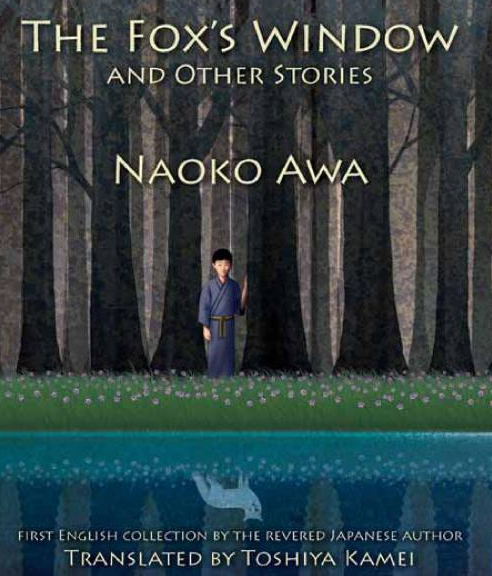
The Fox’s Window

Title: The Fox’s Window: And Other Stories
Japanese Title: きつねの窓 (Kitsune no mado)
Author: Awa Naoko (安房 直子)
Translator: Toshiya Kamei
Publication Year: 2010
Publisher: University of New Orleans Press
Pages: 232

I found out about this book due to the happy accident of stumbling upon the website of the SCBWI (Society of Children’s Book Writers and Illustrators) Tokyo Translation Group. It’s a fantastic site that has taught me a great deal about Japanese children’s literature, and I’m grateful that it’s so well organized and contains so many interesting and well written essays.

Before I discovered the website, however, I had never heard of “the revered Japanese author” Awa Naoko. Thankfully, her translator’s short introduction does a fine job of sketching out her background for the reader:

Naoko Awa (1943-1993) was an award-winning writer of modern fairy tales. She was born in Tokyo, and while growing up, lived in different parts of Japan. As a child, Awa read fairy tales by the Brothers Grimm, Hans Christian Andersen, and Wilhelm Hauff, as well as The Arabian Nights, which later influenced her writings. She earned a bachelor’s degree in Japanese literature from Japan Women’s University, where she studied under Shizuka Yamamuro (1906-2000), who translated Nordic children’s literature into Japanese. While still in college, Awa made her literary debut in the magazine Mejiro jidō bungaku (Mejiro Children’s Literature).

The themes of Awa’s work collected in The Fox’s Window are nature, transformation, and bittersweet pain of fondly remembered past. Like Western fairy tales, Awa’s stories are filled with animals who possess anthropomorphic attributes, such as the ability to talk. Like Classical mythology, Awa’s stories operate on at the edges of a constantly shifting boundary between plant, animal, and human; flowers can easily turn into girls, and rabbits and can easily turn into boys. In the worlds Awa creates in her writing, charming and innocuous trickster spirits abound and good deeds are always rewarded. This childhood realm is seldom presented without nostalgia, and characters often remember the past as being more vibrant than the present.

The story collection opens with “The Sky-colored Chair.” In this story, a blind girl’s father wants to paint a rocking chair he’s built for her the color of the sky so that she will be able to see the sky by sitting in the chair. On a windy hilltop, the father meets a young boy who helps him create the color of the sky for his daughter. The chair is such a success that the father begins to seek out other colors, such as those of the sea and the sunset. The boy, in an effort to help the father achieve these colors, disappears and then reappears as a young man who asks that the girl’s father take him on as an apprentice chair maker. The blind girl is never really able to see any other colors, but her story still ends happily:

After a short while, the blind girl married the young man. She became a happy wife who knew the true color of the sky better than anyone else. Even after her hair turned white, she enjoyed watching the sky in her rocking chair.

In the collection’s title story, “The Fox’s Window,” an archetypal hunter enters an archetypal forest in order to hunt an archetypal fox. After chasing and losing the fox, the hunter emerges into a clearing, in the middle of which is a house he has never seen before. Out of the house emerges the fox, now in the form of a boy, who offers to paint the hunter’s hands blue in an act of magic that will allow the hunter to see into the past. The story has no plot, per se, but the visions that the hunter sees in the window that he forms with his fox-painted hands are lovely:

In my mother’s vegetable garden, a patch of shiso plants was getting soaked by the drizzle. I wondered if she would come out into the yard to pick the leaves. A soft light seeped from the house. From time to time I heard children’s laughter mixed with the music from the radio. The voices belonged to me and my sister, who was now dead. I gave a deep sigh and dropped my hands. The house I grew up in burned down, and that yard doesn’t exist anymore.

Although many of the stories in the collection are harmlessly beautiful, a few, such as “Forest of Voices,” contain touches of genuine fairy-tale horror:

The Forest of Voices returned to silence and waited for its next prey. It was a terrifying place. Countless animals had lost their way in the forest. Like someone scared of his own reflection in the mirror, every animal going astray among the trees was surprised by its own echo and ran in circles until it collapsed and died. Sometimes humans wandered into the forest – hunters pursuing their game and woodcutters following the wrong path in the fog. They all ended up nourishing the oaks.

Such stories always end well, though. The pure of heart always prevail and no one is ever really punished. The only characters who die or get hurt are animals, and even then it’s usually just an instance of the “dead mother” trope.

Unfortunately, this lack of darkness made the stories seem shallow to me. With no true shadows or bursts of light, the separate stories began to blur together into a sepia-toned slurry of adorable children, talking animals, and nature imagery. These stories are completely harmless and thus, in my opinion, mostly forgettable.

Perhaps The Fox’s Window would appeal to parents of young children for whom the stories of Beatrix Potter and Jill Barklem are deemed too scary. The stories might also appeal to the children themselves, as younger readers have an astonishing ability to make up details to fill in the gaps of minimalist narratives. Since the visual imagery of Awa Naoko’s writing is so strong, her stories might also appeal to artists and illustrators looking for inspiration. In fact, I felt that each of the individual pieces in The Fox’s Window was highly impressionistic, like a pencil sketch of a scene onto which a single layer of watercolors has been quickly applied. Although this type of writing doesn’t hold a great deal of appeal for someone like me, who finds beauty and meaning in words and narratives, I imagine that Awa’s short fairy tales could be much more interesting to someone better able to think in pictures and images.

I’d like to thank University of New Orleans Press for making The Fox’s Window available on the Kindle Store. I’ve been noticing a baffling dearth of children’s literature in digital format, and I think it’s wonderful that this collection is helping to remedy the situation.

1Q84

Title: 1Q84
Author: Murakami Haruki (村上 春樹)
Translators: Jay Rubin and Philip Gabriel
Publication Year: 2011 (America); 2009-2010 (Japan)
Publisher: Knopf
Pages: 944

This review contains mild spoilers. Some might argue that warning for spoilers is missing the point, but I think that gradually figuring out what’s going on in this novel is one of the main pleasures of reading it. With that in mind, allow me to summarize the conclusion of my review for anyone trying to decide whether or not to start reading: 1Q84 is an engrossing book, and you more than likely won’t be able to separate yourself from it once you begin. It might be a good idea to save it for when you anticipate having lots of time on your hands. However, if you’ve read Murakami’s work before and don’t particularly like it, this book won’t turn you into a fan. The novel contains several graphic depictions of rape and child abuse. If you imagine that such descriptions might function as triggers, consider yourself warned for both the novel and this review.

IQ84 is about Kawana Tengo, a would-be writer who pays the bills by working as a math teacher at a cram school, and Aomame Masami, a semi-professional assassin who pays the bills by working as a personal trainer at a private gym. Tengo’s story kicks off when his literary agent, an eccentric editor named Komatsu Yuji, drafts him into rewriting a fantasy novella called “Air Chrysalis” written by a seventeen-year-old named Fukada Eriko. Fuka-Eri, as she calls herself, is a beautiful yet incommunicative girl who claims to have actually experienced the things she’s written about. When Tengo meets Fuka-Eri’s guardian, a retired academic named Ebisuno, the man explains that the girl’s biological father had founded a politically radical farming commune called Sakigake that has since reshaped itself into a religious compound closed to the outside world. Unfortunately for Tengo, when Fuka-Eri’s novella is published and becomes a bestseller, Sakigake takes notice. Meanwhile, Aomame works with an older woman referred to as “the Dowager,” who runs a battered women’s shelter called The Willow House. When no other recourse can free the women who take refuge there, the Dowager calls on Aomame to assassinate the men who have made their lives hell. The Dowager ends up rescuing a girl who has been horribly abused by the leader of Sakigake, and she requests that Aomame perform a job so dangerous that it may well be her last – the assassination of this powerful religious figure.

Alternate chapters are told from Aomame and Tengo’s perspectives, and their stories gradually become interwoven even though they never meet or interact with each other. They knew each other briefly as children, however, and it turns out that their bond runs deeper than mere casual coincidence. As the novel progresses, other characters with connections to Aomane and Tengo are introduced, such as Tengo’s strict and conservative father, Aomame’s gentle but romantically unlucky childhood friend Yasuda Kyoko, the Dowager’s personal bodyguard Tamaru Kenichi, an under-the-law private investigator named Ushikawa Toshiharu, and a diabolically relentless NHK fee collector. All of these secondary characters are interesting enough to be the protagonists of their own novels, and their stories and conflicts and motivations are just as engaging as those of Tengo and Aomame.

The novel is divided into three books, which are each characterized by distinctive plot developments and themes.

In the first book, Tengo meets Fuka-Eri. As he edits her novella, he learns more about and is drawn into the strange world she represents. Meanwhile, Aomame accidentally travels from 1984 into an alternate reality (in which two moons hang in the sky) that she calls 1Q84. As she attempts to figure out what happened to her, the reader learns about her daily life and her relationship with the Dowager. This first book is overtly political in its attitude concerning such issues as protest movements, new religions, publicly sanctioned sexism, and the business of literary publishing.

In the second book, both Tengo and Aomame are plunged headlong into the strange business with the Sakigake group. Even as the two characters are thrust forward into an uncertain future, the reader learns more about their pasts and the experiences they had as children. The second book seems primarily concerned with the unknowability of large swaths of reality and the challenges facing moral judgment and action in the face of absurdity. In my mind, this was the most “Murakami-esque” section of the book in that it revisited many of the themes and narrative devices present in the writer’s earlier work.

The third book concerns the aftermath of Aomame’s involvement in the Sakigake affair. Aomame has gone into hiding, and Tengo leaves Tokyo to tend to his catatonic father. Despite their adverse circumstances, the two have begun searching for each other. A chillingly aggressive NHK fee collector threatens Tengo’s neighborhood, and the private investigator Ushikawa stakes out Tengo’s apartment as Fuka-Eri comes and goes. The themes of the third book are fate and love or, more appropriately, the denial of coincidence and the belief that even the most tenuous bonds between people can be extraordinarily powerful. Because of its sentimentality, and because of the way in which the multiple pieces of the complicated plot all begin to fit together, I almost felt as if I were reading a Stephen King novel at certain points towards the end of 1Q84.

“Reading a Stephen King” novel is not necessarily a bad thing, however. One of the aspects of King’s writing that I admire most is his ability to get into the heads of even the most loathsome characters, and one of the most surprising and interesting developments of the third book is that the reader is now offered chapters from Ushikawa’s perspective. While Tengo and Aomame are being irrationally idealistic and swooning over their memories of each other, Ushikawa adds humor, realism, and a sense of tragedy to the novel’s conclusion. As he describes himself:

Maybe I am just an ugly, middle-aged, outdated man, Ushikawa thought. Nope, no maybes about it. I am, without a doubt, one ugly, middle-aged, outdated man. But I do have a couple of talents nobody else has. And as long as I have these talents, no matter what weird world I find myself in, I’ll survive.

But will he really survive if the happiness of the protagonists depends on him not surviving? Ushikawa keeps the novel from becoming too cut-and-dry towards its inevitable conclusion, and I felt that his sections allowed the reader to see the world of 1Q84 from the perspective of a true outsider.

Although 1Q84 is set in a time when most people went about their lives without knowing that computers existed, the novel clearly reflects the concerns of the digital age. Like George Orwell’s 1984, 1Q84 handles issues of identity formation and information control in a world that is unstable and confusing under its placid surface. Cult leaders, lines of power, rapidly shifting worldviews, and the creation and co-existence of multiple histories all factor into the novel, which ultimately questions what sort of agency an individual can have in an environment silently controlled by invisible systems. The subjective viewpoints of Aomame, Tengo, and Ushikawa allow the reader to approach this problem from different angles, and Murakami himself never seems to align his novel with any one political or philosophical perspective. Like Orwell, Murakami also exploits the dark humor implicit in any dystopian situation. For example, the NHK fee collector, who might be seen as a direct allegorical representative of Japanese postwar social control, is just as comic as he is frightening. When he positions himself outside of a victim’s door and starts ranting, his diatribes are gleefully malicious:

“Miss Takai, let’s not play hide and seek anymore, okay? I’m not doing this because I like to. Even I have a busy schedule. Miss Takai, I know you watch TV. And everyone who watches TV, without exception, has to pay the NHK subscription fee. You may not like it, but that’s the law. Not paying the fee is the same as stealing, Miss Takai, you don’t want to be treated as a thief because of something as petty as this, do you? This is a fancy building you live in, and I don’t think you will have any trouble paying the fee. Right? Hearing me proclaim this to the world can’t be much fun for you.”

And so on, and so on and so on, for pages. This character frightens and upsets the characters whenever he appears; but, as a reader, I couldn’t wait for him to show up again. Since he appears so often and at such length, I get the feeling that Murakami enjoyed writing the character as much as I enjoyed reading him.

Like most Murakami novels, 1Q84 is fairly dude-centric. The Aomame chapters alleviate the dudeliness to a certain extent; but, as Aomame is almost continually thinking about how in love with Tengo she is, the sex she wants to have with random men, and the sex she has had with other women, it’s difficult to completely separate her from her role as a female sex object and the object of Tengo’s sexual energy. Aomame may be a hard-boiled ninja assassin, but the reader is constantly reminded that she has a vagina. Then again, we hear a great deal about Tengo’s penis and scrotum, so the repeated descriptions of Aomame’s breasts and public hair may simply be par for the course in 1Q84. This is not to say that Aomame isn’t a fascinating character, but the way the author treats her is markedly different than the way he treats the Dowager (who is old, and thus not a sexual being) and Tamaru (who is gay, and thus not a sexual being).

1Q84 contains descriptions of underage rape and incest, which the text pardons and eroticizes. When Aomame is alone with the Leader of Sakigake, who is clearly guilty of child abuse, it turns out that he is not such a bad guy after all. Furthermore, he explains that, due to the workings of mysterious otherworldly beings known as “the Little People,” his body is sometimes completely paralyzed, at which point the pre-pubescent girls who attend him have sex with him. He can’t move or speak during these times; he can only ejaculate. The sexual activity is spiritual, and it is initiated by the girls. When he penetrated his ten-year-old daughter, the same thing happened: she had sex with him, and the bodies of both parties were controlled by the Little People. The reader finds out several chapters later that he is not lying, as an event occurs in which Tengo finds himself physically paralyzed and, as part of some ritual, mounted by Fuka-Eri (who at seventeen has never had her period and never developed sexually or mentally).

I’m not upset by the deviant sexual lives of fictional characters, and this is one of the more interesting and original plot devices I’ve encountered in serious literary fiction (although I can’t claim to have never seen it before in fan fiction). Still, I found the erotic descriptions of the young girls in question to be off-putting. For example, Tengo thinks Fuka-Eri’s hairless vagina is so beautiful and her lovely ears look just like her vagina and, as he thinks about the flat-chested ten-year-old Aomame while having sex with the childlike Fuka-Eri, he comes so hard and feels so good. It’s kind of gross.

There is a fair amount of sex and sexuality in 1Q84, and these themes are narrated from a perspective that is subtly yet undeniably male. To draw a parallel with a series I happened to be reading at the same time as 1Q84, in A Song of Fire and Ice, the narrative tone changes when the author switches between the perspectives of different characters. In 1Q84, it absolutely does not. The limited third-person narrator of the novel is definitely a heterosexual man, and this does not change when he narrates the story from the perspective of a female character or describes the rape of a young girl. However, I don’t think this type of narration ruins the story, and it’s quite interesting when accepted for what it is.

Issues of sex and gender aside, there’s a lot going on in this novel. The descriptions of Tokyo are wonderful. The descriptions of the suburbs and countryside surrounding Tokyo are also wonderful. The secondary characters are sympathetic and vividly portrayed. I loved Komatsu, and Ushikawa, and Professor Ebisuno, and Aomame’s friends Tamaki and Ayumi. The Dowager and Tamaru are a novel unto themselves. The allusions and parallels to political revolutionaries and religious cults in postwar and contemporary Japan are striking. The novel’s challenge to conventional notions of reality are intriguing. The connections between Murakami’s 1Q84 and Orwell’s 1984 (and in particular the transformation of “Big Brother” into “the Little People”) are fascinating.

As I mentioned at the beginning of this review, if you’re not a fan of Murakami’s writing, 1Q84 won’t change your opinion. The Murakami tropes established by his earlier novels – disappearing women, unsolvable mysteries, perpetually loose plot threads, passive protagonists, close descriptions of genitalia, endless references to jazz records, men cooking alone in sad bachelor kitchens – all appear in force in this novel, which is more of the same, except further up and further in.

If you haven’t read 1Q84 yet, then you definitely have something to look forward to. It’s an incredible novel that will give you the sort of reading experience that the word “spellbound” was created for. This a book that will make you wish your two-hour jog on the treadmill, your fourteen-hour plane ride, or your week-long illness were actually longer. Since 1Q84 will consume your life until you’re done with it, it might be good to save it for an occasion when you can take some time off so that real life doesn’t get in the way of this book.

By the way, the cover image I used for this review was designed by Cory Schmitz.

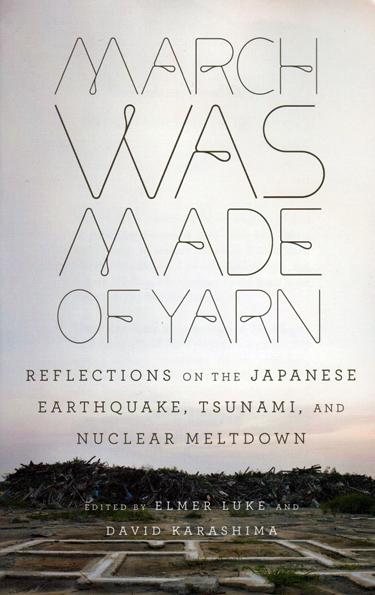
March Was Made of Yarn

Title: March Was Made of Yarn: Reflections on
the Japanese Earthquake, Tsunami, and Nuclear Meltdown
Editors: Elmer Luke and David Karashima
Publication Year: 2012
Publisher: Vintage
Pages: 216

As the March 11 anniversary of the 2011 Tōhoku earthquake and tsunami draws closer, Japanese bookstores have begun to promote retrospective magazine-books. These publications are filled with huge glossy photographs of destruction, and the number of people killed is printed in bold characters across their covers. Although such disaster porn is disturbing, it helps to illustrate a definite aspect of the reality of what happened a year ago in Japan.

March Was Made of Yarn helps to illustrate another aspect of the reality of the earthquake, tsunami, and resulting nuclear crisis. If pictures and body counts inform the physical reality, then this collection of fiction and nonfiction offers insight into the emotional reality. Thankfully, March Was Made of Yarn is infinitely more gentle and subtle than sensationalist reporting and sentimental recollections of heroism and despair.

Even though all of the short pieces brought together by this collection address the events of last year in some fashion, many do so obliquely, and the themes of the pieces are universal. What is it like to live through a crisis? What is it like to know that other people are living through a crisis? What does it feel like to worry about the future? What does it feel like when science fiction becomes reality? What happens when you’re so sick with worry that you can’t fall asleep at night? What happens when words can no longer express truth or meaning?

March Was Made of Yarn features the work of internationally renowned Japanese writers such as Ogawa Yōko, Murakami Ryū, Kakuta Mitsuyo, Furukawa Hideo, and Tawada Yōko. These writers don’t cut corners in their craft simply because they happen to be responding to a topical issue; and, although none of them are writing “happy” stories or essays, their work is a pleasure to read. Kawakami Hiromi, who rewrote her debut story “Kami-sama” (translated as “God Bless You”) to address the incidents at the Fukushima reactor, reminds us that, even though we live in a world shadowed by the fear of radiation and environmental poisoning, we still need to eat, and we still want to go outside. The title story, Kawakami Mieko’s “March Yarn,” deals with the strange ways in which people process their memories and their understanding of their relationships with each other. Tanikawa Shuntarō’s poem “Words,” which opens the book, poses the question of how we can even write about things for which there are no words (yet still “Words put forth buds / From the earth beneath the rubble”). The translators who contributed to this volume are among the best in the field, and their skill illuminates the entirety of the collection.

March Was Made of Yarn isn’t just an excellent anthology of work related to the Tōhoku disasters; it’s an excellent Japanese literary anthology period. The range of authors represented by the book has the most even distribution of gender, generation, and genre I’ve ever encountered, and the English-language contributors, such as David Peace and John Burnham Schwartz, bring an added level of flavor and diversity. This collection is also accessible to casual readers, as few of the stories are any longer than twenty pages, and it has been beautifully published by Vintage. I don’t know how so many good things were able to come together to create this amazing book, but I am extraordinarily grateful that it exits.

March Was Made of Yarn should be available at all major bookstores in North America, Britain, Australia, and Japan, and it’s available on the Kindle Store as well.

If you don’t mind reading entirely in PDF digital format, please consider checking out Waseda University’s Japan Earthquake Charity Literature Project, which has some overlap with March Was Made of Yarn. It’s free to download and read the PDF versions of the stories and essays on the website, and the reader is encouraged to make a donation to disaster relief efforts afterwards.